

Most shopping advice for induction ready pots and pans starts with compatibility and stops there. Compatibility is the floor, not the decision. Every pan worth considering already clears that bar, so the real question becomes how much pan your kitchen genuinely needs, and that question has a dollar answer. The market sorts itself into three clean tiers: roughly $80 to $150 for a competent starter set, $200 to $450 for cookware most people should keep for a decade, and $500 and up for buyers with specific reasons to chase the last few measurable percent.
The tiers track real differences in metal thickness, cladding method, handle engineering, and warranty backing, and they map neatly onto how hard different households actually push their burners. Each tier gets an honest accounting below: what it does well, where it fails, and who should stop there.
What Your Dollars Are Actually Buying
Strip away branding and the price ladder purchases exactly four things: base thickness, wall-to-wall heat spread, hardware quality, and someone standing behind the product afterward. A $35 disc-bottom skillet and a $550 copper-core design respond to the identical magnetic field, draw from the identical element, and reach the same maximum temperature. What differs is how evenly that energy spreads across the cooking surface, how gracefully the pan absorbs abuse, and how long the company answers the phone when something fails. Why some pans never trigger the burner at all is a separate subject entirely; assume compatibility here, because everything discussed below has it.
There is also a hard ceiling worth respecting before climbing the ladder. Residential induction elements deliver roughly 1,800 watts on standard burners and about 3,700 watts on boost zones, and no amount of cookware engineering extracts energy the coil refuses to supply. Keep that number in mind through every tier, because it decides how far up the ladder extra dollars still buy performance rather than prestige.
Tier 1: The $80–$150 Starter Set
Entry-level induction cookware comes in two forms: disc-bottom aluminum, where a stamped steel plate is bonded to an otherwise ordinary pan, and thin house-brand tri-ply from warehouse retailers. Both perform honestly well at gentle work. Simmered tomato sauce, boiled pasta, steamed vegetables, reheated soup — a $90 ten-piece starter kit handles all of it without complaint, and a $30 disc-bottom skillet fries eggs reliably for years.
The weaknesses surface under sustained high heat. Total base thickness in this tier usually measures below 3 millimeters, and thin metal concentrates the coil’s energy into a hot ring directly over the element, so a steak sear produces gray bands instead of an even crust. Lids tell the same story: lightweight domes rattle and spit steam at a rolling boil because they lack the mass to sit still. None of this disqualifies the tier. A first apartment, an RV galley, a vacation condo, or a household still deciding whether induction suits its style gets genuine value here, typically three to six years of service before warping or worn handles retire a piece.
Tier 2: The $200–$450 Range Where Most Kitchens Should Stop
This is the rational center of the market, and the case for it is straightforward. Fully clad tri-ply with a magnetic stainless exterior carries heat up the sidewalls, so reductions happen evenly without constant stirring and shallow braises behave without rotating the pan. Quality encapsulated-disc lines from established manufacturers occupy the lower half of the band and run remarkably close in day-to-day use. Either route buys visible upgrades over the starter tier: bases that stay flat under thermal stress, lids that settle into place with real weight, stay-cool cast handles, and the first appearance of lifetime warranties.
Handle comfort deserves a specific mention, because it separates thoughtful designs from rebadged ones. A riveted stainless grip that stays comfortable through a 20-minute braise signals real engineering; a hollow stamped handle that heats up by minute five signals a factory cutting corners somewhere less visible too. Anchors help as well: a name-brand ten-piece clad set lands between $280 and $420 on sale, individual clad skillets run $60 to $110, and a solid encapsulated-disc saute pan costs $80 to $140. For a household cooking five nights a week, this tier marks the point where additional spending stops fixing problems and starts buying polish.
Spend Where the Duty Lives: Skillet and Saute First
Inside any tier, allocation beats brand loyalty. Track what you reach for across a month and a pattern emerges quickly: the 10-inch skillet and the 3-to-4-quart saute pan shoulder roughly 70 percent of weekday cooking duty. Eggs and stir-fries, chicken thighs and pan sauces, sears and shallow braises all route through those two vessels. Buy the strongest versions of them your budget allows, then economize everywhere else. Saucepans slot third in priority, and a single 2-quart model manages grains, custards, and reheats for most families.
The stockpot is the classic place to save. Eight quarts of boiling water regulate their own temperature, and neither pasta nor blanched broccoli can detect the difference between a 2-millimeter and a 5-millimeter base. A deliberate hybrid — a Tier 2 skillet and saute paired with a Tier 1 stockpot — totals around $180 and outcooks plenty of $350 matched sets, because the money concentrated where the work happens.
Tier 3: Above $500 and the Wattage Ceiling
Fully clad five-ply construction, copper-core hybrids, and professional restaurant lines occupy the top of the ladder, and their advantages are real but narrow. Heavier bases shrug off warping permanently, edges hold within a few degrees of centers across the full surface, and build tolerances feel machined rather than assembled. Then physics intervenes. Once a pan saturates, its ceiling is whatever the element supplies, and a $600 skillet cannot outperform a $200 one connected to the same 3,000-watt zone. Both hit the identical thermal limit; the expensive pan simply holds temperature slightly steadier during the half-minute after a cold steak drops onto the surface.
Two situations justify the spend anyway. Kitchens pairing an induction hob with gas burners gain genuine flexibility from copper-core hybrids built for either fuel. And buyers planning to keep their cookware twenty years amortize a $700 set down to $35 per year, which changes the arithmetic entirely. Everyone else is buying pleasure rather than performance — a legitimate choice, as long as you recognize which purchase you are making.
Set Math: Why Boxed Ten-Piece Sets Pad the Bill
Read advertised piece counts with suspicion. A typical 10-piece set contains six actual vessels: two skillets, two saucepans, one saute pan, one stockpot, plus four lids counted as full participants. The twin saucepans deserve particular skepticism, because a 1.5-quart and a 2-quart pot perform near-identical jobs and most kitchens favor one while the other collects cabinet dust. Lid inflation runs deeper than it looks, too — some 8-piece kits are just four pans wearing hats.
Boxed sets do carry real discounts, generally 20 to 30 percent below the cost of buying each piece separately, so the format is not a swindle. It is a wager that every included vessel earns its counter space, and in most homes that wager loses. Building piece by piece wins at every tier: it lets you mix construction types on purpose, match lid styles to how you actually cook, skip categories you never touch, and replace one worn vessel at a time instead of retiring the whole rack. Four chosen pans beat seven padded ones at $80, at $400, and everywhere between.
A few closing questions cover the decisions that come up in almost every induction cookware purchase.
Is a $100 induction-ready set good enough to cook with every day?
For everyday meals, yes, provided its limits are respected. Daily simmering, boiling, rice, grains, and moderate-heat saute work sit comfortably inside a starter set’s abilities, and many households run theirs for four or five years without complaint. The gap appears when recipes demand sustained high heat, where thin sub-3mm bases cycle hot spots across a sear and lightweight lids chatter over aggressive boils. If the weeknight repertoire rarely climbs past medium-high, a $100 set delivers most of the experience at a fraction of mid-tier pricing.
Which pieces should I buy first when building a collection piece by piece?
Start with the 10-inch skillet, because nothing else covers its range from fried eggs to seared pork chops. The second purchase should be a 3-to-4-quart saute pan with lid, which moonlights as a braiser, a shallow roaster, and an oversized saucepan. Third comes a 2-quart saucepan for grains, reheating, and reduction work. Those three vessels cover close to 85 percent of the tasks a normal week demands, and a 6-to-8-quart stockpot can wait until an actual stock-making session calls for it.
Do expensive pans actually heat faster on a home induction burner?
Raw speed belongs to the element, not the pan. Bring 4 quarts of water to a boil on a 3,000-watt zone and a $120 stockpot crosses the finish within moments of a $500 one, since both draw from the same fixed power supply. Premium construction expresses itself elsewhere: steadier temperatures during a sear, edge-to-edge uniformity on a low simmer, and resistance to warping across years of thermal cycling. Anyone paying $500 and up expecting faster boil times is buying something the burner’s wattage rating settled long ago.

DUXANO
Oil-Less Induction Cooking with DUXANO 12PC Ceramic and Hybrid Cookware Set
The DUXANO 12-piece set combines a searing-focused hybrid stainless steel skillet with smooth ceramic pots for oil-light cooking, faster boiling, and compact storage. It suits cooks with induction, gas, or electric stovetops who need versatile cookware for small kitchens, RVs, or campers.
Pros and Cons
Pros
- The set covers everyday cooking with two saucepans, a cooking pot, a stockpot, and a 10-inch skillet.
- Its ceramic coating is stated to be free of PFAS, PFOA, PTFE, lead, and cadmium, with third-party Intertek testing cited by the brand.
- The handles support up to 22 pounds and were tested through 30,000 open-close cycles and 15,000 load-bearing cycles.
- The two multi-size glass lids fit all five pots and retain heat and moisture during simmering and braising.
Cons
- For optimal lid performance, the detachable handle should be removed while using a lid.
- The product data does not specify the cookware set's total weight or maximum oven-safe temperature.

Amazon Basics
Everyday Induction Cooking: Amazon Basics Stainless Steel 15-Piece Cookware Set
This 15-piece stainless steel cookware set covers frying, sautéing, steaming, simmering, and stockpot cooking, with aluminum-core bottoms for faster, more even heating. It suits home cooks who need induction-ready cookware with oven-safe pots, tempered glass lids, and included serving utensils in one set.
Pros and Cons
Pros
- The set includes useful cookware sizes from an 8-inch frypan to an 8-quart stock pot.
- Included stainless steel turner, spoons, spaghetti server, and ladle reduce the need for separate utensils.
- Stay-cool stainless steel handles provide a more comfortable grip during stovetop preparation.
- The mirror finish and stainless steel surfaces are designed for straightforward cleanup.
Cons
- The tempered glass lids are not oven safe, so they must be removed before oven use.
- The product data does not specify the set's total weight, which may matter when handling larger pieces.
EWFEN
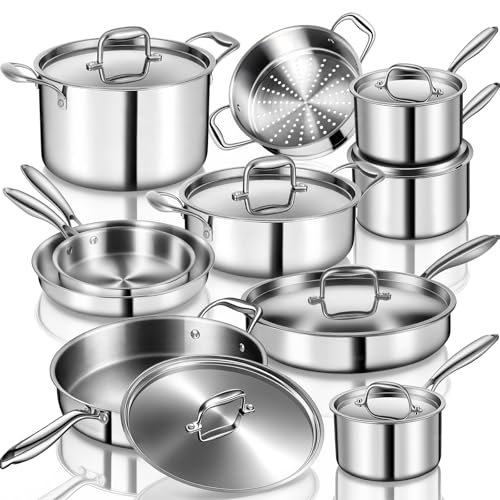
Everyday Multi-Pot Cooking: EWFEN 17-Piece 3-Ply Stainless Steel Cookware Set
This 17-piece EWFEN set covers frying, simmering, sauteing, steaming, and stock preparation, with a 3-ply aluminum core that distributes heat evenly. It suits home cooks replacing mixed cookware with one induction-compatible, dishwasher-safe stainless steel collection.
Pros and Cons
Pros
- The 304 stainless steel cooking surface is free from PFOA, PTFE, and PFOS coatings.
- Three skillet sizes and several covered pots provide useful capacity options for both quick meals and batch cooking.
- The steamer insert expands the Dutch oven's use for vegetables, seafood, and other steamed foods.
- The mirror-finished cookware and stainless steel lids are dishwasher-safe for convenient maintenance.
Cons
- Stainless steel cooking surfaces require proper preheating and added oil to reduce sticking.
- The product data does not provide individual piece weights or dimensions, which may matter to buyers with limited storage or lifting concerns.

CAROTE
Everyday Induction Cooking with the CAROTE 21-Piece Tri-Ply Stainless Steel Cookware Set
The CAROTE 21-piece cookware set handles searing, simmering, and oven cooking with fully clad tri-ply construction that distributes heat from base to rim. It suits home cooks who want durable, coating-free stainless steel cookware compatible with every major cooktop.
Pros and Cons
Pros
- Tri-ply fully clad construction helps minimize hot spots across the cooking surface and sides.
- The stainless steel surface has no traditional nonstick coating to wear away over time.
- All-cooktop compatibility includes induction for flexible kitchen use.
- Oven-safe and dishwasher-safe construction simplifies multi-stage recipes and cleanup.
Cons
- Food can stick if the cookware is not properly preheated and oiled before cooking.
- The supplied product information does not identify every included piece, oven temperature limit, dimensions, or weight.
DUXANO Oil-Less Induction Cooking with DUXANO 12PC Ceramic and Hybrid Cookware Set
DUXANO
Oil-Less Induction Cooking with DUXANO 12PC Ceramic and Hybrid Cookware Set
The DUXANO 12-piece set combines a searing-focused hybrid stainless steel skillet with smooth ceramic pots for oil-light cooking, faster boiling, and compact storage. It suits cooks with induction, gas, or electric stovetops who need versatile cookware for small kitchens, RVs, or campers.
$189.99 at AmazonEditors' Favorite
Color: Charcoal Gray Size: Large Product Group: Kitchen
Shop NowAmazon Basics Everyday Induction Cooking: Amazon Basics Stainless Steel 15-Piece Cookware Set
Amazon Basics
Everyday Induction Cooking: Amazon Basics Stainless Steel 15-Piece Cookware Set
This 15-piece stainless steel cookware set covers frying, sautéing, steaming, simmering, and stockpot cooking, with aluminum-core bottoms for faster, more even heating. It suits home cooks who need induction-ready cookware with oven-safe pots, tempered glass lids, and included serving utensils in one set.
$137.66 at AmazonGreat Value
Color: Silver Size: 15-Piece Set Dimensions: 23.82 x 13.39 x 11.82 inches Weight: 20.62 pounds Product Group: Kitchen Binding: Kitchen
Shop NowEWFEN Everyday Multi-Pot Cooking: EWFEN 17-Piece 3-Ply Stainless Steel Cookware Set
EWFEN
Everyday Multi-Pot Cooking: EWFEN 17-Piece 3-Ply Stainless Steel Cookware Set
This 17-piece EWFEN set covers frying, simmering, sauteing, steaming, and stock preparation, with a 3-ply aluminum core that distributes heat evenly. It suits home cooks replacing mixed cookware with one induction-compatible, dishwasher-safe stainless steel collection.
$169.99 at AmazonColor: Stainless Steel Size: 17 Pieces Weight: 34.0503963659 pounds Product Group: Kitchen Binding: Kitchen
Shop NowCAROTE Everyday Induction Cooking with the CAROTE 21-Piece Tri-Ply Stainless Steel Cookware Set
CAROTE
Everyday Induction Cooking with the CAROTE 21-Piece Tri-Ply Stainless Steel Cookware Set
The CAROTE 21-piece cookware set handles searing, simmering, and oven cooking with fully clad tri-ply construction that distributes heat from base to rim. It suits home cooks who want durable, coating-free stainless steel cookware compatible with every major cooktop.
$109.98 at AmazonColor: Gold Size: 21 PCS Product Group: Kitchen
Shop Now




Write Your Review
No reviews yet. Be the first to share your experience!