

Put the wrong pot on an induction hob and the kitchen goes quiet in a specific way: the zone beeps, flashes an error, and gives up, leaving a full pan of water sitting stone cold above a coil doing who-knows-what. Nothing is broken. The hob is obeying physics, because an induction cooker never heats a pot directly. It arranges for the pot to heat itself.
That one idea explains nearly everything worth knowing about what makes a pot induction ready — why some stainless steel works and some doesn’t, why aluminum fails, why a refrigerator magnet belongs in your cookware-shopping kit, and why a cheap disc-bottom pan sometimes buzzes like an angry wasp at full power.
The Hob Is a Magnet, Not a Heater
Beneath the black glass of every induction zone hides a coil of copper wire. Switch the burner on and its electronics convert household AC into a high-frequency alternating current — usually between 20 and 100 kilohertz — that races through the coil and creates a rapidly oscillating magnetic field. The field passes through the glass as if it were not there. When it finds a ferromagnetic surface above, it induces looping electrical currents called eddy currents inside the base, and the base’s own resistance turns those currents into heat. Ferromagnetism squeezes the action into a paper-thin skin at the surface, which is why induction boils water so fast. A smaller share of the heating comes from hysteresis — friction between flipping magnetic domains — but resistance does most of the work.
The consequence is odd until you sit with it: the pot is the heating element. The coil itself never glows; the glass warms only where a hot pan touches it, which is why a boiled-over spoonful of rice barely scorches. Nearly every quirk of induction cookware traces back to this arrangement.
Why Aluminum and Copper Pots Sit There Cold
Aluminum and copper conduct electricity brilliantly, which sounds helpful and is actually fatal. Neither metal is ferromagnetic, so their magnetic permeability is essentially that of empty air. The oscillating field drifts through without concentrating, the induced currents spread thin and feeble instead of bunching into that hot surface skin, and almost no power transfers. Physics classrooms love the flip side: yank an aluminum sheet through a strong magnet and you feel a magnetic brake; hold a copper pan over a running induction zone and you can feel the field shoving it away. Laboratory systems can drive non-magnetic metals with clever circuitry, but household hobs expect the electrical signature of magnetic metal and refuse to fire otherwise.
Ordinary 18/10 stainless fails for a subtler reason. Chromium brings the shine and the rust resistance, but nickel brings the trouble: it locks the steel’s crystal structure into austenite, a phase that ignores magnets. That is how a gleaming 18/10 sauté pan can look identical to an induction-capable twin and boil nothing. Bend or dent 18/10 hard enough and cold work nudges the structure slightly magnetic — a parlor trick, not a fix, and nowhere near enough to satisfy a hob.
What “Induction Ready” Means, and the Five-Second Magnet Test
An induction ready pot is simply a pot whose base carries enough magnetic material to complete the deal. Cookware makers get there three ways. The most common is the encapsulated disc: a plate of ferritic stainless — typically 430-grade, the same alloy family as appliance doors and car trim — permanently bonded under an otherwise normal aluminum or 18/10 body, with better versions sandwiching an aluminum core between steel layers so the disc grips the field and spreads heat at once. On respectable cookware that disc runs 4 to 5 millimeters thick. Full-clad construction takes another route, laminating the whole pan and reserving the outermost layer for a magnetic 400-series stainless; drag a magnet up the side of a genuine clad pan and it grabs all the way past the rivets. And some pots need no engineering at all, because cast iron, carbon steel, and enameled steel are magnetic through and through.
Labels deserve skepticism, because the coil-in-a-pan symbol is voluntary and nobody polices it. A magnet tells the truth in five seconds. Press it against the center of the pot’s underside — the part that would sit over the coil, not the rim. A firm, confident grab means plenty of ferromagnetic metal. A lazy, sliding attraction signals a thin or borderline layer, which tends to mean sluggish power transfer and a hob that pulses the pan on and off. No pull at all, walk away. One caveat: a strong grab on the sidewalls proves nothing, since a hob energizes only the zone under the base. Test where the work happens.
Base Diameter, Flatness, and Pan Detection
Induction zones are fussy about geometry. The coil under a typical household zone measures roughly 6.5 to 8 inches across, and the electronics decide whether a pan deserves power partly by how much of that coil it shadows. Most manufacturers draw the line at a minimum base diameter near 4.7 inches (12 centimeters). Below it — butter warmers, Turkish coffee pots, many moka pots — the hob throws an error despite a perfectly magnetic pan. Oversize causes different trouble: center a 14-inch stockpot on a 7-inch coil and only a ring above the winding gets hot, so pasta water circulates lazily while the middle scorches fond. Big pots belong on the biggest zone you own.
Flatness matters less than intuition suggests and more than shoppers expect. The magnetic field hops an air gap without complaint, so a whisper of daylight under the base does not strangle induction the way it kills contact on a radiant burner. What flatness actually buys is stability and even conduction: heat is born in the base’s outer skin and must travel inward and up through the metal, so a base that rocks on the glass lets a heavy pot wobble mid-stir while its heat spreads unevenly. Many makers deliberately stamp a slight upward dome into the center, trusting the metal to flatten as it expands with heat — a warped base does the opposite, bowing further out of true with every cycle.
Buzzing, Wobbling, and Other Signs of a Bad Disc
Cheap disc-base pans announce themselves at high power. A light insect-wing hum comes from the bonding layers flexing thousands of times a second under magnetic stress — kin to the magnetostriction that hums out of every transformer on the grid. Well-built encapsulated bases stay quiet. A pan that rattles on medium heat, ticks as it warms, or grows a visible ripple across its underside after a few months has a disc that is separating or simply too thin. Thin discs also warp: hard heating cycles pull the base out of flat until it rocks, spins when stirred, and cooks worse each year. Before buying anything with a bonded base, set it on a flat counter and press the rim; a teeter-totter motion is a verdict. Weigh it in your hand, too — mass tracks disc thickness more honestly than packaging copy ever will.
Metals That Work Without Any Help
Cast iron and carbon steel are magnetic to their cores, so they are natives of any induction hob — no disc, no cladding, no label required. Their quirks are thermal rather than electrical. Cast iron changes temperature grudgingly, so the hob’s instant power control arrives blunted by the pan’s inertia: superb for holding a sear or steady fry oil, clumsy for delicate sauces. Carbon steel splits the difference, answering control changes almost as quickly as a clad pan while weighing a fraction of cast iron. Enameled steel — the stuff of old-school stockpots and many a colorful Dutch oven — is a sheet of magnetic steel wearing a coat of baked glass; the enamel neither helps nor hinders the field, but it chips when knocked, so it rewards gentle handling. Whatever the material, lift pots off the glass rather than sliding them, since dragged rough bases scratch induction tops faster than anything else.
Frequently Asked Questions
Does an induction ready pot work on gas and electric stoves too?
Yes, and that is the quiet case for buying an induction ready pot even before you switch hobs. A magnetic base interferes with nothing: flame licks an encapsulated disc exactly as it would plain aluminum, and a radiant electric burner cares only about flat contact. The reverse is not true — a pure aluminum pot bought for a gas range becomes dead weight the day you renovate or move into a place with induction. Compatibility costs little and forecloses nothing, which is why most decent cookware now ships with it by default.
Why does my pot say induction compatible but still show an error code?
Usually it is geometry, not materials. If the base is narrower than roughly 4.7 inches, many hobs refuse to acknowledge it no matter how hard the magnet sticks. A badly domed or warped base can also leave too much air gap at the sensor, and a pan with an unusually thin magnetic layer presents such a weak electrical load that the electronics read it as absent. Bridge and flexi zones add their own placement demands. Try the largest standard zone, center the pot carefully, and retest the base with a magnet — if all of that checks out, suspect the hob, not the pot.
Is a thicker base always better on induction?
Not always, because thickness trades responsiveness for evenness. A heavy 5-millimeter disc spreads heat generously and shrugs off warping, but it also banks thermal momentum — turn the dial down and the base keeps pouring stored heat into your sauce for a minute or two. Thin bases follow control changes promptly yet distribute unevenly and distort sooner. For stock, braises, and deep-frying, lean thick; for custards, chocolate, and pan sauces, moderate thickness behaves better. The worst corner of the market combines both faults: thin, poorly bonded discs that neither spread nor respond.

Tramontina
Tri-Ply Clad Saucepan for Sauces and Gravies: Tramontina Signature 2-Quart Stainless Steel Sauce Pan
This 2-quart tri-ply clad saucepan wraps an aluminum core in stainless steel so sauces, gravies, and reheated soups heat evenly instead of scorching in hot spots. It suits home cooks who want induction-ready, oven-safe cookware with a lifetime warranty at a mid-range price rather than disposable nonstick pots.
Pros and Cons
Pros
- Tri-ply clad build with an aluminum core delivers even, controllable heat for reduction and tempering work.
- Full cooktop compatibility including induction, plus 500°F oven tolerance for stovetop-to-oven cooking.
- NSF certified and backed by a lifetime warranty, signaling commercial-grade durability standards.
- Stainless lid seals in moisture and is dishwasher-safe along with the pan body.
Cons
- Bare stainless has no nonstick coating, so eggs, milk-based sauces, and sticky reductions need proper preheating and fat to release cleanly.
- Stainless handles conduct heat during long simmers and oven use, so keep a towel or mitt within reach.

Sunhouse
3-Quart Stainless Steel Saucepan for Sauces, Grains and Soups: Sunhouse Classic with Glass Lid and 3-Ply Impact-Bonded Base
This 3-quart Sunhouse saucepan handles everyday stovetop jobs like rice, sauces, and small-batch soups, with a 3-layer impact-bonded base that spreads heat evenly and resists bulging over time. It suits cooks who want one induction-ready pan that moves from any cooktop to a 500F oven and then straight into the dishwasher.
Pros and Cons
Pros
- Oven safe to 500F, so you can brown aromatics on the burner and finish a braise or bake inside the same pan.
- Stay-cool stainless handle gives a secure grip when lifting a full 3-quart pan off the heat.
- Closed rounded edges leave no crevice for food to collect, which speeds up hand washing.
- The 3-quart size covers grains, sauces, blanching vegetables, and soup for two to four people.
Cons
- The glass lid is not oven safe, so it has to come off before the pan goes in.
- Uncoated stainless steel needs preheating and fat to keep eggs and delicate fish from sticking.
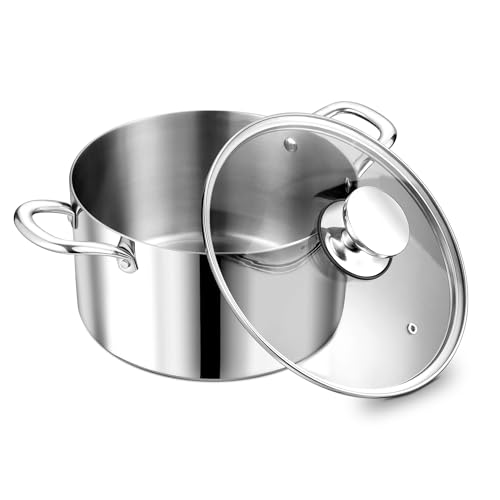
P&P CHEF
5-Quart Tri-Ply Stainless Steel Stock Pot for Soups and Stocks: P&P CHEF Cooking Pot with Glass Lid
This 5-quart tri-ply stock pot layers an aluminum core between 18/10 stainless interior and magnetic 18/0 exterior, so stocks and sauces heat evenly instead of scorching over one hot spot. Buy it if you cook family-sized batches on induction or gas and want an oven-safe pot to 500°F that goes in the dishwasher afterward.
Pros and Cons
Pros
- Full tri-ply construction through the body, not just a disc bonded to the base, gives even heating up the sides for sauces and reductions.
- Induction-compatible without an adapter thanks to the magnetic stainless exterior.
- 18/10 stainless cooking surface is non-reactive, so tomato sauces and wine-based braises will not pick up a metallic taste.
- Vented glass lid shows the pot contents, useful when boiling pasta or watching milk-based soups.
Cons
- The glass lid is not oven safe, so oven finishing means the pot goes in uncovered or you supply your own foil or metal lid.
- Bare stainless has no nonstick coating, so eggs, fish, and starchy foods will stick unless the pot is properly preheated and oiled.
The Best Deals This Week*
-
Tri-Ply Clad Saucepan for Sauces and Gravies
$51.01
($54.95)Save $3.94 -
3-Quart Stainless Steel Saucepan for Sauces
$28.99
($30.99)Save $2.00
*Deals are selected by our commerce team
Tramontina Tri-Ply Clad Saucepan for Sauces and Gravies: Tramontina Signature 2-Quart Stainless Steel Sauce Pan
Tramontina
Tri-Ply Clad Saucepan for Sauces and Gravies: Tramontina Signature 2-Quart Stainless Steel Sauce Pan
This 2-quart tri-ply clad saucepan wraps an aluminum core in stainless steel so sauces, gravies, and reheated soups heat evenly instead of scorching in hot spots. It suits home cooks who want induction-ready, oven-safe cookware with a lifetime warranty at a mid-range price rather than disposable nonstick pots.
$51.01 at AmazonEditors' Favorite
Color: Stainless Steel Size: 2 Quarts Dimensions: 13.79 x 5.75 x 6.5 Inches Weight: 2.55 pounds Product Group: Kitchen Binding: Kitchen
Shop NowSunhouse 3-Quart Stainless Steel Saucepan for Sauces, Grains and Soups: Sunhouse Classic with Glass Lid and 3-Ply Impact-Bonded Base
Sunhouse
3-Quart Stainless Steel Saucepan for Sauces, Grains and Soups: Sunhouse Classic with Glass Lid and 3-Ply Impact-Bonded Base
This 3-quart Sunhouse saucepan handles everyday stovetop jobs like rice, sauces, and small-batch soups, with a 3-layer impact-bonded base that spreads heat evenly and resists bulging over time. It suits cooks who want one induction-ready pan that moves from any cooktop to a 500F oven and then straight into the dishwasher.
$28.99 at AmazonGreat Value
Color: Multicolor Size: 3 Quarts Dimensions: 13.78 x 8.07 x 5.71 inches Weight: 2.94978506556 pounds Product Group: Kitchen Binding: Kitchen
Shop NowP&P CHEF 5-Quart Tri-Ply Stainless Steel Stock Pot for Soups and Stocks: P&P CHEF Cooking Pot with Glass Lid
P&P CHEF
5-Quart Tri-Ply Stainless Steel Stock Pot for Soups and Stocks: P&P CHEF Cooking Pot with Glass Lid
This 5-quart tri-ply stock pot layers an aluminum core between 18/10 stainless interior and magnetic 18/0 exterior, so stocks and sauces heat evenly instead of scorching over one hot spot. Buy it if you cook family-sized batches on induction or gas and want an oven-safe pot to 500°F that goes in the dishwasher afterward.
$24.99 at AmazonColor: Silver Size: 5 Quarts Dimensions: 4.92 x 8.62 x 4.92 Inches Weight: 4.16625 Pounds Product Group: Kitchen Binding: Kitchen
Shop Now



Write Your Review
No reviews yet. Be the first to share your experience!