

Induction cooktops heat differently than anything you may have cooked on before. Instead of a flame or a glowing coil, a copper coil under the glass generates a magnetic field, and that field stirs up heat directly inside the pan itself. The catch is simple but strict: the pan has to be magnetic, or nothing happens. That single rule reshapes how you should think about cookware, because a beautiful copper saucepan or an old aluminum skillet will just sit there, cold. Choosing the right induction cookware material is less about brand loyalty and more about matching the metal to the way you actually cook. Below, I walk through the scenarios that come up in a normal week and point to the material that handles each one best.
Why Material Matters More on Induction Than Anywhere Else
On a gas burner, almost any pot works because the flame licks the sides and bottom without caring what the metal is made of. Induction removes that forgiveness. The magnetic field only couples with ferrous metals, so cast iron, carbon steel, and magnetic stainless steel respond instantly, while pure aluminum, copper, and glass do nothing on their own. Manufacturers get around this by bonding a magnetic disc or a layered steel base onto otherwise non-magnetic pans, which is why a fully clad stainless pot works but a cheap aluminum one might not. There’s a quick test: hold a fridge magnet to the bottom of any pan you own. If it grips firmly, the pan will work. If it slides off or clings weakly, expect uneven heating or no response at all. That test settles most arguments before you spend a dollar.
High-Heat Searing: Cast Iron and Carbon Steel Win
When you want a hard crust on a ribeye or a proper sear on scallops, you need a material that holds heat and shrugs off temperatures that would warp thinner metals. Cast iron is the obvious choice. It’s naturally magnetic, dense, and it stores an enormous amount of thermal energy, so when a cold steak hits the surface the pan barely flinches. On induction, cast iron heats faster than it ever did on gas because the energy goes straight into the metal instead of drifting up the sides.
Carbon steel is the lighter cousin worth knowing about. It has most of cast iron’s heat retention at a fraction of the weight, it’s magnetic, and it responds to temperature changes a little quicker, which some cooks prefer. One practical warning for induction specifically: both metals get hot in a hurry, so start at medium rather than cranking to maximum. I scorched a seasoning layer once by treating an induction burner like a gas one, and the pan needed re-seasoning that same night. Preheat gradually, give the surface a minute to even out, and you’ll get restaurant-level browning without the smoke alarm.
Delicate Sauces and Gentle Simmers: Clad Stainless Steel
A butter sauce that breaks if it gets too hot, or a custard that scrambles the moment you look away, needs a material that spreads heat smoothly and answers the dial fast. This is where fully clad stainless steel shines. The best versions sandwich a core of aluminum between layers of stainless, and the outer layer is magnetic-grade steel so induction can grab it. The aluminum core evens out hot spots, which matters because induction burners concentrate energy in the exact footprint of the coil below.
Watch out for pans that only have a magnetic disc slapped onto the base rather than metal bonded all the way up the walls. Those disc-bottom pots work on induction, but heat pools in the center and the sides stay cooler, so a slow-reducing sauce can catch and scorch in the middle while the edges barely bubble. For anything that needs precision, spend the extra money on a tri-ply or five-ply pan where the layering runs from base to rim. The reward is that a sauce reacts almost immediately when you drop the power, the same responsiveness cooks used to buy copper for.
Everyday Cooking: Nonstick That Actually Grips the Burner
Most weeknight cooking is eggs, stir-fries, reheated rice, and quick vegetables, and for that a good nonstick pan earns its place. The problem is that classic nonstick pans have aluminum bodies, which are invisible to induction. Manufacturers solve this by welding a stainless steel plate to the underside, so before you buy, confirm the box or product page says induction-compatible. A plain aluminum nonstick pan from a few years ago will most likely fail the magnet test and stay cold.
There’s a second thing to check that catches people off guard: the base has to be flat and it has to be big enough. Induction burners have a minimum diameter they can detect, often somewhere around four or five inches, and a small warped pan may flash an error code or cut out mid-cook. Nonstick coatings also dislike the fast, intense heat induction produces, so keep these pans on low to medium settings. High heat degrades the coating faster and can release fumes, which is bad for the pan and worse for the air in your kitchen. Treated gently, an induction-ready nonstick pan handles the daily grind for years.
Boiling, Steaming, and Big-Batch Cooking
Bringing a stockpot to a boil is where induction genuinely outpaces gas, and the material choice is more relaxed here. A magnetic stainless steel pot, even one with a simpler encapsulated base, boils water astonishingly fast because the energy transfers with very little waste. For pasta night or a big pot of soup, you don’t need premium multi-clad construction; you need a wide, flat, magnetic bottom that sits squarely on the cooking zone.
Enameled cast iron deserves a mention for braises and stews. A Dutch oven made of enamel-coated iron is magnetic through the coating, holds a low simmer beautifully for hours, and moves straight from the induction burner into the oven. The only habit to build is lifting rather than sliding these heavy pots, since dragging cast iron across the glass surface is the fastest way to scratch it. That scratch won’t stop the cooktop from working, but it’s permanent, and it’s avoidable.
What to Skip and How to Build a Working Set
Pure copper and pure aluminum, on their own, are out unless they carry a bonded magnetic base. Glass, ceramic, and clay cookware don’t work at all without a special induction interface disc, and even then the results are lukewarm. If you already own a cherished copper pan, an interface disc lets you use it, but you lose the responsiveness that made copper appealing in the first place, so it’s a compromise rather than a fix.
A practical starter kit covers three roles. Get one heavy cast iron or carbon steel skillet for searing, one clad stainless saucepan for sauces and precise work, and one induction-ready nonstick pan for daily eggs and quick meals. Add a magnetic stainless stockpot when you cook for a crowd. That mix handles nearly everything a home kitchen throws at it, and every piece passes the magnet test. Buy for the cooking you actually do rather than the pretty photos, and your cooktop will reward you with speed and control that older stoves simply can’t match.
Can I use my old cookware on an induction cooktop?
Sometimes, and there’s a free way to find out. Press a refrigerator magnet against the bottom of each pan. If it sticks firmly, the pan is magnetic enough to work on induction. Cast iron, carbon steel, and most stainless steel pots will pass, while aluminum, copper, glass, and older nonstick pans usually fail. Pans that grip the magnet weakly may still work but heat unevenly, so treat a strong, confident pull as your green light.
Does the type of stainless steel really change how it performs?
Yes, and it’s the detail most shoppers miss. Fully clad or multi-ply stainless steel, where an aluminum core runs from the base up the walls, spreads heat evenly and responds quickly to the dial. Cheaper pans with only a magnetic disc welded to the bottom concentrate heat in the center, so sauces can scorch in the middle while the edges stay cool. Both work on induction, but the clad version is worth the extra cost for anything delicate.
Why does my pan buzz or click on the induction burner?
A faint hum or buzz is normal and comes from the magnetic field vibrating the layers of metal in the pan, and it’s usually louder at high power settings or with lightweight multi-ply construction. Clicking or rattling is different and often means the base isn’t perfectly flat or the pan is too small for the cooking zone. Try a heavier, flatter pan or a larger burner, and make sure the base is clean and dry, since debris under the pan can amplify the noise.
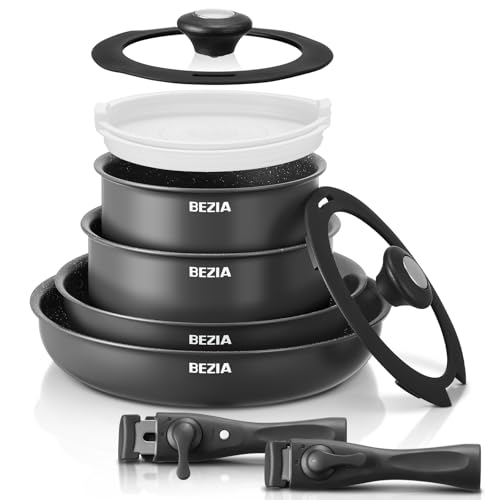
BEZIA
Compact Induction Cookware Set for Small Kitchens: BEZIA 10-Piece Removable-Handle Nonstick Set
The BEZIA 10-piece cookware set handles stovetop cooking, oven finishing, serving, and storage while its removable handles save space. It suits small kitchens, RVs, and campers needing compatible cookware for induction and other stovetops.
Pros and Cons
Pros
- Removable handles provide useful control with a stated support capacity of up to 22 pounds.
- The PFAS-free, PFOA-free, and PFOS-free nonstick materials support lower-stick cooking.
- Two saucepan sizes and two frying pan sizes cover everyday cooking tasks.
- Oven use, stovetop cooking, serving, and refrigerator storage add versatility to the set.
Cons
- The handles must be removed before oven use, adding an extra step during cooking.
- The set includes only two frying pans and two saucepans, so larger households may need additional cookware.

SENSARTE
Everyday Nonstick Cooking: SENSARTE 14-Piece Ceramic Induction Cookware Set
This 14-piece cookware set handles frying, sautéing, simmering, and boiling, with a ceramic nonstick surface free of PFAS, PTFE, PFOA, PFOS, lead, and cadmium. It suits health-conscious home cooks who want versatile induction-compatible cookware that uses less oil and cleans easily.
Pros and Cons
Pros
- The ceramic coating is free of PFAS, PTFE, PFOA, PFOS, lead, and cadmium.
- The set includes multiple pan sizes, lids, utensils, and pot protectors for a practical starter collection.
- Its stainless steel base supports induction cooking while the aluminum body promotes even heating.
- Glass lids provide cooking visibility and help contain splashes.
Cons
- Hand washing is recommended, which may not suit buyers who prefer dishwasher-safe cookware.
- The provided product information does not specify oven compatibility or a maximum oven-safe temperature.
The Best Deals This Week*
-
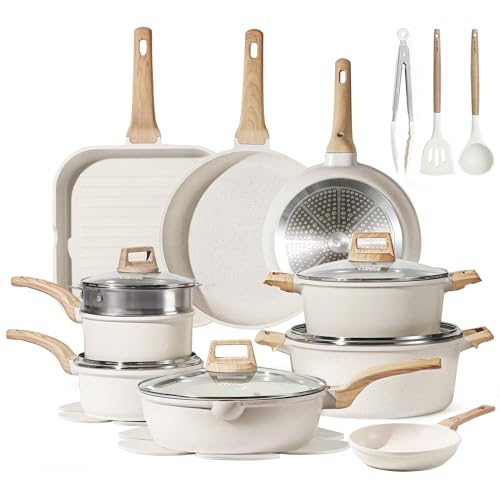
CAROTE 26pcs Pots and Pans Set
$159.99
($229.99)Save $70.00 -
Everyday Nonstick Cooking
$74.99
($109.99)Save $35.00
*Deals are selected by our commerce team
CAROTE 26pcs Pots and Pans Set, Nonstick Cookware Sets, with Grill Pan
Editors' Favorite
Color: Cream White Size: 26 Piece Dimensions: 22.834645646 x 15.74803148 x 11.023622036 inches Weight: 22.266688462 Pounds Product Group: Kitchen
Shop NowBEZIA Compact Induction Cookware Set for Small Kitchens: BEZIA 10-Piece Removable-Handle Nonstick Set
BEZIA
Compact Induction Cookware Set for Small Kitchens: BEZIA 10-Piece Removable-Handle Nonstick Set
The BEZIA 10-piece cookware set handles stovetop cooking, oven finishing, serving, and storage while its removable handles save space. It suits small kitchens, RVs, and campers needing compatible cookware for induction and other stovetops.
$59.99 at AmazonGreat Value
Color: Black Size: 10 Piece Dimensions: 11.2204724295 x 11.2204724295 x 7.87401574 inches Weight: 4.40924524 Pounds Product Group: Kitchen Binding: Kitchen
Shop NowSENSARTE Everyday Nonstick Cooking: SENSARTE 14-Piece Ceramic Induction Cookware Set
SENSARTE
Everyday Nonstick Cooking: SENSARTE 14-Piece Ceramic Induction Cookware Set
This 14-piece cookware set handles frying, sautéing, simmering, and boiling, with a ceramic nonstick surface free of PFAS, PTFE, PFOA, PFOS, lead, and cadmium. It suits health-conscious home cooks who want versatile induction-compatible cookware that uses less oil and cleans easily.
$74.99 at AmazonColor: Ceramic White Product Group: Kitchen
Shop Now




Write Your Review
No reviews yet. Be the first to share your experience!