

TL;DR — Attach the sous vide immersion circulator to a pot of water, set the exact target temperature, seal your food in a bag (removing air), submerge it, and let it cook to the precise doneness you set — no overcooking possible. Then sear meats briefly for a crust. It’s precise, hands-off cooking. Set the temperature, seal, submerge, and finish with a sear. The HomeWhisk team compiled this from usage guidance and aggregated feedback. For picks, see our best sous vide guide.
The HomeWhisk editorial team researches kitchen equipment by analyzing manufacturer specifications, usage technique, and aggregated user reviews from major retailers and cooking communities. This guide reflects established sous vide principles, not personal testing.

Sous vide sounds fancy but is one of the easiest, most foolproof ways to cook — it uses precise temperature to cook food perfectly every time. Here’s the beginner’s walkthrough. For choosing a device, see our best sous vide guide. (For the concept, see our what-is-sous-vide-cooking guide.)

potterybag
Reusable Sous Vide Bags for Anova and Joule Cookers, potterybag 30-Piece Vacuum Seal Kit with Auto Pump
This 30-bag set uses an automatic pump to vacuum-seal food in washable BPA-free pouches that handle sous vide water baths, freezing, and microwave reheating. It suits home cooks running Anova or Joule circulators who want to stop buying disposable vacuum rolls for every batch.
Pros and Cons
Pros
- The auto pump removes the manual effort that makes hand-pump bag systems tedious during large meal prep sessions.
- Compatible with standard immersion circulators including Anova and Joule, so no separate chamber sealer is needed.
- Washable and reusable design pays back the purchase over repeated meal prep cycles.
- Thirty bags across three sizes is enough volume to prep a full week without rationing bags.
Cons
- Valve leakage is common enough that the manufacturer built troubleshooting steps into the manual, so expect a learning curve before your first long cook.
- Reusable valve bags rarely hold a seal as reliably as heat-sealed rolls during multi-hour sous vide sessions, so check bags mid-cook on long cooks.

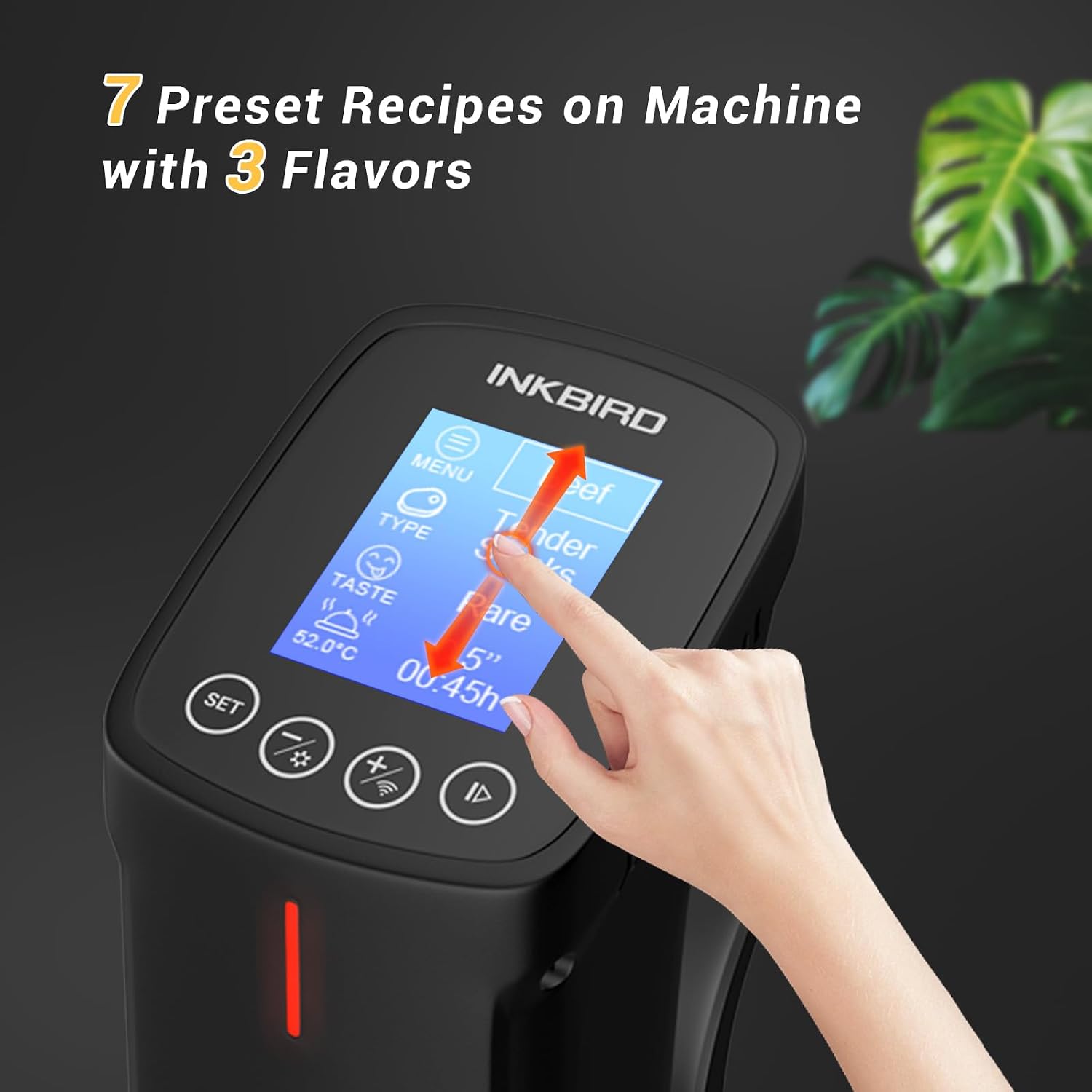
Inkbird
WiFi Sous Vide Cooker for Restaurant-Quality Steaks at Home - INKBIRD ISV-100W 1000W Immersion Circulator
The INKBIRD ISV-100W delivers precise temperature control within 0.1°C and app-based remote monitoring, letting you cook perfect steaks and chicken while handling other tasks. Home cooks who want consistent, restaurant-quality results without constant supervision should consider this 1000-watt circulator.
Pros and Cons
Pros
- WiFi connectivity and app control let you monitor and adjust cooks from another room or while running errands.
- The 1000-watt heating element reaches target temperature faster than lower-wattage models, especially with larger water volumes.
- Timer supports up to 99 hours for long cooks like brisket or pork shoulder that need 24+ hours to tenderize.
Cons
- No waterproof rating means you must keep the control head completely clear of splashes and steam during use.
- Temperature range starts at 77°F, preventing low-temperature applications like yogurt or fermentation that require 68-75°F holds.

MOMODA
Sous Vide and Freezer Food Storage Kit: MOMODA 55-Piece Cordless Vacuum Sealer with 30 Reusable Bags and Mason Jar Attachments
This 55-piece kit pairs a cordless rechargeable handheld vacuum sealer with 30 reusable BPA-free bags in three sizes, so you can vacuum-seal sous vide proteins, leftovers, and marinades without wrestling a countertop machine or buying replacement rolls. Buy it if you cook with a Joule or Anova circulator and want reusable bags plus Mason jar sealing in one purchase rather than two separate systems.
Pros and Cons
Pros
- Bags are BPA-free and freezer safe, so the same set moves from marinating to long-term frozen storage to the sous vide bath.
- The handheld sealer is compact enough to store in a drawer rather than occupying permanent counter space.
- The kit bundles bags, jar sealers, and discs together, so there is nothing else to source before the first use.
- Three bag sizes reduce wasted space and water displacement compared with sealing everything in one oversized bag.
Cons
- Valve-style reusable bags generally pull a softer vacuum than heat-sealed channel bags, so very long freezer storage may still show some frost.
- The rechargeable battery needs periodic charging, which is an extra step before a big meal-prep or batch-freezing session.
Repinsta
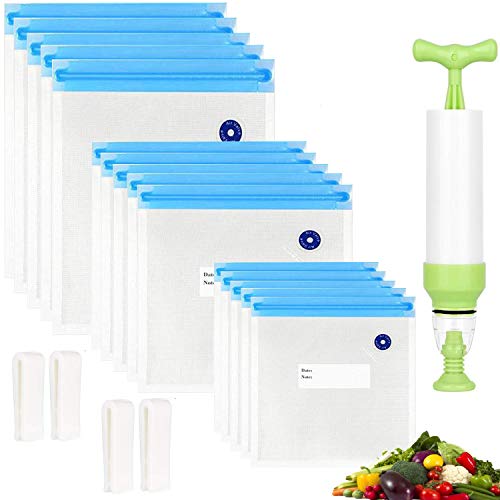
Sous Vide Cooking and Freezer Storage Bags: Repinsta Reusable Sous Vide Bag Kit, 20 Pack in 3 Sizes with Hand Pump and Sealing Clips
This 20 bag kit replaces disposable vacuum rolls for sous vide cooking, using a hand pump to draw air out through a valve and clips to lock the seal so food stays submerged through long water bath cooks. Buy it if you run a sous vide circulator often and want reusable, BPA-free, puncture-resistant bags in three sizes instead of paying for single-use plastic every session.
Pros and Cons
Pros
- Hand pump and clips give you real air removal and a secure seal without owning a vacuum sealer.
- Three bag sizes handle steaks, vegetables, and larger batch cooks from one kit.
- BPA-free, food-grade material is rated for extended low-temperature cooking and doubles for fridge and freezer storage.
- Reusable design lowers the running cost of frequent sous vide cooking compared to disposable rolls.
Cons
- A hand pump cannot match the air removal of a chamber vacuum sealer, so dense or fatty cuts may still need a weight to stay submerged.
- Bags must be washed and fully dried between uses, which adds cleanup time that single-use bags do not.
potterybag Reusable Sous Vide Bags for Anova and Joule Cookers, potterybag 30-Piece Vacuum Seal Kit with Auto Pump
potterybag
Reusable Sous Vide Bags for Anova and Joule Cookers, potterybag 30-Piece Vacuum Seal Kit with Auto Pump
This 30-bag set uses an automatic pump to vacuum-seal food in washable BPA-free pouches that handle sous vide water baths, freezing, and microwave reheating. It suits home cooks running Anova or Joule circulators who want to stop buying disposable vacuum rolls for every batch.
$24.99 at AmazonEditors' Favorite
Color: Transparent Size: S+M+L-30 Pcs With Pump Product Group: BISS
Shop NowInkbird WiFi Sous Vide Cooker for Restaurant-Quality Steaks at Home - INKBIRD ISV-100W 1000W Immersion Circulator
Inkbird
WiFi Sous Vide Cooker for Restaurant-Quality Steaks at Home - INKBIRD ISV-100W 1000W Immersion Circulator
The INKBIRD ISV-100W delivers precise temperature control within 0.1°C and app-based remote monitoring, letting you cook perfect steaks and chicken while handling other tasks. Home cooks who want consistent, restaurant-quality results without constant supervision should consider this 1000-watt circulator.
$95.99 at AmazonGreat Value
Wattage: 1000 Voltage: 120 Volts Control Method: App Upper Temperature Rating: 212 Degrees Fahrenheit Smart Home Compatibility: Smart Home Compatible Lower Temperature Rating: 77 Degrees Fahrenheit Item Dimensions D x W x H: 2.36"D x 2.36"W x 16.14"H Capacity: 15 Liters Material: Metal Color: Black Brand Name: Inkbird UPC: 652722827740 Warranty Description: 365 Model Number: ISV-100W Part Number: ISV-100W Manufacturer: Inkbird Item Type Name: Inkbird Sous Vide Precision Cooker Included Components: Vide Precision Cooker Unit Count: 1.0 Count Best Sellers Rank: #5,604 in Kitchen & Dining (See Top 100 in Kitchen & Dining) #3 in Sous Vide Machines ASIN: B07RNWJZNR Customer Reviews: 4.5 4.5 out of 5 stars (5,310) 4.5 out of 5 stars Product Dimensions: 2.36"D x 2.36"W x 16.14"H Brand: Inkbird
Shop NowMOMODA Sous Vide and Freezer Food Storage Kit: MOMODA 55-Piece Cordless Vacuum Sealer with 30 Reusable Bags and Mason Jar Attachments
MOMODA
Sous Vide and Freezer Food Storage Kit: MOMODA 55-Piece Cordless Vacuum Sealer with 30 Reusable Bags and Mason Jar Attachments
This 55-piece kit pairs a cordless rechargeable handheld vacuum sealer with 30 reusable BPA-free bags in three sizes, so you can vacuum-seal sous vide proteins, leftovers, and marinades without wrestling a countertop machine or buying replacement rolls. Buy it if you cook with a Joule or Anova circulator and want reusable bags plus Mason jar sealing in one purchase rather than two separate systems.
$39.99 at AmazonColor: Electric Pump-SilveryWhite Size: Vacuum Sealer Set Weight: 3.2 pounds Product Group: Drugstore
Shop NowRepinsta Sous Vide Cooking and Freezer Storage Bags: Repinsta Reusable Sous Vide Bag Kit, 20 Pack in 3 Sizes with Hand Pump and Sealing Clips
Repinsta
Sous Vide Cooking and Freezer Storage Bags: Repinsta Reusable Sous Vide Bag Kit, 20 Pack in 3 Sizes with Hand Pump and Sealing Clips
This 20 bag kit replaces disposable vacuum rolls for sous vide cooking, using a hand pump to draw air out through a valve and clips to lock the seal so food stays submerged through long water bath cooks. Buy it if you run a sous vide circulator often and want reusable, BPA-free, puncture-resistant bags in three sizes instead of paying for single-use plastic every session.
$12.59 at AmazonColor: Blue Kit Size: Small Dimensions: 0.2 x 0.1 x 0.1 inches Weight: 0.70988848364 pounds Product Group: Kitchen Binding: Kitchen
Shop NowHow Sous Vide Works
Understanding the principle explains why sous vide is so foolproof and how to use it.
Sous vide (French for “under vacuum”) cooks food by immersing it (sealed in a bag) in precisely temperature-controlled water. A device called an immersion circulator heats and circulates the water to hold an exact temperature you set. Because the water is held at the exact temperature you want the food to reach, the food cooks to precisely that doneness and can’t overcook — it can’t get hotter than the water.
Why this is powerful:
- Perfect, precise doneness: set 130°F for a medium-rare steak, and the steak reaches exactly 130°F throughout — edge to edge, no gray overcooked band. You get the exact doneness every time.
- Foolproof/hands-off: you can’t overcook it (leaving it a bit longer barely changes it), so timing is forgiving and it’s very hands-off.
- Even cooking: the whole piece reaches the same temperature uniformly.
- Great for: steak, chicken, pork, fish, eggs, and tough cuts (long low-temp cooking tenderizes them).
The one catch — no browning: because it cooks in water at a moderate temperature, sous vide doesn’t brown or crisp food. So you finish with a quick sear (in a hot pan or with a torch) for a flavorful crust on meats. Sear at the end, not before.
What you need: an immersion circulator (the sous vide device that clips to a pot), a pot or container of water, and bags to seal the food (zip-top bags or vacuum-sealed — see our vacuum-sealer-for-sous-vide guide). This guide covers the immersion-circulator method (the common home approach). Our best sous vide guide covers devices.
Step-by-Step: Cooking Sous Vide
Here’s the process from setup to searing.
1. Set up the water bath. Fill a large pot or container with water, and attach the immersion circulator to the side (it clips on). Use enough water to submerge the food and stay within the device’s min/max fill lines.
2. Set the temperature. Set the circulator to your target temperature — this is the doneness the food will reach. For example:
- Steak: ~129-134°F for medium-rare.
- Chicken breast: ~145-150°F.
- Pork: ~140-145°F.
- Eggs: ~145-167°F depending on style.
Follow a sous vide temperature guide for your food and desired doneness. Let the water preheat to the set temperature.
3. Season and seal the food. Season the food, then seal it in a bag with the air removed:
- Vacuum sealer: best air removal (see our vacuum-sealer guides), especially for long cooks.
- Zip-top bag + water displacement: seal all but a corner, lower the bag into water so pressure pushes the air out, then seal the corner. Works well for most home cooking.
Removing air ensures the food sinks and contacts the water evenly (air bubbles insulate and make it float).
4. Submerge the food. Once the water is at temperature, submerge the sealed bag fully in the water bath, clipping it to the side if needed so it stays under. Make sure no part floats above the water.
5. Cook for the target time. Cook for the recommended time for your food and thickness (e.g., steak 1-4 hours, tough cuts much longer). Because it can’t overcook, the timing is forgiving — a bit longer is usually fine. It’s completely hands-off during this time.
6. Remove and finish with a sear (for meats). Take the food out and pat it dry, then sear it quickly in a very hot pan (with oil), or use a torch, for a browned, flavorful crust — just 30-60 seconds per side (the inside is already cooked to temperature). For foods that don’t need browning (eggs, some fish), skip the sear.
7. Serve. The food is cooked to exactly the doneness you set, with a fresh sear for texture.
That’s it — set temperature, seal, submerge, cook, and sear to finish. Our best sous vide guide covers immersion circulators.
Tips and Common Questions
A few tips and clarifications make sous vide even easier and better.
Tips for good results:
- Use a lid or cover (or ping-pong balls / foil) on the water container for long cooks to reduce evaporation.
- Remove air well from the bag — floating or air-insulated food cooks unevenly. Vacuum-sealing is best for long cooks; water-displacement works for shorter ones.
- Don’t skip the sear for meats — it adds the crust and flavor sous vide alone can’t (a hot pan or torch, patting food dry first).
- Follow temperature/time guides for your specific food and desired doneness — temperature sets doneness, time depends on thickness.
- Season before sealing; you can add aromatics (herbs, garlic) to the bag.
- Safety: for long cooks and poultry, use proper time/temperature combinations that ensure food safety (sous vide guides provide these — lower temps require longer times to be safe).
- Chill quickly if not eating immediately (cook-chill), or serve right away.
Common questions clarified:
- Do I need a vacuum sealer? Not strictly — zip-top bags with water displacement work for most home sous vide, though a vacuum sealer is better for long cooks and batch prep (see our do-you-need-a-vacuum-sealer-for-sous-vide guide).
- Can it overcook? Barely — food can’t exceed the water temperature, so it holds at the set doneness; very long times can affect texture, but you won’t “overcook” it the usual way.
- Is the plastic safe? Use food-grade, BPA-free sous vide or freezer bags rated for the purpose.
The takeaway: sous vide is precise and foolproof — attach the circulator, set the exact temperature (which sets doneness), seal and submerge the food, cook hands-off, and sear meats at the end for a crust. Removing air and finishing with a sear are the two things to get right. Our best sous vide and best vacuum sealer guides cover the gear.
Frequently Asked Questions
How do you use a sous vide?
Attach the immersion circulator to a pot of water, set your exact target temperature (which determines the food’s doneness), and let the water preheat. Season and seal your food in a bag with the air removed (vacuum sealer or zip-top bag with water displacement), then submerge it fully in the water bath. Cook for the recommended time — it can’t overcook since it won’t exceed the water temperature. Finally, pat meats dry and sear them briefly in a hot pan or with a torch for a crust. Set temperature, seal, submerge, and sear to finish.
Do you need to sear food after sous vide?
For meats, yes. Sous vide cooks food in water at a moderate temperature, so it doesn’t brown or crisp — the meat comes out perfectly cooked inside but pale and without a crust. Searing it quickly (30-60 seconds per side) in a very hot pan with oil, or with a torch, after sous vide gives the browned, flavorful crust that makes it appetizing. Pat the food dry first for a better sear. Foods that don’t need browning (eggs, some fish) can skip the sear. The sear is the finishing step for meats.
Do I need a vacuum sealer for sous vide?
Not strictly. A vacuum sealer removes air best and is ideal for long cooks and batch prep, but for most home sous vide you can use zip-top bags with the water-displacement method: seal all but a corner, lower the bag into water so the pressure pushes air out, then seal the corner. This works well for shorter cooks. A vacuum sealer is a worthwhile upgrade if you sous vide often or do long cooks (better air removal prevents floating), but it’s not required to start. See our do-you-need-a-vacuum-sealer-for-sous-vide guide.
Can you overcook food with sous vide?
Barely — that’s a big appeal of sous vide. Because the food is held in water at the exact temperature you set and can’t get hotter than the water, it reaches your target doneness and holds there without overcooking the usual way. Leaving a steak in a bit longer barely changes it. That said, very long cook times can eventually affect texture (making some foods mushy or overly tender), so follow recommended time ranges. But you won’t get the overcooked gray band or dryness you’d get from overcooking on a stove or grill. It’s very forgiving.
What temperature do I set for sous vide?
Set the temperature to the exact doneness you want the food to reach, since the food cooks to the water’s temperature. Common examples: steak around 129-134°F for medium-rare, chicken breast around 145-150°F, pork around 140-145°F, and eggs 145-167°F depending on style. Follow a sous vide temperature guide for your specific food and desired doneness. The temperature sets the doneness, while the time depends on the food’s thickness. Getting the temperature right is how you achieve precise, perfect doneness with sous vide.
Is sous vide cooking safe?
Yes, when done properly. Use food-grade, BPA-free bags rated for sous vide or freezer use, and follow proper time-and-temperature combinations that ensure food safety — especially for poultry and long cooks, where lower temperatures require longer times to be safe (sous vide guides provide safe combinations). Cook to safe internal temperatures for the food, and if not eating immediately, chill the food quickly. Modern sous vide is a safe, precise cooking method used in restaurants and homes, as long as you follow tested temperature/time guidelines and use appropriate bags. See our what-is-sous-vide-cooking guide.
Related buying guides: best meat thermometer, best instant pot and best chef knives on a budget.
The Bottom Line
Using a sous vide is precise and foolproof: attach the immersion circulator to a pot of water, set the exact target temperature (which determines the food’s doneness), and preheat. Season and seal your food in a bag with the air removed (vacuum sealer or zip-top bag with water displacement), submerge it fully, and cook hands-off for the recommended time — it can’t overcook since it won’t exceed the water temperature. Finish meats with a quick sear in a hot pan or with a torch for a flavorful crust. Removing air from the bag and searing at the end are the two things to nail. See our best sous vide and best vacuum sealer guides.


Write Your Review
No reviews yet. Be the first to share your experience!