

TL;DR — Three knives cover about 90% of home cooking: a chef’s knife, a paring knife, and a serrated bread knife. Most cooks never need more than five or six. Buy these few well rather than a big block of mediocre blades, and add specialty knives only when a specific task demands one. The HomeWhisk team compiled this from aggregated cook feedback and knife-use patterns. The honest answer is fewer than most knife sets suggest. For picks, see our best kitchen knife set guide.
The HomeWhisk editorial team researches kitchen equipment by analyzing manufacturer specifications, knife-use patterns, and aggregated user reviews from major retailers and cooking communities. Our recommendations are based on what the products actually deliver, not what brands promise.
Walk past a 20-piece knife block and it’s easy to assume you need a lot of knives. You don’t. Here’s how many kitchen knives you actually need and why. For picks, see our best kitchen knife set guide.
The Essential Three
The short answer to “how many knives do I need” starts with three — and for many cooks, ends not far past it.
1. Chef’s knife (8″). The workhorse, used for the vast majority of cutting: chopping vegetables, slicing, dicing, mincing, cutting boneless meat, and general prep. If you own one knife, it’s this. A quality chef’s knife handles most tasks alone. See our best chef knife guide.
2. Paring knife (3-4″). The small-detail knife: peeling, hulling strawberries, deveining shrimp, trimming, segmenting citrus, and any precise in-hand work too fiddly for a chef’s knife.
3. Serrated bread knife (8-10″). The sawing specialist for anything with a firm exterior and soft interior: crusty bread, cakes, and — importantly — tomatoes, which the other two crush. Its serrated edge does what a straight blade can’t.
These three cover roughly 90% of home cooking. The chef’s knife does the bulk, the paring knife handles small precise work, and the bread knife covers what a straight edge can’t. For a lot of home cooks, this is genuinely all they need — and buying just these three, but good ones, gives better results than a big cheap set. See our guide on choosing a knife set for why quality beats quantity.
The Useful Additions (Getting to Five or Six)
Beyond the essential three, a few more knives and tools are genuinely useful — bringing most cooks to a complete kit of five or six.
4. Utility knife (5-6″). The in-between knife for medium tasks too big for a paring knife but not needing a chef’s knife — slicing a sandwich, a tomato, cheese, or small produce. Convenient, though it overlaps with the other two (see our utility-knife guide).
5. Kitchen shears. Underrated and surprisingly versatile: spatchcocking poultry, snipping herbs, opening packaging, trimming fat. Many cooks use them constantly. They round out a practical kit.
Plus a honing steel for maintaining edges between sharpenings (honing, not sharpening — see our honing guide), and a storage solution (block, magnetic strip, or in-drawer tray — see our best knife block set guide).
That’s a complete kit for most home cooks: 3 core knives + utility knife + shears + honing steel + storage. This 5-6 knife setup handles essentially all everyday cooking with quality tools and no wasteful filler. Most people never need more than this.
The key insight: the jump from 3 to 5-6 adds real convenience, but beyond that, additional knives are specialty tools for specific tasks, not general necessities. If you stop at a well-chosen 5-6 knives, you’re fully equipped. Our best kitchen knife set guide covers sets built around this practical core.
When You Need Specialty Knives
Beyond the core kit, specialty knives are worth adding only when a specific task justifies them — not by default. Here’s when each earns its place.
Boning knife — if you break down whole chickens, fillet, or trim your own large cuts of meat (see our boning-knife guide).
Carving/slicing knife — if you regularly cook large roasts or brisket and want clean, even slices (see our carving-knife guide).
Santoku or nakiri — if you prefer a Japanese-style blade or do lots of vegetable prep; a santoku can even replace the chef’s knife as your main knife (see our santoku and nakiri guides).
Steak knives — if you regularly eat steak or table-cut meats (see our steak-knife guide).
Fillet knife — if you fish or prep whole fish often.
Cleaver — if you chop through bone (Western) or want an all-purpose Asian prep knife (Chinese).
The principle: each of these is a specialist for a task the core kit doesn’t cover well. Add them individually, when your cooking actually calls for them — not as part of a big set bought upfront. Buying a 20-piece block to “have everything” means paying for knives you’ll never use while the core knives are mediocre. Buy the essential three well, add the useful two, and acquire specialists one at a time as needed. That’s how you end up with knives you actually use, all of good quality. See our best kitchen knife set and best chef knife guides.
Frequently Asked Questions
How many kitchen knives do I really need?
Three cover about 90% of home cooking: a chef’s knife (the workhorse for chopping, slicing, dicing), a paring knife (small precise tasks), and a serrated bread knife (crusty bread, cakes, tomatoes). Most cooks are fully equipped with five or six — adding a utility knife and kitchen shears, plus a honing steel and storage. Beyond that, additional knives are specialty tools for specific tasks, not general necessities. Fewer, better knives beat a big block of mediocre ones.
What are the three essential kitchen knives?
A chef’s knife (8 inches) for the bulk of cutting — chopping, slicing, dicing, mincing; a paring knife (3-4 inches) for small precise tasks like peeling and trimming; and a serrated bread knife (8-10 inches) for crusty bread, cakes, and tomatoes that a straight edge would crush. These three handle roughly 90% of home cooking. Buying just these three but choosing quality versions gives better everyday results than a large set of cheaper knives.
Do I need a big knife set with lots of pieces?
No. Large 15-20 piece sets usually dilute the budget across mediocre blades and padding (six steak knives, unused specialty knives), so each knife is worse. You use three knives for most cooking and rarely need more than five or six. A quality 5-6 piece set — or buying the essential three individually — beats a big cheap block. Add specialty knives one at a time only when a specific task calls for them. Quality and the right few knives matter far more than piece count.
Is a chef’s knife enough on its own?
It’s the single most versatile knife and handles the majority of cutting alone, so if you owned only one knife, it should be a chef’s knife. But two gaps remain: small precise detail work (better with a paring knife) and cutting crusty bread or tomatoes (which need a serrated bread knife, since a chef’s knife crushes them). So a chef’s knife alone covers a lot but not everything — the three essentials together cover ~90% of cooking comfortably.
When should I buy specialty knives?
Only when a specific task in your cooking justifies one — not upfront as part of a big set. Add a boning knife if you break down whole chickens or trim large cuts, a carving knife if you cook large roasts, a santoku or nakiri for Japanese-style or heavy vegetable prep, steak knives if you eat steak often, or a fillet knife if you handle whole fish. Buy them individually as needed so you end up with knives you actually use, all of good quality.
Should I buy knives individually or as a set?
Both work. Buying individually lets you invest in a great chef’s knife, good paring knife, and bread knife, putting money where it matters — often beating a pre-packaged set. A quality 5-6 piece set offers convenience, matching looks, and a storage block. Either way, prioritize the quality of the core three knives over piece count, and avoid big sets that spread the budget thin. Add specialty knives individually as your cooking needs them. See our knife-set-buying guide.
Related buying guides: best knife sets and best bread knife.
The Bottom Line
Most home cooks need far fewer knives than a big block suggests. Three — a chef’s knife, a paring knife, and a serrated bread knife — cover about 90% of cooking, and a complete practical kit is just five or six: those three plus a utility knife, kitchen shears, a honing steel, and storage. Beyond that, additional knives are specialty tools (boning, carving, santoku, steak, fillet, cleaver) worth adding individually only when a specific task calls for one. Buy the essential few well rather than a big set of mediocre blades, and you’ll have knives you actually use, all of good quality. See our best kitchen knife set and best chef knife guides.

Pros & Cons
Pros
- Single-piece stamped blade construction balances durability with lightweight maneuverability, reducing fatigue during extended prep work.
- Satin-finished blades hold their edge longer than cheaper alternatives, staying sharp enough for clean cuts on soft and hard foods.
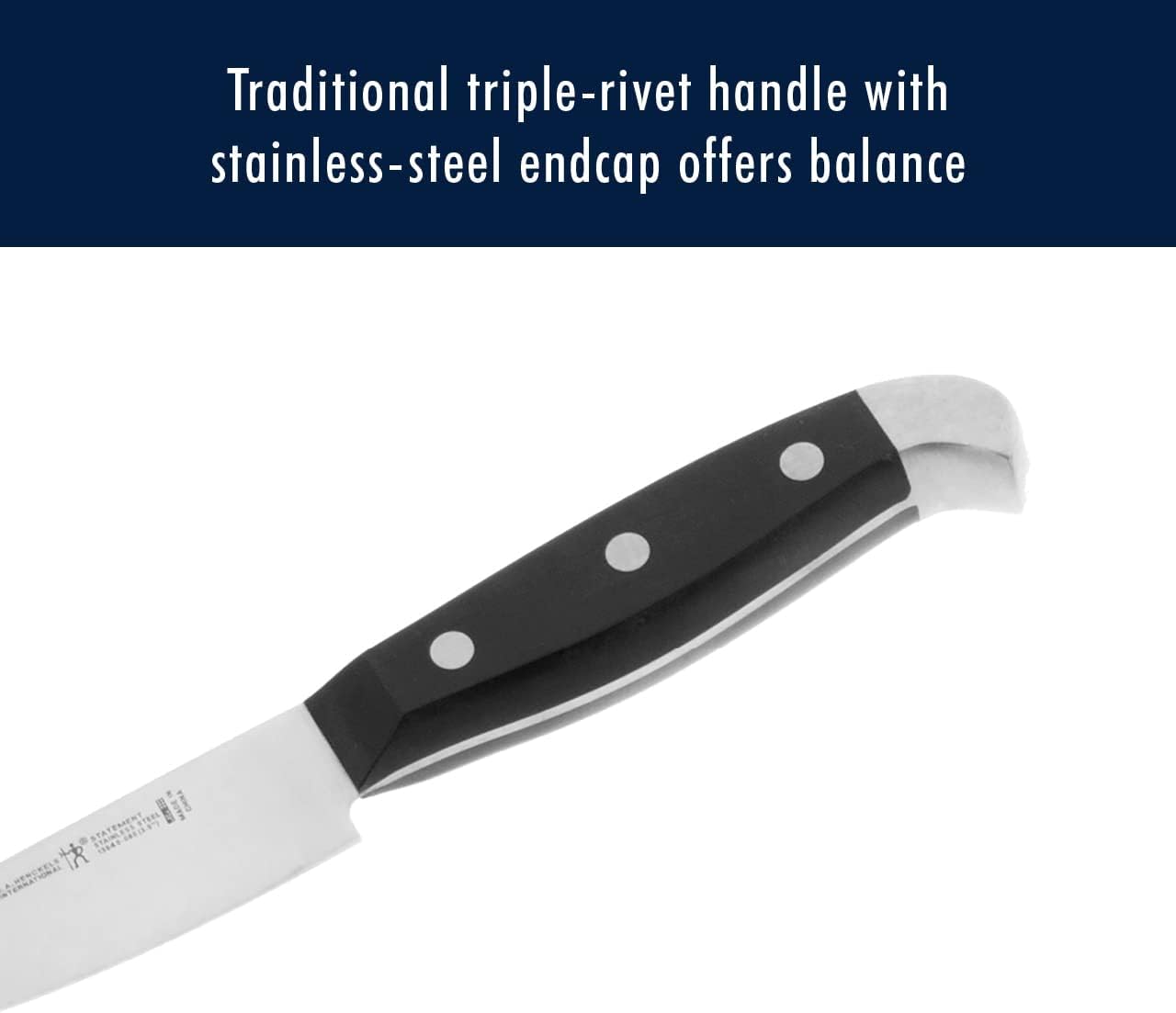
- Triple-rivet handles with curved design and stainless-steel endcap provide secure grip and professional appearance on countertops.
Cons
- Stamped blades cannot be resharpened as aggressively as forged knives, so eventual replacement may be necessary after years of heavy use.
- Hardwood block requires occasional oiling to prevent drying and cracking in low-humidity kitchens.
Details
A complete knife system designed to eliminate the need for multiple purchases. Solves the common problem of owning mismatched knives that don’t perform consistently across different cutting tasks.
The 8-inch chef’s knife handles 80% of daily prep work, while the hollow-edge santoku’s grantons prevent herb and vegetable slipping. The 8-inch bread knife cuts through crusty loaves without crushing the interior.
High-carbon stainless steel blades resist staining and rust. Full-tang construction distributes weight evenly. Includes 3-inch paring, 5-inch serrated utility, two santoku options, 8-inch chef’s knife, 8-inch bread knife, six 4.5-inch steak knives, honing steel, kitchen shears, and hardwood block.
Stamped blades are thinner than forged alternatives, making them lighter but slightly less durable under extreme pressure or chopping on hard surfaces.
Best for home cooks who want professional-grade performance without forged-knife weight or specialty maintenance routines.
Care Guide
Hand wash immediately after use under warm running water with mild soap. Dry blades with a soft cloth before storing to prevent water spots. Never leave knives soaking or in the dishwasher overnight, as prolonged moisture exposure can dull edges.
Use the included honing steel weekly by drawing each blade spine-down along the steel at a 15-degree angle. This realigns the blade edge without removing metal, keeping knives sharp for months between professional sharpening.
Oil the hardwood block quarterly with food-grade mineral oil to prevent cracking and drying. Store knives blade-up in the block away from direct sunlight and heat sources to preserve both blade sharpness and wood finish.

Save $20.01
Pros & Cons
Pros
- Built-in sharpener works effectively with one hand, eliminating the learning curve of manual sharpening methods.
- Complete 15-piece set covers every cutting task from delicate paring to heavy-duty bread slicing without gaps.
- German stainless steel resists staining and rust even in dishwashers, maintaining appearance and edge retention.
Cons
- Hand-washing is recommended despite dishwasher-safe rating to maximize blade longevity and sharpness retention.
- Built-in sharpener works best for maintenance honing; heavily dulled blades may require professional resharpening.
Details
A 15-piece kitchen knife system designed to eliminate multiple tool purchases and constant sharpening hassles. The integrated sharpener solves the problem of dull blades interrupting meal prep without requiring separate equipment.
The built-in hand-operated sharpener maintains edges between uses, and the tapered edge grinding provides precise cuts through proteins, vegetables, and bread. German 1.4116 stainless steel resists staining and rust through repeated washing.
The set includes an 8-inch chef knife, 7-inch Santoku, 8-inch slicing knife, serrated bread knife, utility knife, paring knife, six steak knives, kitchen shears, and a hard wood block. Total footprint is compact enough for standard counters.
The built-in sharpener works best for routine maintenance; heavily dulled blades benefit from professional sharpening services.
Best for home cooks who meal prep multiple times weekly and want a complete knife collection without buying pieces individually.
Care Guide
Hand-wash blades immediately after use with warm soapy water and dry thoroughly. Dishwasher use is safe but accelerates edge wear; reserve it for occasional deep cleaning. Never soak blades for extended periods as moisture can affect the handle.
Use the built-in sharpener weekly during regular cooking to maintain optimal edge. Stroke each blade 3-5 times through the sharpening slot at a consistent angle. This quick maintenance prevents the need for professional resharpening.
Store blades in the wood block immediately after drying to prevent accidental damage and protect your hands. Avoid cutting on glass, marble, or ceramic surfaces; use wood or plastic cutting boards to preserve the edge.

Pros & Cons
Pros
- The integrated NeverDull sharpener eliminates the learning curve of manual honing and delivers consistent professional results without guesswork.
- German stamped steel construction resists rust and maintains edge retention longer than typical kitchen knife sets, justifying the investment over time.
- Ergonomic handles with perfect balance reduce hand and wrist strain during extended prep work, a major advantage for home cooks who entertain frequently.
Cons
- At $399.99, this is a premium investment that requires proper maintenance and handwashing to honor the 10-year sharpness guarantee.
- The ceramic sharpening wheel works best with regular maintenance swipes; neglecting the built-in sharpener will void the durability advantage.
Details
This 17-piece German stainless steel knife system solves the dual problem of maintaining professional sharpness and managing multiple cutting tools in a small kitchen footprint.
The NeverDull ceramic sharpener built into the block automatically engages each blade at the optimal angle and pressure, restoring a professional edge in seconds. German stamped steel blades glide through meat, vegetables, and bread without requiring a separate honing steel or annual professional sharpening.
The set weighs approximately 8 pounds and includes a chef knife, bread knife, santoku, slicing knife, boning knife, utility knife, paring knife, eight steak knives, kitchen shears, and the knife block itself. Handles are ergonomically designed with chef-approved balance to reduce fatigue during long prep sessions.
The sharpener requires regular use to maintain effectiveness; occasional users may not see the full 10-year durability benefit if the blade is neglected between uses.
Best for home cooks who entertain regularly and want restaurant-quality cuts without mastering manual sharpening techniques or investing in professional honing services.
Care Guide
Hand wash all blades immediately after use and dry thoroughly before returning to the block. Never place knives in the dishwasher, as high heat and harsh detergents degrade the German steel and ceramic sharpener over time.
Use the built-in sharpener every 2-3 weeks with regular kitchen use by swiping each blade through the lever 3-5 times per side. The ceramic wheel maintains optimal pressure automatically, so consistent light swipes work better than aggressive pressure.
Store the block on a stable countertop away from moisture and direct heat. Wipe the exterior stainless steel accents monthly with a soft cloth to maintain the polished appearance and prevent water spots.

Pros & Cons
Pros
- Includes 14 specialized pieces: chef knife, santoku, bread knife, paring knife, steak knives, and shears for nearly every cutting task.
- Solid acacia wood block resists warping and includes a built-in sharpener, eliminating the need for separate storage or maintenance tools.
- Japanese high-carbon stainless steel with 10° edge angle provides sharper cuts than Western-style knives while resisting rust and corrosion.
- Ergonomic handles with contoured grip reduce hand strain during long prep sessions, making it accessible for both home cooks and professionals.
Cons
- Hand-washing required to maintain blade edge and warranty coverage; dishwasher use voids the lifetime service guarantee.
- Acacia wood block requires occasional oiling to maintain appearance and prevent drying, adding minor maintenance beyond knife care.
Details
A 14-piece Japanese steel knife set designed to handle every cutting task without dulling quickly or requiring constant resharpening. The 10° blade edge slices through ripe tomatoes, thick squash, and frozen foods cleanly without crushing or tearing.
Advanced heat treatment keeps blades sharp 3X longer than standard steel. Ergonomic handles reduce hand fatigue during extended prep work, while the half-bolster design adds safety and prevents blade breakage under pressure.
Solid acacia wood block with built-in sharpener stores all pieces and provides convenient maintenance. Anti-slip silicone base keeps the block stable on countertops. Includes chef, bread, slicing, santoku, utility, paring knives, steak knives, and shears.
Requires hand-washing to preserve blade edge and maintain warranty. Acacia wood benefits from occasional oiling to prevent drying over years of use.
Best for home cooks and meal-prep enthusiasts who want professional-grade cuts and durability without replacing knives frequently or investing in separate sharpening services.
Care Guide
Hand-wash immediately after use with warm soapy water and dry with a soft cloth. Never soak blades or place in the dishwasher, as this dulls edges and voids the lifetime warranty. Store in the provided acacia block between uses to protect blade edges and prevent accidents.
Use the built-in sharpener monthly or when you notice slight resistance during cutting. For deep sharpening, professional honing every 6 months extends blade life significantly. Avoid cutting on glass, marble, or ceramic surfaces; use wooden or plastic cutting boards only.
Condition the acacia wood block quarterly with food-grade mineral oil to prevent drying and cracking. Wipe the block with a damp cloth after each use and allow it to air-dry completely before storing knives. This simple routine maintains both blade sharpness and wood appearance for years.

Pros & Cons
Pros
- Complete 14-piece set includes chef, bread, slicing, santoku, utility, paring knives plus steak knives and shears—no additional purchases needed.
- Japanese steel formulation with 10° edge angle delivers cleaner cuts through vegetables, proteins, and bread compared to standard 15° Western blades.
- Ergonomic grip and perfect weight balance reduce hand fatigue during meal prep, making this set suitable for both professional and home kitchen use.
Cons
- Hand-washing only requirement means these knives cannot go in the dishwasher, adding extra cleanup steps compared to some budget alternatives.
- Angled acacia wood block takes up more counter space than magnetic strips or knife rolls, which may not fit smaller kitchen layouts.
Details
This 14-piece knife set solves the problem of owning mismatched knives by providing every blade needed for daily meal preparation in one cohesive collection.
The 10° blade edge and heat-hardened Japanese steel enable swift, precise cuts through proteins, vegetables, and bread while maintaining sharpness through repeated use. The built-in sharpener keeps all pieces razor-sharp without requiring separate tools.
The set includes an 8″ chef knife, 8″ bread knife, 8″ slicing knife, 7″ santoku, 5″ utility knife, 3.5″ paring knife, six 4.5″ steak knives, kitchen shears, and a built-in sharpener housed in a solid angled acacia wood block with non-slip base.
Hand-washing is required to preserve the blade edge and prevent rust, which adds a minor maintenance step compared to dishwasher-safe alternatives.
Best for home cooks and meal prep enthusiasts who want professional-grade cutting performance without the professional price tag.
Care Guide
Hand-wash immediately after use with warm soapy water and dry with a soft cloth. Never soak blades or place in the dishwasher, as moisture and heat damage the steel and loosen handles over time.
Use the built-in sharpener regularly to maintain the 10° blade edge. Store knives in the angled acacia block between uses to protect edges and prevent accidental contact with other utensils.
Avoid cutting on glass, marble, or ceramic surfaces—use wooden or plastic cutting boards only. Hone blades monthly with a steel if you notice any loss of sharpness during cutting tasks.
About These Recommendations
The technique above is the point of this guide; the products are here because they help. We have not tested them ourselves — we did not buy or use this gear. The recommendations come from comparing specifications and materials against the patterns in verified owner reviews, so treat them as a shortlist worth researching rather than a verdict from our own kitchen.
Availability and prices change often, so check the current listing before buying. We earn a commission on purchases made through links on this page, which never affects what we recommend.

Write Your Review
No reviews yet. Be the first to share your experience!