

TL;DR — How long do egg cooker last is one of those kitchen questions where the useful answer is usually more practical than complicated. The right move depends on how you cook, what you already own, and how much maintenance you are willing to do. When this turns into a purchase decision, compare best rice cooker, best slow cooker, and best pressure cooker before narrowing your shortlist.
The HomeWhisk approach is research-first: compare construction, usability, cleaning, and long-term complaints before recommending a direction. For appliance topics, we pay close attention to capacity, controls, cleanup, storage, reliability complaints, and whether the machine saves enough effort to justify the space.

Pros & Cons
Pros
- Narrow topic focus gives more depth on egg pickling than a general preserving cookbook chapter.
- Written around long term storage, which is the question most first time egg picklers actually have.
- Doubles as both a snack manual and an entertaining resource for appetizer plates.
- Digital and print recipe format takes no counter or cabinet space in a crowded kitchen.
Cons
- The listing publishes no description, feature list, or page count, so recipe volume is unclear before you buy.
- No published customer feedback yet, meaning photography quality and instruction clarity are unverified.
Details
A recipe collection built entirely around pickled eggs, aimed at cooks who end up with surplus hard boiled eggs and want a shelf stable way to use them.
The stated focus is brining for long term storage, so you boil and jar a batch once and pull ready snacks from the fridge over following weeks.
It is also positioned for entertaining, with pickled eggs framed as a make ahead appetizer you prepare days before guests arrive.
Listed under canning and preserving rather than general cooking, though the seller does not state page count, format, or number of recipes.
Best for backyard chicken keepers and bulk egg buyers who want one dedicated reference on brining and storing eggs safely.
Best Uses
Use it when a laying flock or a warehouse carton outpaces your breakfast rotation and eggs are approaching their date.
Reach for it before hosting, since pickled eggs need brining days ahead and free up your kitchen the day guests arrive.
Pair it with wide mouth jars and your existing vinegar stock, since egg pickling needs no pressure canner or specialty equipment.
Pros & Cons
Pros
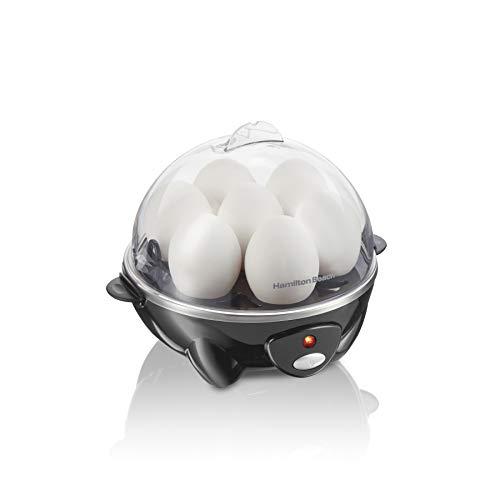
- Three cooking modes in one unit replace a saucepan, a poaching insert, and a skillet.
- The measuring-cup water method removes guesswork from doneness, a common failure point with stovetop boiling.
- Audible beep plus indicator light means you can walk away mid-cycle.
- Compact black housing fits on a crowded counter and suits small kitchens or dorm setups.
Cons
- Poaching capacity is limited to one or two eggs, so it lags behind the seven-egg boiling tray when cooking for a group.
- Doneness depends on measuring water accurately, so expect a few test runs before you dial in your preferred yolk.
Details
An electric egg cooker that handles boiling, poaching, and omelets so you stop babysitting a pot and guessing at timing.
Fill the measuring cup to the marked level and the unit steams eggs to soft, medium, or hard, then beeps and shuts its indicator light off.
The omelet bowl swaps in for steaming one to two servings of vegetables such as carrots, green beans, or zucchini.
Small footprint in black plastic, sized to hold seven eggs, so it stores in a cabinet between uses rather than living on the counter.
Best for households cooking eggs several mornings a week who want repeatable results without stovetop attention.
How to Use
For boiled eggs, fill the measuring cup to the soft, medium, or hard line, pour it into the base, load up to seven eggs in the tray, and cover.
For poaching, add water, set the poaching tray, and crack one or two eggs in. For omelets, beat eggs directly in the omelet bowl before covering.
Press the power button once. When the beep sounds and the light goes out, unplug, lift the lid away from you, and run boiled eggs under cold water before peeling.

Pros & Cons
Pros
- Twelve-egg capacity handles batch cooking that most compact egg cookers cannot.
- Thermal sensor delivers consistent doneness without timing or watching the unit.
- Trays and lid are dishwasher-safe, keeping cleanup to a minute.
- Internal accessory storage keeps the poaching tray and omelet plate from scattering across drawers.
Cons
- It handles one omelet at a time, so it will not keep up with a family breakfast.
- The cooker needs counter or cabinet space and an outlet, which is a real cost in a small kitchen when a pot already works.
Details
An electric egg cooker that removes the timing and watching from boiled eggs, replacing a pot of water and a timer with a single button.
Capacity is the standout: 12 hard boiled eggs per cycle, or 7 poached, plus a tray for steaming vegetables and dumplings.
A built-in precision thermal sensor governs the cycle, so doneness stays consistent batch to batch instead of drifting with water volume.
Trays, lid, and measuring cup are non-electric and dishwasher-safe, and they nest inside the base for storage in one cabinet slot.
The limitation: omelet capacity is one at a time, and it occupies counter space plus an outlet.
Best for meal preppers and families who cook eggs by the dozen every week.
How to Use
Pierce each egg with the tool on the measuring cup, fill the cup to the soft, medium, or hard line, and pour the water into the base.
Load the boiling rack, poaching tray, or omelet plate, cover, and press the button; the thermal sensor ends the cycle and signals when done.
Rinse the base, run the trays and lid through the dishwasher, and nest the accessories back inside before storing.

Pros & Cons
Pros
- Onsen tamago preset delivers a silky ramen-style egg that normally requires precise low-temperature water control.
- Mutable alert is a genuinely useful touch for shared kitchens, dorms, and pre-dawn cooking.
- Steam cooking plus the included rack and bowl means boiled, poached, and omelet duty all happen in one footprint.
- One-touch icon display keeps the learning curve near zero compared to timer-dial egg cookers.
Cons
- Six-egg capacity caps batch size, so large households or heavy meal preppers will need to run consecutive cycles.
- Results depend on the preset matching your egg size and starting temperature, so expect a cycle or two of trial before you dial in your preferred doneness.
Details
A countertop steam egg cooker that removes guesswork from egg doneness, replacing stovetop timing, water-level judgment, and the shell-cracking chaos of a rolling boil.
The onsen tamago preset is the standout, producing custardy ramen-topper eggs without a circulator, while the poach and omelet modes use the included bowl for single-serve breakfasts.
The rack holds six eggs, the cooking bowl is BPA-free, and the touch panel uses doneness icons rather than a dial, keeping the unit compact enough for a permanent counter spot.
Capacity stops at six eggs, so batch cooking for a large family means running back-to-back cycles.
Best for ramen enthusiasts, breakfast-in-a-hurry households, and meal preppers who want consistent eggs without monitoring a pot.
How to Use
Load up to six eggs on the rack for boiled or onsen modes, or swap in the BPA-free bowl for poached eggs and omelets. Add water, close the lid, and tap your mode on the touch panel.
The icon display shows your selected doneness. The cooker manages timing and shuts off automatically, then signals with an audible alert when the cycle finishes.
To silence the beeper for early mornings or shared spaces, hold the Menu button for three seconds. Transfer boiled eggs to cold water right away if you want shells that peel cleanly.
What To Look For
Hold a appliance to a short checklist: fit, control, cleanup, and durability. Those are the variables that decide whether it earns a spot in your kitchen or ends up unused. Ignore cosmetic upgrades until the fundamentals check out.
Why It Matters
The variables that decide the outcome — preset controls, digital versus dial controls, and noise level — are the ones buyers most often overlook. That is why two appliances that look alike can feel completely different in use — one saves time, the other quietly adds friction to every task. If you are shopping, our best rice cooker and best slow cooker guides are the fastest way in.
How To Get It Right
Think through the whole workflow: descaling water-based units, wiping the interior after use, and checking the seals and gaskets. A appliance that fits your routine and cleanup habits beats a technically superior one you fight with. We cover specific models in best rice cooker, best slow cooker, and best pressure cooker.
The Short Answer
Cut through it and how long do egg cooker last is a fit question — the appliance has to match how you cook. The practical takeaway is that preset controls matters more day to day than headline features. For product picks, compare best rice cooker, best slow cooker, and best pressure cooker.
Related Product Guides
If this topic is part of a buying decision, these are the HomeWhisk guides most closely tied to it:
- best rice cooker
- best slow cooker
- best pressure cooker
- best air fryer
- best blender
- best instant pot
- best stand mixer
Frequently Asked Questions
Is a premium appliance worth it?
Only if you use it enough to notice better control, durability, or cleanup regularly. Occasional users are well served by a mid-range pick like those in best pressure cooker.
What matters most for how long do egg cooker last?
Focus on noise level, motor or heating-element power, and preset controls first. Those decide real performance; the rest is secondary. Compare best rice cooker and best slow cooker for options that get the basics right.
Who is this most useful for?
Mainly busy weeknight cooks, and gadget-minimalists who want one do-it-all unit. If that is you, treat storage bulk as a requirement rather than a nice-to-have.
What gear pairs well with it?
Start with a reliable core piece, then add as needs appear. Compare best rice cooker, best slow cooker, and best pressure cooker for related choices.
How do I keep it in good shape?
Build not overfilling past the max line, and letting the motor rest between heavy loads into normal cleanup. Light, consistent care prevents lingering odors far better than occasional deep effort.
The Bottom Line
For most home cooks, the best choice is the one that removes friction without adding maintenance you will ignore. Start with your use case, then cross-check best rice cooker, best slow cooker, and best pressure cooker.

Write Your Review
No reviews yet. Be the first to share your experience!