

A juicer earns the label heavy duty through hardware, not adjectives. Open one up and you find cast metal where a consumer unit molds plastic, a linkage that multiplies arm strength many times over, and contact surfaces chosen to survive daily baths in one of the kitchen’s most acidic foods. Those decisions determine whether the machine presses its ten-thousandth lime as cleanly as its first.
This guide breaks the category down mechanically. First comes the manual lever press and the physics that let it deliver crushing loads no hand could manage alone, then the motorized reamer and the features — torque delivery, auto-reverse, presoak activation — that separate bar equipment from toys. Materials chemistry, cone design, and a volume-based buying map round out the picture.
What Actually Makes a Citrus Juicer Heavy Duty
Two designs dominate serious citrus work. The first is the manual lever press, the hinged cast-metal machine familiar from juice bars and taco shops: swing the arm down and a domed crushing cup forces a halved fruit into a perforated strainer. The second is the electric reamer, a motorized ridged dome that spins against the cut face of an orange while you lean in. Everything else on store shelves — plastic handheld squeezers, battery gadgets, lightweight spinners — imitates one of these two shapes in weakened form.
The dividing line is force delivery. A plastic squeezer hands the job straight to your grip muscles, so output caps out wherever your wrist starts complaining. A heavy duty machine interposes a mechanism between palm and fruit: either a lever system that converts hand pressure into hundreds of pounds of crushing load, or a geared motor that keeps twisting no matter how dense the membranes are. That middle mechanism is the entire difference between equipment built for nightly service and a gadget meant to survive occasional weekends.
The Physics of a Manual Lever Press
The lever press runs on the oldest force multiplier in engineering. Its handle is a long arm pivoting on a fulcrum set close to the base, with the crushing cup hung near that pivot. Effort travels a long arc at the handle while the cup moves only a short distance against the fruit, so force is multiplied by the ratio between the two arms — commonly eight to twelve to one on commercial frames. Forty pounds of relaxed downward pressure therefore arrives at a lime as 300 to 500 pounds of crush.
Refined versions add a geared fulcrum, a rack-and-pinion or cam linkage at the pivot that keeps the multiplication constant through the whole stroke instead of letting it fade as the handle falls. The frame has to carry these loads, which is why serious presses are cast from thick aluminum rather than stamped sheet or resin. Enameled cast aluminum became the industry default because the casting supplies mass and rigidity while the baked enamel shell shields the alloy underneath.
The payoff shows up during a rush. A bartender making margaritas drops a halved lime into the strainer, pulls the handle, and releases in about two seconds, seeds trapped below and coarse pulp held back by the perforations. Repeat that motion a few hundred times on a busy night and nothing heats up, loosens, or strains a wrist — exactly the workload that snaps plastic hinges within a month.
Inside Electric Reamer Machines: Torque, Auto-Reverse, Presoak
Motorized reamers swap the lever for a motor, usually rated between 40 and 160 watts. That sounds feeble beside a blender, but citrus extraction lives on low-speed torque rather than blade velocity. A well-geared 100-watt motor driving a broad ribbed dome out-extracts a faster appliance that wastes its wattage whipping air, and commercial bars favor slow, heavily geared drives precisely because they stall rarely and run for years.
Two refinements mark out the better machines. Auto-reversing reamers alternate spin direction every few seconds, collapsing juice sacs from both sides instead of grinding a single groove into the membrane, a change you can taste in thick-skinned oranges and grapefruit. Pressure-sensing activation starts the motor only when you bear down on the fruit and stops it the instant you lift, removing the fumbled wet-hands toggle switch entirely.
Some professional units add presoak activation: each fruit half rests on a stationary or barely turning reamer for a beat before full speed engages. That brief dwell lets juice flood back through the ruptured cells and soften dry pulp, so the spinning pass afterward carries flavor out instead of leaving it locked in the rind. Duty rating matters as much as wattage here — home-grade motors expect short bursts with cooling pauses, while juice-bar models specify continuous operation with protected bearings and thermal cutoffs guarding the windings.
Cast Metal Bodies and the Chemistry of Citric Acid
Citrus is quietly hostile to machinery. Lemon and lime juice sits near pH 2, and citric acid is a chelator, meaning it grabs metal ions and pulls them out of exposed surfaces. Unprotected aluminum grows gray pits, zinc-alloy die castings slowly lose their zinc to the bath, and plain steel rusts wherever a coating gets scratched. Quality presses respond by enameling their castings and specifying stainless steel for every surface the juice touches.
Peel oil mounts a second attack. D-limonene, the terpene behind the familiar citrus smell, doubles as an industrial degreasing solvent, and left in weekly contact it clouds cheap polystyrene, embrittles ABS, and swells rubber gaskets until they leak. Cast metal simply ignores all of it.
Plastic also fails structurally. A lever press flexes its frame under hundreds of pounds of load thousands of times, and resin hinge bosses crack long before anything has properly worn out. Cheap units additionally trap pulp in seams that absorb pigment and gray out permanently, while cast and enameled surfaces wipe clean because nothing porous faces the juice.
Pulp and Seed Separation Is a Geometry Problem
Every competent press pairs its crushing cup with a perforated strainer that does the actual sorting. Slot size sets the pulp level: fine perforations hold nearly everything back for clear lemonade, wider holes let a measured amount of body through for pulpy orange juice. On many machines the strainer lifts out and swaps for a different gauge, which costs far less than owning two appliances.
Seeds need their own escape route. Well-designed cones raise a central boss and cut drainage channels that herd seeds and coarse membrane into a pocket below the strainer, away from the juice stream, so even a seedy orange empties clean in one pull. Inspect this area before buying, since product photos tend to hide it: you want a removable strainer, a visible seed cavity, and no corner where wet pulp can pack itself somewhere fingers cannot reach.
Matching the Build to Your Volume
Begin with honest arithmetic. If the week’s citrus amounts to a few lemons for salad dressing and an occasional glass of juice, none of this engineering is necessary; a modest press serves perfectly and extra spend buys durability you will never tax.
Batch cooking changes the calculation. Pressing a dozen oranges for Sunday meal prep, mixing pitchers of lemonade for a cookout, or juicing limes for a tray of margaritas means repeating the same motion twenty to fifty times per session — exactly the point where plastic hinges and thin handles start giving up. An enameled cast aluminum lever press shrugs off that routine indefinitely and never asks for an outlet.
Daily or commercial volume justifies going electric. Cafés, smoothie counters, and households running a genuine juice program should look for a geared motor in the 60-to-160-watt range, auto-reversing action, a cast or stainless base, and above all a manufacturer that still stocks replacement reamers and strainers years after purchase. Parts availability is the most honest signal of a machine built to last; disposable models lose support the moment the product line turns over.
Frequently Asked Questions
How much force does a manual citrus press actually apply?
Far more than hands alone. Typical lever-arm ratios of eight to twelve to one convert forty pounds of easy downward pressure into roughly 320 to 500 pounds at the fruit, and larger floor-model presses quote peaks approaching half a ton. The practical benefit is uniformity, since the fruit is crushed completely every time rather than squeezed until your grip fades. That consistency, not raw power, is what the linkage exists to provide.
Is a 40-watt motor too weak for an electric citrus juicer?
No, because citrus rewards torque rather than speed. These motors turn slowly through reduction gearing, converting modest wattage into steady twisting force across a wide reamer face, and a 60-watt geared unit routinely outperforms a faster appliance claiming triple the power. Wattage becomes critical mainly at volume: in the 100-to-160-watt band you gain headroom for back-to-back grapefruit and continuous service without tripping the thermal protector. For household batches, even entry-level ratings extract thoroughly.
Do enameled finishes chip, and is a chipped juicer still safe to use?
Enamel can chip when a knife edge or a hard drop meets the casting, although the baked coatings bonded to quality aluminum shrug off ordinary knocks. A chip on the outer housing is purely cosmetic. The real concern is damage inside the strainer bowl or crushing cup, where exposed aluminum will eventually pit and shed gray residue into the juice. Retire or repair the unit if bare metal spreads across a food-contact zone; otherwise keep pressing, ideally ordering a replacement strainer from the manufacturer if one is sold.
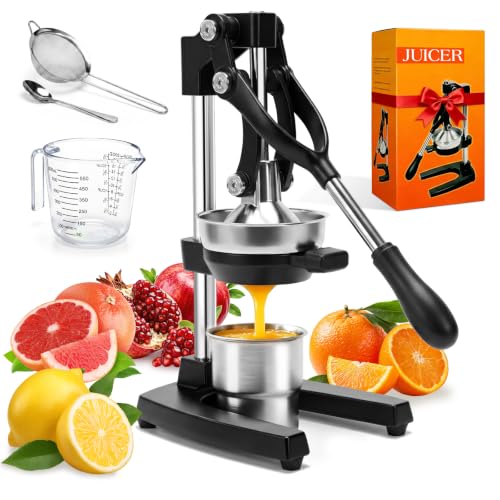
TNELTUEB
Fresh Citrus Juice Without an Electric Machine: TNELTUEB Manual Citrus Juicer Press with Cast Iron Base and Full Accessory Kit
The TNELTUEB press uses a cast iron lever to empty a lemon, lime, or orange in a single pull, with a detachable strainer holding seeds and pulp back from the glass. It suits home bartenders and daily juice drinkers who press citrus often enough to justify permanent counter space.
Pros and Cons
Pros
- Cast iron and stainless construction is sized for repeat pressing behind a bar, not occasional weekend use.
- Ships with strainer, stainless cup, measuring cup, spoon, and Allen wrench, so nothing extra is needed at setup.
- Handles lemon, lime, orange, and halved pomegranate rather than being locked to one fruit size.
- Detachable components turn cleanup into a rinse instead of a disassembly job.
Cons
- The cast iron build is heavy to move and too tall for most cabinets, so it needs dedicated counter space.
- The press is built around lemons, limes, and oranges, so large grapefruit and thick-skinned fruit fit poorly.
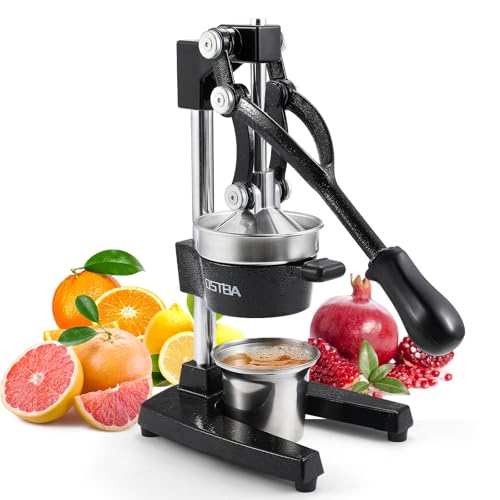
OSTBA
Cast Iron Manual Citrus Juicer for Oranges, Lemons and Grapefruit — OSTBA Heavy Duty Hand Press with Steel Cup
This lever-operated cast iron press squeezes oranges, lemons, limes, grapefruit and pomegranates on your countertop, using a long handle to generate strong pressing force with minimal hand strain. It suits home juice drinkers and small cafes or juice bars that need daily citrus output without a motor, cords, or setup.
Pros and Cons
Pros
- Cast iron construction and stainless steel contact surfaces are built for the repeat pressing of a cafe or juice bar, not just occasional home use.
- Lever mechanics extract more juice per fruit than hand squeezing, which lowers what you spend on citrus over time.
- Removable stainless cup and strainer make serving and washing straightforward after each batch.
- Silent, motor-free operation works early mornings without waking the house.
Cons
- Cast iron construction makes this heavy to move or store, so it needs a permanent spot on the counter rather than a cabinet shelf.
- Fruit still has to be halved by hand before each press, so high-volume sessions involve prep work the juicer does not handle.

Eurolux
Manual Citrus Press for Oranges and Pomegranates: Eurolux Ultra-Premium Cast Iron Juicer, Extra-Large Commercial Grade
This cast iron lever press squeezes halved oranges, lemons, and pomegranates in one pull, extracting more juice with less hand strain than twist-style reamers. Buy it if you make fresh juice often enough that a hand squeezer feels slow and a countertop electric juicer feels like too much cleanup.
Pros and Cons
Pros
- Cast iron body and lever mechanism let you extract juice from tough fruit like pomegranate without straining your grip.
- Removable dishwasher-safe parts keep pulp and pith from drying onto the press.
- Suction base holds the unit steady so you can pull the lever with one hand.
- Finished look means it can stay out on the counter instead of taking up cabinet space.
Cons
- Heavy duty cast iron means real weight, so this is not something you will move in and out of storage between uses.
- It takes up a meaningful footprint on the counter, and fruit still has to be halved by hand before pressing.

YDXHXH
Manual Citrus Juicer for Fresh Lemonade and Cocktails: YDXHXH Cast Iron Lemon Squeezer Press with Stainless Steel Cone
This cast iron hand press squeezes oranges, lemons, and limes directly into your glass in about three seconds, using a long lever handle for high yield with minimal effort. It suits home bartenders, lemonade stand operators, and anyone juicing citrus daily who wants a countertop press that stays put instead of a flimsy handheld squeezer.
Pros and Cons
Pros
- Cast iron construction resists the flexing and cracking that sink plastic and thin aluminum squeezers over time.
- Stainless steel cone contacts the citrus, so acidic juice will not pit or discolor the pressing surface.
- Quick-release cone and bowl make cleanup a rinse rather than a disassembly project.
- Ergonomic handle length gives enough mechanical advantage to press oranges, not just small limes.
Cons
- Cast iron makes this heavy and countertop-bound, so it is not something you will move in and out of a cabinet between uses.
- The listing has no verified buyer feedback yet, so long-term durability of the handle mechanism is unproven.
The Best Deals This Week*
-
Fresh Citrus Juice Without an Electric Machine
$64.99
($89.99)Save $25.00 -
Cast Iron Manual Citrus Juicer for Oranges
$59.99
($89.99)Save $30.00 -
Manual Citrus Press for Oranges and Pomegranates
$65.83
($73.14)Save $7.31 -
ROVSUN Professional Citrus Juicer Lemon Squeezer
$43.98
($59.99)Save $16.01
*Deals are selected by our commerce team
TNELTUEB Fresh Citrus Juice Without an Electric Machine: TNELTUEB Manual Citrus Juicer Press with Cast Iron Base and Full Accessory Kit
TNELTUEB
Fresh Citrus Juice Without an Electric Machine: TNELTUEB Manual Citrus Juicer Press with Cast Iron Base and Full Accessory Kit
The TNELTUEB press uses a cast iron lever to empty a lemon, lime, or orange in a single pull, with a detachable strainer holding seeds and pulp back from the glass. It suits home bartenders and daily juice drinkers who press citrus often enough to justify permanent counter space.
$64.99 at AmazonEditors' Favorite
Color: black Size: Extra Large Dimensions: 1 x 1 x 1 Inches Product Group: Kitchen
Shop NowOSTBA Cast Iron Manual Citrus Juicer for Oranges, Lemons and Grapefruit — OSTBA Heavy Duty Hand Press with Steel Cup
OSTBA
Cast Iron Manual Citrus Juicer for Oranges, Lemons and Grapefruit — OSTBA Heavy Duty Hand Press with Steel Cup
This lever-operated cast iron press squeezes oranges, lemons, limes, grapefruit and pomegranates on your countertop, using a long handle to generate strong pressing force with minimal hand strain. It suits home juice drinkers and small cafes or juice bars that need daily citrus output without a motor, cords, or setup.
$59.99 at AmazonGreat Value
Color: Black Size: Large Dimensions: 15.74 x 6.69 x 15.52 Inches Weight: 13.88 pounds Product Group: Kitchen Binding: Kitchen
Shop NowEurolux Manual Citrus Press for Oranges and Pomegranates: Eurolux Ultra-Premium Cast Iron Juicer, Extra-Large Commercial Grade
Eurolux
Manual Citrus Press for Oranges and Pomegranates: Eurolux Ultra-Premium Cast Iron Juicer, Extra-Large Commercial Grade
This cast iron lever press squeezes halved oranges, lemons, and pomegranates in one pull, extracting more juice with less hand strain than twist-style reamers. Buy it if you make fresh juice often enough that a hand squeezer feels slow and a countertop electric juicer feels like too much cleanup.
$65.83 at AmazonColor: Gray Product Group: Kitchen Binding: Kitchen
Shop NowROVSUN Professional Citrus Juicer Lemon Squeezer, Cast Iron Juicer, Commercial Manual Fruit Press Juicer for Lemon Pomegranate Orange Juice, Heavy Duty Hand Press and Lime Squeezer Stand (Black)

ROVSUN
Professional Citrus Juicer Lemon Squeezer, Cast Iron Juicer, Commercial Manual Fruit Press Juicer for Lemon Pomegranate Orange Juice, Heavy Duty Hand Press and Lime Squeezer Stand (Black)
$43.98 at AmazonColor: Black Dimensions: 8.661417314 x 7.086614166 x 14.566929119 Inches Weight: 13.448197982 Pounds Product Group: Kitchen Binding: Kitchen
Shop NowYDXHXH Manual Citrus Juicer for Fresh Lemonade and Cocktails: YDXHXH Cast Iron Lemon Squeezer Press with Stainless Steel Cone
YDXHXH
Manual Citrus Juicer for Fresh Lemonade and Cocktails: YDXHXH Cast Iron Lemon Squeezer Press with Stainless Steel Cone
This cast iron hand press squeezes oranges, lemons, and limes directly into your glass in about three seconds, using a long lever handle for high yield with minimal effort. It suits home bartenders, lemonade stand operators, and anyone juicing citrus daily who wants a countertop press that stays put instead of a flimsy handheld squeezer.
$69.99 at AmazonColor: Gray Size: cast iron juicer-Gray Dimensions: 8.6 x 6.7 x 15.3 inches Weight: 14.55 Pounds Product Group: Kitchen
Shop Now









Write Your Review
No reviews yet. Be the first to share your experience!