

Manual brewing equipment has carved out a devoted following among coffee enthusiasts who value control over convenience. These tools strip away the automation, putting every variable—water temperature, pour rate, extraction time—directly in your hands. The market spans from $15 pour-over cones to $200+ portable espresso makers, and understanding where each price tier delivers real value helps you avoid both overspending and false economy.
The appeal extends beyond taste. Hand-powered brewers need no electricity, travel easily, and create almost zero electronic waste. A quality manual grinder paired with a simple brewer often outperforms a $300 automatic machine in cup quality, though it demands more from you in technique and patience.
Budget Pour-Over: Where Value Starts
Ceramic and plastic drippers represent the entry point, typically running $15–$35. The Hario V60 and Melitta pour-over cones have dominated this space for decades because they work. A conical dripper, paper filters, and a gooseneck kettle give you genuine control over extraction. The V60’s spiral ribs and large opening reward precise technique—circular pours, bloom phases, temperature management—while Melitta’s flat-bottom design forgives inconsistent pouring.
Plastic versions cost less and survive drops better than ceramic, though they retain heat poorly. Ceramic holds temperature more steadily during the brew, which matters for maintaining extraction consistency across the full pour. Glass carafes with integrated drippers, like the Chemex, push toward $45–$50 but double as serving vessels and deliver a cleaner cup through thicker filters.
This tier demands separate investment in a scale ($20–$30) and gooseneck kettle ($25–$60). Without measuring both coffee and water by weight, results swing wildly. The total system cost—dripper, kettle, scale, filters—lands around $80–$120, but each component serves you for years. Pour-over rewards repetition; your fifth brew will taste noticeably better than your first as muscle memory develops.
Mid-Tier Immersion: French Press and AeroPress Territory
The $30–$70 bracket introduces full-immersion brewers that eliminate pour technique as a variable. French presses steep grounds in hot water for four minutes, then separate them with a metal mesh plunger. The Bodum Chambord and Frieling stainless models anchor this category. Glass carafes with stainless frames cost $30–$45 for 34-ounce capacity; double-walled stainless versions run $60–$80 and hold heat far longer.
Metal mesh filters pass coffee oils that paper traps, producing fuller body and richer mouthfeel. This comes with a trade—fine sediment reaches your cup, and over-extraction happens easily if you leave grounds steeping past four minutes. Pre-heating the carafe and using coarse-ground coffee (think sea salt texture) minimize these issues.
AeroPress occupies the same price range ($35–$40) but functions differently. You steep grounds for 1–2 minutes, then force water through a paper or metal filter using hand pressure. The short steep time and pressure produce clean, concentrated coffee that resembles espresso in strength though not in crema or texture. Single-cup capacity (8 ounces) limits batch brewing, but the compact size and near-indestructible plastic construction make it the default choice for travel and camping.
Immersion methods forgive inconsistent grind size and water temperature more than pour-over, making them easier for beginners. You still need a grinder—pre-ground coffee loses aroma within days of opening—but you can skip the gooseneck kettle and scale initially. A kitchen kettle and eyeballed measurements produce decent results until you’re ready to refine.
Premium Hand Grinders: The Foundation That Matters
Grind quality affects the cup more than brewing method. Blade grinders produce uneven particles—boulders and dust simultaneously—that extract at different rates and create bitter, sour cups. Burr grinders crush beans between two abrasive surfaces, creating uniform particles. Hand-crank burr grinders at $50–$180 match or exceed electric models costing twice as much.
The $50–$80 bracket (Hario Mini Mill, Porlex) uses ceramic conical burrs. They grind slowly—60–90 seconds of cranking per 20-gram dose—and adjustment lacks precision, but particle uniformity beats any blade grinder decisively.
The $120–$180 tier (Timemore C2, 1Zpresso Q2) introduces steel burrs, aluminum bodies, and calibrated adjustment dials. Grinding takes 30–45 seconds with less effort. Steel burrs stay aligned and sharp far longer than ceramic.
Pairing a $140 hand grinder with a $30 AeroPress produces better coffee than a $200 automatic brewer with its built-in blade grinder.
Portable Espresso: The Premium Frontier
True espresso requires 9 bars of pressure and water at 195–205°F forced through finely ground, tamped coffee. Manual espresso makers at $80–$250 attempt this without pumps or boilers. The Flair Classic ($120) and Rok ($180) use long lever arms to generate pressure through mechanical advantage.
Results depend heavily on grind precision, tamping pressure, and pre-heat thoroughness. The learning curve is steep, but successful shots rival cafe espresso in flavor concentration and crema production.
The Wacaco Nanopresso ($80) and Picopresso ($150) compress the mechanism into handheld pumps. Portability and ease of cleaning make them ideal for travel, but 18-gram basket capacity limits them to occasional use.
Manual espresso only makes sense if you already own a capable hand grinder. Adding a $140 grinder to a $120 Flair puts total investment at $260—competitive with electric espresso machines but requiring far more skill and effort per shot.
Where the Value Breaks Actually Land
The sharpest value point sits at $100–$150 total: a quality hand grinder ($80–$120) plus a simple brewer ($20–$40). This combination lets you explore pour-over, immersion, and cold brew while grinding fresh for each cup. The grinder preserves upgrade paths—add a Flair for espresso, a Chemex for entertaining, a travel AeroPress—without needing to replace your foundation.
Budget missteps happen when someone buys a $60 French press but grinds with a $20 blade grinder, or invests $200 in a manual espresso maker before owning a grinder capable of espresso-fine consistency. The brewer showcases what the grinder provides; reversing that priority guarantees disappointment.
Diminishing returns arrive past $180 for grinders and $150 for brewers unless you’re chasing specific goals. A $250 Comandante grinder grinds 15 seconds faster than a $140 Timemore and offers finer adjustment increments, but both produce excellent cups. A $200 Flair 58 uses 58mm baskets like commercial machines, while a $120 Flair Classic uses proprietary 36mm baskets—the shots taste nearly identical.
Time investment scales with complexity. Pour-over and French press take 5–8 minutes start to finish. AeroPress runs 3–5 minutes. Manual espresso demands 10–15 minutes including pre-heat, grinding, tamping, pulling the shot, and cleaning. Cold brew requires 12–24 hours of steeping but only two minutes of active work. Matching method to your morning schedule matters as much as matching it to your budget.
Materials, Maintenance, and Longevity
Stainless steel and aluminum bodies outlast plastic indefinitely but cost more upfront. A $70 stainless French press will brew coffee for 20 years; a $30 glass-and-plastic version might last five before the frame cracks or the glass breaks. Ceramic drippers survive decades if you avoid dropping them. AeroPress plastic shows remarkable durability despite feeling cheap—units from 2005 still function perfectly.
Replacement parts and consumables add ongoing costs. Paper filters run $8–$12 per 100 for V60, Chemex, or AeroPress. Metal filters (AeroPress, pour-over) cost $15–$25 upfront but last years, though they change the cup profile by allowing oils and fines through. French press mesh screens wear out after 2–3 years of daily use; replacements cost $8–$15 depending on model.
Hand grinders need burr replacement every 5–10 years depending on volume. Ceramic burrs cost $20–$30; steel burrs run $40–$60. Most brewers require only hot water and a brush for cleaning. Espresso equipment demands more: backflushing portafilters, descaling chambers, and replacing gaskets every 12–18 months. Factor maintenance time into your decision—manual espresso adds 5 minutes of cleaning per session compared to 30 seconds for rinsing an AeroPress.
Can you make strong coffee without an espresso machine?
AeroPress with a metal filter produces concentrated coffee approaching espresso strength, though without the crema or full body that 9 bars of pressure creates. Use a 1:5 coffee-to-water ratio (20 grams coffee to 100 grams water), grind fine, steep for 90 seconds, and press slowly. The result works well for americanos or milk drinks. Moka pots offer another option, brewing at 1–2 bars of pressure and creating strong, slightly bitter coffee that sits between drip and espresso. Both cost under $50 and deliver more intensity than pour-over or French press.
How long does it take to learn pour-over technique?
Most people brew acceptable cups within five attempts and good cups within 15–20. The learning curve involves coordinating pour speed, water temperature, and bloom timing. Start with a simple recipe—30-gram bloom for 45 seconds, then circular pours every 30 seconds until you reach 500 grams total water at three minutes—and adjust one variable at a time. Sour coffee means under-extraction (grind finer or use hotter water); bitter coffee signals over-extraction (grind coarser or pour faster). A notebook tracking grind setting, water temp, and taste results accelerates improvement. Expect three months of daily brewing before technique becomes automatic.
Is a hand grinder worth the arm workout?
Modern hand grinders with steel burrs and geared mechanisms require minimal effort—20 grams of coffee takes 30–45 seconds of easy cranking, not the 90-second struggle older ceramic models demanded. The workout matters less than the trade-offs: hand grinders cost half what comparable electric burr grinders do, stay silent for early morning brewing without waking others, never break down electrically, and travel easily. If you brew 1–2 cups daily, the time cost stays trivial. Grinding for four people every morning or making multiple espresso shots back-to-back becomes tedious. Electric makes sense at high volume; hand grinding works well for solo or couple households prioritizing grind quality over speed.

GROSCHE
Milano Stovetop Moka Pot Espresso Maker - 6 Cup Italian Coffee Percolator for Gas & Electric Stoves
This Italian-made moka pot brews rich stovetop espresso in minutes using gas or electric heat, with a safety valve and heat-resistant handle that solves the burnt-finger problem common in cheaper models. Buy it if you want barista-quality coffee at home without the cost or complexity of an electric espresso machine.
Pros and Cons
Pros
- Made in Italy with a larger, cooler-touch handle that addresses the most common moka pot complaint.
- Premium silicone gasket uses standard replacement sizes and creates a better seal than cheaper rubber versions.
- Works reliably on gas and electric stovetops plus camping stoves, giving you flexibility other brewers lack.
Cons
- Heats very slowly on induction cooktops because aluminum is not magnetic, requiring a separate induction adapter disk.
- Requires manual monitoring during brewing since there is no automatic shutoff like electric espresso makers.
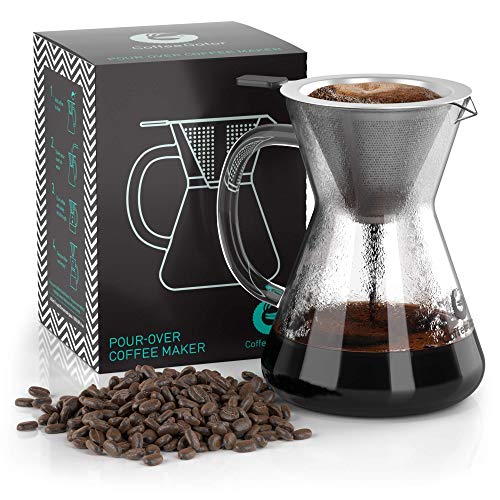
Coffee Gator
Hand-Brewed Coffee Without Paper Filters: Coffee Gator 14oz Pour Over Coffee Maker with Stainless Steel Mesh Filter
This 14oz glass pour over dripper brews coffee by hand through a laser-cut stainless steel mesh filter, so the oils that paper traps end up in your cup instead. Buy it if you want fuller-bodied manual brew for one or two mugs and never want to restock paper filters again.
Pros and Cons
Pros
- Stainless steel mesh filter passes coffee oils through for a heavier body than paper brewing.
- Glass carafe lets you watch the brew line and stop pouring at the exact volume you want.
- No consumables required, so the only ongoing cost is coffee.
- Compact glass-and-steel build stores easily and presents well enough to give as a gift.
Cons
- Metal mesh lets fine grounds and sediment through, so a coarser grind is required for a clean cup.
- Glass construction makes it vulnerable to chipping or breaking if knocked in a busy kitchen sink.
Noarixa Pour Over Coffee Dripper, Ceramic Pour Over Coffee Maker, White

Editors' Favorite
Color: White Size: Small Dimensions: 3 x 3 x 3 inches Weight: 1.00971715996 pounds Product Group: Kitchen Binding: Unknown Binding
Shop NowGROSCHE Milano Stovetop Moka Pot Espresso Maker - 6 Cup Italian Coffee Percolator for Gas & Electric Stoves
GROSCHE
Milano Stovetop Moka Pot Espresso Maker - 6 Cup Italian Coffee Percolator for Gas & Electric Stoves
This Italian-made moka pot brews rich stovetop espresso in minutes using gas or electric heat, with a safety valve and heat-resistant handle that solves the burnt-finger problem common in cheaper models. Buy it if you want barista-quality coffee at home without the cost or complexity of an electric espresso machine.
$44.99 at AmazonGreat Value
Other Special Features of the Product: Electric Stovetop Compatible, Gas Stovetop Compatible, Manual, Permanent Filter Coffee Maker Type: Percolator Specific Uses For Product: Coffee maker Operation Mode: Manual Wattage: 230 watts Human Interface Input: Touchscreen Coffee Input Type: ground Power Source: Manual Filter Type: Reusable Capacity: 9.3 ounces Item Dimensions D x W x H: 3.9"D x 3.9"W x 7.8"H Item Weight: 0.58 Pounds Number of Items: 1 Unit Count: 1.0 Count Brand Name: GROSCHE Included Components: Milk Frother Model Number: GR 439 Manufacturer: GROSCHE UPC: 627982004392 Part Number: GR 439 Best Sellers Rank: #4,013 in Home & Kitchen (See Top 100 in Home & Kitchen) #2 in Stovetop Espresso & Moka Pots ASIN: B0984GXSSP Customer Reviews: 4.4 4.4 out of 5 stars (25,253) 4.4 out of 5 stars Color: Blue Style: Modern Material: Aluminum Is the item dishwasher safe?: No Brand: GROSCHE Product Dimensions: 3.9"D x 3.9"W x 7.8"H Special Feature: Electric Stovetop Compatible, Gas Stovetop Compatible, Manual, Permanent Filter
Shop NowCoffee Gator Hand-Brewed Coffee Without Paper Filters: Coffee Gator 14oz Pour Over Coffee Maker with Stainless Steel Mesh Filter
Coffee Gator
Hand-Brewed Coffee Without Paper Filters: Coffee Gator 14oz Pour Over Coffee Maker with Stainless Steel Mesh Filter
This 14oz glass pour over dripper brews coffee by hand through a laser-cut stainless steel mesh filter, so the oils that paper traps end up in your cup instead. Buy it if you want fuller-bodied manual brew for one or two mugs and never want to restock paper filters again.
$25.99 at AmazonColor: Clear Size: 14 oz Dimensions: 5.5 x 5.5 x 6.8 inches Weight: 0.9 pounds Product Group: Kitchen Binding: Kitchen
Shop Now


Write Your Review
No reviews yet. Be the first to share your experience!