

A half size sheet pan does more work than anything else in most kitchens and arrives with less useful information printed on it. Two pans stamped 18 by 13 can differ by a pound in weight, by three tenths of a millimeter in thickness, and by enough surface temperature to take the same cookie dough from golden to scorched. Here is the spec sheet the box leaves out: where the name came from, what gauge means, why finish changes your bake times, and what the rolled edge is for.
The name comes from a bakery, not your kitchen
Sheet pan sizes are fractions of a pan hardly anyone owns. A full sheet measures 26 by 18 inches, which is 468 square inches sized to slide into a commercial bakery rack, and it fits no standard domestic oven. Halve it and you get the half sheet at 18 by 13, or 234 square inches. Halve that for a quarter sheet at 13 by 9, and once more for an eighth sheet at 9 by 6.5. The names describe a commercial kitchen, which is why a half sheet sounds modest and is in fact the largest pan most home ovens will take.
Will take, not always will fit. Cavities in a 30-inch range usually run 22 to 24 inches wide, so an 18-inch pan looks like it clears easily. Hardware eats that margin: rack supports stamped or bolted along the side walls, and the bake or convection vent at the back. A pan shoved all the way back can sit against that vent and starve the rear of the oven of moving air; one too long front to back rides on the door gasket and holds the door a hair open. Measure the cavity between the rack supports and from the closed gasket to the back wall, not the doorway.
Gauge is the number that decides whether it warps
Thickness is quoted in gauge, which runs backward: lower numbers mean thicker metal. An 18-gauge sheet is about 1.02 mm, 20-gauge about 0.81 mm, and 22-gauge about 0.71 mm. Those gaps look trivial in millimeters and are not, because stiffness climbs much faster than thickness. Weight is the easiest proxy on a shelf. An 18-gauge bare aluminum half sheet runs roughly 1.6 to 2 pounds and feels inert; a 22-gauge one comes in under a pound and flexes when you hold it by one short end.
Warping is differential thermal expansion. Metal grows as it heats, so slide a thin pan under a broiler or into a 450°F oven and the upper face, taking radiant heat directly, expands before the underside catches up. The sheet wants to curl, a thin panel has little stiffness to resist, and it releases the stress all at once, snapping into a new shape with an audible bang. Thick metal takes the same stress and holds its shape while the temperature evens out. The bang is permanent: the pan has yielded rather than flexed, it will never sit flat again, and oil and batter will run to the same low corner for the rest of its life.
Alloy and finish quietly change your bake
Bare aluminum conducts heat about four times better than stainless steel, and that conductivity is what browns food evenly. Heat arriving in one spot spreads sideways instead of pooling, so the pan averages out your oven’s hot zones rather than printing them onto dinner. Aluminized steel, a steel core clad in an aluminum-silicon alloy, is stiffer at the same thickness and holds flat better, in exchange for reacting a little more slowly.
Finish deserves the same attention and rarely gets it. Dark surfaces, whether nonstick coating or dark anodized aluminum, absorb more radiant energy than a bright pan reflects, so the cooking surface runs hotter than the air around it. That is why cookies timed on a bare sheet burn on a dark one at the same setting: the bottoms set and darken before the tops are ready. Drop the oven 25°F, or leave the dial alone and start checking a few minutes early; a dark sheet and a bare one are not interchangeable mid-recipe.
The rolled rim is structure, and depth is a decision
Run a finger along the edge of a good pan and you feel a bead rather than a fold. Inside it is a steel or aluminum wire, encased by rolling the sheet around it, and it works as the pan’s frame. Twist is what starts a warp, almost always at a corner, and an encapsulated wire resists twist in a way flat metal cannot. Pans finished with a plain hemmed edge, the sheet folded back on itself with nothing inside, flex at the corners first, and you can feel it by gripping two opposite corners and twisting.
That rim also sets working depth, about 1 inch on a half sheet, and depth separates roasting from accidental steaming. Vegetables are mostly water and shed it as steam in a hot oven; over a 1-inch wall the steam clears and keeps moving, surfaces dry, sugars concentrate, and browning can start. Give the same vegetables a roasting pan with 2 to 3 inch sides and the steam has nowhere to go, condenses back onto the food, and pins every surface near boiling instead of letting it climb. Broccoli comes out olive drab and potatoes go soft without a crust, at the same oven setting. One inch still catches the fat rendering off chicken thighs while letting hot air reach the sides of the food.
Crowding, and the arithmetic of 234 square inches
The 18 by 13 measurement is taken across the rim, so 234 square inches is the footprint, not the floor. Inside the sloped walls the flat area is nearer 17 by 12, roughly 204 square inches, and leaving a half inch clear of the walls for air brings the usable space to about 16 by 11, or 176 square inches. Two pounds of potatoes in 1-inch cubes fills that in a single layer with nothing to spare. Once pieces touch or stack they trap each other’s steam, and a shallow pan starts behaving like a deep one.
The test is whether you can see pan between the pieces. When a recipe outgrows that, two half sheets on two racks beat one crowded pan. Rack positions are not equal, though: the lower one sits closer to the bottom element and browns undersides harder. Swapping the pans between racks and turning each front to back at the halfway mark erases most of that difference.
Patina, parchment, and what shortens a pan’s life
Bare aluminum does not stay bright, and it does not need to. It builds a mottled gray-brown patina of oxide and polymerized oil that is harmless and releases food slightly better than new metal. Dishwasher detergent is strongly alkaline and accelerates that dulling, which is why a few cycles leave aluminum chalky; hot water and dish soap by hand keep the pan looking like a working tool. Parchment does more for a sheet pan than any cleaner, since sugar that never touches metal never has to be scraped off it. On a nonstick sheet the coating fails first, so keep metal spatulas, knives, and scouring pads off it and treat it as a consumable.
If you want one specification to shop by, it is an 18-gauge bare aluminum half sheet with an encapsulated rolled rim, and it is worth owning two, since most of what fits on one pan cooks better spread across two. Check the gauge, or the weight standing in for it, the rim construction, and whether 18 by 13 inches truly fits your oven.
Questions readers ask
Is a half size sheet pan the same thing as a jelly roll pan?
No, and swapping one for the other changes the result. A jelly roll pan is usually 15 by 10 inches with a rim near 1 inch, which gives 150 square inches against the half sheet’s 234, and it is often pressed from lighter steel. Batter spread across the larger pan sits thinner, so it sets faster at the same temperature. A half sheet’s worth of vegetables, meanwhile, crowds a jelly roll pan and steams. Treat them as two sizes, not two names for one pan.
Will an 18 by 13 pan fit a standard oven?
In a full-size 30-inch range, almost always, since the cavity typically runs 22 to 24 inches wide. Problems show up in smaller appliances: 24-inch apartment ranges, wall ovens with heavy side rack supports, and countertop ovens, which mostly cap out at a quarter sheet’s 13 by 9. Cut cardboard to 18 by 13, set it on a rack, and close the door before you buy. If the door will not seal or the cardboard reaches the rear vent, size down.
Can a warped sheet pan be flattened again?
Not in any lasting way. The bend is plastic deformation, meaning the metal has already yielded, so hammering it back stresses the same spot rather than restoring it, and thin pans tend to move again on the next hot bake. Keep the pan for broiler duty or storage, where a puddle at one end does not matter. Prevention is the real answer: skip cold water on a hot pan, keep thin sheets away from the broiler element, and buy 18-gauge, which mostly refuses to move.
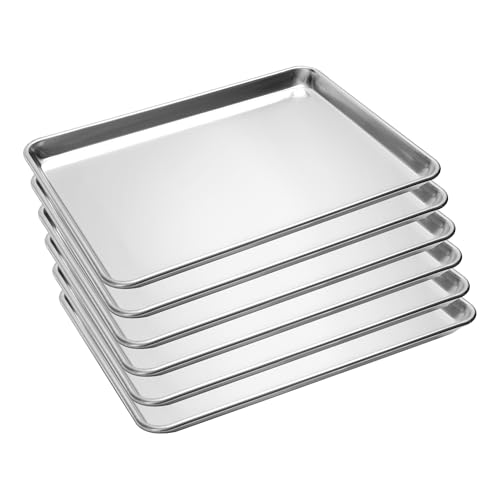
STEELUS
Half Sheet Pans for Batch Baking and Roasting: STEELUS 6 Pack 18x13 Aluminum Baking Sheets
These six natural aluminum half sheet pans measure 18 by 13 inches with rolled rims and a polished mirror surface that releases cookies, roasted vegetables, and sheet dinners without heavy greasing. Buy this set if you bake or meal prep in volume and want enough pans in rotation to fill an oven twice over without washing between batches.
Pros and Cons
Pros
- Standard 18 by 13 inch half sheet size fits full-size home and commercial ovens and matches common cooling racks and pan liners.
- Rust-proof aluminum alloy with anti-distortion rolled edges holds shape through repeated high-heat cycles.
- Six-pan quantity supports holiday baking, catering, and weekly meal prep without staggering batches.
- One inch rim depth contains rendered fat and marinades during roasting.
Cons
- Hand wash only, since dishwasher detergent discolors the aluminum surface.
- Bare aluminum darkens and stains over time with acidic foods like tomatoes and citrus, which is cosmetic but permanent.

FSUON
Half Sheet Pans for Cookies, Roasting & Meal Prep: FSUON 6-Pack NSF Aluminum Baking Sheets, 18 x 13 in
This six-pack of NSF-certified 18 by 13 inch aluminum half sheet pans handles cookies, roasted vegetables, and sheet-pan dinners with rolled rims that resist warping up to 500°F. Buy it if you bake or meal-prep in batches and want enough pans in rotation to avoid waiting on a single tray to cool between rounds.
Pros and Cons
Pros
- NSF certification signals commercial-kitchen durability standards rather than light home-use construction.
- Aluminum body heats fast and evenly for consistent baking results across the full pan surface.
- Rolled edges add rigidity and give you a secure grip when pulling hot pans from the oven.
- Six matching pans stack neatly and cover baking, roasting, prepping, and storage in one purchase.
Cons
- Hand-wash only, since dishwasher detergent discolors bare aluminum.
- Uncoated aluminum is not truly non-stick, so delicate items still need parchment or a light grease.

USAPan
Half Sheet Baking Pans for Cookies and Roasting - USA Pan Aluminized Steel Set of 2
This USA Pan set delivers two commercial-grade half sheet pans with fluted surfaces that prevent warping and promote even browning on cookies, vegetables, and sheet cakes. Home bakers who want restaurant-quality results and easy cleanup should choose these over thin grocery store pans.
Pros and Cons
Pros
- Fluted design prevents sticking and creates better air circulation than flat pans, making release effortless even without greasing.
- Reinforced rims stay flat and rigid at high roasting temperatures where budget pans buckle and warp.
- Made in the USA with heavy duty aluminized steel that outlasts thin imported sheet pans by years.
Cons
- The textured surface requires hand washing in crevices, adding a few extra seconds compared to completely smooth pans.
- At just over 17 inches wide, these half sheets fit standard home ovens but may be tight in compact or older models.
STEELUS Half Sheet Pans for Batch Baking and Roasting: STEELUS 6 Pack 18x13 Aluminum Baking Sheets
STEELUS
Half Sheet Pans for Batch Baking and Roasting: STEELUS 6 Pack 18x13 Aluminum Baking Sheets
These six natural aluminum half sheet pans measure 18 by 13 inches with rolled rims and a polished mirror surface that releases cookies, roasted vegetables, and sheet dinners without heavy greasing. Buy this set if you bake or meal prep in volume and want enough pans in rotation to fill an oven twice over without washing between batches.
$59.99 at AmazonEditors' Favorite
Color: Silver Size: Standard 18"×13" (Half Size 6 Pack) Dimensions: 18 x 13 x 1 inches Weight: 10.59982555696 Pounds Product Group: Kitchen Binding: Kitchen
Shop NowFSUON Half Sheet Pans for Cookies, Roasting & Meal Prep: FSUON 6-Pack NSF Aluminum Baking Sheets, 18 x 13 in
FSUON
Half Sheet Pans for Cookies, Roasting & Meal Prep: FSUON 6-Pack NSF Aluminum Baking Sheets, 18 x 13 in
This six-pack of NSF-certified 18 by 13 inch aluminum half sheet pans handles cookies, roasted vegetables, and sheet-pan dinners with rolled rims that resist warping up to 500°F. Buy it if you bake or meal-prep in batches and want enough pans in rotation to avoid waiting on a single tray to cool between rounds.
$50.99 at AmazonGreat Value
Color: Silver Size: 6-pack Solid Half Size (18"×13") Dimensions: 18 x 13 x 1 inches Weight: 9.700339528 pounds Product Group: Kitchen Binding: Kitchen
Shop NowUSAPan Half Sheet Baking Pans for Cookies and Roasting - USA Pan Aluminized Steel Set of 2
USAPan
Half Sheet Baking Pans for Cookies and Roasting - USA Pan Aluminized Steel Set of 2
This USA Pan set delivers two commercial-grade half sheet pans with fluted surfaces that prevent warping and promote even browning on cookies, vegetables, and sheet cakes. Home bakers who want restaurant-quality results and easy cleanup should choose these over thin grocery store pans.
$47.74 at AmazonBrand Name: USA Pan Global Trade Identification Number: 00859166007084 Manufacturer Warranty Description: limited lifetime warranty UPC: 859166007084 Model Number: 1300ST Manufacturer Part Number: 1300ST-6 Included Components: Half Sheet Pan - Set of 2 Unit Count: 2.0 Count Manufacturer: USA Pan Item Type Name: Baking Sheet Pan Best Sellers Rank: #5,315 in Kitchen & Dining (See Top 100 in Kitchen & Dining) #27 in Baking & Cookie Sheets ASIN: B076736W8H Customer Reviews: 4.7 4.7 out of 5 stars (7,766) 4.7 out of 5 stars Material Type: Aluminized Steel Is the item dishwasher safe?: No Material Type Free: BPA Free Size: Half Sheet Item Dimensions L x W x H: 17.75"L x 12.75"W x 1"H Item Weight: 1.2 Pounds Color: Aluminized Steel Material: Aluminized Steel Brand: USA Pan Product Dimensions: 17.75"L x 12.75"W x 1"H Is Dishwasher Safe: No
Shop Now




Write Your Review
No reviews yet. Be the first to share your experience!