

A griddle sandwich press is simply a flat griddle used with a weight on top, and it turns out a crisp, evenly pressed sandwich without any special gadget. Heat the flat surface to medium, butter the bread, set the sandwich down, and press it flat with a heavy pan or a spatula for the first minute or two.
This guide walks through how to press a sandwich on a griddle, which temperature range works, what to use as a press, and which electric griddles from our research list have the surface area to handle several sandwiches at once. If you’re comparing broader options, our best electric griddle roundup is a good companion read.
How a griddle works as a sandwich press
A dedicated panini maker clamps two hot plates around the bread. A griddle gives you only the bottom plate, so you replace the top plate with weight and a flip. That’s the whole trade. You get one big flat surface, which means you can press three or four sandwiches side by side instead of one at a time.
The flat surface also gives you a bigger margin for error. Bread browns evenly because the whole slice sits in contact with the metal, and there are no ridges to leave pale stripes. Steam from melting cheese escapes out the sides instead of getting trapped between two plates, so the crust stays crisp rather than going soft.
There’s a second advantage that people overlook. A panini maker has a fixed gap, so a thick sandwich either bulges out or gets squashed. On a griddle, you decide how hard to press. A thin ham and cheese can be flattened to a diner-style slab, while a loaded turkey and avocado sandwich gets a gentler hand.
The VIKEER electric griddle is a 14 inch flat top with adjustable temperature control from 90 to 575 degrees Fahrenheit, according to its listing. That range matters for sandwiches because the sweet spot sits well below the maximum. A wide dial gives you room to dial in medium heat, then drop it to a warming setting while you finish the batch.

VIKEER
14-Inch Commercial Flat Top Electric Griddle for Pancakes and Steaks: VIKEER Stainless Steel with 90-575°F Control
This VIKEER griddle delivers a 14 by 17.5 inch flat cooking surface on an 8mm thickened iron plate that spreads heat evenly enough to run pancakes, eggs, and smash burgers side by side. It suits home cooks feeding a crowd and small snack bars or steak shops that need restaurant-style output without a gas line.
Pros and Cons
Pros
- Large flat top handles multiple items simultaneously, cutting total cook time for group meals.
- Wide 90 to 575°F range makes one appliance work for delicate eggs and hard sears alike.
- Splash guards plus a removable drip tray contain the mess that usually comes with griddle cooking.
- Thick iron plate resists the warping and hot-spotting common to thin griddle surfaces.
Cons
- The iron plate needs proper seasoning and consistent, even oiling to stay non-stick, and the manufacturer warns that rushing the process with high heat will not work.
- It requires ongoing maintenance: residue must be cleaned after every use, and a coat of edible oil is needed before long storage to prevent rust.
VIKEER 14-Inch Commercial Flat Top Electric Griddle for Pancakes and Steaks: VIKEER Stainless Steel with 90-575°F Control
VIKEER
14-Inch Commercial Flat Top Electric Griddle for Pancakes and Steaks: VIKEER Stainless Steel with 90-575°F Control
This VIKEER griddle delivers a 14 by 17.5 inch flat cooking surface on an 8mm thickened iron plate that spreads heat evenly enough to run pancakes, eggs, and smash burgers side by side. It suits home cooks feeding a crowd and small snack bars or steak shops that need restaurant-style output without a gas line.
$159.99 at AmazonEditors' Favorite
Color: stainless steel Size: 14 inch Dimensions: 17.7 x 14.1 x 8.7 Inches Weight: 36 Pounds Product Group: Kitchen Binding: Kitchen
Shop NowPick the right temperature
Most pressed sandwiches brown best on medium heat, roughly 325 to 350 degrees Fahrenheit on an electric griddle. Go hotter and the butter scorches before the cheese melts. Go cooler and the bread dries out and turns pale instead of crisp. Thick bread and dense fillings lean toward the lower end of that range, since the heat needs time to reach the middle.
Preheat fully
Give an electric griddle five to ten minutes to come up to temperature. Most models have an indicator light, but the first sandwich is often the one that suffers when people skip the wait. A properly preheated surface sizzles faintly when the bread touches it. If the bread lands in silence, the surface isn’t ready.
Adjust between batches
Cheese and butter drip onto the surface as you cook. If the second batch browns faster than the first, drop the dial a notch and wipe the surface with a folded paper towel held in tongs. Residual grease burns quickly and leaves dark, bitter patches on the next round of bread.
Watch the color, not the clock
Timing is a guide, not a rule. Lift a corner with a spatula after about two minutes. You’re looking for a deep golden brown, not tan and not dark mahogany. Every griddle runs a little differently, so trust your eyes after the first sandwich.
What to use as a press
You’ve got plenty of options already in your kitchen. A cast iron skillet is the classic choice because it’s heavy and flat. A second, smaller pan filled with a can of beans works too. A burger press or a large metal spatula handles lighter sandwiches, and a foil-wrapped brick is the old diner trick.
Press firmly for the first 30 to 60 seconds, then ease off. Squeezing the whole time forces filling out the sides. Thin fillings like ham and cheese flatten nicely, while thick tomato slices need a gentler touch.
Wrap the weight in foil
A sheet of foil or parchment between the pan and the bread keeps the top of the sandwich from sticking to the weight and makes cleanup easy. Skip it, and a smear of melted cheese on the bottom of your skillet becomes a scrubbing job.
Mind the handle
If you use a skillet as a press, grab it with a dry towel or oven mitt. Heat travels up from the sandwich quickly, and a metal handle gets uncomfortably warm within a minute or so.
Step-by-step: pressing a sandwich on a griddle
Start with bread that’s sturdy enough to hold up, like sourdough, ciabatta, or thick-cut white. Spread softened butter or mayonnaise on the outside faces. Mayo browns more evenly and doesn’t burn as quickly, which is why many cooks swear by it.
Layer cheese on both slices of bread, with fillings in the middle, so the cheese acts as glue. Shredded or thinly sliced cheese melts faster than thick slabs. Set the sandwich on the preheated surface, add the press, and cook for two to three minutes. Flip, press again briefly, and cook another two minutes until the crust is deep golden.
Let it rest for a minute before slicing. Molten cheese needs a moment to set up. Cut too early and half the filling ends up on the cutting board.
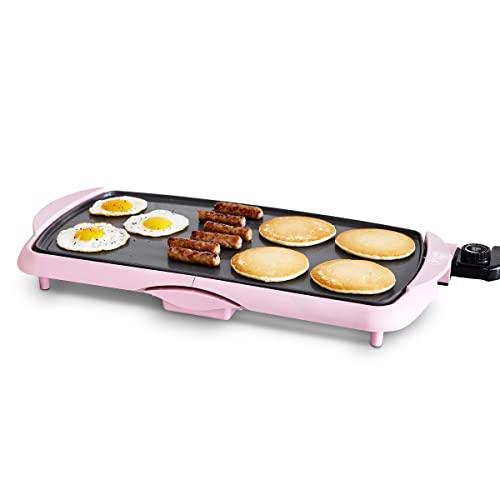
For a bigger family batch, a wider surface really helps. The GreenLife 20 inch extra large electric griddle in pink is listed with a 20 inch size, which is enough room to press several sandwiches at one time and keep early ones warm while others finish. Note that it’s a larger footprint, so check your counter space first.
GreenLife
20-Inch Electric Griddle for Pancakes, Eggs and Steaks: GreenLife Extra Large Ceramic Nonstick Griddle in Pink
This 1500-watt electric griddle gives you a 10.5" x 20" ceramic nonstick surface that cooks pancakes, omelets, and steaks in one batch instead of three. Buy it if you cook breakfast for a full table and want a PFAS-free surface that wipes clean without scrubbing.
Pros and Cons
Pros
- Extra-large cooking area handles multiple servings in a single pass.
- Toxin-free ceramic coating releases food cleanly and wipes down with minimal effort.
- Stay-cool handles let you reposition the griddle safely while it is hot.
- Adjustable temperature probe removes for washing and stores separately.
Cons
- Ceramic nonstick coatings typically lose their release properties faster than traditional PTFE surfaces, especially under high heat or metal utensils.
- At 20 inches wide, it takes up significant counter and cabinet space, which is tight in a small kitchen.
GreenLife 20-Inch Electric Griddle for Pancakes, Eggs and Steaks: GreenLife Extra Large Ceramic Nonstick Griddle in Pink
GreenLife
20-Inch Electric Griddle for Pancakes, Eggs and Steaks: GreenLife Extra Large Ceramic Nonstick Griddle in Pink
This 1500-watt electric griddle gives you a 10.5" x 20" ceramic nonstick surface that cooks pancakes, omelets, and steaks in one batch instead of three. Buy it if you cook breakfast for a full table and want a PFAS-free surface that wipes clean without scrubbing.
$49.99 at AmazonEditors' Favorite
Color: Soft Pink Size: Extra Large 20" Electric Griddle Dimensions: 11.42 x 23.23 x 2.76 Inches Weight: 4.23 pounds Product Group: Kitchen Binding: Kitchen
Shop NowFillings that press well
Not every sandwich behaves the same under a weight. Cheese-forward combinations are the safest bet. Cheddar with sliced apple, ham and Swiss, or mozzarella with basil and a thin smear of pesto all hold together and brown nicely.
Meats
Thin deli slices heat through in the time it takes the bread to brown. Thick, raw, or undercooked fillings don’t. Cook any raw protein first, then assemble and press just to melt the cheese and crisp the bread.
Vegetables
Roasted peppers, sauteed onions, and wilted spinach add flavor without water. Raw tomato and cucumber are better added after pressing, tucked in once the sandwich comes off the heat.
Sweet options
Peanut butter and banana, or Nutella with sliced strawberries, press beautifully. Lower the heat slightly, because sugar caramelizes and then burns fast.
Common mistakes
Too much heat is the big one. Burnt outside, cold inside. Another is overstuffing, which pushes fillings out and makes the sandwich impossible to flip cleanly.
Wet fillings
Tomatoes, pickles, and fresh mozzarella release water. Pat them dry first, or add them after the sandwich comes off the heat.
Skipping the fat
Dry bread on a dry surface just toasts. Butter, mayo, or a light brush of oil is what produces that crisp, glossy crust.
Crowding the surface
Leave an inch or so between sandwiches so you can slide a spatula underneath and so steam has somewhere to go.
Cleanup and care
Let the griddle cool slightly, then wipe off crumbs and grease while it’s still warm. Nonstick surfaces should be cleaned with a soft sponge, not steel wool. Check the manufacturer’s instructions before submerging anything, since many electric griddles have a removable temperature probe that must stay dry.
Removable plates make this much easier. The NEWBULIG 17 inch electric griddle and indoor grill is listed with a dishwasher safe plate and a nonstick surface, which suits anyone who presses sandwiches often and wants a quick cleanup. It’s also marketed for steak, burgers, salmon, and pancakes, so it earns its counter space beyond sandwiches.

NEWBULIG
Indoor Grilling and Pancake Griddling in One: NEWBULIG 17-Inch Electric Griddle & Indoor Grill with Interchangeable Nonstick Plates
This 17-inch countertop unit swaps between a flat nonstick griddle plate and a ridged grill plate, so pancakes and sausages in the morning and seared steak or salmon at night run on the same appliance at up to 500F. Buy it if you cook for a family and want char marks and breakfast volume without a second pan, a grill, or a smoke-filled kitchen.
Pros and Cons
Pros
- Two plate styles mean one appliance covers breakfast griddling and dinner grilling.
- High 500F ceiling produces real searing and grill marks indoors.
- Even heat distribution removes the cold spots that force you to rotate food.
- Removable plates go in the dishwasher, so daily cleanup is quick.
Cons
- A 17-inch body plus a spare plate takes real counter and cabinet space, so it is not a small-kitchen grab-and-go tool.
- Low-smoke is not no-smoke; fatty cuts at high heat still need ventilation or an open window.
NEWBULIG Indoor Grilling and Pancake Griddling in One: NEWBULIG 17-Inch Electric Griddle & Indoor Grill with Interchangeable Nonstick Plates
NEWBULIG
Indoor Grilling and Pancake Griddling in One: NEWBULIG 17-Inch Electric Griddle & Indoor Grill with Interchangeable Nonstick Plates
This 17-inch countertop unit swaps between a flat nonstick griddle plate and a ridged grill plate, so pancakes and sausages in the morning and seared steak or salmon at night run on the same appliance at up to 500F. Buy it if you cook for a family and want char marks and breakfast volume without a second pan, a grill, or a smoke-filled kitchen.
$69.93 at AmazonEditors' Favorite
Color: Silver Size: 17.01 × 14.65 × 10.83 inch Dimensions: 14.65 x 17.01 x 10.83 Inches Product Group: Kitchen Binding: Kitchen
Shop NowWhen to upgrade your setup
If you’re already using a stovetop pan, it may be time for an electric griddle when you want steadier heat or need to cook for more people. Gas and induction owners can also look at stovetop options, such as our guides to the best griddle for stove top, the best griddle for gas stove, and the best griddle for induction.
If burgers are also on your list, see the best griddle for burgers and the best electric griddle for smash burgers. Those flat tops handle a pressed sandwich just as well. Our best griddle for electric stove top page covers the same ground for coil and glass-top ranges.
Whatever you choose, the technique stays the same. Medium heat, fat on the outside, cheese on the inside, and a firm press early on. That’s it.
FAQ
Can you make a pressed sandwich on a griddle?
Yes. Heat the griddle to medium, place a buttered sandwich on it, and press down with a heavy pan or spatula. Cook two to three minutes per side until golden and the cheese melts.
What temperature should a griddle be for grilled sandwiches?
Aim for about 325 to 350 degrees Fahrenheit. That’s hot enough to crisp the bread but gentle enough for the cheese to melt before the crust burns.
What can I use if I don’t have a sandwich press?
A cast iron skillet, a smaller pan weighted with a can, or a large spatula all work. Wrap the base in foil or parchment so the bread doesn’t stick.
Is butter or mayo better for the outside of the bread?
Both work. Butter gives richer flavor, while mayo browns more evenly and resists burning a bit longer. Pick based on taste.
Can I press several sandwiches at once?
That’s one of the biggest advantages of a griddle. A larger surface, such as a 17 or 20 inch model, fits multiple sandwiches, so just leave a little space between each.


Write Your Review
No reviews yet. Be the first to share your experience!