

A glass lasagna pan is a good pick if you want to see the bottom crust brown, bake at moderate heat, and carry the dish straight from oven to table. It heats evenly, doesn’t react with tomato sauce, and goes into the fridge for leftovers without a transfer.
This guide explains what to look for in a glass lasagna pan, how to bake in one without cracking it, and which alternatives (ceramic, cast iron and stainless steel) make sense when glass isn’t the right fit. It’s a research-based guide, not a hands-on review.
Why a glass lasagna pan works well
Glass is a slow, steady heater. It takes a little longer than metal to warm up, then holds that heat well, so the edges of a lasagna don’t scorch before the center is hot. Because it’s clear, you can look through the side and check whether the bottom noodles are browned or still pale. That’s hard to judge in an opaque pan.
Glass is also non-reactive. Acidic tomato sauce won’t pick up a metallic taste or stain the surface. A standard family lasagna usually fits a rectangular dish around 13 x 9 inches, with sides at least 2 inches deep. Anything shallower and the sauce bubbles over.
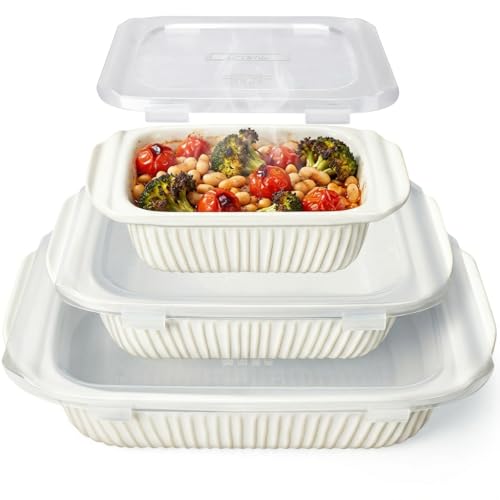
If you want a ceramic option with the same rectangular shape and extras, the Artena set is a useful reference point. It’s a ceramic set of three baking dishes with handles and lids, in 5.1, 2.3 and 1.1 quart sizes. Ceramic isn’t glass, so treat it as an alternative.
Artena
Family Lasagna and Oven Baking Set: Artena Ceramic Casserole Dishes with Handles and Lids
This three-piece Artena ceramic bakeware set handles family lasagna, roasting, and smaller baked dishes, with wide handles and included lids for convenient serving and storage. It suits home cooks who need multiple oven-safe sizes that nest for cabinet storage and move easily from oven to table.
Pros and Cons
Pros
- The 5.1-quart, 2.3-quart, and 1.1-quart sizes cover family casseroles, side dishes, and smaller portions.
- Food-grade certified ceramic offers a non-porous surface for cooking, serving, and easier cleaning.
- Wide handles make transferring hot bakeware more manageable.
- Lids support stacking and spill-resistant transport for leftovers or potluck dishes.
Cons
- The lids are not airtight, so they are intended for brief covering and transport rather than sealed long-term storage.
- Ceramic bakeware can require more careful handling than lighter metal pans.
Artena Family Lasagna and Oven Baking Set: Artena Ceramic Casserole Dishes with Handles and Lids
Artena
Family Lasagna and Oven Baking Set: Artena Ceramic Casserole Dishes with Handles and Lids
This three-piece Artena ceramic bakeware set handles family lasagna, roasting, and smaller baked dishes, with wide handles and included lids for convenient serving and storage. It suits home cooks who need multiple oven-safe sizes that nest for cabinet storage and move easily from oven to table.
$49.45 at AmazonEditors' Favorite
Color: White Size: 5.1Qt/2.3Qt/1.1Qt (With Lids) Dimensions: 15.95 x 9.95 x 3.45 inches Weight: 13.54961062252 pounds Product Group: Kitchen Binding: Kitchen
Shop NowWhat size and depth to choose
Size drives the result more than material. A 13 x 9 inch dish is the usual choice for a full recipe with three or four noodle layers. A smaller 8 x 8 inch dish works for a half batch, but you’ll need to trim noodles to fit.
Depth matters for layers
Look for a pan at least 2 inches deep. Deep sides hold the sauce and cheese as they bubble. If you plan to stack extra layers, go deeper. Our best pan for lasagna guide covers sizes in more detail.
Handles and lids
A full lasagna is heavy, often well over 6 pounds. Wide handles make it easier to lift with oven mitts. A lid is handy for covering during the first part of baking and for storing leftovers.
How to bake in a glass lasagna pan safely
Glass handles heat well but doesn’t like sudden temperature swings. Follow a few simple habits and you’ll avoid most problems.
Skip the thermal shock
Don’t take a cold dish straight from the fridge to a hot oven. Let it sit on the counter for 20 to 30 minutes first, or start it in a cold oven. Never set a hot dish on a wet counter or cold stone.
Keep some liquid in the pan
Make sure the bottom has a thin layer of sauce before you add noodles. That helps heat spread and keeps noodles from sticking. Cover with foil for the first 30 to 40 minutes, then uncover to brown the cheese. Check the manufacturer’s directions for the maximum oven temperature, because it varies by brand.
Don’t use glass under a broiler or on a stovetop unless the label says it’s allowed. That’s a common mistake and a common cause of cracks.
Glass vs. cast iron, ceramic and stainless steel
Glass isn’t the only way to bake lasagna. Each material changes browning, weight and cleanup. If glass isn’t what you’re after, these are alternatives, not glass pans.
Cast iron browns hard and holds heat for a long time. The Firequince is a cast iron lasagna pan measuring 13 x 9.2 x 2.3 inches, listed as oven and grill safe and suited to casserole, focaccia and Sicilian bread. It’s heavier than glass, so it’s less friendly if you have weak wrists. Cast iron needs seasoning, and long contact with acidic sauce can dull that seasoning over time.

Firequince
Deep Cast Iron Lasagna & Casserole Pan for Even Edge-to-Edge Baking: Firequince Pre-Seasoned 13 x 9.2 x 2.3 Inch Oven & Grill Safe Dish
This pre-seasoned cast iron baking dish handles lasagna, casseroles, focaccia and Sicilian bread in a standard 13 by 9 footprint, with cast iron's edge-to-edge heat retention browning corner servings as evenly as the center. Buy it if you bake layered dishes or crusty breads often and want a pan that also moves to the stovetop, grill or campfire instead of owning three separate dishes.
Pros and Cons
Pros
- Cast iron construction delivers consistent browning across the whole dish, not just the center.
- Works across oven, stovetop, grill and open campfire, which suits both weeknight baking and outdoor cooking.
- Arrives pre-seasoned, so it is usable straight away and the surface improves with regular cooking.
- The 2.3 inch depth gives room for saucy casseroles and thick focaccia without spillover on standard bakes.
Cons
- At 2.3 inches deep it comfortably fits three to four noodle layers, so very tall lasagna builds will overflow.
- The listing's feature text describes a lidded Dutch oven, so confirm with the seller whether a lid is actually included before ordering.
Firequince Deep Cast Iron Lasagna & Casserole Pan for Even Edge-to-Edge Baking: Firequince Pre-Seasoned 13 x 9.2 x 2.3 Inch Oven & Grill Safe Dish
Firequince
Deep Cast Iron Lasagna & Casserole Pan for Even Edge-to-Edge Baking: Firequince Pre-Seasoned 13 x 9.2 x 2.3 Inch Oven & Grill Safe Dish
This pre-seasoned cast iron baking dish handles lasagna, casseroles, focaccia and Sicilian bread in a standard 13 by 9 footprint, with cast iron's edge-to-edge heat retention browning corner servings as evenly as the center. Buy it if you bake layered dishes or crusty breads often and want a pan that also moves to the stovetop, grill or campfire instead of owning three separate dishes.
$38.99 at AmazonEditors' Favorite
Color: Black Size: 13 x 9.2 x 2.3 inch Dimensions: 15.3 x 9.2 x 2.4 Inches Product Group: Kitchen Binding: Kitchen
Shop NowStainless steel is the lightest of the group and tolerates hot ovens and broilers. The Cuisinart Chef’s Classic 14-inch lasagna pan comes with a stainless roasting rack, so it can also handle a small roast. Steel doesn’t let you watch the bottom crust, and it can brown the edges faster than glass, so you’ll want to watch the timer.
Cuisinart 7117-14RR 14-Inch Chef's-Classic Cookware-Collection, Lasagna Pan w/Stainless Roasting Rack, Stainless Steel

Cuisinart
7117-14RR 14-Inch Chef's-Classic Cookware-Collection, Lasagna Pan w/Stainless Roasting Rack, Stainless Steel
$59.95 at AmazonEditors' Favorite
Color: Stainless Steel Size: 14-Inch Dimensions: 10.5 x 3 x 13 inches Weight: 5 Pounds Product Group: Kitchen Binding: Kitchen
Shop NowFor other baking shapes, see our guides to the best loaf pan, best cake pan and best sheet pan.
Common mistakes with lasagna pans
The first is choosing a pan that’s too shallow. Sauce overflows and burns on the oven floor. The second is overfilling: leave about half an inch of space below the rim. The third is cutting too soon. Let the lasagna rest for 15 to 20 minutes after baking so the layers set and slice cleanly.
Another one is scrubbing with abrasive pads. Soak baked-on cheese in warm water and dish soap instead. Glass and ceramic clean up easily this way. Skip harsh scouring, which can scratch the surface over time.
When to replace your lasagna pan
Replace a glass or ceramic dish if it has chips, deep scratches or hairline cracks. Those weak spots can fail under heat. Replace cast iron only if it’s cracked or badly pitted with rust that won’t clean off.
If you bake bread, casseroles and desserts as well, a versatile dish saves cabinet space. Our best pan bread and best pie pan guides show what else is worth owning.
How to build a lasagna that bakes evenly
The pan only does half the job. Layering matters just as much. Start with a thin coat of sauce, then noodles, then ricotta or bechamel, then meat or vegetables, then sauce and cheese. Repeat until you reach about an inch below the rim. End with sauce and a generous layer of mozzarella so the top doesn’t dry out.
Oven rack and temperature
Place the rack in the middle of the oven so heat reaches the top and bottom evenly. Many recipes bake at 375 degrees F, but follow the guidance printed on your dish. A clear pan lets you check progress without opening the oven door often, which keeps the temperature steady.
Resting and slicing
Rest the dish on a trivet or folded towel, not a cold surface. Give it 15 to 20 minutes. Cut with a sharp knife or a thin spatula and lift the first piece out carefully. It’s always the messiest one. Don’t worry about it.
Cleaning and storing your pan
Baked-on cheese is the usual enemy. Fill the dish with hot water and a squirt of dish soap and let it sit for 30 minutes. Most residue wipes away with a soft sponge. Skip steel wool on glass and ceramic, since it can leave scratches that trap food later.
For leftovers, cover the dish with its lid or tight foil and refrigerate within two hours of baking. Reheat single portions in the microwave, or warm the whole dish in a moderate oven, covered, until hot in the center. A lidded set keeps things simple here, because the same dish goes from oven to fridge to table.
Store pans where they won’t get knocked around. Stacking heavy cast iron on top of glass or ceramic is a quick way to chip an edge. Put a dish towel between them if cabinet space is tight.
Which material fits your kitchen
If you bake lasagna a few times a year and want to see the layers, glass is a safe, familiar choice. If you cook for a crowd and want one dish that also does bread and casseroles, a ceramic set with lids covers more ground. If you love crisp, dark edges and don’t mind the weight, cast iron is worth a look. And if you roast meat as well as bake pasta, a stainless pan with a rack earns its place.
Whatever you pick, check the stated dimensions against your oven and your usual recipe before you buy. A pan that’s a little too big for your oven shelf is a pain. One that’s too small ruins dinner.
FAQ
Is a glass lasagna pan better than metal?
It depends on what you want. Glass heats gently and lets you see the bottom crust. Metal heats faster and browns more. For a classic, evenly baked lasagna, many home cooks like glass.
What size glass lasagna pan do I need?
A 13 x 9 inch dish at least 2 inches deep suits most family recipes. Use a smaller dish for half batches.
Can I put a glass lasagna pan in the fridge and oven?
Yes, but avoid sudden swings. Let a cold dish warm on the counter before baking, and cool a hot dish before refrigerating.
Do I need to grease a glass lasagna pan?
A light coat of oil or a thin layer of sauce on the bottom helps prevent sticking. Most recipes call for one of the two.
Can I use a ceramic or cast iron pan instead of glass?
Yes. Both work for lasagna. Ceramic is close to glass in feel, while cast iron browns harder and weighs more. Adjust baking time and watch the edges.





Write Your Review
No reviews yet. Be the first to share your experience!