

Almost nobody regrets buying a giant lasagna pan because it turned out too big. The regret is more specific, and it arrives the first time the thing comes out of the oven for a crowd. The corners are dark and blistered, the middle is merely warm, the whole assembly weighs more than anyone guessed, and there is a scorched puddle on the oven floor that will announce itself at every preheat for the next month.
None of that is bad luck. Each disappointment follows predictably from making a casserole dish deeper and wider, and each one points at a spec worth checking before buying or a habit worth changing at the stove. Start from the failures and both the shopping list and the baking schedule write themselves.
The cool middle is geometry, not a defective dish
The defining failure of an extra-large lasagna is a centre still lukewarm while the outer inch has gone brown and crisp. It is tempting to blame the pan, and occasionally that is fair, but the real cause is distance. Heat arrives at the outside surfaces and then has to conduct inward through pasta, ricotta, sauce and cheese, which are wet, dense and slow. A casserole 3 inches deep has half again as far to travel to its core as one 2 inches deep, through the same sluggish material the whole way.
So a deep dish cannot be baked like a shallow one. A 2-inch pan does fine at 400°F for 40 minutes. A 3-inch pan loaded to the top does badly there, because the surface reaches browning temperature long before the middle is anywhere near serving heat. Drop to 350°F and give it 60 to 75 minutes. The lower setting slows the crust enough for the interior to catch up, and the extra time is not waste; it is what the centre needs.
Then the rest, which gets skipped more often than anything else. A casserole pulled from a 350°F oven keeps cooking, and the core climbs for a while after the door closes. Twenty to thirty minutes on the counter lets carryover finish the middle and lets the layers firm up. Cut at five minutes and the slice slumps off the spatula; cut at twenty-five and it holds an edge.
The pan you cannot get out of the oven safely
An empty extra-large dish already has real heft, and a thick stoneware or heavy metal one can run several pounds before anything goes in. Add noodles, three cheeses and a couple of quarts of sauce and the loaded weight commonly lands between 12 and 18 pounds. That is easy to lift off a counter and genuinely hard to lift at arm’s length, leaning forward, through a hot oven door, in mitts that dull every bit of grip.
Which is why handles deserve more attention than any other feature here. What works is a wide grip, riveted or moulded, standing clear of the rim with room behind it for a mitted thumb to wrap around. What does not work is a folded lip that asks fingertips to pinch 15 pounds of hot dish, or a pair of shallow decorative ears. Most dropped casseroles are not clumsiness but a hand that never had a secure hold, adjusting halfway across the kitchen. Test it at the sink with both mitts on before the first bake, because a grip that feels marginal empty will be frightening at 18 pounds.
Three places it has to fit, and one it probably will not
Oven width is the measurement everyone checks and the one that misleads. A standard 30-inch range is wide enough for almost anything sold as extra-large, but the usable depth front to back is smaller than the cavity looks, because the door has to close against its seal and nothing should press against the rear wall where air needs to move. Handles usually blow the budget, adding 2 to 3 inches that the printed baking dimensions never mention. Measure from the inside face of the closed door to a point an inch shy of the back wall, then compare that against handle-to-handle length.
The second fit is the fridge, and it decides whether the dish is any use for entertaining. Half the appeal of a big lasagna is assembling it the day before, which means a night on a shelf. Shelves are often spaced 8 to 10 inches apart, so a 3-inch dish plus a cover clears easily enough, but only if some shelf is long and wide enough to take it flat.
The third is the dishwasher, and the honest answer is that it probably will not go in. These dishes are generally longer than the widest span inside a domestic basket, and even wedged in diagonally one blocks the spray arm and consumes the entire lower rack. This is a hand-wash item for life, which is fine as a decision and unwelcome as a surprise on the night of a dinner for twelve.
Overflow, flex, and the sheet pan that fixes both
Layered casseroles do not sit still. Sauce loosens, moisture turns to steam, cheese melts, and the whole mass expands and bubbles upward. A dish filled to within half an inch of the rim sends some of that over the edge onto the oven floor, where it carbonises into a black spot that smokes at every hot preheat for weeks. A genuine inch of freeboard is the entire fix, and on a large dish that inch costs a small fraction of the volume.
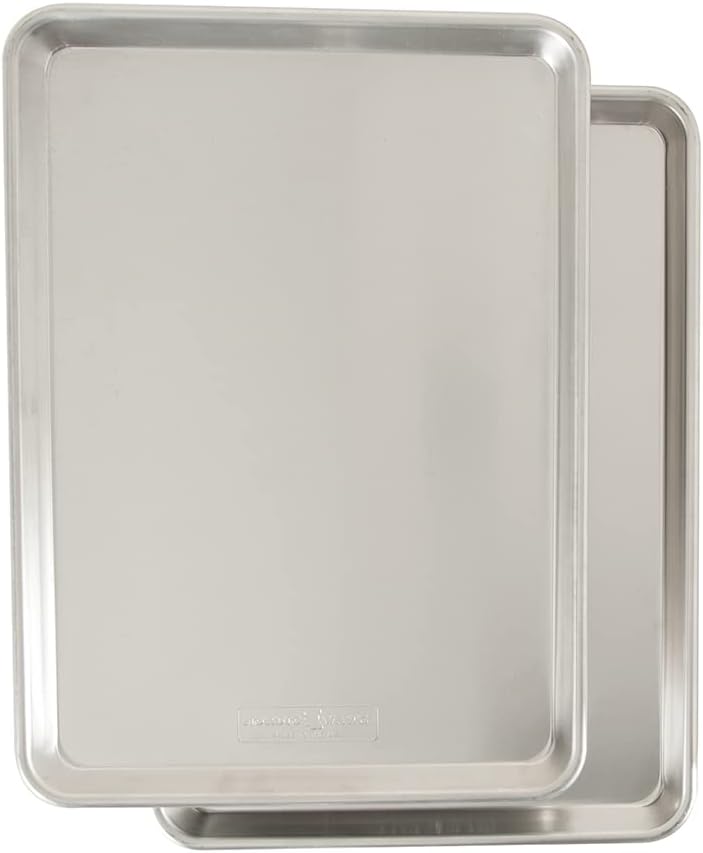
Slide a sheet pan onto the rack underneath regardless. It catches whatever escapes anyway, and it does a better second job: it puts a rigid flat platform under the casserole, so instead of hauling 16 pounds out by the handles alone, both hands take the sheet pan and the load comes out close in and balanced.
That stiffness points at the other structural failure, which is flex. A large thin metal pan carrying 12 pounds of wet filling has a long unsupported span in the middle, and heat plus load lets it bow. The trouble is not the bowing during the bake but the fact that once a big pan takes a set it never sits flat again. From then on the filling pools at the low end, one corner bakes dry while the other stays soupy, and careful assembly cannot correct it. Thickness earns its money specifically in the large formats, because stretching the same wall across 15 or 16 inches with a heavy middle is what exposes it.
Fewer, thicker layers, and the lid you do not have
Extra depth feels like licence to add layers, and that instinct produces a lasagna that looks magnificent in the dish and disintegrates under the knife. Every extra interface between pasta and filling is another plane a slice can slide along, and thin bands of ricotta or sauce lack the body to bind the sheets above and below. Seven wispy layers stacked 3 inches high have nothing structural holding the column together.
The better use of depth is thicker layers rather than more of them. Four or five generous ones in a 3-inch dish behave completely differently from seven thin ones, because each band sets into something cohesive as it cools. Keeping the sauce on the drier side helps, since excess liquid turns a set layer back into a slurry. Finish with a firm top of cheese that browns and knits into a light crust, which holds the slice together from above.
A deep casserole also needs a covered phase, so the interior climbs in a humid environment before the surface is allowed to brown. Foil is the default answer and a poor one on a big dish: a single sheet is rarely wide enough, joined sheets come apart, and the covering sags onto the cheese then peels the best of the top away with it. A fitted lid solves that outright, and earns its place again in the fridge overnight and with leftovers. Without one, tent the foil over three or four crumpled foil balls set on the rim and crimp the edges down so steam stays in.
Two dishes or one, and the protocol that works
The last failure is the one nobody wants to hear. An extra-large dish is bulky, heavy and shaped badly for storage, and it nests with nothing. If it appears twice a year, it holds prime cabinet space at a poor rate per use. Two ordinary 9-by-13 dishes feed the same crowd, cook noticeably more evenly because neither exceeds about 2 inches of depth, fit a fridge shelf without rearranging anything, mostly go in the dishwasher, and stack away easily. They also allow one of them to be vegetarian. Hosting large numbers monthly justifies the single big dish; for most households the pair is quietly the better tool.
The working protocol is short. Choose a heavy dish with wide handles that clear the rim, since weight is what evens out the baking and handles are what make it safe. Fill to an inch below the rim and no further. Set it on a sheet pan. Bake at 350°F rather than 400°F, covered for the first two thirds and uncovered for the last 20 to 25 minutes, about 60 to 75 minutes total at a 3-inch depth. Build four or five thick layers and finish with cheese. Lift the whole thing out on the sheet pan with both hands, then rest it 20 to 30 minutes before cutting. Do that and the middle is hot, the edges are intact, the oven stays clean and the slices stand up.
Common questions
How deep should a giant lasagna pan be?
Around 3 inches is the sweet spot, and going much past that costs more than it gains. At 3 inches there is room for four or five substantial layers plus a full inch of freeboard, and the centre still reaches temperature within 60 to 75 minutes at 350°F. Push to 4 inches and the distance heat must travel inward grows enough that the outside is well past browning before the middle is ready, so the bake stretches and the edges suffer for it. Depth adds weight too, several pounds for every extra inch across a big footprint. If more food is needed than a 3-inch dish holds, a second dish beats a deeper one.
Why is the middle of my lasagna still cold when the edges are done?
Because the oven is almost certainly too hot for the depth of the dish. Heat enters from the outside and conducts inward through wet, dense layers, so the surfaces hit browning temperature long before the core is near serving heat. Dropping from 400°F to 350°F and extending to 60 to 75 minutes narrows the gap, since a slower surface gives the interior time to catch up. Covering the dish for the first two thirds helps as well, because trapped steam moves heat into the mass better than dry air does. Then rest it 20 to 30 minutes, which is when carryover finishes the centre; much of what reads as undercooked is really a casserole cut too soon.
Is one extra-large pan better than two standard 9-by-13 dishes?
It depends on how often large numbers get fed, and for most households the two dishes win. A pair of 9-by-13 pans serves the same crowd, and because neither is deeper than about 2 inches both cook more evenly and finish faster than one deep dish. They also sit on a fridge shelf without rearranging anything, generally fit the dishwasher, weigh a manageable amount loaded, and stack away in a fraction of the space. The single extra-large dish is genuinely better for one unbroken presentation piece, or for hosting big groups often enough to justify a 12 to 18 pound object that otherwise sits in a cabinet all year. Being honest about that frequency is the whole decision.

MATANA
Lasagna and Catering Trays: MATANA 25-Pack 10x14 Disposable Aluminum Foil Pans, Half Size Deep
These half-size deep foil pans hold 164 fl oz across a 14.6 by 10.5 inch top and stay rigid up to 480°F, so a full lasagna or roast travels without the base flexing. Buy them if you cook in bulk for holidays, parties, or catering runs and want to skip scrubbing baked-on pans.
Pros and Cons
Pros
- Rigid enough at 10x14 to carry a full dish without the bottom bowing under weight.
- Handles oven, freezer, and serving duty, which covers prep, storage, and buffet in one tray.
- Sturdy enough to wash and reuse several times before recycling.
Cons
- No lids are included, so you will need foil or separate covers for transport and freezer storage.
- Not microwave safe, which rules out quick reheating of leftovers in the same pan.

casaWare
Extra Large Lasagna and Turkey Roasting Pan: casaWare Grande 18 x 12 x 3-Inch Ceramic Nonstick Roaster (Red Granite)
This 18 x 12 x 3-inch carbon steel roaster handles whole turkeys, full-size lasagna, and party-sized casseroles on a double-coated ceramic surface that releases food without PTFE or PFOA. Buy it if you cook for a crowd and want one deep pan that goes from holiday roast to baked ziti without sticking or warping.
Pros and Cons
Pros
- Genuinely oversized capacity that fits jumbo roasts and 18-inch lasagna layers most home pans cannot handle.
- Ceramic nonstick surface is derived from inert quartz sand and skips the fluorinated chemicals found in conventional coatings.
- The 0.7 mm carbon steel body gives the pan enough rigidity to carry a loaded turkey out of the oven.
- Red granite finish covers both the interior and exterior, so the pan looks presentable going straight to the table.
Cons
- Hand washing is recommended, which means a large, awkward pan to clean in the sink after every use.
- The 450 F ceiling rules out high-heat broiling and initial blast-roasting methods that call for 500 F.

Fig & Leaf
Large-Batch Lasagna and Turkey Roasting Pans, Fig & Leaf B07N62XC5L 30-Pack
These heavy-duty aluminum pans handle lasagna, turkey, casseroles, and other oven foods while offering convenient disposable cleanup. They suit hosts, caterers, meal preppers, and families who need stackable pans for cooking, transporting, freezing, or reheating large portions.
Pros and Cons
Pros
- The heavy-duty recyclable aluminum is designed for cooking and transporting substantial portions.
- Flat bottoms make the pans suitable for baking, reheating, and freezing.
- A 30-pack provides multiple pans for catering, batch cooking, or recurring events.
- Stackable storage and disposable cleanup simplify handling before and after meals.
Cons
- These are disposable pans, so they are not intended to replace reusable cookware.
- The product weight is not specified, so buyers cannot compare its heft with other foil pans.
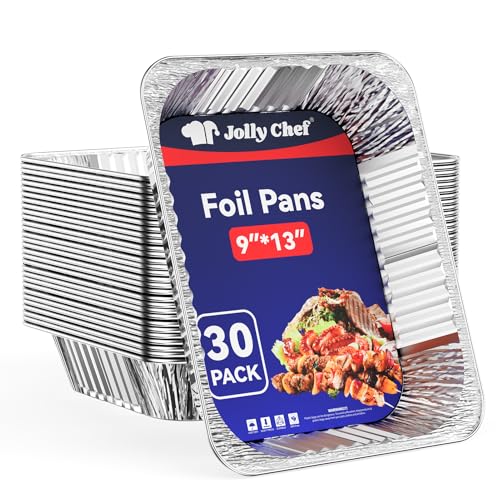
JOLLY CHEF
Deep 9x13 Foil Pans for Roasting and Casseroles: JOLLY CHEF 30-Pack
JOLLY CHEF 9x13 aluminum foil pans handle roasting, baking, grilling, serving, and storage, with heavy-duty construction that helps prevent leaks and grease seepage. They suit hosts, caterers, campers, and busy home cooks who need 30 disposable pans for simpler cleanup.
Pros and Cons
Pros
- The 30-pan quantity offers useful capacity for gatherings, catering, camping, and routine meal preparation.
- Food-grade aluminum is heat-resistant and designed to resist warping or cracking.
- Reinforced foil construction helps contain grease and liquids during cooking and transport.
- Disposable use saves time by removing the need to scrub baked-on residue.
Cons
- These pans are disposable, so they are intended for one-time use rather than repeated cookware use.
- The listed top dimensions are 12.6 by 10.23 by 2.1 inches, while the bottom measures 10 by 7.7 inches, so the usable base is smaller than the top opening.

EsOfficce
3-Inch Deep Lasagna and Roasting Pan Set: EsOfficce 2-Piece Nonstick Carbon Steel Bakeware, 13.7" and 16"
This two-piece set gives you 13.7-inch and 16-inch rectangular pans with 3-inch walls and side grips, deep enough to hold a full layered lasagna or a whole roasting chicken without spillover. Buy it if you cook for a full table and want two sizes of oven-to-freezer pan that go straight into the dishwasher afterward.
Pros and Cons
Pros
- Two pan sizes in one purchase handles both everyday baking and large-batch roasting.
- Deep 3-inch sidewalls contain rendered fat and bubbling sauce instead of letting it hit the oven floor.
- Integrated handles are shaped to stay grippable when the pan is loaded and slippery.
- Dishwasher safe construction removes the hand-wash step most nonstick bakeware requires.
Cons
- The 16-inch pan is too wide for some standard 24-inch ovens and smaller countertop ovens, so measure your rack before ordering.
- Nonstick coatings on carbon steel wear faster under metal utensils and abrasive pads, so silicone or wood tools are needed to protect the surface.
MATANA Lasagna and Catering Trays: MATANA 25-Pack 10x14 Disposable Aluminum Foil Pans, Half Size Deep
MATANA
Lasagna and Catering Trays: MATANA 25-Pack 10x14 Disposable Aluminum Foil Pans, Half Size Deep
These half-size deep foil pans hold 164 fl oz across a 14.6 by 10.5 inch top and stay rigid up to 480°F, so a full lasagna or roast travels without the base flexing. Buy them if you cook in bulk for holidays, parties, or catering runs and want to skip scrubbing baked-on pans.
$39.99 at AmazonEditors' Favorite
Color: Silver Size: 10x14 (25 Pans) Dimensions: 8.661417314 x 14.566929119 x 2.755905509 Inches Weight: 0.11684499886 pounds Product Group: Kitchen Binding: Kitchen
Shop NowcasaWare Extra Large Lasagna and Turkey Roasting Pan: casaWare Grande 18 x 12 x 3-Inch Ceramic Nonstick Roaster (Red Granite)
casaWare
Extra Large Lasagna and Turkey Roasting Pan: casaWare Grande 18 x 12 x 3-Inch Ceramic Nonstick Roaster (Red Granite)
This 18 x 12 x 3-inch carbon steel roaster handles whole turkeys, full-size lasagna, and party-sized casseroles on a double-coated ceramic surface that releases food without PTFE or PFOA. Buy it if you cook for a crowd and want one deep pan that goes from holiday roast to baked ziti without sticking or warping.
$44.99 at AmazonGreat Value
Color: Red Granite Size: Extra Large Dimensions: 18 x 12 x 3 inches Weight: 2.2 pounds Product Group: Kitchen Binding: Kitchen
Shop NowFig & Leaf Large-Batch Lasagna and Turkey Roasting Pans, Fig & Leaf B07N62XC5L 30-Pack
Fig & Leaf
Large-Batch Lasagna and Turkey Roasting Pans, Fig & Leaf B07N62XC5L 30-Pack
These heavy-duty aluminum pans handle lasagna, turkey, casseroles, and other oven foods while offering convenient disposable cleanup. They suit hosts, caterers, meal preppers, and families who need stackable pans for cooking, transporting, freezing, or reheating large portions.
$37.99 at AmazonColor: Silver Size: 14 Inch x 10 Inch x 3 Inch Dimensions: 3 x 10 x 3 inches Weight: 1.54984970186 Pounds Product Group: Kitchen Binding: Kitchen
Shop NowJOLLY CHEF Deep 9x13 Foil Pans for Roasting and Casseroles: JOLLY CHEF 30-Pack
JOLLY CHEF
Deep 9x13 Foil Pans for Roasting and Casseroles: JOLLY CHEF 30-Pack
JOLLY CHEF 9x13 aluminum foil pans handle roasting, baking, grilling, serving, and storage, with heavy-duty construction that helps prevent leaks and grease seepage. They suit hosts, caterers, campers, and busy home cooks who need 30 disposable pans for simpler cleanup.
$25.99 at AmazonColor: Silver Size: 30PACK Dimensions: 2.1 x 10.23 x 2.1 Inches Weight: 2.0502990366 pounds Product Group: BISS Binding: Kitchen
Shop NowEsOfficce 3-Inch Deep Lasagna and Roasting Pan Set: EsOfficce 2-Piece Nonstick Carbon Steel Bakeware, 13.7" and 16"
EsOfficce
3-Inch Deep Lasagna and Roasting Pan Set: EsOfficce 2-Piece Nonstick Carbon Steel Bakeware, 13.7" and 16"
This two-piece set gives you 13.7-inch and 16-inch rectangular pans with 3-inch walls and side grips, deep enough to hold a full layered lasagna or a whole roasting chicken without spillover. Buy it if you cook for a full table and want two sizes of oven-to-freezer pan that go straight into the dishwasher afterward.
$29.99 at AmazonColor: Dark Grey Dimensions: 16.06 x 3.15 x 11.61 inches Product Group: Kitchen Binding: Unknown Binding
Shop Now




Write Your Review
No reviews yet. Be the first to share your experience!