

Ferromagnetic cookware is a metallurgical category before it is a shopping one. Either a pan holds enough iron, nickel, or cobalt in the right crystal structure to interact with a fast-alternating magnetic field, or it does not, and no wording on the box changes that.
What follows is the metallurgy under that split: which alloys carry magnetism, which cannot, and how manufacturers build it into materials that lack it. The alloy numbers explain most of the confusion around stainless steel and induction.
What Ferromagnetism Actually Does Inside a Pan
Iron, nickel, and cobalt share an unusual feature: unpaired electrons whose magnetic moments each behave like a minute compass needle. In these three metals the moments of neighboring atoms lock into parallel alignment across regions a few microns wide, called domains. Hold a magnet near a cast iron skillet and those domains swing into line with it, which is why the pan tugs back. That alignment matters far more when the field reverses tens of thousands of times a second.
An induction hob sends no heat into a pan. It sends a magnetic field, alternating at 20 to 50 kHz, from a coil under about 4mm of ceramic glass. The field induces circulating currents in the metal above, and the metal’s own resistance converts them into heat. Ferromagnetic metal adds a second, smaller share through hysteresis, the energy lost each time the domains are dragged back and forth. Two properties set the yield: permeability, which crowds the field into a shallow surface layer, and resistivity, which decides how much heat each induced ampere produces.
That pairing explains why aluminum, among the best electrical conductors in any kitchen, makes such a weak target. Its resistivity runs about 2.7 microhm-centimeters against roughly 60 for 430 stainless, and its relative permeability is essentially 1. Current is induced, but it flows through a wide, low-resistance path and heats almost nothing. In ferritic steel, permeability confines the same current to the outer tenth of a millimeter, where high resistivity turns it into heat.
The Stainless Steel Split: 430 Against 304 and 316
Stainless steel is not one material, and the gap between two of its families causes most of the trouble. 430 is ferritic: roughly 16 to 18 percent chromium, essentially no nickel, and a body-centered cubic lattice that leaves iron’s ferromagnetism intact. It is magnetic, cheap, and couples to a coil well.
304, sold as 18/8, and 316 are austenitic. Same chromium range, but with 8 to 10.5 percent nickel in 304 and 10 to 14 percent plus molybdenum in 316. Nickel stabilizes a face-centered cubic structure that is not ferromagnetic at room temperature, its relative permeability barely above 1. That nickel earns its keep, since austenitic grades resist pitting and take tomato, wine, and lemon without shedding a metallic taste. Hence the central inconvenience of the material. 18/10, the alloy you want against food, cannot be heated by an induction coil at all.
The industry’s answer is a laminate: an 18/10 interior for food, an aluminum core 2 to 3mm thick that moves heat sideways at roughly 200 watts per meter-kelvin where stainless manages 25, and a 430 exterior layer, often 0.4 to 0.6mm, as the part the field grabs. Three metals, three jobs, and only the outermost is electromagnetically active.
Cold Work, Martensite, and Faintly Magnetic Stainless
Austenitic stainless is not permanently non-magnetic, which is where much of the confusion starts. Heavy deformation, such as the deep draw that pulls a stockpot body from a flat blank, shears some austenite into alpha-prime martensite, a body-centered phase that is ferromagnetic. The result is a 304 pot magnetically inert across most of its surface and faintly responsive where the metal was worked hardest. The permeability produced is tiny, a few percent above nothing rather than the several-hundred-fold of ferritic steel.
Faint attraction and electromagnetic coupling are different quantities. A hob’s power stage needs a strongly permeable path across a minimum footprint, commonly 4.3 to 5.5 inches of base diameter depending on coil design, both to register a pan and to deliver rated wattage into it. A trace of martensite in a stamped rim supplies neither.
The Curie Point, Which Nobody Mentions
Every ferromagnetic material has a temperature at which thermal agitation overwhelms domain alignment and the magnetism stops. Pure iron crosses it near 1418°F, nickel far lower at about 669°F, and many ferritic stainless grades between 1150 and 1380°F. Cooking never comes close, so this is context rather than a caution. It matters as the physical ceiling of the heating mechanism itself, and it is why a very thin ferritic base driven empty toward extreme temperatures behaves less predictably than its mass suggests.
What the Alloy Predicts at the Stove
Cast iron is 96 to 98 percent iron with 2 to 4 percent carbon, and it couples about as strongly as cookware metal can. Heat lands in the base fast, but cast iron conducts sideways at only about 50 watts per meter-kelvin, so it heats in the shape of the coil: a hot annulus with a cooler middle that a 5mm base evens out over minutes, not seconds.
Carbon steel is metallurgically close, iron with under 1 percent carbon, but a 2 to 3mm skillet carries perhaps a third of the mass. It answers a power change faster and it distorts more readily, since the same alloy is far less rigid at 2mm than at 6mm.
Enameled steel is a thin ferritic sheet, often 0.6 to 1.2mm, with glass frit fused onto it near 1500°F. Coupling is excellent, since the steel is magnetic and the enamel is electromagnetically transparent, but there is almost no metal to conduct laterally and the coil’s outline shows up in the food. Enamel itself moves heat at roughly 1 watt per meter-kelvin.
Copper, at about 1.7 microhm-centimeters, and aluminum are the finest thermal conductors on the rack and the poorest induction targets, for the same reason: their electrons move too freely for resistive heating. Both reach an induction surface only with ferritic steel added, as a bonded base plate or full cladding. Titanium fails differently, being paramagnetic with permeability effectively 1, so its resistivity of about 42 microhm-centimeters has no concentrated field to work with. Stoneware and ceramic bodies are insulators; no current can be induced in them at all.
How the Magnetic Layer Is Attached, and Why the Joint Matters
Three joining methods dominate. Impact bonding presses a steel and aluminum plate onto a formed base under extreme force, cold-welding the interfaces. Brazing joins that plate with a molten filler metal that wets both surfaces and freezes as a distinct third layer. Full cladding rolls the whole stack of 430, aluminum, and 18/10 together before the pan is formed, so the layers run continuously up the walls.
The method governs two outcomes. One is whether the magnetic layer can ever part from the pan, since any joint made after forming is an interface of finite strength, and cycling between metals of unequal expansion works against it, while rolled cladding has no seam to open. The other is where heat travels: a bonded plate concentrates it inside its own footprint, while cladding carries conduction up the sides.
Geometry decides how much field arrives at all. Coupling weakens with distance, and the field already crosses roughly 4mm of glass before it meets steel, so a base bowed 1mm at the center adds about a quarter again to that gap, directly over the densest part of the coil. Flatness is an electromagnetic specification, not a cosmetic one.
Base thickness settles into a range for related reasons. Under about 3mm there is too little metal to redistribute the ring of heat the coil deposits. Over about 6mm the base stores enough energy to lag behind the control. Three to six millimeters overall, of which the ferritic layer may be half a millimeter, is where most well-built bases land.
Does the aluminum core in a clad pan do anything on induction?
Nothing electromagnetic. Aluminum’s resistivity is too low and its permeability effectively 1, so a coil induces current in it without producing useful heat; a pan made only of aluminum would barely register on the hob. The core’s work begins after the ferritic layer has turned the field into heat. Conducting at roughly 200 watts per meter-kelvin against 25 for stainless, it takes the ring of heat over the coil and pushes it outward. A clad pan with a 2 to 3mm core therefore browns more evenly than plain ferritic steel of equal thickness.
How thick does the magnetic layer itself need to be?
Thinner than most people assume. Because permeability confines the induced current to a shallow skin, a ferritic layer of about 0.4 to 0.5mm already carries nearly all the current a 20 to 50 kHz field induces. Steel beyond that adds no electrical coupling, only mass, and since 430 conducts heat poorly it inserts a sluggish layer between heat and food. What extra thickness buys is lateral spreading, which is aluminum’s or cast iron’s job. A base can be 4mm overall with a magnetic component a tenth of that and still take full power.
Is 430 stainless a downgrade for the surface that touches food?
For a cooking surface, yes, which is why better pans keep it outside. 430 carries the 16 to 18 percent chromium that makes stainless resist rust, but without nickel its passive film is less stable, so it pits and marks more readily under salt, acidic sauces, and standing water. It conducts heat at about 25 watts per meter-kelvin, no better than 304. Pans pressed entirely from 430 exist and are magnetic throughout, and they stain in ways an 18/10 interior does not.

Ammeloo
18-Piece Ceramic Cookware Set with Removable Handles for Stovetop to Oven Cooking: Ammeloo Non-Toxic Induction-Ready Pots and Pans
This 18-piece ceramic set covers everyday stovetop and oven cooking with a PFAS, PFOA, and PTFE free non-stick surface that releases food using minimal oil. It suits health-conscious households and small-space cooks in apartments, RVs, or campers, since the detachable handles let the pots stack flat and move straight from burner to oven to fridge.
Pros and Cons
Pros
- Full 18-piece range covers pots, pans, and lids, so one purchase handles most weeknight cooking without mixing brands.
- Removable handles make oven transfers straightforward and eliminate the protruding handles that block cabinet stacking.
- Works on every common cooktop including induction, so the set survives a move to a different kitchen.
- Manufacturer offers replacements or solutions through direct support if the set arrives short of expectations.
Cons
- The manufacturer specifies low to medium heat only, so high-heat searing and aggressive browning are off the table.
- Ceramic non-stick coatings generally lose slickness faster than traditional non-stick, meaning this set is more of a multi-year than a lifetime purchase.

Nuwave
Healthy Ceramic Nonstick Cooking with Nuwave Duralon Blue Cookware Set
The Nuwave Healthy Duralon Blue cookware set delivers fast, even heating and effortless food release with a PFAS-free ceramic coating. It suits cooks who want durable, induction-ready cookware made without PTFE, PFOA, lead, or cadmium.
Pros and Cons
Pros
- The Gen10 Duralon Blue ceramic coating is designed for easy food release and fast heating.
- Induction-ready construction provides broad stovetop compatibility and even heat distribution.
- Forged construction balances durability with a lightweight design.
- The coating is tested free of 106 known PFAS elements and avoids several other listed chemicals.
Cons
- The available listing does not provide individual pan sizes or included-piece details, making it harder to judge whether the set fits your kitchen.

All-Clad
Everyday Nonstick Frying Pan Set: All-Clad HA1 5-Piece Induction Cookware
The All-Clad HA1 set handles meals from small omelets to family-size sautés, with heavy-gauge aluminum providing consistent heating and PTFE nonstick simplifying food release. It suits induction users and home cooks who want three skillet sizes, two glass lids, and oven-safe versatility.
Pros and Cons
Pros
- The set includes 8-inch, 10-inch, and 12-inch fry pans for varied portions and recipes.
- Double-riveted stainless-steel handles provide a secure connection during daily cooking.
- The pans are dishwasher safe, although gentle hand washing can better preserve the nonstick coating.
- The cookware is backed by a limited lifetime warranty.
Cons
- The 8-inch skillet does not include a lid.
- Preserving the PTFE nonstick surface requires silicone, nylon, or wooden utensils and gentle cleaning.
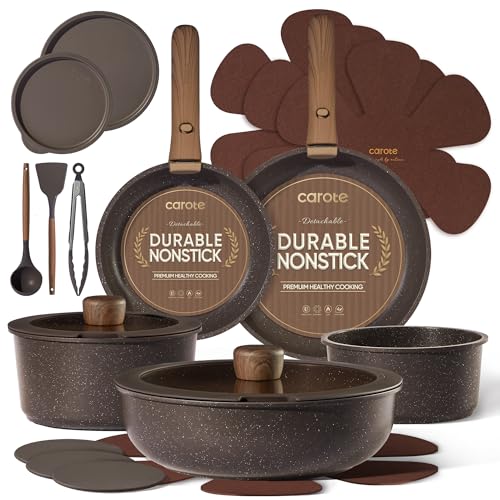
CAROTE
21-Piece Detachable-Handle Nonstick Cookware Set for Compact Kitchens and All Stovetops
This CAROTE cookware set handles frying, sautéing, boiling, and simmering while its ultra-nonstick coating simplifies cooking and cleanup. It suits apartment kitchens, RVs, campers, and home cooks who need versatile cookware that stacks compactly.
Pros and Cons
Pros
- The 21-piece set covers common tasks with frying pans, saucepans, a sauté pan, lids, utensils, and storage accessories.
- Detachable handles provide a practical space-saving solution for small kitchens, apartments, RVs, and camping.
- The set works across induction, gas, electric, and ceramic stovetops.
- The 12-month warranty provides coverage for quality problems after purchase.
Cons
- The detachable-handle design requires removing and reattaching handles when switching between storage and cooking.
- The lightweight aluminum construction may feel less substantial than heavier cookware.
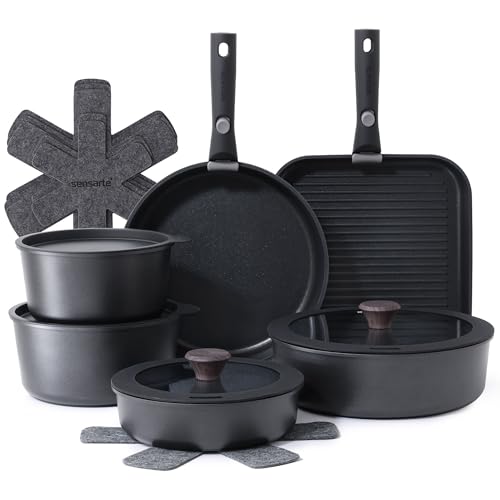
SENSARTE
Space-Saving Cookware for Compact Kitchens: SENSARTE 17-Piece Detachable Handle Set
This 17-piece SENSARTE set handles everyday stovetop cooking while its detachable handles and stackable design reduce storage space. It suits small kitchens and RVs that need versatile cookware without bulky handles taking up cabinet room.
Pros and Cons
Pros
- The 17-piece configuration provides several pan shapes and sizes for everyday cooking.
- Removable handles support compact stacking and are tested to hold up to 22 pounds.
- The coating is advertised as free of intentionally added PFOA, lead, and cadmium.
- Dishwasher-safe pans include a wear-resistant bottom designed to help prevent black residue.
Cons
- Only two removable handles are included, so they may need to be moved between pans during multitasking.
- The product data does not specify individual pan weights or induction compatibility.
The Best Deals This Week*
-
18-Piece Ceramic Cookware Set with Removable
$56.99
($68.89)Save $11.90 -
Healthy Ceramic Nonstick Cooking with Nuwave
$215.99
($259.99)Save $44.00 -
CAROTE 21-Piece Detachable-Handle Nonstick
$69.99
($99.99)Save $30.00 -
Space-Saving Cookware for Compact Kitchens
$79.98
($99.99)Save $20.01
*Deals are selected by our commerce team
Ammeloo 18-Piece Ceramic Cookware Set with Removable Handles for Stovetop to Oven Cooking: Ammeloo Non-Toxic Induction-Ready Pots and Pans
Ammeloo
18-Piece Ceramic Cookware Set with Removable Handles for Stovetop to Oven Cooking: Ammeloo Non-Toxic Induction-Ready Pots and Pans
This 18-piece ceramic set covers everyday stovetop and oven cooking with a PFAS, PFOA, and PTFE free non-stick surface that releases food using minimal oil. It suits health-conscious households and small-space cooks in apartments, RVs, or campers, since the detachable handles let the pots stack flat and move straight from burner to oven to fridge.
$56.99 at AmazonEditors' Favorite
Color: Black Size: 18-piece ceramic pots and pans Product Group: Kitchen
Shop NowNuwave Healthy Ceramic Nonstick Cooking with Nuwave Duralon Blue Cookware Set
Nuwave
Healthy Ceramic Nonstick Cooking with Nuwave Duralon Blue Cookware Set
The Nuwave Healthy Duralon Blue cookware set delivers fast, even heating and effortless food release with a PFAS-free ceramic coating. It suits cooks who want durable, induction-ready cookware made without PTFE, PFOA, lead, or cadmium.
$215.99 at AmazonGreat Value
Color: Metallic Rustic Copper Size: 12pc Cookware Set Dimensions: 22.9 x 14 x 13.5 inches Weight: 22.5 pounds Product Group: Kitchen Binding: Kitchen
Shop NowAll-Clad Everyday Nonstick Frying Pan Set: All-Clad HA1 5-Piece Induction Cookware
All-Clad
Everyday Nonstick Frying Pan Set: All-Clad HA1 5-Piece Induction Cookware
The All-Clad HA1 set handles meals from small omelets to family-size sautés, with heavy-gauge aluminum providing consistent heating and PTFE nonstick simplifying food release. It suits induction users and home cooks who want three skillet sizes, two glass lids, and oven-safe versatility.
$199.99 at AmazonColor: Black Size: 5 Piece Set Dimensions: 23.46 x 13.43 x 6.73 Inches Product Group: Kitchen Binding: Kitchen
Shop NowCAROTE 21-Piece Detachable-Handle Nonstick Cookware Set for Compact Kitchens and All Stovetops
CAROTE
21-Piece Detachable-Handle Nonstick Cookware Set for Compact Kitchens and All Stovetops
This CAROTE cookware set handles frying, sautéing, boiling, and simmering while its ultra-nonstick coating simplifies cooking and cleanup. It suits apartment kitchens, RVs, campers, and home cooks who need versatile cookware that stacks compactly.
$69.99 at AmazonColor: Brown Size: 21 Piece Weight: 10.69903357486 Pounds Product Group: Kitchen
Shop NowSENSARTE Space-Saving Cookware for Compact Kitchens: SENSARTE 17-Piece Detachable Handle Set
SENSARTE
Space-Saving Cookware for Compact Kitchens: SENSARTE 17-Piece Detachable Handle Set
This 17-piece SENSARTE set handles everyday stovetop cooking while its detachable handles and stackable design reduce storage space. It suits small kitchens and RVs that need versatile cookware without bulky handles taking up cabinet room.
$79.98 at AmazonColor: Black Size: 17 Piece Dimensions: 3.93700787 x 2 x 19.68503935 inches Product Group: Kitchen Binding: Kitchen
Shop Now



Write Your Review
No reviews yet. Be the first to share your experience!