

A dual pot coffee maker brews into two separate carafes rather than one, either from a single brew head that alternates or from two paths running in parallel. That distinction decides whether the machine deserves its counter space. Here are the situations where two pots genuinely earn their keep, and what to check in each before spending the money.
One House, Two Kinds of Coffee
The clearest reason to own one is a household split between regular and decaf. Someone drinks caffeinated at six in the morning, someone else has been told by a doctor to stop, and the two share a kitchen. On a single machine that means brewing twice, or one person quietly settling for whatever is already in the pot. Two carafes fixes it: nobody waits and nobody drinks the wrong thing.
Whether a machine actually does this comes down to one spec, which is independent brew baskets and independent start controls. That sounds obvious, and it is not, because plenty of machines sold as dual-carafe models have a single basket and simply divide the finished coffee between two vessels. That design gives you two pots of identical coffee, which solves nothing. Product names rarely make the difference clear, so look for two filter compartments in the photographs and two separate brew buttons on the panel. A listing that mentions one filter and a combined 24-cup capacity is a splitter. Independent controls also let you brew four cups of decaf at night without heating the other side.
The Office Kitchen and the Shop Back Room
In a workplace the numbers change: nobody cares about decaf lanes, only throughput and holding time. Two 12-cup carafes cover roughly 20 to 24 small cups, since a rated cup runs about five ounces and the mugs people bring to work hold eight or ten. That is a staff of fifteen to twenty through a morning, brewed once.
The real question is not how fast it brews but how long the second pot sits before anyone drinks it. Coffee held on a warming plate at 175 to 185°F degrades noticeably within 20 to 30 minutes; the aromatics cook off, bitterness climbs, and by the hour mark it tastes scorched. In an office where people arrive between seven and ten, the second carafe will sit for exactly that long.
So for staggered drinking, the thermal-carafe version matters more than any brewing feature the machine could otherwise offer. An insulated stainless carafe holds coffee near serving temperature for two to four hours with no heat applied, so the cup at nine-thirty resembles the cup at seven. Two hot plates and two glass carafes is the wrong tool for slow consumption, though fine for a breakfast rush that empties both pots in fifteen minutes.
When One Side Isn’t For Coffee
Some of these machines pair a coffee side with a hot-water tap or a dedicated tea side rather than a second coffee carafe. For a family where one person drinks tea, that removes a kettle from the counter and is genuinely useful.
One detail is worth checking first: whether the hot-water outlet draws from the same tank and tubing as the coffee. If it does, the water carries coffee flavour with it, not much but enough. A delicate green tea brewed through lines that passed this morning’s dark roast tastes muddy and faintly bitter, and rinsing does not fix it permanently because the residue rebuilds every cycle. Independent tanks are the feature to look for, since two reservoirs and two water paths keep the tea side clean-tasting indefinitely. With a single central tank feeding both outlets, treat the tap as useful for instant soup and washing up. Manufacturers seldom state this, so the reservoir count in the specifications is your best proxy.
A Full House on Sunday Morning
Guests are where people expect most from a dual machine and often get least. Brewing two pots back to back does beat two consecutive cycles on one machine, because you skip the reload and the second basket is already charged. But it is not twice as fast.
Most of these machines share one heater between both brew paths. A single thermoblock or boiler can only deliver its rated power to one path at a time, so asking it to serve two at once produces one of two outcomes: it halves the flow to each side and both pots crawl, or the control board alternates, heating one path while the other pauses. Either way, 24 cups lands close to what two sequential cycles would take, perhaps five to eight minutes better, most of it saved on refilling.
Two genuinely independent heating elements is the only arrangement that brews both pots at full speed together, and it costs more: a second heater, a second pump path, a heavier power draw. For brunch four times a year, the shared-heater version is fine. For brunch every week, or a house where two people leave at different times and both want a fresh pot, independent heaters pay for themselves in patience.
Measure the Counter First
These machines are wide, and width is the specification most likely to send one back in its box. Two carafes side by side usually means 15 to 19 inches of counter, against roughly nine to eleven for a conventional single-carafe drip machine. On a galley counter where the toaster and the knife block already have claims, that is not a small difference.
Width is not the whole measurement. Two lids need clearance to open, and on many models they hinge up and back, so the machine cannot sit flush to a backsplash. The more common failure is vertical: the reservoir usually sits centrally at the rear and higher than on a single machine, and a wall cabinet 16 inches above the counter will block the lid outright, leaving you to slide the machine forward every time you fill it. Measure your width, then countertop to cabinet underside, before buying. A removable tank you can carry to the sink makes the vertical figure much less important.
Twice the Machine, Twice the Descaling
Two brew paths mean twice the scale, and descaling only works if it runs through both sides. Treating the side you use and skipping the other leaves half the machine untouched, which defeats the maintenance entirely.
The predictable pattern is that one side gets used and the other does not. The neglected path builds scale in its tubing and holds stagnant water in its lines, and the tell is unmistakable: a stale, faintly metallic taste the first time you brew on it after several months. It clears after two or three cycles, but you have wasted the coffee and confirmed you bought more machine than you needed. Every four to six weeks in hard water, or every two to three months in soft, run descaling solution through both sides in sequence and rinse each with two full water cycles. If you know you will realistically only use one side, buy a single machine.
Who Should Actually Buy One
A dual pot coffee maker earns its place where two different coffees are drunk at once, or where volume is high enough that one 12-cup carafe runs out before the morning does. In those kitchens the features to insist on are independent baskets, independent controls, and thermal carafes if the coffee will sit.
Everywhere else it is a poor buy. A household that drinks one kind of coffee gets a wider machine, a harder cleaning routine and a second brew path quietly scaling in the dark. The same money buys a considerably better single machine with a thermal carafe, and its coffee will still be good at nine in the morning.
Can a dual pot coffee maker brew regular and decaf at the same time?
Only if it has two separate brew baskets, and not every machine sold as a dual-carafe model does. Some designs use one basket and divide the finished coffee between two carafes, producing two identical pots that cannot separate regular from decaf. Look for two filter compartments in the product photographs and two independent start buttons on the panel. A specification listing a single filter with a combined 24-cup capacity is a strong sign of the splitting design. If separating two coffees is your main reason for buying, verify this before anything else.
Does a dual machine brew two pots twice as fast?
Rarely, because most share one heating element between both brew paths. A single boiler can send its rated power to one path at a time, so simultaneous brewing either halves the flow to both sides or makes the machine alternate between them. The saving over two consecutive cycles is real but modest, usually five to eight minutes, mostly from not reloading the basket and refilling the tank. Only machines with two independent heaters brew both pots at full speed together, and they cost noticeably more. For occasional entertaining, the shared-heater version is the sensible choice.
Are thermal carafes worth the extra cost on a two-pot machine?
If the second pot will sit more than half an hour, yes, and more so than on a single-carafe machine. Coffee kept at 175 to 185°F on a warming plate degrades within 20 to 30 minutes and tastes scorched by the hour mark, and the whole premise of two pots is that one of them waits. An insulated stainless carafe holds coffee near drinking temperature for two to four hours with no applied heat. Where both carafes empty inside fifteen minutes, glass and warming plates are adequate and easier to clean. For offices and households with staggered wake-up times, thermal is the better buy.

YUANHAO
Office Break Room Coffee Brewing: YUANHAO 12-Cup Commercial Coffee Maker with Dual Warmers and Stainless Steel Body
This 120V commercial drip brewer pushes out full 12-cup pots through a multi-directional spray head while its top and bottom warming plates keep one carafe hot as the next batch brews. Buy it if you run an office break room, church hall, or event table where coffee needs to flow all day without a full commercial plumbing setup.
Pros and Cons
Pros
- Two warmers mean continuous service during a rush without juggling a single hot plate.
- Stainless funnel and body clean up quickly between batches in a shared kitchen.
- Toggle switch controls for brew and warm need no training for volunteers or staff.
- Ships with a 12-cup glass carafe, so it brews the day it arrives.
Cons
- It ships with only one glass carafe, so getting real use out of the dual warmers means buying a second pot separately.
- Manual pourover operation requires someone to fill the reservoir for every batch, unlike plumbed commercial brewers.
YUANHAO Office Break Room Coffee Brewing: YUANHAO 12-Cup Commercial Coffee Maker with Dual Warmers and Stainless Steel Body
YUANHAO
Office Break Room Coffee Brewing: YUANHAO 12-Cup Commercial Coffee Maker with Dual Warmers and Stainless Steel Body
This 120V commercial drip brewer pushes out full 12-cup pots through a multi-directional spray head while its top and bottom warming plates keep one carafe hot as the next batch brews. Buy it if you run an office break room, church hall, or event table where coffee needs to flow all day without a full commercial plumbing setup.
$149.97 at AmazonEditors' Favorite
Color: Black&Silver Size: 12-Cup Dimensions: 15 x 18 x 8 Inches Product Group: Kitchen
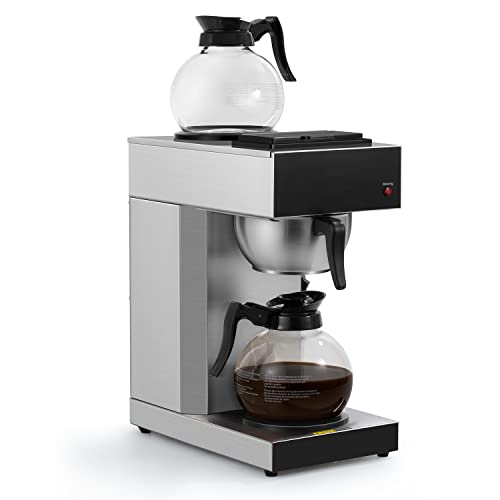
Shop NowSYBO 12-Cup Commercial Pour Over Coffee Maker SF-CB-2GA
Great Value
Color: Stainless Steel Size: 2 Glass Decanters Dimensions: 13.9 x 8.2 x 16.5 inches Weight: 16.4 pounds Product Group: Kitchen Binding: Kitchen
Shop NowExisting Beauty 12-Cup Commercial Coffee Maker Stainless Steel - Double Coffee Machine for Office, Restaurant, Industrial Use - High Capacity Office Coffee Maker - TQS Cafe

Existing Beauty
12-Cup Commercial Coffee Maker Stainless Steel - Double Coffee Machine for Office, Restaurant, Industrial Use - High Capacity Office Coffee Maker - TQS Cafe
$159.99 at AmazonColor: Stainless Steel Dimensions: 12.4 x 19 x 17.25 inches Weight: 17 pounds Product Group: Kitchen Binding: Kitchen
Shop Now



Write Your Review
No reviews yet. Be the first to share your experience!