

TL;DR — Yes, a meat thermometer is genuinely worth it for anyone who cooks meat — it’s the only reliable way to know meat is cooked safely (not undercooked) without overcooking it. Cheap and easy to use, it takes the guesswork out of cooking meat, poultry, and more. An instant-read digital thermometer is the recommended type for most people. It’s a small tool with a big payoff. The HomeWhisk team compiled this from cooking guidance and aggregated feedback. For picks, see our best meat thermometer guide.
The HomeWhisk editorial team researches kitchen equipment by analyzing manufacturer specifications, usage benefits, and aggregated user reviews from major retailers and cooking communities. Our recommendations are based on what the products actually deliver, not what brands promise.

A meat thermometer is an inexpensive tool that many cooks overlook, yet it solves one of cooking’s biggest problems: knowing when meat is done. Here’s whether you need one. For picks, see our best meat thermometer guide.

Pros & Cons
Pros
- App setup skips account registration and WiFi pairing, getting you cooking in minutes.
- Dual-probe design handles both food and ambient grill temperature on a single device.
- Tight ±1.8°F accuracy holds up across smoking, grilling, and oven roasting.
- Rechargeable base unit avoids ongoing battery costs during marathon BBQ sessions.
Cons
- Bluetooth-only range limits how far you can wander from the grill compared to WiFi-enabled models.
- Two probes may not be enough for cooks juggling several different cuts on a large smoker.
Details
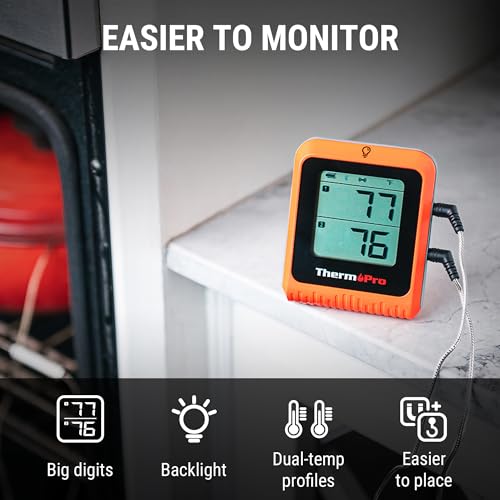
A wireless dual-probe thermometer that solves the problem of guessing doneness when grilling or smoking multiple cuts at once.
The two probes track meat and pit temperature simultaneously, with ±1.8°F accuracy across a 14°F to 572°F range covering everything from cold-smoked salmon to seared steak.
The rechargeable base unit displays both readings in real time, while the Bluetooth app pushes pre-alarms to your phone without requiring registration.
Bluetooth range is shorter than WiFi-based competitors, so straying far from the backyard may break the connection.
Best for home grillers and weekend smoker users who want reliable two-channel monitoring without app complexity.
How to Use
Charge the base unit, insert one probe into the thickest part of the meat, and clip the second probe to the grill grate to track ambient temperature.
Open the ThermoPro app, pair via Bluetooth, and set your target temp plus a pre-alarm so you get a heads-up before the meat hits doneness.
Keep the base unit within Bluetooth range of your phone, and pull the probes once the alert fires to rest your meat before slicing.

Save $4.00
Pros & Cons
Pros
- The -58°F to 572°F span covers frozen storage checks, low and slow smoking, and hot sugar work.
- The foldable probe stores flat and shields the tip between uses.
- Magnet and hook give two mounting options without needing a separate holster.
- MAX/MIN tracking shows how far temperatures drifted during a long cook.
Cons
- It is a spot-check tool rather than a leave-in probe, so long smokes still mean opening the lid to check.
- No waterproof or wash-down rating is stated, so the body needs wiping instead of rinsing.
Details
A battery-powered instant read thermometer that ends guesswork on doneness, returning a temperature in 2 to 3 seconds so food leaves the heat when it hits target instead of minutes later.
Accuracy runs to ±1°F across a -58°F to 572°F range, covering chilled fish, low and slow brisket, and frying oil. HOLD locks the reading as you withdraw the probe.
The large backlit LCD auto-rotates for left or right handed reading, and the probe folds into the body. A magnet and hanging hook keep it on the fridge or grill hood.
The single folding probe is not a leave-in unit, so you open the oven or smoker at every check, which costs heat during long cooks.
Best for home grillers and bakers who want fast spot checks without a wireless probe system.
Best Uses
For steak and burgers, probe the thickest part away from bone and pull near 130°F for medium rare. Poultry needs 165°F in the thigh once the reading settles.
Bread and sourdough finish around 200°F to 210°F in the center, while candy and frying sit well inside the 572°F ceiling.
MAX/MIN tracking follows smoker and oil temperature swings, though auto shutoff after 10 minutes means waking the unit between checks.

Pros & Cons
Pros
- Switches between °F and °C, so US recipes and metric baking charts both work without conversion math.
- IP66 rating means splashes and a quick rinse under the tap will not kill the display.
- Slim body and magnet mount keep it within arm's reach of the stove or smoker.
- Fast read speed makes it practical for checking several pieces of chicken or multiple steaks in one pass.
Cons
- IP66 covers rinsing only, so it cannot be soaked or run through the dishwasher.
- This is an instant read tool, not a leave-in probe, so a roast cannot be monitored without opening the oven.
Details
A pocket-sized digital thermometer that ends guesswork on doneness, reading steak, chicken, turkey, pork, and fish in 2 to 3 seconds with ±2°F accuracy.
The backlit screen stays legible at dusk on the grill, and the °F/°C toggle suits both American recipes and metric baking charts.
The 5.3 inch probe reaches the center of a thick roast while keeping hands away from flame, and a built-in magnet stores it on the fridge or grill hood.
IP66 means splash and rinse safe only, so it should never be soaked or placed in the dishwasher.
Best for home grillers and weeknight cooks who want quick doneness checks without paying for a multi-probe monitoring system.
Best Uses
For meat, probe the thickest part away from bone: poultry at 165°F, pork at 145°F, and beef pulled around 130°F for medium rare before resting.
Beyond meat, track frying oil near 350°F, candy stages, warmed milk for yogurt, and sourdough loaves finished around 205°F to 210°F.
Insert about half an inch, wait for the number to settle, then wash the tip with hot soapy water, dry it, and return it to the magnet.

Pros & Cons
Pros
- The thermocouple sensor locks onto temperature in under a second, noticeably faster than standard thermistors.
- The 4-inch probe is long enough to reach the center of thick briskets and whole chickens without burning fingers.
- Full waterproof construction allows a quick rinse after raw meat contact, reducing cross-contamination risk.
- Motion-sensing wake eliminates the need to find a power button mid-cook with messy hands.
Cons
- Brand is newer with limited long-term durability data compared to established thermometer makers.
- No backlit probe mark or guidelines for optimal insertion depth on different meat types.
Details
A folding probe thermometer built to answer one question instantly: is your meat at the right internal temperature?
The thermocouple sensor hits ±0.5°F accuracy in 0.5 seconds, fast enough to check multiple pieces on a loaded grill without losing heat.
The body is compact with a folding 4-inch stainless steel probe, fully waterproof housing, and a backlit LCD that auto-flips based on orientation.
No Bluetooth, no app, no wireless features. This is a manual spot-check tool only.
Best for hands-on grillers and kitchen cooks who value speed and accuracy over connected smart features.
Best Uses
Ideal for searing steaks to precise doneness, verifying poultry has reached 165°F safely, and checking candy or oil temperatures during frying.
The long probe works well for thick pork shoulders and whole birds where center temperature differs significantly from the surface.
Use the temperature lock feature when pulling readings from deep ovens or smokers so you can step back before checking the display.
Why a Meat Thermometer Matters
Understanding what a meat thermometer solves shows why it’s genuinely worth owning.
Cooking meat to the right doneness is a guessing game without a thermometer — you can’t see inside, and visual cues (color, firmness) are unreliable. A meat thermometer measures the internal temperature, which is the only accurate way to know:
1. Food safety (avoiding undercooked meat): the biggest reason. Undercooked poultry, ground meat, and pork can carry harmful bacteria, and the only reliable way to confirm meat is safely cooked is to check its internal temperature against safe minimums (e.g., poultry 165°F, ground meat 160°F, etc.). Color and texture aren’t reliable indicators — a thermometer confirms safety.
2. Avoiding overcooking (better results): just as important for quality, a thermometer stops you overcooking meat trying to be “safe.” Pull a steak, roast, or chicken at the right temperature and it’s juicy and perfectly done — not dry and overcooked. This is how you get restaurant-quality doneness consistently.
3. Consistency: every time you cook, you hit the exact doneness you want (medium-rare steak, juicy chicken) rather than guessing and hoping.
The core value: a meat thermometer removes the guesswork, ensuring meat is both safe and not overcooked — the two things that are otherwise hard to get right together. For anyone who cooks meat, poultry, or roasts, this is a genuine, everyday benefit from a cheap tool. It’s especially valuable for thick cuts, whole poultry, roasts, and anything where getting doneness right matters. Our best meat thermometer guide covers options.
Do You Need One?
Weighing the benefit, here’s who genuinely needs a meat thermometer (most meat cookers) and the rare case for skipping it.
You genuinely benefit from a meat thermometer if you:
- Cook meat, poultry, or roasts at all — it ensures safe, perfectly-done results.
- Cook chicken, turkey, pork, or ground meat — where undercooking is a safety risk and a thermometer confirms doneness.
- Cook steaks or roasts to a specific doneness — it nails medium-rare, medium, etc. every time.
- Want to stop over- or under-cooking meat and get consistent results.
- Grill, roast, or bake meat — thick cuts and whole birds especially benefit.
- Are a beginner unsure how to tell when meat is done — it removes the anxiety and guesswork.
- Cook for others and want to ensure food safety.
Honestly, this is almost everyone who cooks meat. A meat thermometer is one of the highest-value, lowest-cost kitchen tools — cheap, small, easy to use, and it solves a real, frequent problem (safe, well-cooked meat).
You might not need one if you:
- Rarely or never cook meat (vegetarian/vegan cooking).
- Only cook thin cuts you’re highly experienced with (though even then it helps).
The honest verdict: for anyone who cooks meat, yes, you need a meat thermometer — it’s inexpensive, easy, and the only reliable way to ensure meat is safely cooked without overcooking. It’s not a luxury gadget; it’s a genuinely useful everyday tool that improves both safety and results. The main reason people don’t own one is simply not realizing how much it helps. See our how-to-use-a-meat-thermometer and best meat thermometer guides.
Choosing and Using a Meat Thermometer
If you’re getting one, here’s the type to choose and how to use it well.
Types of meat thermometers:
- Instant-read digital: the recommended all-around choice for most people — you insert it into the meat and get a fast, accurate reading in seconds, then remove it. Versatile for all meats and quick checks. See our best meat thermometer guide.
- Leave-in probe (oven/grill probe): a probe that stays in the meat during cooking, with a display or app outside, alerting you when the target temp is reached. Great for roasts, whole poultry, and hands-off monitoring (and for sous vide finishing — see our sous vide guide).
- Dial (analog) thermometers: cheaper but slower and less precise than digital; digital is generally preferred.
- Smart/wireless probes: premium options with app alerts, good for grilling and roasting.
For most people, an instant-read digital thermometer is the best first choice — fast, accurate, versatile, and affordable.
How to use it (briefly):
- Insert the probe into the thickest part of the meat, away from bone, fat, and gristle (which give false readings).
- For thin cuts, insert from the side.
- Wait for a stable reading, then compare to safe/target temperatures.
- Check near the end of cooking, and pull meat a few degrees before target (it rises while resting — carryover cooking).
- Clean the probe after use (see our how-to-use-a-meat-thermometer guide for full technique).
Key safe internal temperatures (check the probe against these):
- Poultry (chicken, turkey): 165°F.
- Ground meat: 160°F.
- Pork, beef, lamb (whole cuts): 145°F + rest (adjust for desired doneness on steaks/roasts).
- Follow current food-safety guidelines for exact temps.
The takeaway: get an instant-read digital thermometer (or a leave-in probe for roasts), insert it in the thickest part away from bone, and check against safe/target temperatures. It’s the reliable way to cook meat safely and perfectly. Our best meat thermometer and best sous vide guides cover related tools.
Frequently Asked Questions
Do I need a meat thermometer?
Yes, if you cook meat, poultry, or roasts at all. A meat thermometer is the only reliable way to know meat is cooked safely (not undercooked, avoiding foodborne illness) without overcooking it — visual cues like color and firmness aren’t reliable. It ensures safe, perfectly-done results consistently, taking the guesswork out of cooking meat. It’s cheap, small, easy to use, and solves a real, frequent problem. For anyone who cooks meat, it’s a genuinely useful, high-value tool — not a luxury gadget. An instant-read digital thermometer is the recommended type for most people.
Why is a meat thermometer important?
Because it’s the only accurate way to know meat’s internal temperature, which determines both safety and doneness. For safety, undercooked poultry, ground meat, and pork can carry harmful bacteria, and a thermometer confirms the meat reached a safe temperature (color and texture aren’t reliable indicators). For quality, it prevents overcooking — you pull meat at the exact right temperature for juicy, perfectly-done results instead of dry, overcooked meat. So it ensures meat is both safe and not overcooked, which is otherwise hard to get right together. It removes the guesswork from cooking meat.
What kind of meat thermometer should I buy?
An instant-read digital thermometer is the best all-around choice for most people — you insert it into the meat and get a fast, accurate reading in seconds, versatile for all meats and quick checks. A leave-in probe thermometer (which stays in during cooking and alerts you at the target temp) is great for roasts, whole poultry, and hands-off monitoring. Dial (analog) thermometers are cheaper but slower and less precise. For a first thermometer, get an instant-read digital one; add a leave-in probe if you roast large cuts often. See our best meat thermometer guide.
Can’t I just tell when meat is done by looking?
Not reliably. Visual cues like color, firmness, and juices are unreliable indicators of doneness and safety — meat can look done but be undercooked inside (a safety risk), or you can overcook it trying to be safe. The only accurate way to know is to measure the internal temperature with a thermometer and compare it to safe/target temperatures. Experienced cooks develop some feel, but even they use thermometers for accuracy, especially with thick cuts, whole poultry, and roasts. A thermometer removes the guesswork that visual cues can’t reliably replace.
Where do I insert a meat thermometer?
Insert the probe into the thickest part of the meat, away from bone, fat, and gristle, which conduct heat differently and give false (often higher) readings. For whole poultry, check the thickest part of the breast and the innermost thigh (away from bone). For thin cuts, insert the probe from the side to reach the center. Wait for a stable reading before comparing to safe/target temperatures. Check near the end of cooking, and pull meat a few degrees before target since the temperature rises while resting (carryover cooking). See our how-to-use-a-meat-thermometer guide.
What temperature should meat be cooked to?
Check the internal temperature against safe minimums: poultry (chicken, turkey) to 165°F, ground meat to 160°F, and whole cuts of pork, beef, and lamb to 145°F followed by a rest (adjust higher for well-done or to preferred doneness on steaks and roasts). These are general USDA-style safe minimums; follow current food-safety guidelines for exact figures. For steaks and roasts, you can cook to your preferred doneness (e.g., medium-rare beef around 130-135°F) as long as safety guidelines for that meat are met. A thermometer lets you hit these temperatures accurately.
Related buying guides: best vacuum sealer, best instant pot and best chef knife for slicing meat.
The Bottom Line
Yes, you need a meat thermometer if you cook meat, poultry, or roasts — it’s the only reliable way to ensure meat is safely cooked (avoiding undercooking and foodborne illness) without overcooking it, since visual cues like color and firmness aren’t reliable. It removes the guesswork, giving safe, perfectly-done, consistent results every time, and it’s cheap, small, and easy to use. This applies to almost everyone who cooks meat — it’s a high-value, low-cost tool, not a luxury gadget. An instant-read digital thermometer is the recommended type for most people; insert it into the thickest part away from bone and check against safe temperatures. See our best meat thermometer and best sous vide guides.





Write Your Review
No reviews yet. Be the first to share your experience!