

All-Clad’s D5 line collects more myths per square inch than almost any pan on the market. Walk into any cooking forum and you will hear that its five bonded layers cook better than three, that it spreads heat more evenly than the older D3, that stainless steel becomes non-stick once you master it, that metal utensils will scratch it to ruin, that a faint rainbow sheen means the metal is damaged, that the dishwasher destroys it, and that induction cooking demands a special version. Almost none of that survives contact with how the pan is actually built. Below, each belief gets taken apart with the engineering behind bonded stainless, so you can decide whether D5 or the cheaper D3 fits the way you cook.
More layers do not mean better cooking
The name D5 refers to five bonded layers, and the intuition that five must beat three feels reasonable until you look at what each layer does. Heat conductivity in a clad pan is governed almost entirely by the aluminum core, because aluminum moves heat roughly fifteen times faster than stainless steel. D3 sandwiches one aluminum core between two stainless skins. D5 splits that arrangement with an extra stainless layer running through the middle, so you get stainless, aluminum, stainless, aluminum, stainless. That interior stainless slice does not conduct heat well. It is there for rigidity, not speed.
What the extra layers genuinely buy you is a thicker, stiffer body that resists warping. A D5 fry pan runs around 3.7 millimeters thick against roughly 2.6 for D3. That added mass and the internal stainless brace make the pan far less likely to distort after years of thermal cycling, which matters on flat induction hobs where a warped base loses contact. So the five-layer count is real and it does something, but that something is structural durability, not superior heat transfer.
D5 does not heat more evenly than D3
Because both pans distribute heat through aluminum, and because their aluminum cores are similar in total thickness, the evenness of the cooking surface is nearly identical in practice. Blind sear tests routinely show browning patterns that are hard to tell apart. Where a measurable difference shows up is preheat behavior. The thinner, lighter D3 has less metal to bring up to temperature, so it reaches searing heat noticeably faster and it responds quicker when you drop or raise the burner. The heavier D5 takes longer to preheat and it cools more slowly once you pull it off the flame.
That thermal inertia cuts both ways. If you cook on an inconsistent burner or you tend to crowd the pan with cold ingredients, D5’s slower swings act as a buffer and hold the surface temperature steadier through the shock. If you want a pan that snaps to your commands, that lets you kill the heat under a delicate sauce and have it actually stop cooking, D3 rewards you. Neither is more even across the base. They simply react at different speeds, and the right answer depends on your stove and your habits rather than the marketing.
Stainless steel is not secretly non-stick
No amount of technique turns a polished stainless surface into a non-stick one, and believing otherwise leads to torn eggs and welded chicken skin. Bare stainless grips protein on purpose. That grip is what builds fond, the browned residue that carries most of the flavor in a pan sauce. The trick is not to defeat the sticking but to time it. A properly heated pan lets protein bond, sear, and then release on its own once a crust forms, so you fight the food only when you try to move it too early.
The reliable gauge is the Leidenfrost test. Heat the empty pan, then flick in a few drops of water. If they sizzle and evaporate immediately, the pan is still too cool and food will glue itself down. If the droplets gather into quicksilver beads that skate across the surface without boiling away, the pan has crossed the Leidenfrost threshold and is ready for a thin film of oil and your ingredients. Add the fat, let it shimmer, then lay the protein down and leave it alone. That sequence, not any special coating, is what people mean when they say they made stainless release cleanly.
Metal utensils, rainbow stains, and dishwasher panic
The fear of metal utensils comes from the nonstick world and does not transfer to bonded stainless. The cooking surface is 18/10 stainless steel with no coating to gouge, so metal spatulas, tongs, and whisks are all fine. You may leave faint utensil marks on a mirror finish over time, but those are cosmetic and do not affect performance. The pan is built to be scraped, which is exactly what you want when you are lifting fond off the bottom for a sauce.
The rainbow sheen that sometimes blooms on the interior alarms people who assume it signals damage. It is a thin chromium oxide tint, a heat discoloration that stainless develops as its passive layer reacts to temperature. It is harmless and it wipes away with a splash of white vinegar or a dedicated stainless cleaner rubbed in with a cloth. As for the dishwasher, All-Clad rates the pans as dishwasher-safe, so a run through it will not wreck them. Over many years, harsh detergent can dull the exterior polish and leave a hazy cast, which is why hand washing keeps a pan looking new longer. That is a matter of appearance, not function, and it is entirely your call.
Induction does not require a special D5
A persistent shopping myth holds that you need a particular induction-ready version of D5. You do not. Both D3 and D5 are fully clad, meaning the bonded layers wrap the entire pan including the base, and the outer skin is magnetic stainless. Any induction cooktop recognizes them without an adapter or a separate product line. The magnet test settles it in seconds: if a fridge magnet clings to the bottom, the pan works on induction, and it will.
Where D5 does earn a small edge on induction is that warp resistance discussed earlier. Induction elements heat the base intensely and locally, and a thicker, internally braced pan stays flatter under that stress across its lifetime, keeping full contact with the glass. A D3 pan can develop a slight belly over years of aggressive induction use, though many owners never see it. So the induction advantage is about long-term flatness, not about needing a different pan to make induction function at all.
So which one should you actually buy
Strip away the myths and the choice comes down to temperament rather than a better-or-worse ranking. D5 suits cooks who value a heavier, warp-resistant pan with forgiving, stable heat, especially on induction or an uneven gas burner where thermal inertia smooths out the swings. Its weight feels reassuring to some and tiring to others, so lifting a full pan is worth considering. D3 suits cooks chasing responsiveness, faster preheats, and quicker reaction to burner changes, in a lighter body that many find easier to handle for everyday sautéing.
Price is the other honest lever. D5 typically lists around one hundred to two hundred dollars more per piece than the equivalent D3. A D3 ten-inch fry pan lists roughly in the one hundred twenty to one hundred fifty dollar range, while the D5 equivalent sits closer to one hundred eighty to two hundred thirty at list, before the frequent sales that hit both lines. Since their cooking performance is close to a wash, that premium is money spent on build heft and long-run warp resistance. If those traits match your stove and your grip, D5 is worth it. If you want speed and savings, D3 loses you almost nothing at the stove.
Is All-Clad D5 worth the extra money over D3?
It depends on what you are paying for, because you are not buying better browning. The two lines cook almost identically since heat conductivity is set by their similar aluminum cores. What the D5 premium buys is a thicker, internally braced body that resists warping and delivers steadier, slower-swinging heat. If you cook on induction or a temperamental gas burner and you plan to keep the pan for decades, that durability and stability can justify the extra hundred to two hundred dollars per piece. If you prize responsiveness and a lighter pan, the money adds little for you and D3 is the smarter buy.
Why does food stick to my D5 even though it is high quality?
Sticking is almost always a preheat problem, not a defect. Bare stainless is designed to grip protein so it can build a flavorful crust, and it only releases once that crust forms. If you add food to a pan that has not reached temperature, it bonds and tears. Run the water-drop test first: when droplets bead up and skate rather than sizzling away, the pan is hot enough. Then add oil, let it shimmer, lay the food down, and resist the urge to move it until it lets go on its own.
Does the rainbow discoloration on my pan mean it is ruined?
No, the rainbow tint is cosmetic and completely harmless. It is a thin layer of chromium oxide that forms when the stainless passive layer reacts to heat, and it says nothing about the integrity of the pan. Your D5 will cook exactly the same with the sheen present. If the look bothers you, wipe the interior with a little white vinegar or a stainless cleaner and it lifts right off. This is normal behavior for every bonded stainless pan, not a sign of damage or overheating.
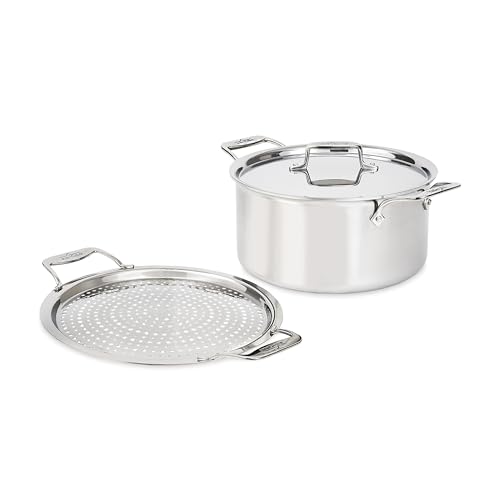
All-Clad
8-Quart Stockpot for Soups, Stews and Stock: All-Clad D5 Stainless Steel Core with Splatter Strain Lid
This 8-quart All-Clad D5 stockpot uses 5-ply bonded construction with a stainless steel core that spreads heat evenly across the base and up the walls, so long-simmered stocks and stews do not scorch in hot spots. It suits cooks who batch-cook soups, stocks and braises and want an induction-ready, oven-safe pot backed by a limited lifetime warranty rather than a replaceable one.
Pros and Cons
Pros
- The stainless cooking surface browns aromatics and meat well, building fond for soups and braises.
- Made in All-Clad's Pennsylvania factory with a limited lifetime warranty behind it.
- Eight quarts handles big-batch stock, chili and pasta for a crowd in one pot.
- The strain lid doubles as a splatter guard, cutting cleanup on rolling boils.
Cons
- Handwashing is recommended, so this is not a set-and-forget dishwasher pot.
- The splatter guard lid is made in China while the pot itself is US-made, which may matter to buyers sourcing domestically.

Idomin
Kitchen Equipment Repair Bolts: Idomin D5 x 20mm 304 Stainless Steel Socket Head Shoulder Screws, M4 x 0.7mm, 5-Pack
These 304 stainless shoulder screws pair a 5mm smooth shoulder with an M4 x 0.7mm thread, giving pivoting kitchen hardware such as cart casters, cabinet hinges, and mixer arms a proper bearing surface that resists corrosion in humid, wash-down areas. Buy them if you repair or build your own kitchen equipment and need a fastener that holds torque and will not rust after repeated cleaning.
Pros and Cons
Pros
- 304 stainless is an appropriate alloy for food-prep areas and will not stain or pit near ranges and sinks.
- The precision shoulder diameter and M4 thread drop into a spec'd hole without reaming or shimming.
- The socket head lets you apply real torque with a small Allen key in cramped equipment cavities.
- The line offers multiple shoulder lengths, so reordering a matching size for the same repair is straightforward.
Cons
- The M4 thread is small and not suited to structural loads such as a wall-mounted rack carrying cast iron.
- This is general-purpose hardware rather than a purpose-built kitchen item, so measure your existing bolt against the 5mm shoulder and 20mm length before ordering.

XiaoZu
Flipping Eggs, Fish and Burgers in Cast Iron: XiaoZu Thin Flexible Stainless Steel Spatula Turner Set, Small and X-Large
The XiaoZu set pairs a thin, flexible stainless blade with a reinforced spine, so it slides under eggs, crepes and fish in cast iron without shredding them while still holding rigid enough to lift a steak. Buy it if you cook on cast iron, carbon steel or stainless and want both a small everyday turner and an extra-large one for filets and cookie sheets.
Pros and Cons
Pros
- Thin, flexible blade slides under delicate foods like eggs and crepes without tearing them.
- Silicone handle with an internal steel core stays safe on a hot pan rim and cleans in the dishwasher.
- Set covers both ends of the job with a small turner and an extra-large one for filets and steaks.
- Stainless build stands up to cast iron use that warps or melts nylon turners.
Cons
- The metal edge will scratch nonstick coatings, so it is limited to cast iron, carbon steel and stainless pans.
- The extra-large turner is oversized for small skillets and eats up drawer space.

Tramontina
Everyday Omelettes and Searing: Tramontina Signature Tri-Ply Clad 10-Inch Stainless Steel Frying Pan
This 10-inch tri-ply clad skillet wraps an aluminum core in 18/10 stainless steel so heat spreads evenly across the base instead of pooling in hot spots. Buy it if you want one induction-compatible, oven-safe skillet for eggs, sauces, and pan sauces that will not warp or peel like nonstick.
Pros and Cons
Pros
- Tri-ply clad construction runs the aluminum core through the pan for consistent heat rather than a disc bonded only to the base.
- The 10-inch diameter gives enough surface for a three-egg omelette or two chicken breasts without crowding.
- Backed by a lifetime warranty, which signals confidence in the Brazilian-made build.
- Induction compatibility and a 500°F oven rating make it usable across nearly any cooking setup.
Cons
- Bare stainless steel is not nonstick, so eggs and fish require proper preheating and fat to release cleanly.
- No lid is included, which limits it for covered braising or steaming without buying a separate 10-inch lid.
All-Clad 8-Quart Stockpot for Soups, Stews and Stock: All-Clad D5 Stainless Steel Core with Splatter Strain Lid
All-Clad
8-Quart Stockpot for Soups, Stews and Stock: All-Clad D5 Stainless Steel Core with Splatter Strain Lid
This 8-quart All-Clad D5 stockpot uses 5-ply bonded construction with a stainless steel core that spreads heat evenly across the base and up the walls, so long-simmered stocks and stews do not scorch in hot spots. It suits cooks who batch-cook soups, stocks and braises and want an induction-ready, oven-safe pot backed by a limited lifetime warranty rather than a replaceable one.
$349.95 at AmazonEditors' Favorite
Color: Silver Size: 8 Quart Dimensions: 15 x 13.5 x 8.11 inches Weight: 13.00065959014 pounds Product Group: Kitchen Binding: Kitchen
Shop NowIdomin Kitchen Equipment Repair Bolts: Idomin D5 x 20mm 304 Stainless Steel Socket Head Shoulder Screws, M4 x 0.7mm, 5-Pack
Idomin
Kitchen Equipment Repair Bolts: Idomin D5 x 20mm 304 Stainless Steel Socket Head Shoulder Screws, M4 x 0.7mm, 5-Pack
These 304 stainless shoulder screws pair a 5mm smooth shoulder with an M4 x 0.7mm thread, giving pivoting kitchen hardware such as cart casters, cabinet hinges, and mixer arms a proper bearing surface that resists corrosion in humid, wash-down areas. Buy them if you repair or build your own kitchen equipment and need a fastener that holds torque and will not rust after repeated cleaning.
$10.69 at AmazonGreat Value
Color: One Color Size: D5 x 20-5pcs Weight: 0.110231131 Pounds Product Group: Home Binding: Kitchen
Shop NowXiaoZu Flipping Eggs, Fish and Burgers in Cast Iron: XiaoZu Thin Flexible Stainless Steel Spatula Turner Set, Small and X-Large
XiaoZu
Flipping Eggs, Fish and Burgers in Cast Iron: XiaoZu Thin Flexible Stainless Steel Spatula Turner Set, Small and X-Large
The XiaoZu set pairs a thin, flexible stainless blade with a reinforced spine, so it slides under eggs, crepes and fish in cast iron without shredding them while still holding rigid enough to lift a steak. Buy it if you cook on cast iron, carbon steel or stainless and want both a small everyday turner and an extra-large one for filets and cookie sheets.
$15.97 at AmazonColor: Sliver Size: Medium + Large Weight: 0.72973008722 pounds Product Group: Kitchen Binding: Kitchen
Shop NowTramontina Everyday Omelettes and Searing: Tramontina Signature Tri-Ply Clad 10-Inch Stainless Steel Frying Pan
Tramontina
Everyday Omelettes and Searing: Tramontina Signature Tri-Ply Clad 10-Inch Stainless Steel Frying Pan
This 10-inch tri-ply clad skillet wraps an aluminum core in 18/10 stainless steel so heat spreads evenly across the base instead of pooling in hot spots. Buy it if you want one induction-compatible, oven-safe skillet for eggs, sauces, and pan sauces that will not warp or peel like nonstick.
$31.99 at AmazonColor: Stainless Steel Size: 10-Inch Dimensions: 18.25 x 1.88 x 10.5 inches Weight: 2.25 Pounds Product Group: Kitchen Binding: Kitchen
Shop Now



Write Your Review
No reviews yet. Be the first to share your experience!