

A cookware set with storage is any pots-and-pans set that packs away neatly, either because the pieces nest inside each other, the lids stack flat, or the set ships with a carrying bag or rack. If your cabinets are tight, nesting is the feature that matters most.
This guide explains what “with storage” really means, how to judge the options, and which kinds of sets fit which kitchens. We’ve also included two sets from our product database, each solving storage in a different way. For wider comparisons, see our best cookware set roundup.
What “with storage” actually means
Shoppers use the phrase for three different things, and mixing them up leads to disappointment. The first is nesting design, where each pot sits inside the next larger one so the whole stack takes up the footprint of the biggest pan. The second is included storage, such as a carry tote, a hanging rack or a lid organizer. The third is a built-in storage lid or container, which is rare in standard cookware.
Decide which one you need before you compare prices. A small apartment kitchen benefits from nesting. A camper or RV needs a bag. A big kitchen with a pot rack may not care at all.
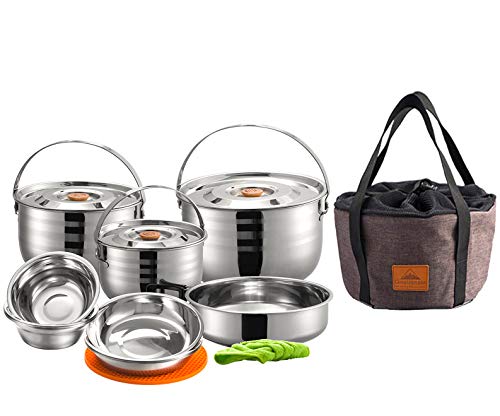
One set in our database leans hard into the bag approach. The CAMPINGMOON 16-piece camping cookware set is made of stainless steel and bundles pots, pans and bowls in a nesting mess kit, with a storage carrying tote bag included. It lists 16 pieces, so everything travels as one bundle.
camping moon CAMPINGMOON 16PCS Camping Cookware Set Stainless Steel Outdoor Nesting Cooking Mess Kit Pots Pans Bowls with Storage Carrying Tote Bag MC240
camping moon
CAMPINGMOON 16PCS Camping Cookware Set Stainless Steel Outdoor Nesting Cooking Mess Kit Pots Pans Bowls with Storage Carrying Tote Bag MC240
$84.95 at AmazonEditors' Favorite
Color: 16PCS set (MC240) Weight: 10.0751253734 pounds Product Group: Outdoors Binding: Sports
Shop NowHow to judge a set’s storage design
Start with the piece count. A set advertised as 16 pieces sounds generous, but lids, utensils and bowls count toward that number. Count the actual pots and pans, then check how many lids you’ll be juggling.
Nesting and stacking
True nesting needs pots with straight, slightly tapered walls and handles that fold, detach or sit flat. If the handles stick out at fixed angles, the stack won’t compress much. Look at the product photos and ask whether the smallest pot fits inside the next one with the lid on.
Lids
Lids are the hardest part to store. Glass lids are bulky but let you see the food. Flat lids stack neatly. Some sets share one lid across several pots, which saves space but means you can’t cover two pans at once. Think about how you actually cook before you trade lids for room.
Handles
Handles decide how a set stacks. Long, fixed handles rest on each other and waste vertical space. Short handles or detachable ones pack tighter. Check whether a handle can go in the oven, because that often depends on the material.
Match the set to where you cook
A home kitchen, a dorm and a campsite all call for different trade-offs. Here’s how to think about each.
Small kitchens and apartments
Choose fewer pieces with sensible sizes. A 10 or 11 piece set often covers everything a household cooks day to day: a couple of saucepans, a sauté pan, a stockpot and a skillet. Extra pieces just crowd the cabinet.
Big kitchens
You can afford a larger set and a hanging rack or a deep drawer. Here, material and cooking performance matter more than how tightly things nest.
Outdoor use
Camping sets are built for portability. Stainless steel is a common pick because it holds up to open flame and rough handling. Expect a lighter feel than home cookware, and remember that these sets are designed around outdoor stoves rather than induction cooktops.
A home set that still stacks well
If you want a full home set rather than a camp kit, a smaller coated set is a sensible middle path. The Ninja Ceramic Pro 11-piece cookware set is described as a non-stick pots and pans set with glass lids. Its listing also says it’s nontoxic, PTFE free, ceramic coated, oven safe, and compatible with all stovetops including induction.
The listing doesn’t promise a storage bag or a nesting design, so treat it as a regular home set and check the dimensions before you buy. Eleven pieces is a manageable count, though glass lids take more room than flat ones. It comes in Midnight Blue and Steam White. At a listed price near $359.99 it’s an investment, so weigh that against what you’d spend on a simpler set. Our best nonstick cookware set page compares more coated options.

Ninja
PTFE-Free Nonstick for Everyday Searing and Simmering: Ninja Ceramic Pro 11-Piece Cookware Set CW39011MM, Induction Ready
This four-vessel Ninja set covers frying, sauteing, saucepan work, and stockpot batches with a titanium-infused ceramic surface Ninja rates 5x more scratch resistant and 3x more scrub resistant than Caraway ceramic cookware. It suits cooks replacing worn PTFE pans who want nonstick that tolerates metal utensils, dishwasher cycles, and broiling to 550F under a 10-year nonstick guarantee.
Pros and Cons
Pros
- Ninja backs the cooking surface with a 10-year nonstick guarantee, which is unusually long for ceramic coatings.
- Flat, fitted tempered glass lids stack cleanly in a cabinet and let you monitor a simmer without lifting.
- Dishwasher safe and stain resistant, so tomato sauce and turmeric cleanup does not require hand scrubbing.
- Warp resistant body keeps the pan flat on induction and glass tops, maintaining full contact for even searing.
Cons
- The piece count includes lids and guides, so you get only four cooking vessels: a 10.25 inch fry pan, 3qt saute pan, 2qt saucepan, and 6qt stock pot, with no second skillet for parallel cooking.
- Ceramic coatings lose slickness faster than PTFE when run at high heat, so daily ripping-hot searing will shorten the nonstick life despite the durability claims.
Ninja PTFE-Free Nonstick for Everyday Searing and Simmering: Ninja Ceramic Pro 11-Piece Cookware Set CW39011MM, Induction Ready
Ninja
PTFE-Free Nonstick for Everyday Searing and Simmering: Ninja Ceramic Pro 11-Piece Cookware Set CW39011MM, Induction Ready
This four-vessel Ninja set covers frying, sauteing, saucepan work, and stockpot batches with a titanium-infused ceramic surface Ninja rates 5x more scratch resistant and 3x more scrub resistant than Caraway ceramic cookware. It suits cooks replacing worn PTFE pans who want nonstick that tolerates metal utensils, dishwasher cycles, and broiling to 550F under a 10-year nonstick guarantee.
$359.99 at AmazonEditors' Favorite
Color: Midnight Blue Size: 11-piece Weight: 18.3 Pounds Product Group: Kitchen Binding: Kitchen
Shop NowMaterials and how they affect storage
Material changes weight, durability and how carefully you have to stack. Stainless steel is tough and can be stacked without much worry, though pieces may scratch each other over time. Ceramic coated pans are more sensitive. If you nest them, the cooking surface can get scuffed by the base of the pan above it.
The fix is cheap. Slip a paper towel, a felt pan protector or a thin dish cloth between each nested piece. It takes seconds and protects the coating for years of use. Hang-up storage avoids the issue entirely, but only if you have wall or ceiling space.
Weight matters too. A heavy 11-piece set on a high shelf is a strain to reach. Put the pieces you use most, usually the skillet and the medium saucepan, at waist height and keep the stockpot low.
Simple ways to store cookware you already own
You don’t always need a new set. Often a small change solves the problem. A vertical divider turns a deep cabinet into slots for pans, so you can pull one out without lifting the rest. A door-mounted lid rack frees a surprising amount of shelf space. A pull-out shelf puts the back corner within reach.
If you do buy new, think about the whole system. A set that nests well but needs a rack you don’t have isn’t really saving you anything. Add the cost of any organizer to your budget up front, and measure the space it will sit in. Small prep done now saves a lot of rearranging later.
For campers, the logic flips. Pack the heaviest pot at the bottom of the bag, nest the bowls and lids inside, and keep utensils in the gap. A compact kit is easier to load into a car, a canoe or a backpack.
Common mistakes when buying for storage
The biggest one is buying by piece count. A 20-piece set sounds like a bargain until you realize half of it is lids, spoons and trivets. Another is ignoring your stovetop. If you cook on induction, check the listing for induction compatibility, because not every set works.
People also forget to measure. Open your cabinet, note the height and depth, and compare it to the stack height. Skip this step and you’ll end up with pans living on the counter.
A fourth mistake is choosing on looks alone. Color is nice. Cabinet fit is better. Finally, don’t pay extra for storage features you won’t use, such as a travel bag for a set that never leaves your stove. If budget is the real constraint, browse best cookware set under 100 and best cookware set under 200.
When to replace or upgrade your current set
Replace cookware when the coating flakes, the base warps so the pan rocks on the burner, or handles get loose. Those are safety and performance issues, not cosmetic ones. If you’re replacing for health reasons, our best non-toxic cookware set guide is a good next stop.
Upgrading to save space is a fair reason too. If your current pots don’t nest, a compact set can free up a whole shelf. Induction owners should read best induction cookware set before they commit.
FAQ
What is a cookware set with storage?
It’s a set designed to pack away compactly. That can mean nesting pots, stackable lids, or an included bag or rack. Check which of those a specific set offers before you buy.
Do nesting pots work on every stove?
No. Nesting is a shape feature, not a stovetop rating. Always read the listing for gas, electric or induction compatibility. The Ninja set above, for example, states compatibility with all stovetops and induction.
How many pieces do I need?
Most households do well with 10 to 12 pieces. That usually covers saucepans, a skillet, a sauté pan and a stockpot with lids. More than that tends to add clutter.
Is a camping cookware set okay for home use?
It can work for small jobs, but camp sets are built for portability and outdoor stoves. For daily cooking, a home set with a flat, stable base is usually the better fit.
Where should I store cookware lids?
A vertical lid organizer inside the cabinet or on the door keeps them flat and easy to grab. Stacking lids on top of each other works if they’re the same size. Mixed sizes slide around.


Write Your Review
No reviews yet. Be the first to share your experience!