

TL;DR — Cookware sizes are measured two ways: pans by top diameter in inches or centimeters, and pots by capacity in quarts or liters. The diameter on the box is the rim, not the smaller flat cooking surface, so an 8-inch pan really only cooks on about 6 inches. Most home cooks are well served by an 8-inch and a 10- or 12-inch frying pan, a 2-quart and 3-quart saucepan, and a 6- to 8-quart stockpot. Match sizes to how many people you cook for and to your burner diameters. A good cookware set bundles the essential sizes together at a lower cost than buying each piece separately. For picks, see our best cookware sets guide.
The HomeWhisk editorial team researches kitchen equipment by analyzing manufacturer dimension specs, material behavior, and aggregated owner feedback from major retailers and cooking communities. Cookware sizing confuses a lot of shoppers because the industry mixes units — pans in inches, pots in quarts, European brands in centimeters and liters — and because the headline number rarely matches the actual usable cooking area. This guide explains what each measurement means, the common sizes and what they’re for, and how to pick the right combination for your kitchen.

CAROTE
Everyday Cooking and Baking Set: CAROTE 44-Piece Granite Nonstick Cookware Set
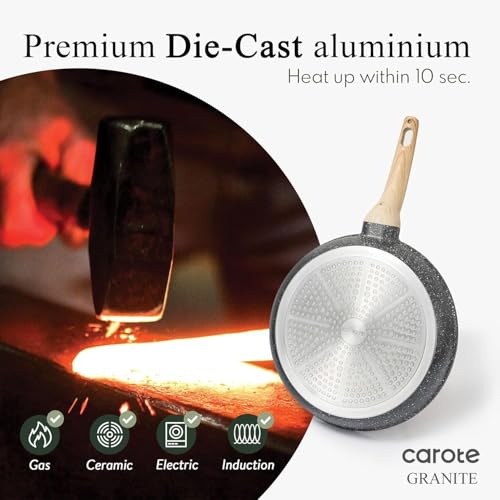
The CAROTE 44-piece set handles stovetop cooking and baking with reinforced die-cast aluminum, fast even heating, and a granite nonstick surface. It suits home cooks who want one lightweight, induction-compatible collection covering pans, pots, bakeware, knives, utensils, and storage.
Pros and Cons
Pros
- The set includes multiple frying pans, saucepans, stockpots, a sauté pan, steamer, and matching lids.
- Its induction-compatible extended bottom broadens cooktop compatibility.
- The lightweight die-cast aluminum construction is easier to handle than heavier cookware materials.
- A 12-month warranty provides coverage for quality problems.
Cons
- Hand washing is recommended, so the set is less convenient for buyers who prefer a dishwasher.
- The large assortment requires more storage space than a basic cookware collection.

Astercook
Space-Saving Everyday Cooking: Astercook 23-Piece Ceramic Nonstick Cookware Set with Removable Handle
The Astercook 23-piece set handles everyday stovetop cooking while its removable handle saves cabinet space and simplifies cleaning. It suits cooks with compact kitchens, RVs, or induction, gas, and ceramic cooktops who want versatile stackable cookware.
Pros and Cons
Pros
- The PFOA-free nonstick coating supports easier cooking and cleanup.
- The removable handle improves storage flexibility for small kitchens and RVs.
- The set works with induction, gas, and ceramic hobs.
- The cookware is designed to stack and is oven safe.
Cons
- The listing does not provide pot and pan dimensions or weights, making capacity planning difficult.
- The handle must be removed for the compact storage and cleaning benefits.
The Best Deals This Week*
-
Everyday Cooking and Baking Set
$199.97
($329.99)Save $130.02 -
Nutrichef 54-Piece Marble Non-Stick Cookware
$249.99
($288.99)Save $39.00 -
Space-Saving Everyday Cooking
$79.99
($129.99)Save $50.00
*Deals are selected by our commerce team
CAROTE Everyday Cooking and Baking Set: CAROTE 44-Piece Granite Nonstick Cookware Set
CAROTE
Everyday Cooking and Baking Set: CAROTE 44-Piece Granite Nonstick Cookware Set
The CAROTE 44-piece set handles stovetop cooking and baking with reinforced die-cast aluminum, fast even heating, and a granite nonstick surface. It suits home cooks who want one lightweight, induction-compatible collection covering pans, pots, bakeware, knives, utensils, and storage.
Check price on AmazonThe CAROTE 44-piece collection combines cookware, bakeware, knives, utensils, a steamer, a container, and pan protectors to reduce the need to assemble a kitchen set piece by piece.
Its granite nonstick surface is designed for easier food release, while the extended bottom supports quick, even heating on induction and other cooktops.
Reinforced die-cast aluminum keeps the cookware lightweight while adding durability. Included cookware ranges from an 8-inch frying pan to a 6.5-quart stockpot.
Hand washing is recommended, so buyers seeking dishwasher convenience may prefer a different set.
Verdict: best for home cooks who want a broad, lightweight cookware and baking collection for an induction-compatible kitchen.
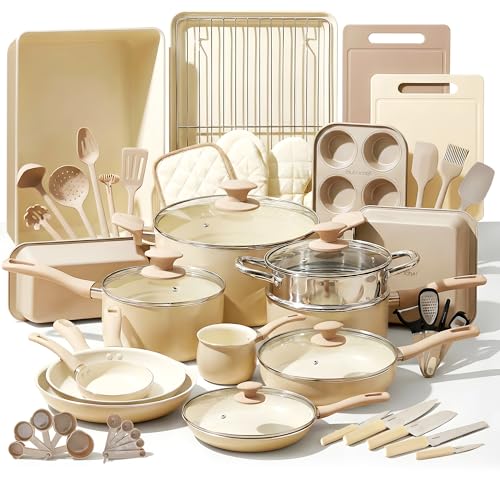
NutriChef 54-Piece Marble Non-Stick Cookware and Bakeware Set, Professional Home Kitchen Collection with Multi-Sized Pots and Pans Set, and Heat-Resistant Tools
NutriChef
54-Piece Marble Non-Stick Cookware and Bakeware Set, Professional Home Kitchen Collection with Multi-Sized Pots and Pans Set, and Heat-Resistant Tools
Check price on AmazonAstercook Space-Saving Everyday Cooking: Astercook 23-Piece Ceramic Nonstick Cookware Set with Removable Handle
Astercook
Space-Saving Everyday Cooking: Astercook 23-Piece Ceramic Nonstick Cookware Set with Removable Handle
The Astercook 23-piece set handles everyday stovetop cooking while its removable handle saves cabinet space and simplifies cleaning. It suits cooks with compact kitchens, RVs, or induction, gas, and ceramic cooktops who want versatile stackable cookware.
Check price on AmazonThis 23-piece Astercook cookware set addresses crowded cabinets with detachable handles and stackable cookware for compact kitchens and RVs.
The nonstick coating supports easier food release and cleanup, while the secure locking handle provides a stable grip during stovetop cooking.
Aluminum construction keeps the set focused on practical daily use, with compatibility across induction, gas, and ceramic cooktops.
The listing does not specify individual cookware dimensions, weights, or oven-safe temperature limits.
Best for space-conscious cooks who need versatile cookware across multiple cooktop types.
How Cookware Is Measured: Diameter vs. Capacity
There are two systems, and knowing which applies to which piece prevents most sizing mistakes.
Frying pans and skillets are measured by top diameter — the distance across the outer rim, given in inches (US) or centimeters (Europe). The catch: because a frying pan has sloped, flared sides, the flat cooking surface at the bottom is significantly smaller than the rim. An 8-inch pan typically has only about a 6-inch flat base; a 12-inch pan, roughly a 9- to 10-inch base. When you’re judging how many eggs or chops actually fit, think in terms of that base, not the advertised rim.
Pots, saucepans, and stockpots are measured by capacity — volume in quarts (US) or liters (Europe). Roughly, 1 quart is a bit under 1 liter (0.95 L), so a 6-quart pot is about 5.7 liters. Capacity tells you how much liquid or food the pot holds but says nothing about its footprint on the burner, which is why two pots of the same quart rating can be tall-and-narrow or wide-and-shallow. Getting this two-system distinction right is the foundation of choosing a balanced set — the kind our best cookware sets guide is built around.
Frying Pan and Skillet Sizes
Frying pans are the workhorses, and most kitchens want two or three sizes.
- 8-inch (20 cm): small, single-serving pan. Ideal for one or two eggs, toasting spices, a grilled cheese, or a small sauté. Its ~6-inch base can’t sear more than one portion without crowding.
- 10-inch (26 cm): the most versatile everyday size for one to two people. Handles a couple of chicken breasts, a two-egg omelet, or vegetables for two.
- 12-inch (30 cm): the family and searing pan. Its wide base browns food properly instead of steaming it, and it’s the right size for a stir-fry, a family portion of protein, or a full pan of vegetables. If you buy one pan, many cooks argue for this one.
- 14-inch and larger: batch cooking and entertaining, but these can overhang standard burners and heat unevenly.
The key sizing principle for searing: don’t crowd the pan. Food needs space to release steam and brown, so err toward a larger pan for proteins. If you cook mostly for one or two, an 8-inch plus a 12-inch covers nearly everything. For nonstick versions of these sizes, see our best nonstick cookware guide.
Saucepan, Sauté Pan, and Pot Sizes
Beyond frying pans, the pots handle liquids, grains, sauces, and braises.
- 1 to 1.5-quart saucepan: small jobs — melting butter, a single serving of oatmeal, reheating, or a small sauce.
- 2 to 3-quart saucepan: the everyday saucepan. Rice for a family, boiling a few eggs, blanching vegetables, a batch of sauce. A 3-quart is the most-reached-for pot in many kitchens.
- 3 to 4-quart sauté pan: wide with straight sides and a lid, bridging skillet and pot. Great for braising chicken thighs, a one-pan pasta, or shallow frying, since the straight sides hold more liquid than a sloped skillet.
- 5 to 6-quart Dutch oven / casserole: for soups, stews, braises, and batch cooking; a heavy one holds heat well for low-and-slow dishes.
- 6 to 8-quart stockpot: pasta for a crowd, stock, soups, boiling corn, or canning. An 8-quart suits most families; larger 12-quart-plus pots are for stock-making and big batches.
A saucepan measures by volume but also has a diameter that must fit your burner, which is where cooktop compatibility comes in. Multi-cookers overlap with this category too — our best instant pot guide covers the 6- and 8-quart sizes that mirror stockpot capacities.
Matching Cookware Size to How Many You Cook For
The most useful way to choose sizes is by household and cooking style, not by guessing.
- One or two people: an 8-inch and a 10- or 12-inch skillet, a 2-quart and a 3-quart saucepan, and a 6-quart pot handle almost everything without wasting energy heating oversized pans.
- Family of four: step up the main pieces — a 12-inch skillet, a 3-quart saucepan, a 3- to 4-quart sauté pan, and an 8-quart stockpot. The wider skillet matters most, because four portions of protein need base area to brown rather than steam.
- Entertaining or batch/meal prep: add capacity — a 12- to 14-inch skillet or wide sauté pan, a large 8- to 12-quart stockpot, and a big Dutch oven. Batch cooking rewards width (more searing surface) and volume (fewer rounds).
A common mistake is buying pans that are too small and then overcrowding them, which steams food gray instead of browning it. When in doubt for proteins and sautéing, size up. Sets are the efficient way to get this spread of sizes at once, which our best cookware sets guide focuses on.
Cooktop Compatibility and Building a Practical Set
Two sizing factors get overlooked until something doesn’t fit.
Match pan diameter to your burner. A pan much wider than the burner heats unevenly, with a hot center and cool edges; a pan much smaller than the burner wastes energy and can scorch handles. On induction, the pan base should roughly match the element to trigger and heat evenly. Measure your burners before buying oversized pans, and check that your largest stockpot fits between burners without overhanging.
Build a practical size combination rather than collecting duplicates. A solid core kit is: 8-inch and 12-inch skillets, 2-quart and 3-quart saucepans (with lids), a 3- to 4-quart sauté pan or Dutch oven, and a 6- to 8-quart stockpot. That set covers the large majority of home cooking. Specialty vessels — a best moka pot for stovetop espresso, or a best camping cookware kit for the outdoors — sit outside the core set and are bought for their specific job. For premium materials, our best copper cookware guide covers responsive copper pieces in these same sizes.
Frequently Asked Questions
What size frying pan should I buy?
For most kitchens, a 10-inch pan is the versatile everyday choice for one to two people, and a 12-inch is the best all-rounder for families and for searing, because its wide base browns food instead of steaming it. Add an 8-inch pan for small jobs like a couple of eggs. Remember the advertised size is the rim diameter, not the smaller flat cooking base — an 8-inch pan only cooks on about 6 inches — so err larger for proteins. If you buy just one pan, a 12-inch covers the widest range of tasks.
What size saucepan do I need?
A 2- to 3-quart saucepan is the everyday size most cooks reach for — enough for rice for a family, boiling eggs, blanching vegetables, or a batch of sauce. Add a small 1- to 1.5-quart pan for melting butter, single servings, and reheating. For larger households, a 4-quart saucepan or sauté pan adds capacity for one-pot meals. Saucepans are measured by volume in quarts or liters (a quart is just under a liter), but also check the diameter fits your burner so it heats evenly.
What size cookware is best for cooking for four?
A family of four is well served by a 12-inch skillet, a 3-quart saucepan, a 3- to 4-quart sauté pan or Dutch oven, and a 6- to 8-quart stockpot. The wide skillet is the most important upgrade, because four portions of meat need base area to brown rather than crowd and steam. An 8-quart stockpot handles pasta and soup for the whole table. This combination covers weeknight dinners through batch cooking, and buying it as a set is usually cheaper than assembling the pieces individually.
How do I choose the right pan size for my cooktop?
Match the pan’s base diameter to your burner or element. A pan much larger than the burner develops a hot center and cool edges and cooks unevenly; a pan much smaller wastes heat and can scorch the handle and sides. On induction, the base should roughly cover the element to register and heat efficiently. Measure your burners before buying wide pans, and confirm your biggest stockpot fits without overhanging neighboring burners. If your cooktop has one large and several small burners, size your skillets to the large one.
What size stock pot do I need?
A 6- to 8-quart stockpot suits most families for pasta, soups, boiling corn, and small batches of stock. An 8-quart is a safe all-round choice. If you regularly make large batches of stock, cook for crowds, or do water-bath canning, step up to a 12-quart or larger pot. Smaller households can manage with a 4- to 6-quart pot. Because stockpots are tall, remember that capacity (quarts or liters) matters more than footprint here, but the base still needs to sit properly on your burner.
Are cookware sets or individual pieces better value?
For most people, a set is the better value and the easiest way to get a balanced spread of sizes at once — sets bundle the essential skillets, saucepans, and a stockpot for less than buying each separately, and the pieces share a matching design and often nesting storage. Buy individual pieces when you have a specific gap to fill, want a particular size or material a set doesn’t include, or need a higher-quality version of one workhorse pan. Many cooks start with a set and add specialty pieces over time.
The Bottom Line
Cookware sizing comes down to two systems — pans by rim diameter, pots by capacity — and remembering that the advertised number overstates the true cooking area on a sloped pan. Build around a practical core: 8-inch and 12-inch skillets, 2- and 3-quart saucepans, a sauté pan or Dutch oven, and a 6- to 8-quart stockpot, scaled up for bigger households and batch cooking. Match every piece to your burner size so it heats evenly, and size up for searing so food browns instead of steaming. A well-chosen set delivers all the essential sizes efficiently, with specialty pieces added as your cooking demands them. For picks, see our best cookware sets and best nonstick cookware guides.


Write Your Review
No reviews yet. Be the first to share your experience!