

TL;DR — Ceramic knife reviews is one of those kitchen questions where the useful answer is usually more practical than complicated. The right move depends on how you cook, what you already own, and how much maintenance you are willing to do. When this turns into a purchase decision, compare best chef knife, best knife sets, and best bread knife before narrowing your shortlist.
The HomeWhisk approach is research-first: compare construction, usability, cleaning, and long-term complaints before recommending a direction. For knife topics, the details that usually matter are edge geometry, steel, handle comfort, sharpening habits, and whether the knife suits the cuts you make most often.


Eocogup
Ceramic Kitchen Knives for Fruit, Veg and Bread Prep: Eocogup 4-Piece Colored Knife Set with Sheaths
This four-piece ceramic knife set slices fruit, vegetables, bread and boneless meats with blades that stay sharp for years without a whetstone, at under half the weight of comparable steel knives. It suits cooks with wrist fatigue or arthritis who do long prep sessions, and anyone who wants color-coded blades to keep raw meat and produce separate.
Pros and Cons
Pros
- Non-reactive blades rinse clean quickly and leave no metallic taste on citrus or tomatoes.
- Four sizes cover most everyday prep tasks without buying a full block set.
- Sheath covers mean the knives can live in a drawer without dulling or posing a grab hazard.
- Light weight makes the set easier to control for smaller hands and cooks with joint pain.
Cons
- Ceramic is brittle, so the blades cannot be used on frozen food, bones, hard squash, or for smashing garlic without risking chips.
- A chipped or dulled ceramic edge cannot be fixed with a standard home sharpener and usually means replacing the knife.
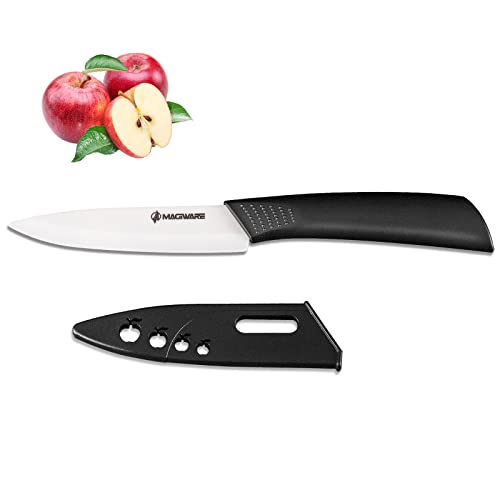
Magiware
Fruit and Vegetable Prep: Magiware Classic 4-Inch Ceramic Paring Knife with Sheath
The Magiware Classic 4-inch ceramic paring knife handles fruit, vegetables, slicing, mincing, and dicing while resisting rust, stains, and food odors. It suits shoppers who want a lightweight small knife with a textured non-slip handle and a blade designed to stay sharp longer.
Pros and Cons
Pros
- Ceramic construction resists corrosion and staining.
- The compact 4-inch size supports controlled fruit and vegetable preparation.
- The textured ergonomic handle provides a more secure grip.
- The sheath adds convenient blade protection between uses.
Cons
- Its 4-inch blade is intended for small or intricate kitchen work rather than large foods.
- The product data does not specify weight or dishwasher suitability.
Eocogup Ceramic Kitchen Knives for Fruit, Veg and Bread Prep: Eocogup 4-Piece Colored Knife Set with Sheaths
Eocogup
Ceramic Kitchen Knives for Fruit, Veg and Bread Prep: Eocogup 4-Piece Colored Knife Set with Sheaths
This four-piece ceramic knife set slices fruit, vegetables, bread and boneless meats with blades that stay sharp for years without a whetstone, at under half the weight of comparable steel knives. It suits cooks with wrist fatigue or arthritis who do long prep sessions, and anyone who wants color-coded blades to keep raw meat and produce separate.
$16.88 at AmazonEditors' Favorite
Color: Multicolour Size: 3", 4", 5", 6" Weight: 0.73 pounds Product Group: Kitchen Binding: Kitchen
Shop NowMagiware Fruit and Vegetable Prep: Magiware Classic 4-Inch Ceramic Paring Knife with Sheath
Magiware
Fruit and Vegetable Prep: Magiware Classic 4-Inch Ceramic Paring Knife with Sheath
The Magiware Classic 4-inch ceramic paring knife handles fruit, vegetables, slicing, mincing, and dicing while resisting rust, stains, and food odors. It suits shoppers who want a lightweight small knife with a textured non-slip handle and a blade designed to stay sharp longer.
$7.96 at AmazonGreat Value
Color: White Size: 4" Dimensions: 8.267716527 x 0.9842519675 x 0.68897637725 inches Product Group: Kitchen Binding: Kitchen
Shop NowVos Ceramic Paring Knife - 4 Inch Zirconia Blade With Sheath Cover - Handle Fruit and Vegetables Kitchen Knife (Green)

Vos
Ceramic Paring Knife - 4 Inch Zirconia Blade With Sheath Cover - Handle Fruit and Vegetables Kitchen Knife (Green)
$8.98 at AmazonColor: Green Size: 4 inches Dimensions: 4 x 0.2 x 0.2 inches Weight: 0.14991433816 Pounds Product Group: Kitchen Binding: Kitchen
Shop NowMaterials That Matter
Material decides how a ceramic knife performs and lasts: it drives edge retention, and tang construction and how much hand-washing and drying immediately it demands. There is rarely one best material — each trades cost against durability and upkeep, so pick for how you actually cook. If you are shopping, our best chef knife and best knife sets guides are the fastest way in.
How To Get It Right
Think through the whole workflow: honing before each use, hand-washing and drying immediately, and oiling carbon steel after washing. A kitchen knife that fits your routine and cleanup habits beats a technically superior one you fight with. We cover specific models in best chef knife, best knife sets, and best bread knife.
Common Misconceptions
The biggest myth is that the most expensive kitchen knife is automatically the best for you. In reality, the right choice depends on grind type, and weight and heft — plus your own habits. Another trap is buying by brand alone — the same maker sells both excellent and forgettable lines.
What To Look For
Hold a kitchen knife to a short checklist: fit, control, cleanup, and durability. Those are the variables that decide whether it earns a spot in your kitchen or ends up unused. Ignore cosmetic upgrades until the fundamentals check out.
Related Product Guides
If this topic is part of a buying decision, these are the HomeWhisk guides most closely tied to it:
Frequently Asked Questions
Which material is best for a ceramic knife?
It depends on your priorities around blade steel and hardness, and edge retention. See best chef knife and best knife sets for how materials play out in real models.
Who is this most useful for?
Mainly anyone breaking down whole vegetables or proteins, and cooks moving up from a dull starter set. If that is you, treat tang construction as a requirement rather than a nice-to-have.
How do I keep it in good shape?
Build keeping the edge off hard cutting boards, and hand-washing and drying immediately into normal cleanup. Light, consistent care prevents pitting along the bevel far better than occasional deep effort.
What matters most for ceramic knife?
Focus on spine thickness, edge geometry and bevel angle, and edge retention first. Those decide real performance; the rest is secondary. Compare best chef knife and best knife sets for options that get the basics right.
What should I avoid?
Avoid buying by brand alone, ignoring periodic sharpening on a whetstone, and oversizing for your space. Each invites bent or wavy tips down the line.
The Bottom Line
For most home cooks, the best choice is the one that removes friction without adding maintenance you will ignore. Start with your use case, then cross-check best chef knife, best knife sets, and best bread knife.






Write Your Review
No reviews yet. Be the first to share your experience!