

A recipe calls for an 8×8 pan. Your cupboard holds a 9×13, a 9-inch round, and a battered loaf tin, and not one of them is the pan being asked for. The substitution that follows usually gets made on instinct, and instinct is wrong about bakeware more often than almost anything, because pans are sold by their sides while batter responds only to area and depth. Two labels that look half an inch apart can describe pans that differ by a quarter of their capacity.
Nearly every bad brownie conversion traces back to a short list of beliefs that sound sensible right up to the moment somebody multiplies. What follows states each one plainly, then corrects it with the actual numbers, so the next swap you make rests on a ratio instead of a hunch. The arithmetic is small: length times width for a rectangle, pi times the radius squared for a round, one division at the end.
Start With One Division
Every pan swap collapses into a single ratio: the area of the pan you own divided by the area of the pan the recipe wants. An 8×8 is 64 square inches. A 9×13 is 117. Divide 117 by 64 and the answer is 1.83, and that number is what you multiply the batter volume by if you want the same depth in the larger pan. Run it backwards and the rule holds: a 9×13 recipe moved into an 8×8 keeps about 55 percent of the batter.
Time is the one figure that refuses to scale. It tracks depth rather than area, and it answers to the pan and the oven in ways no ratio predicts, so the rule is to check early rather than compute. Set a timer ten minutes before the recipe’s stated minimum and look. For brownies the signal is a toothpick with moist crumbs clinging to it; a clean one means you are already past the point where the middle was fudgy, and cooling will not bring it back.
The 9×9 Is Not an 8×8 With Elbow Room
The first belief is that a 9×9 is basically an 8×8, near enough that nobody needs to think about it. It is 27 percent larger. Sixty-four square inches against eighty-one, and that gap is a full quarter of the pan. The batter you mixed for the smaller pan does not politely stay put; it spreads and settles thinner, and a thinner layer bakes faster.
A second consequence shows up on the plate. A 9×9 has more perimeter serving less interior, so the ratio of chewy edge to soft centre shifts toward edge. The adjustment is not a temperature change. Keep the oven where the recipe set it and start checking eight to ten minutes early, because heat reaching a shallower slab finishes the job sooner than the clock says.
Related and just as expensive is the belief that doubling a recipe means doubling the pan. Areas scale, sides do not. A 9×13 measures 117 square inches, which is 1.83 times an 8×8 rather than two times it, so a doubled 8×8 batch, 128 square inches’ worth of batter at the original depth, arrives in a pan offering only 117 to spread across. The result sits roughly 10 percent deeper than the recipe was written for and wants about five to ten extra minutes. That is a manageable error, but if you want a doubled batch to behave exactly like the single one, the honest answer is two 8×8 pans.
Squares and Circles Do Not Match by Name
Here is the belief that gets reversed most often: that a round pan and a square pan carrying the same number are interchangeable. They are not, and the mistake runs in the opposite direction from what most people assume. A 9-inch round is about 63.6 square inches, pi times 4.5 squared, which puts it within half a square inch of an 8×8’s 64. The correct substitute for an 8-inch square is therefore a 9-inch round, and it is close enough to pour and bake with no adjustment.
Run the other pairing and the error surfaces. A 9×9 is 81 square inches, 27 percent more than the 9-inch round, so treating them as equivalent shorts or floods the pan by a quarter. The 8-inch round is the real trap: pi times 4 squared is about 50 square inches, roughly 22 percent smaller than the 8×8 sharing its number. Ask 50 square inches to hold 64 worth of batter and it climbs the rim, and whatever stays inside bakes into a domed centre with scorched edges.
Depth Runs the Bake, Not Area
Matching area feels like the finish line and it is half the calculation. Depth decides what happens in the oven more than area does, because heat travels inward from the surfaces and the middle of the slab is the last place it arrives. Roughly one inch of batter bakes through in the time a standard brownie recipe assumes. Push that to an inch and a half and the centre falls behind while the edges keep cooking on schedule, and the instinct to simply add ten minutes turns the outer two inches into something you cut around. The better correction is dropping the oven 15 to 25°F and extending the time, which lets heat reach the middle before the edges are finished.
Which raises how much batter a pan should get at all. Two-thirds full is the working ceiling for anything chemically leavened, and brownies carrying baking powder count. Above two-thirds you get some combination of overflow and a domed, cracked top, because the batter still has lift left when it runs out of pan. Converting the other way has its own floor: a batter filling less than about half the pan’s depth bakes as a thin slab that dries through, and the edges harden and pull away before the centre has set into anything worth eating.
Size also decides what happens after the pan leaves the oven, which is why two batches pulled at the identical toothpick reading finish differently. A large thin slab sheds heat quickly and sets within a few minutes on the rack. A deep bake in a small pan holds enough residual heat to keep cooking its own middle for 20 to 30 minutes, so it should come out looking slightly underdone and then be left alone.
Glass Pans and Loaf Tins, Both Underestimated
Two beliefs remain. The first says glass and ceramic bake like metal as long as the dimensions match. They do not: both heat more slowly and then hold that heat far longer, so lower the oven roughly 25°F, expect the bake to run past the stated time, and expect genuine carryover. A glass pan keeps cooking its own edges for several minutes on the counter, which means the reading that looked correct in the oven has moved by the time you cut.
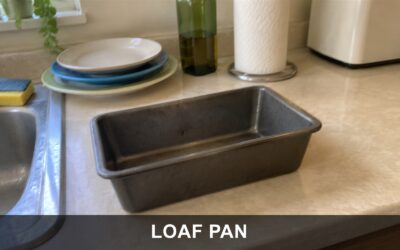
The second says brownies require a brownie pan, and arithmetic disposes of it. A quarter sheet at roughly 9.5 by 13 inches works out to about 124 square inches, which spreads a doubled 8×8 batch into a thin slab with crisp edges throughout and little soft middle, so check it 12 to 15 minutes early. A 9×5 loaf tin runs the other way entirely at about 45 square inches. An 8×8’s batter poured in there sits more than 40 percent deeper than intended, which turns brownies into a dense fudgy bar wanting the oven dropped 25°F and something like half again the original time.
Frequently Asked Questions
Can I use a 9×9 pan when the recipe calls for an 8×8?
Yes, with one adjustment. The 9×9 gives you 81 square inches against the 8×8’s 64, so the same batter spreads 27 percent wider and correspondingly shallower, closer to three-quarters of an inch than a full inch in most brownie recipes. Leave the oven temperature alone and start checking eight to ten minutes before the recipe’s earliest stated time. Expect a chewier tray overall, since the wider pan hands you more edge per square inch of centre. If you want the original texture instead, scale the batter up by 1.27 and the depth returns to where the recipe wanted it.
How do I scale batter between a round pan and a square one?
Convert both pans to square inches first, then divide. A square is length times width; a round is pi times the radius squared, so a 9-inch round is 3.14 times 4.5 squared, or about 63.6 square inches. Divide the target area by the original area and multiply your batter volume by the figure you get. Going from an 8×8 at 64 square inches to a 10-inch round at about 78.5 gives a ratio of 1.23, so make 23 percent more batter to hold the same depth. Ignore the numbers printed on the pans, because only the areas govern the outcome.
Why did my converted brownies burn at the edges while the middle stayed raw?
That pattern is almost always depth rather than temperature. Batter deeper than about an inch and a quarter needs longer than the recipe allows, and adding that time at the original setting cooks the edges well past done before the centre catches up. Drop the oven 15 to 25°F and give it the extra minutes instead, so heat has a chance to travel inward. Check also whether you exceeded two-thirds of the pan’s depth, the point where a leavened batter starts doming and cracking. If the pan was glass, subtract another 25°F and account for the carryover that keeps the edges cooking on the counter.

Tiawudi
12-Cavity Mini Brownie and Loaf Pan Set: Tiawudi 2-Pack Non-Stick Carbon Steel Bakeware
This two-pack of 12-cavity carbon steel pans bakes 24 individual brownies, mini loaves, or muffins at once, with a non-stick coating that releases squares without cutting or prying. Buy it if you bake in batches for a family, potluck, or bake sale and want every portion to have crisp edges instead of fighting over the corner pieces.
Pros and Cons
Pros
- Portion-sized cavities skip the cooling, cutting, and crumbling step that comes with slab-baked brownies.
- Carbon steel construction resists warping better than thin aluminum trays at high oven temperatures.
- At 14 x 10 1/2 inches, both pans fit side by side on most standard oven racks.
- Arrives in a gift-ready box, so it works as a present without extra wrapping.
Cons
- Hand washing is recommended, so these will not go in the dishwasher with the rest of your bakeware.
- The 1-inch depth limits rise height, making these better suited to brownies and bars than tall muffins or full-size loaves.

AOTASO
12-Cup Silicone Mini Brownie Pan with Built-In Dividers - AOTASO Square Baking Mold, Cream
This 14.8 x 9 inch silicone pan bakes twelve 2.5-inch square brownies with dividers already in place, so every piece comes out with four crisp edges and no knife work. Buy it if you bake for crowds, kids, or bake sales and want uniform portions that pop out without cutting, greasing, or scrubbing.
Pros and Cons
Pros
- Built-in dividers mean every brownie gets edge-piece texture on all four sides.
- Nonstick performance comes from the silicone itself, not a coating that wears off with use.
- BPA-free and odor-free food-grade silicone won't transfer smells between batches.
- Freezer-to-oven range makes it useful for prepping batter or storing finished portions.
Cons
- Flexible silicone still needs a baking sheet underneath for safe handling of a full load.
- Fixed 2.5-inch square cavities limit you to one portion size, so larger brownies aren't an option.
KCKHFA Silicone Square Brownie Pan 2 Pack, 8x8 Baking Pan for Brownies, Cakes, Bread, Pie & Lasagna

KCKHFA
Silicone Square Brownie Pan 2 Pack, 8x8 Baking Pan for Brownies, Cakes, Bread, Pie & Lasagna
$9.99 at AmazonEditors' Favorite
Color: Red Size: Nomal Dimensions: 9.84 x 9.45 x 2 inches Product Group: Kitchen
Shop NowTiawudi 12-Cavity Mini Brownie and Loaf Pan Set: Tiawudi 2-Pack Non-Stick Carbon Steel Bakeware
Tiawudi
12-Cavity Mini Brownie and Loaf Pan Set: Tiawudi 2-Pack Non-Stick Carbon Steel Bakeware
This two-pack of 12-cavity carbon steel pans bakes 24 individual brownies, mini loaves, or muffins at once, with a non-stick coating that releases squares without cutting or prying. Buy it if you bake in batches for a family, potluck, or bake sale and want every portion to have crisp edges instead of fighting over the corner pieces.
$18.99 at AmazonGreat Value
Color: Gold Size: Mini Dimensions: 10.6 x 13.9 x 1.1 inches Weight: 1.54984970186 pounds Product Group: Kitchen Binding: Kitchen
Shop NowAOTASO 12-Cup Silicone Mini Brownie Pan with Built-In Dividers - AOTASO Square Baking Mold, Cream
AOTASO
12-Cup Silicone Mini Brownie Pan with Built-In Dividers - AOTASO Square Baking Mold, Cream
This 14.8 x 9 inch silicone pan bakes twelve 2.5-inch square brownies with dividers already in place, so every piece comes out with four crisp edges and no knife work. Buy it if you bake for crowds, kids, or bake sales and want uniform portions that pop out without cutting, greasing, or scrubbing.
$9.99 at AmazonColor: Square Size: 2.5 inch Dimensions: 1 x 9 x 14.8 inches Weight: 0.68 pounds Product Group: Kitchen Binding: Kitchen
Shop Now




Write Your Review
No reviews yet. Be the first to share your experience!