

The Belgian-versus-classic argument keeps splitting waffle maker shoppers along the same fault line it has for thirty years. One camp wants deep pockets that hold a puddle of syrup and a scoop of berries without spillage. The other wants a thin, crisp golden disc that crackles when you bite it and works equally well with chicken on top. Air fryers haven’t dented this category the way they’ve eaten into toaster ovens and small grills, because a waffle iron does one job that no other countertop appliance does even passably — it presses batter between two heated grids until starch gelatinizes, sugar caramelizes, and the result has the geometry of a textured grid. You can’t fake that. If you also cook breakfast for a crowd and want the companion appliance, our best electric griddle bracket guide pairs nicely with whichever waffle maker you land on here.
Pros & Cons
Pros
- Two independent waffle stations double throughput for busy mornings or small catering operations.
- Wide temperature range (122-572°F) handles thick Belgian batters and thin crispy styles equally well.
- Stainless steel construction resists kitchen humidity and grease buildup better than competitor models with composite shells.
- Non-stick Teflon plates release batter cleanly and require only a quick wipe between uses.
Cons
- 2600W draw may trip older kitchen circuits if used alongside other high-wattage appliances on the same breaker.
- Round waffle shape limits plating options compared to square or rectangular formats for certain cafe presentations.
Details
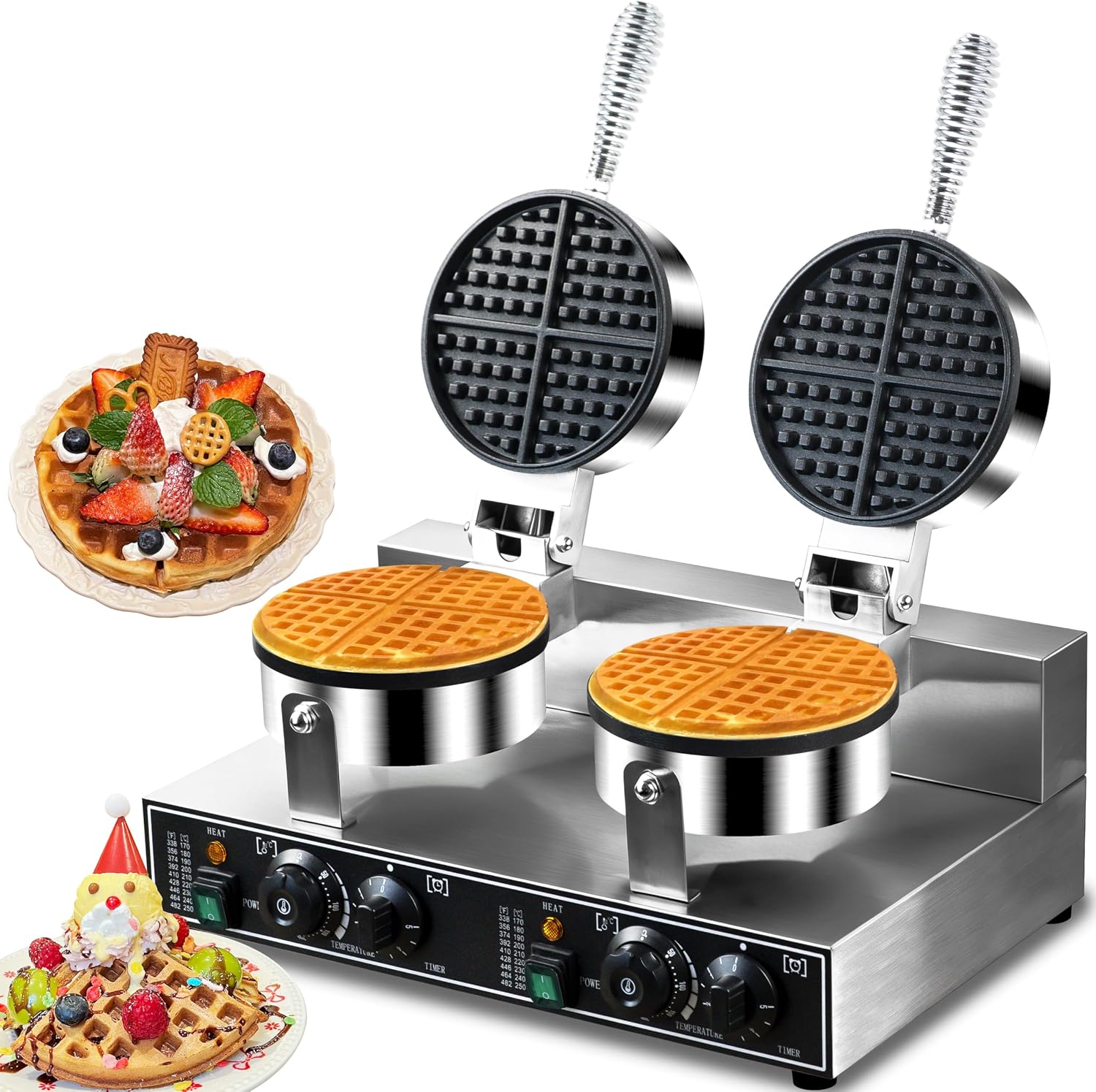
This is a dual-station commercial waffle maker designed to solve the bottleneck of single-waffle appliances during breakfast rushes or family weekends. Each side operates independently with its own timer and temperature dial.
The 2600W output splits into two 1300W heating elements that recover temperature quickly between pours. Temperature adjusts from 122°F to 572°F, letting you bake soft hotel-style waffles or crispy Liège waffles without swapping machines.
The body is stainless steel with non-stick Teflon-coated plates. The rotating handles use heat-resistant stainless that stays cool during flipping. The unit weighs enough to sit stable on a counter but remains portable for catering setups.
The 110V plug draws 2600W total, so verify your circuit can handle the load if running other appliances nearby. Some buyers report the timer dial feels loose after heavy use.
Best for home cooks who batch-cook weekend breakfasts or small food operations that need commercial durability without the footprint of separate single units.
How to Use
Preheat both sides to your target temperature for 3-4 minutes before the first pour. The indicator light shows when plates reach set temp. Lightly oil the plates on first use only; the non-stick coating handles subsequent batches without added fat.
Pour batter to cover about 80% of the lower plate, close the lid, and flip the handle 180 degrees. The rotating design distributes batter evenly. Set the timer based on batter thickness: 3 minutes for thin batters, 4-5 for thick Belgian styles.
When the timer beeps, check doneness by lifting the lid slightly. If steam still escapes heavily, close and wait 30 seconds. Use a silicone spatula to lift finished waffles. Wipe plates with a damp cloth while still warm, then unplug and let cool fully before storing.

Save $3.00
Pros & Cons
Pros
- Bakes one large waffle with four equal quarters that release cleanly without sticking.
- Adjustable temperature control delivers repeatable results once you find your preferred setting.
- Ready lights prevent opening too early, which tears the waffle and wastes batter.
Cons
- Makes only one waffle at a time, so feeding a family requires multiple batches.
- Non-removable plates cannot go in the dishwasher and must be wiped by hand.
Details
This Cuisinart round waffle maker solves the problem of unevenly cooked waffles by combining 1250 watts of heating power with five precise browning levels.
The one-inch deep pockets create thick waffles with plenty of room for syrup, fruit, or whipped cream. Indicator lights show when the plates reach baking temperature and when the waffle finishes cooking.
Brushed stainless steel cover over a durable plastic base. The round grid measures approximately seven inches in diameter. The unit stands upright and includes a cord storage channel at the base.
The non-removable plates require hand cleaning with a damp cloth. Batter can seep into the hinge area if you overfill.
Best for individuals or couples who want reliable single waffles without occupying permanent counter space.
How to Use
Plug in the unit and select your browning level before the red light turns on. Wait until the green light signals that the plates are hot enough.
Pour batter into the center and let it spread naturally toward the edges. Close the lid without pressing down. The green light will turn off while the waffle cooks.
When the green light turns back on, open the lid and use a silicone or wooden utensil to lift the waffle. Unplug and wipe the plates with a damp cloth while still warm but not hot.

Pros & Cons
Pros
- The flip function produces uniformly cooked waffles without rotating mid-bake, a common complaint with cheaper single-sided models.
- Preheat and done beeps remove the guesswork, preventing both raw centers and burnt edges.
- The drip tray catches overflow, keeping counters clean even when you overfill the plates.
Cons
- The round shape yields one large waffle per cycle instead of four separate squares, which may slow down batch cooking for families.
- The unit takes up more vertical space when flipped than traditional flat waffle makers, requiring higher cabinet clearance for storage.
Details
This is a rotary Belgian waffle maker that solves the uneven browning problem by flipping the batter 180 degrees mid-cook.
The ceramic nonstick plates are PFAS-free and heat evenly, while the 5-setting dial adjusts cook time to match your preferred crispness level. Indicator lights and audible beeps eliminate timing errors.
The housing is brushed stainless steel with a compact footprint. The drip tray is removable and dishwasher safe. The measuring cup ensures consistent batter volume across batches.
The round shape means one waffle at a time, which may feel slow if you’re feeding more than two people back-to-back.
Best for couples or small households who prioritize waffle quality over speed and want appliance-grade durability without occupying excessive counter space.
How to Use
Plug in the unit and wait for the preheat beep, which takes about four minutes. Lightly coat the plates with cooking spray only on the first use.
Pour batter using the included measuring cup to avoid overfill, then close the lid and flip the entire unit 180 degrees. The second beep signals when the waffle is done.
Lift the waffle out with a silicone spatula to protect the nonstick coating. Wipe plates with a damp cloth while still warm, then empty the drip tray after each session.

Pros & Cons
Pros
- Vertical design delivers consistent heat distribution that produces evenly cooked waffles from edge to center.
- NeverStick surface releases cleanly without oil or spray and requires minimal scrubbing after use.
- Precision-pour cup and audible alerts eliminate common waffle-making frustrations like overflow and undercooking.
Cons
- Vertical orientation requires more counter height clearance than traditional flat waffle makers.
- Single waffle capacity means longer wait times when cooking for multiple people.
Details
The Ninja BW1001 is a 1000-watt Belgian waffle maker that solves uneven cooking and stuck-on batter with vertical heating and a NeverStick interior.
The vertical design channels heat uniformly across the 1-inch-deep waffle grid, producing fluffy interiors and crisp exteriors without flipping. The specialty setting adjusts temperature for sugar-heavy batters that normally burn.
The unit measures approximately 10 x 8 x 14 inches in the vertical position with a matte black and brushed silver finish. The nonstick plates are fixed, not removable.
The single-waffle capacity requires batch cooking for families, and the taller footprint needs more vertical clearance than flip-style makers.
Best for home cooks who prioritize consistent results and fast cleanup over high-volume production.
How to Use
Plug in the unit and select your shade setting. The ready light will illuminate when the plates reach temperature, usually within 3 minutes.
Fill the included precision-pour cup to the fill line with batter and pour into the center of the lower plate. Close the lid and the vertical position automatically distributes batter to the edges.
Wait for the audible beep and green light. Open the lid and use a silicone spatula to lift the waffle out. Wipe plates with a damp cloth while still warm for fastest cleanup.

Pros & Cons
Pros
- Reaches baking temperature quickly and maintains consistent heat for batch production without long waits between cones.
- Non-stick surface performs well even after repeated use, requiring minimal oil and making cleanup straightforward.
- Temperature and timer controls are independent, allowing you to fine-tune results based on batter recipe and desired texture.
Cons
- Upper heating plate makes less contact than the lower plate due to gravity since the unit does not rotate, resulting in uneven browning on some cones.
- Instructions recommend preheating before each session, adding 5-10 minutes to your startup routine compared to instant-on models.
Details
This is a countertop waffle cone baker designed for cafes, bakeries, and ice cream shops that want to make fresh cones on-site instead of buying pre-made stock. It solves the problem of stale, generic cones by letting you bake custom flavors and shapes to order.
The 2600W dual heating system bakes two cones at once in 3 minutes, fast enough to keep up with moderate customer flow. Independent temperature control from 122°F to 572°F adapts to different batters, whether you want soft crepe-style cones or extra-crispy sugar cones.
Cast-aluminum plates with triple non-stick Teflon coating resist sticking and clean easily. The unit is compact enough for small prep areas but heavy enough to stay stable during use. Heat-insulated handles protect your hands during continuous operation.
The upper plate contacts batter less firmly than the lower plate because the machine does not rotate, which can cause lighter browning on the top side. You may need to flip cones manually for even color.
Best for small businesses adding fresh cones to their menu or serious home bakers who make ice cream regularly and want professional results.
How to Use
Preheat the machine to your target temperature before pouring batter. Most sugar cone recipes work well at 350-400°F for 2-3 minutes. Set the timer so you can step away without checking constantly.
Pour batter onto the center of the lower plate, close the lid gently, and let the timer run. When it beeps, lift the lid and use a heat-resistant spatula to remove the cone while it is still pliable. Roll it immediately around a cone form and hold for 10-15 seconds until it sets.
Wipe plates with a damp cloth between batches while still warm. Avoid metal utensils that can scratch the non-stick coating. Store the machine with plates slightly open to prevent moisture buildup.

Pros & Cons
Pros
- Consistent results across all browning levels with clear indicator lights that show when the unit is ready to cook.
- Cool-touch handles and locking mechanism make it safe to flip and store even when hot.
- PFOA-free nonstick surfaces release waffles cleanly without oil or spray every time.
Cons
- No audible timer means you need to watch the clock or risk over-browning if distracted.
- Single waffle capacity requires multiple batches for families larger than three people.
Details
This is a rotating Belgian waffle maker that solves the uneven cooking problem common in non-rotating models. The flip mechanism spreads batter uniformly across both plates.
The 9-setting browning dial gives precise control from pale golden to deep brown. Indicator lights eliminate guesswork by signaling when the plates reach temperature and when your waffle is ready.
Stainless steel exterior with nonstick ceramic titanium plates. Compact footprint stores upright. Removable drip tray catches overflow and goes in the dishwasher. Cool-touch handle stays safe during flipping.
Makes one large Belgian waffle at a time, so cooking for four or more people requires back-to-back batches. No audible alert when cooking time completes.
Best for couples or small families who want cafe-quality waffles at home without trial-and-error browning.
How to Use
Preheat the unit with the lid closed until the ready light illuminates, usually 4 to 5 minutes. Pour batter onto the center of the lower plate, close the lid, and rotate 180 degrees immediately to start even cooking.
Select your browning level before cooking begins. Lower settings (1 to 3) yield softer, lighter waffles in about 4 minutes. Higher settings (7 to 9) deliver crispier texture in 6 to 7 minutes. The ready light turns off during cooking and back on when done.
Let the waffle cool for 10 seconds before removing with a silicone or wooden utensil to protect the nonstick surface. Wipe plates with a damp cloth while still warm for easiest cleanup. Empty the drip tray after every use to prevent sticky buildup.

Pros & Cons
Pros
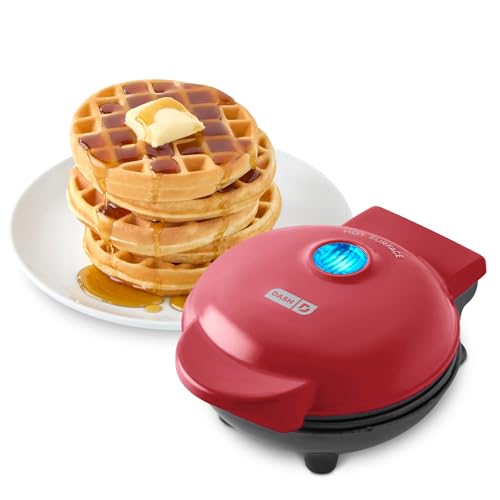
- Cooking four waffles per cycle keeps a table of eaters served at the same time.
- One-step operation is just plug in, wait for the light, and pour.
- Nonstick plates release waffles cleanly and require only a quick wipe between batches.
- The small graphite body fits apartment kitchens and dorm counters without claiming permanent counter space.
Cons
- Mini waffles are small, so adult portions need two or three per plate.
- The heating plates are fixed rather than removable, so cleaning happens on the unit itself.
Details
A four-well mini waffle iron built for households that currently cook waffles one at a time while the first batch goes cold.
Dual nonstick heating plates cook top and bottom together, and the quick heat-up system has the iron ready by the time batter is mixed.
PTFE-coated plates, a compact graphite body, and non-slip feet keep the unit steady on a crowded counter and easy to store upright.
Plates are fixed in place, so cleanup means wiping the unit rather than washing removable inserts.
Best for families and small-kitchen cooks who want a full round of waffles served hot at once.
How to Use
Plug in and let the iron preheat until the indicator light shows it is ready. Preheating fully is what gives you crisp edges instead of pale, soft waffles.
Pour batter into each well without overfilling, close the lid, and leave it shut until steam slows. Opening early tears the waffle apart.
Lift waffles out with a wooden or silicone tool to protect the nonstick coating, then wipe the cooled plates with a damp cloth.
Pros & Cons
Pros
- Cooks two large Belgian waffles simultaneously for efficient batch preparation.
- The rotating cooking system helps produce more evenly cooked waffles.
- The removable drip tray and nonstick coating simplify cleanup.
- Cool-touch handles and nonslip feet improve handling during use.
Cons
- The product data does not list adjustable temperature controls, so cooking customization may be limited.
- Size and weight specifications are not provided, making countertop and storage planning less certain.
Details
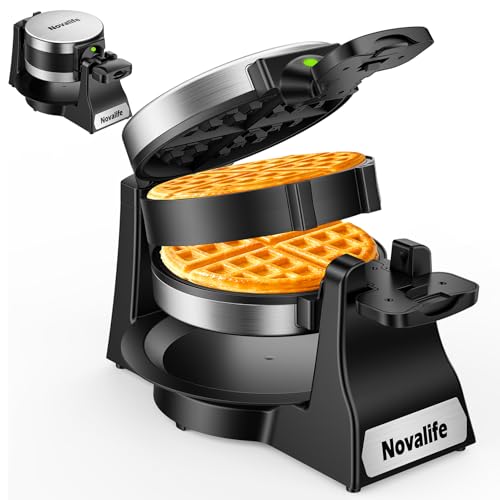
This double Belgian waffle maker addresses slow breakfast prep by cooking two large waffles at once instead of handling individual batches.
Its 1400W heating system and 180° flip mechanism help spread batter evenly while producing fluffy waffles with crisp, golden exteriors.
The stainless steel body is scratch-resistant and durable, while upright storage and cord storage help organize the kitchen. Exact size and weight are not provided.
Adjustable temperature controls are not listed, which may limit control over browning and texture.
Verdict: best for families and busy cooks who want quick batches with easier cleanup.
How to Use
Close the plates and wait for the indicator light to show that the unit is preheated. Add batter without overfilling, then secure the handle.
Use the cool-touch handle to rotate the plates 180° so the batter spreads across both cooking surfaces. Cook until the waffles reach your preferred finish.
After unplugging and cooling, wipe the nonstick plates with a damp cloth and place the removable drip tray in the dishwasher.
How We Evaluated These Picks
This guide is research-based, not a hands-on test. We did not buy, cook with, or measure the products below. Instead we compared manufacturer specifications, materials and construction details, listed capacities and wattages, and the patterns that repeat across large volumes of verified owner reviews — particularly the complaints that only surface after weeks of use, such as coatings failing, motors weakening, controls drifting, or a product proving awkward to clean and store.
Where we describe how something performs, we are reporting what the specifications state and what owners consistently report, not a result we produced ourselves. Prices and availability change constantly, so check the current listing before buying. We earn a commission on purchases made through links on this page, which never affects which products we include or how we rank them.
For more, see our Belgian vs Classic Waffle Maker and How to Clean an Electric Griddle guides.
Quick Picks
| Waffle Maker | Style | Watts | Best For |
|---|---|---|---|
| Commercial 110V Double Belgian (B0CXCXLQ3R) | Belgian, double | 2600W | Best Overall Belgian — high-volume, deep pockets |
| Cuisinart WMR-CANAS Round Classic (B0DZ32BFKK) | Classic thin | 1250W | Best Classic Thin — golden discs with 5-shade dial |
| Cuisinart WAF-F30NAS Round Flip (B0F5YKHMSW) | Flip Belgian | 1100W | Best Flip-Style — even browning via rotation |
| Ninja Belgian Waffle Maker Pro BW1001 (B0B358VDZJ) | Vertical Belgian | 1200W | Best Compact — small footprint, vertical pour |
| Commercial Waffle Cone Maker 2600W (B0CXDQX1BY) | Specialty cone | 2600W | Best Multi-Function — flat plates for cones, bowls, pizzelle |
Commercial 110V Double Belgian — Best Overall Belgian
The Commercial 110V Double Belgian waffle maker (B0CXCXLQ3R) takes the prosumer approach that home shoppers usually overlook. It’s a 2600-watt double-iron unit built around stainless-steel housing and cast-aluminum cooking plates that hold heat the way restaurant equipment is supposed to. Two independent thermostats let you run both irons at slightly different temperatures, which matters more than it sounds — you can hold the first waffle at light browning while the second pushes deeper for someone who wants real crisp edges. The Belgian pockets run roughly 1 inch deep, which is the geometry that holds the syrup-and-fruit load most home waffle maker designs spill onto the plate. Heat-up time runs around 4 minutes from cold, and once the plates stabilize the temperature variance across the cooking surface stays inside 15°F, which is roughly half what residential models drift. The 110V spec is the quiet selling point — most commercial-rated waffle irons require a 220V circuit and a hardwired install, while this one plugs into any standard kitchen outlet. The recovery time between waffles runs under 45 seconds because the cast-aluminum thermal mass barely drops in temperature during the open-and-pour cycle. You’re buying restaurant-grade thermal mass without the 220-volt commercial circuit, and that’s the whole pitch.
Cuisinart WMR-CANAS Round Classic — Best Classic Thin
The Cuisinart Round Classic Waffle Maker WMR-CANAS (B0DZ32BFKK) is the round, thin-waffle answer to the deep-pocket Belgian wave. It runs 1250 watts through a brushed stainless housing with a 5-setting browning dial calibrated from light gold to deep mahogany. The waffle is roughly 7 inches across and about 3/8 inch thick — the geometry that fits chicken-and-waffles plating, crispy texture without the puddle pockets, and the kind of thin-edged crunch some bakers refuse to give up. Indicator lights signal when the iron has preheated and when each waffle reaches the doneness you dialed in, which removes the lift-and-peek habit that ruins crust formation. The non-stick interior releases batter cleanly through at least 18 months of weekly use before you’ll need a thin oil wipe. There’s no flip, no rotation, no digital timer — just a hinged clamshell that does one thing exceptionally well for the price band. If you grew up on classic waffles and a Belgian iron has always felt like overcorrection, this is the waffle maker that ends the search.
Cuisinart WAF-F30NAS Round Flip — Best Flip-Style
The Cuisinart Round Flip Belgian Waffle Maker WAF-F30NAS (B0F5YKHMSW) brings the diner-counter rotation system into a residential footprint without the diner-counter price. The 180-degree flip mechanism does what stationary irons can’t — it forces the batter against the upper plate as the unit rotates, which evenly distributes the wet portion across both heated grids and eliminates the “thin top, thick bottom” geometry that plagues stationary Belgian models when batter pools toward gravity. The result is a 1-inch-thick round Belgian waffle with consistent crust on both faces and pockets that hold their shape under syrup. Browning runs through a 6-setting dial with audible alerts at preheat and at each waffle completion. The flip handle is the most-touched component, and Cuisinart over-engineered the bearings — flip resistance stays consistent through hundreds of cycles. Storage isn’t great because the rotating cradle adds vertical bulk, so this waffle maker earns its counter space rather than living in a cabinet. For households that make waffles weekly, the even-browning win justifies the trade.
Ninja Belgian Waffle Maker Pro BW1001 — Best Compact
The Ninja Belgian Waffle Maker Pro BW1001 (B0B358VDZJ) flips the form factor sideways. It’s a vertical design — the iron stands upright on the counter, and you pour batter into a top port using the included precision-pour cup that meters exactly the right volume for a single Belgian waffle. The vertical orientation forces gravity to distribute batter evenly down the cooking chamber, which produces consistent thickness and edge fill the way a flip-style does but without any moving plates. The footprint is roughly 8 by 6 inches on the counter — meaningfully smaller than any horizontal Belgian unit in this lineup — which means this waffle maker fits where the others can’t. The 5-shade browning dial covers light to deep, the heat-up runs around 4 minutes, and the cleanup is the standout: cooled plates wipe clean with a damp cloth because batter never spills onto the housing the way it does with open-top horizontal designs. If counter space drives the decision and you still want true Belgian pocket depth, this is the answer.
Commercial Waffle Cone Maker 2600W — Best Multi-Function
The Commercial Waffle Cone Maker 2600W (B0CXDQX1BY) earns its slot because it’s not a single-purpose waffle iron — the flat upper and lower plates with shallow grid patterns let you produce ice cream cones, dessert bowls, pizzelle, stroopwafel halves, and traditional thin waffles from a single machine. The 2600-watt heating element brings the plates to working temperature in roughly 3 minutes, and adjustable thermostats let you run lower temperatures for delicate pizzelle batter or higher for crisp cone shells. The cone-forming mandrel ships in the box, which is the small detail that turns this from a waffle maker into a multi-format dessert station. Footprint is large and the unit is built for restaurant counters, so this isn’t the right answer for a small apartment. For households that entertain, run a home-based dessert side hustle, or want the appliance that handles four breakfast and dessert formats in one footprint, the flexibility justifies the size. It’s the waffle maker for cooks who think in formats rather than recipes.
How to Choose
Belgian vs Classic Waffles
The Belgian-versus-classic split is geometric before it’s culinary. A Belgian waffle maker presses batter into pockets that are roughly 1 inch deep, with grids spaced wide enough that each square holds a measurable amount of syrup, melted butter, or fruit compote without overflow onto the plate. The classic waffle uses shallow pockets — typically 1/4 to 3/8 inch — with tighter grid spacing, which produces a thinner disc with a higher crust-to-interior ratio. The classic browns faster and crisps harder because there’s more surface area exposed to the heated plate per unit volume of batter. Belgians stay softer in the center because the deep pockets insulate the interior from the heat zone. Neither geometry is “better” in absolute terms. If you eat waffles with a fork and want pockets to catch syrup, choose Belgian. If you eat waffles with your hands or stack them with savory toppings like fried chicken, the thin classic disc handles weight better and stays crisp longer.
Flip vs Stationary Design
The flip mechanism solves a problem stationary waffle makers don’t admit they have. When you close a stationary iron on poured batter, gravity pulls the wet portion to the bottom plate while the top plate sits over what is briefly an air gap until the batter rises into it. The result is asymmetric browning — bottom darker, top lighter — and an inconsistent pocket depth on the upper face. Flip-style irons rotate 180 degrees roughly 30 seconds after closing, which forces the still-liquid portion against the now-top plate and reverses the gravity asymmetry. The browning evens out, the pockets fill uniformly, and the waffle releases cleanly from both sides. The trade-offs are real: flip units take more counter space, the rotation mechanism adds moving parts that can wear out (though Cuisinart’s design holds up well past 5 years of weekly use), and the workflow includes one extra step. For households making one waffle at a time, the flip is overkill. For batch breakfast on weekend mornings where every waffle should look identical, it earns its keep. Pairing the right batter helps too — if you’re folding meringue into your mix, the best hand mixer guide covers the tool that makes that step actually work.
Plate Material and Cleanup
Most residential waffle maker plates fall into two material camps: PTFE-coated cast aluminum and ceramic-coated cast aluminum. PTFE (the classic non-stick coating) releases waffles cleanly from day one and stays functional for roughly 2 to 3 years of weekly use before the coating starts to thin at the high-contact zones — typically the corners where batter overflows and the center where utensil contact concentrates. Ceramic coatings last longer (3 to 5 years before noticeable wear) but require a slightly more generous oil coat after the first 6 months because the release isn’t as slick as fresh PTFE. Commercial units like the 110V double Belgian use uncoated cast aluminum or stainless-clad cast aluminum that requires seasoning — a process where you coat the plates with neutral oil and run them hot until the polymerized layer becomes the non-stick surface. Seasoned plates last indefinitely if maintained but demand more care than coated plates. Cleanup workflow matters too: vertical-pour designs like the Ninja BW1001 contain spills in the cooking chamber, while open-clamshell designs let batter overflow onto the housing where it bakes into a hard crust if not wiped within the first few minutes after use. Removable plates are the third variable worth checking — a few mid-range waffle maker models let you pop the plates out for dishwasher cleanup, which solves the hand-wash bottleneck that frustrates owners of clamshell units after a sticky batter overflow.
How We Picked
These five picks weren’t pulled from a generic best-seller list. We narrowed the category by waffle geometry first (Belgian deep-pocket, classic thin, multi-format), then by build quality at each price tier, then by the specific use cases readers actually shop for — overall daily use, classic-style preference, even-browning flip, compact footprint, and multi-function flexibility. The two commercial-grade picks earned their slots because the 110V spec lets them work on standard home outlets, which removed the usual barrier between residential shoppers and prosumer build quality. The two Cuisinart models represent the brand’s strongest residential lineup positions — the round classic and the round flip have held their slots through five product-line revisions because the underlying geometry works. The Ninja vertical earned its compact slot because no other major waffle maker brand currently ships a true vertical Belgian at this price point. Each pick had to clear three filters: a coherent use case, a build quality match for its price band, and availability through standard retail channels.
Common Questions
Why are Belgian waffles thicker?
Belgian waffles are thicker because the iron itself is designed with deeper pockets — typically about 1 inch versus the 1/4 to 3/8 inch of a classic waffle iron — and the batter recipe traditionally uses yeast or whipped egg whites to create more rise. The deep pockets give the batter room to expand without spilling, and the yeasted batter fills that volume during the cook. Run a thin classic batter in a Belgian iron and you’ll get a thinner Belgian-shaped waffle. Run yeasted batter in a classic iron and it overflows. The depth of the pockets is the defining variable.
Is a flip-style waffle maker worth the extra?
For weekly use, yes. The flip mechanism produces visibly more uniform browning and pocket fill, which matters when you serve waffles to guests or photograph them. For occasional weekend use where one or two waffles per session is the routine, a stationary iron is enough. The flip’s value scales with batch size — making six identical waffles in sequence is where the design earns its price premium over a stationary Belgian.
How do you keep waffles from sticking?
Three habits prevent sticking. First, preheat the iron fully before pouring batter — undertemperature plates are the leading cause of stuck waffles. Second, lightly oil or spray the plates before the first waffle of each session (a thin film, not a puddle). Third, don’t open the iron until the steam slows visibly — premature opening tears the waffle’s surface and leaves crust on the plate. With these habits, modern PTFE-coated waffle maker plates release cleanly for years.
Can you make waffles with pancake mix?
Yes, but the texture won’t match a dedicated waffle batter. Pancake mix lacks the higher fat content and sometimes the higher leavening that gives waffles their crisp exterior. The workaround is to add one extra tablespoon of oil per cup of pancake mix and an extra 1/4 teaspoon of baking powder. The result is closer to a true waffle texture without buying a separate mix. For the deep crisp of a real Belgian, a dedicated waffle batter still wins.
Related Guides
- Belgian vs Classic Waffle Maker
- How to Clean an Electric Griddle
- How to Use a Waffle Maker
- Small Kitchen Appliance Guide
- What Is an Electric Griddle Used for
Bottom Line
The right waffle maker depends less on power ratings than on which waffle geometry matches your eating style. The Commercial 110V Double Belgian (B0CXCXLQ3R) is the workhorse for households making waffles regularly for groups, and the prosumer build quality earns its price across a decade of ownership. The Cuisinart WMR-CANAS Round Classic (B0DZ32BFKK) is the answer for thin-waffle loyalists who want a 5-shade browning dial in a brushed-stainless package. The Cuisinart Round Flip WAF-F30NAS (B0F5YKHMSW) is the right pick for weekly Belgian use where even browning matters. Choose by use case, not headline wattage.
- If you make Belgian waffles weekly for a household of four or more, buy the Commercial 110V Double Belgian (B0CXCXLQ3R).
- If you want thin classic waffles with reliable browning control, buy the Cuisinart WMR-CANAS Round Classic (B0DZ32BFKK).
- If counter space drives the decision and you still want true Belgian depth, buy the Ninja Belgian Waffle Maker Pro BW1001 (B0B358VDZJ).



Write Your Review
No reviews yet. Be the first to share your experience!