

Picture a household that runs on coffee. Two adults, one of whom needs a cup before speaking to anyone, and both of whom top up around 3pm. Call it four cups a day between them. For two years that meant a pod machine on the counter, and the pods added up faster than either of them wanted to admit. At roughly 55 cents a capsule, four a day is about $2.20 daily, which lands near $800 a year going into the bin as foil and plastic. That number is what usually pushes people toward a bean-to-cup machine, and it is the right place to start, because the whole point of the value tier is the math, not the marketing.
So let’s do the sum honestly. Whole beans run about $14 to $18 a pound at the grocery store, and a pound brews somewhere between 25 and 40 cups depending on how strong you like it. That puts your cost per cup in the 40 to 55 cent range for good beans, and closer to 25 cents if you buy in bulk. Not a dramatic saving over pods on paper, but the coffee is fresher, the waste disappears, and you are grinding beans seconds before extraction instead of drinking something that was portioned and sealed months ago. The saving is real, but it is the quality jump that makes the purchase feel justified.
What “value” actually means at this price
Value does not mean cheap. The genuinely cheap bean-to-cup machines, the ones under $300, tend to use pressurized portafilters or grinders that clog and overheat, and they break inside two years. The sweet spot for a machine you will keep sits around $400 to $700. Below that band you are paying for a plastic grinder and a boiler that struggles to hold temperature. Above it you are paying for touchscreens, app connectivity, and milk systems you may never use. The value tier is where the core parts, the burr grinder, the pump, the brew group, are built to last without the luxuries you are subsidizing higher up.
The single most important thing to confirm is an integrated burr grinder rather than a blade grinder or, worse, a pre-ground hopper. A burr grinder crushes beans to a consistent particle size, which is what lets the machine pull an even shot instead of a bitter-and-sour mess. Any machine at this price that skips the integrated grinder is not really competing in the same category, and you should treat it as a step down.
Ceramic versus steel burrs, and why it matters
Here is a spec that most buyers ignore and later regret. The burrs inside the grinder come in two materials. Steel burrs are sharp, cut fast, and are cheaper to produce, but they generate more heat and dull sooner with heavy daily use. Ceramic burrs stay cool, hold their edge for years, and are less likely to scorch delicate beans, though they can chip if a stone slips through with the beans. For a four-cups-a-day household, ceramic is the one I would chase, because it is the part that determines grind consistency over the long haul. Plenty of value machines still ship steel, and that is fine, but if two machines are otherwise even, the ceramic set is the tiebreaker.
Grind adjustment matters too. You want a dial with real steps, ideally adjustable while the machine runs, so you can dial in a coarser grind for a lighter roast or tighten it for a dark one. A machine locked to a single grind setting will fight you every time you change beans.
Milk: automatic system or manual wand?
This is the fork in the road that splits the value tier in half. An automatic milk system uses a carafe or a tube into the milk carton and froths at the push of a button, dispensing a flat white or cappuccino without you touching anything. A manual steam wand hands you the frothing pitcher and expects you to do the work yourself. The automatic route is genuinely convenient for a busy morning and for anyone who does not want to learn latte art, but the milk pathways need daily rinsing and periodic deep cleaning, or they turn sour and start to smell. The manual wand is more work up front and has a learning curve of a week or two, but it makes better microfoam, cleans with a single wipe and purge, and has far fewer parts to fail.
My honest take for the coffee-heavy household: if you drink mostly milk drinks and want speed, pay for the automatic system and commit to the cleaning routine. If you drink espresso or the occasional flat white and care about the foam, take the manual wand and save the money. The wand also tends to age better, because there is simply less to break.
Descaling and the maintenance you are signing up for
Nobody mentions this in the showroom, but a bean-to-cup machine is a maintenance commitment. Hard-water areas will need descaling every four to six weeks; soft-water areas can stretch to a couple of months. The good machines prompt you and run a guided cycle with a descaling solution or citric acid; the cheaper ones let scale build until the boiler chokes. Look for a removable brew group, the part where the puck of grounds forms, because being able to pop it out and rinse it under the tap once a week is the difference between a machine that lasts eight years and one that gums up in three. Fully sealed brew groups mean you are dependent on chemical cycles alone, which is a quiet downgrade.
Factor a water filter into the running cost too. A filter in the tank slows scale dramatically and is cheaper than repairs. Budget maybe $40 to $60 a year for filters and descaler combined, and add that to your cost-per-cup math so the comparison against pods stays honest.
The small specs that decide daily happiness
Cup clearance is the detail that quietly ruins a machine for some kitchens. Measure your tallest travel mug and check the adjustable spout height before you buy, because plenty of value machines top out around 5.5 inches and will not fit a 20-ounce tumbler underneath. An adjustable drip tray that slides down for tall cups and back up for espresso is worth hunting for. Water tank size matters if you refill from a distant sink; anything under 1.5 liters means daily top-ups for a four-cup habit. Bean hopper size is less critical but a sealed lid keeps beans fresher between shops.
Noise is real as well. Every one of these machines grinds loudly for a few seconds, and if your first coffee happens while others sleep, that grind at 6am carries through a wall. It is not a dealbreaker, but it is worth knowing before it surprises you.
Is the switch worth it for a four-cup household?
Run the numbers back for that household from the top. Pods were costing roughly $800 a year. Beans, filters, and descaler for the same four cups land somewhere around $450 to $550 a year once you account for maintenance. That is a saving of $250 to $350 annually, which pays off a $500 machine inside two years and keeps saving after that, assuming the machine survives, which is exactly why the build quality of the value tier matters more than the sticker price. Buy at the bottom of the range and you risk a replacement before payback; buy sensibly in the middle and the machine earns its keep. The money argument gets you in the door, but the fresh grind every morning is what keeps the pod machine in the cupboard for good.
How much should I actually spend on a value bean-to-cup machine?
For a machine you intend to keep, plan on $400 to $700. Under $300 you are usually buying a plastic grinder and a weak boiler that will not survive daily use, and the repair or replacement wipes out any saving over pods. Above $700 you are paying for touchscreens and milk automation that do not improve the coffee in the cup. The middle band gives you the durable core parts, a proper burr grinder, a metal brew group, and a pump that holds pressure, without the premium features you would be financing for no real return.
Do I really need the automatic milk system?
Only if milk drinks are most of what you make and speed matters more than foam quality. The automatic carafe is convenient on a rushed morning, but it adds parts that need daily rinsing and monthly deep cleaning, and neglecting that turns the milk pathway sour. A manual steam wand costs less, cleans with one wipe and a quick purge, makes better microfoam once you practice, and has far fewer components to fail over the years. If you drink mostly espresso or one flat white a day, the wand is the smarter buy.
How often will I have to descale and clean it?
It depends on your water. Hard-water homes should descale every four to six weeks; soft-water areas can go two months or more. On top of that, rinse the removable brew group under the tap weekly, empty the grounds drawer every day or two, and change the tank water filter every couple of months. A water filter slows scale build-up and cuts descaling frequency, so it pays for itself. Machines with a sealed brew group depend entirely on chemical descaling cycles, which is why a removable one is worth prioritizing when you shop.
The Best Deals This Week*
-
Fast Single-Serve Coffee at Home
$69.99
($109.99)Save $40.00 -
Home Espresso, Latte and Cold Brew Station
$249
($299.99)Save $50.99 -
Fresh-Ground Espresso and Milk Drinks at Home
$299.99
($399.99)Save $100.00 -
Make Lattes and Cappuccinos at Home
$289.99
($359.99)Save $70.00 -
Fresh Whole-Bean Drip Coffee at Home
$139.98
($179.99)Save $40.01
*Deals are selected by our commerce team
Deeper Dive: Our Top Picks
Our Top Picks

Keurig
Fast Single-Serve Coffee at Home: Keurig K-Express with Strong Brew and 42oz Reservoir
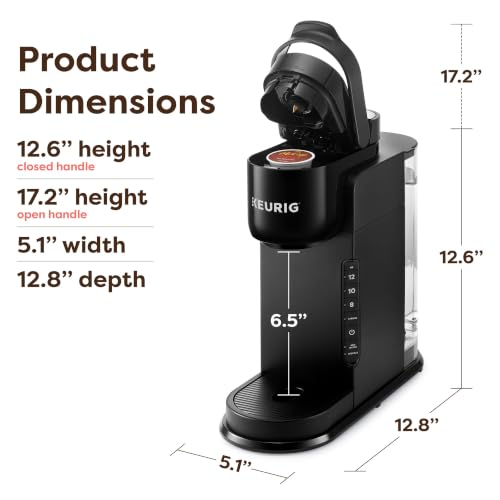
The Keurig K-Express brews 8, 10, or 12 oz. K-Cup servings in minutes, with a Strong button for a bolder cup. It suits busy coffee drinkers who want quick brewing, multiple cups between refills, and space for a travel mug.
Pros and Cons
Pros
- The 42 oz. removable water reservoir supports several servings and is easier to refill than a fixed tank.
- Selectable 8, 10, and 12 oz. cup sizes accommodate different coffee strengths and mug capacities.
- The Strong brew setting provides a bolder flavor option without adding extra controls or steps.
- Compatibility with the My K-Cup Universal Reusable Coffee Filter allows brewing ground coffee when the filter is purchased separately.
Cons
- Brew volume is limited to three fixed cup sizes, with no smaller concentrated setting listed.
- The reusable filter needed for ground coffee is sold separately.

Grindora
Home Espresso, Latte and Cold Brew Station: Grindora Espresso Machine with Grinder and PID Control
The Grindora espresso machine grinds, doses, brews, and froths coffee, with 44 grind settings providing precise control over extraction. It suits home baristas who want to prepare espresso, Americano, latte, cappuccino, and cold brew without buying separate appliances.
Pros and Cons
Pros
- Forty-four grind settings provide more adjustment range than basic built-in grinders.
- PID control offers selectable brewing temperatures of 194°F, 198°F, and 205°F.
- Pre-infusion can reduce channeling by wetting the coffee bed before full-pressure extraction.
- The stainless steel construction and integrated grinder create a durable-looking, space-conscious home coffee station.
Cons
- The included 51mm portafilter has a smaller accessory ecosystem than the widely used 58mm professional format.
- Temperature adjustment is limited to three preset levels rather than continuous degree-by-degree control.

Chefman
Fresh-Ground Espresso and Milk Drinks at Home: Chefman Crema Supreme Espresso Machine
The Chefman Crema Supreme grinds beans directly into its 58mm portafilter and brews 15-bar espresso, reducing the need for a separate grinder. It suits home coffee drinkers who want adjustable grinding, shot control, and manual milk steaming in one machine.
Pros and Cons
Pros
- The built-in conical burr grinder provides 30 grind settings for dialing in different coffee roasts.
- A 15-bar pump, pressure gauge, and adjustable shot settings provide more control over espresso extraction.
- The package includes a milk pitcher, stainless-steel tamper, grinding funnel, cleaning tools, and two filter baskets.
- The large removable water tank reduces refill frequency when preparing several drinks.
Cons
- As a semi-automatic machine, it still requires hands-on grinding adjustments, tamping, and milk steaming.
- The manual steam wand may require practice to produce consistent milk texture.

Gevi
Make Lattes and Cappuccinos at Home: Gevi 20 Bar Espresso Machine with Grinder
The Gevi espresso machine grinds beans, pulls single or double shots, and steams milk, with its 30-setting conical burr grinder providing the biggest advantage for dialing in fresh espresso. It suits home coffee drinkers who want customizable café-style drinks without buying a separate grinder.
Pros and Cons
Pros
- A built-in conical burr grinder with 30 settings supports freshly ground espresso without a separate appliance.
- The 20 bar Italian pump is designed to produce rich, full-bodied extraction.
- PID and NTC controls regulate temperatures for both espresso brewing and milk frothing.
- The steam wand handles microfoam, hot water dispensing, and flushing for routine cleaning.
Cons
- The listing does not provide dimensions, weight, or material details, so buyers cannot easily confirm countertop fit or exterior durability.
- The adjustable grinder, dosing, temperature, and steam controls may require experimentation before producing consistent drinks.

Gevi
Fresh Whole-Bean Drip Coffee at Home: Gevi 10-Cup Grind-and-Brew Coffee Maker with Burr Grinder
The Gevi 10-Cup Grind-and-Brew makes 2 to 10 cups from freshly ground beans, with its built-in burr grinder providing the biggest flavor advantage. It suits households that want adjustable grind size, brew strength, and serving volume without using a separate grinder.
Pros and Cons
Pros
- A built-in burr grinder combines bean grinding and drip brewing in one countertop appliance.
- Eight grind settings and three strength options provide useful control over the finished cup.
- The adjustable 2-to-10-cup capacity avoids brewing a full carafe when only a smaller serving is needed.
- The washable reusable filter simplifies cleanup and reduces dependence on disposable filters.
Cons
- At 16.93 inches tall, the machine may not fit beneath low cabinets, so clearance should be measured before ordering.
- The supplied product information does not specify the machine's weight or housing materials, making portability and exterior durability harder to assess.
Editors' Picks
Keurig Fast Single-Serve Coffee at Home: Keurig K-Express with Strong Brew and 42oz Reservoir
Keurig
Fast Single-Serve Coffee at Home: Keurig K-Express with Strong Brew and 42oz Reservoir
The Keurig K-Express brews 8, 10, or 12 oz. K-Cup servings in minutes, with a Strong button for a bolder cup. It suits busy coffee drinkers who want quick brewing, multiple cups between refills, and space for a travel mug.
$69.99 at AmazonEditors' Favorite
Color: Black Size: 12.8” L x 5.1” W x 12.6” H Dimensions: 12.8 x 5.1 x 17.2 Inches Weight: 4.1 pounds Product Group: Kitchen Binding: Kitchen
Shop NowGrindora Home Espresso, Latte and Cold Brew Station: Grindora Espresso Machine with Grinder and PID Control
Grindora
Home Espresso, Latte and Cold Brew Station: Grindora Espresso Machine with Grinder and PID Control
The Grindora espresso machine grinds, doses, brews, and froths coffee, with 44 grind settings providing precise control over extraction. It suits home baristas who want to prepare espresso, Americano, latte, cappuccino, and cold brew without buying separate appliances.
$249.00 at AmazonGreat Value
Color: Silver Size: 20bar Dimensions: 11.02 x 9.57 x 14.57 inches Weight: 12.6 Pounds Product Group: Kitchen
Shop NowChefman Fresh-Ground Espresso and Milk Drinks at Home: Chefman Crema Supreme Espresso Machine
Chefman
Fresh-Ground Espresso and Milk Drinks at Home: Chefman Crema Supreme Espresso Machine
The Chefman Crema Supreme grinds beans directly into its 58mm portafilter and brews 15-bar espresso, reducing the need for a separate grinder. It suits home coffee drinkers who want adjustable grinding, shot control, and manual milk steaming in one machine.
$299.99 at AmazonColor: Stainless Steel Size: Large Dimensions: 13.7 x 16.26 x 16.34 inches Weight: 21.78 pounds Product Group: Kitchen Binding: Kitchen
Shop NowGevi Make Lattes and Cappuccinos at Home: Gevi 20 Bar Espresso Machine with Grinder
Gevi
Make Lattes and Cappuccinos at Home: Gevi 20 Bar Espresso Machine with Grinder
The Gevi espresso machine grinds beans, pulls single or double shots, and steams milk, with its 30-setting conical burr grinder providing the biggest advantage for dialing in fresh espresso. It suits home coffee drinkers who want customizable café-style drinks without buying a separate grinder.
$289.99 at AmazonColor: Silver Size: 11.5"W*12.01"D*16.53"H Dimensions: 12.01 x 11.5 x 16.53 inches Product Group: Kitchen
Shop NowGevi Fresh Whole-Bean Drip Coffee at Home: Gevi 10-Cup Grind-and-Brew Coffee Maker with Burr Grinder
Gevi
Fresh Whole-Bean Drip Coffee at Home: Gevi 10-Cup Grind-and-Brew Coffee Maker with Burr Grinder
The Gevi 10-Cup Grind-and-Brew makes 2 to 10 cups from freshly ground beans, with its built-in burr grinder providing the biggest flavor advantage. It suits households that want adjustable grind size, brew strength, and serving volume without using a separate grinder.
$139.98 at AmazonColor: Black Size: 12.4"D x 8.4"W x 16.9"H Dimensions: 12.36 x 8.37 x 16.93 Inches Product Group: Kitchen
Shop Now


Write Your Review
No reviews yet. Be the first to share your experience!