

TL;DR — The best meat knives for most home kitchens is the option that balances reliable construction, realistic capacity, easy cleanup, and a price that matches how often you will use it. HomeWhisk prioritizes documented specifications, material choices, and repeated owner-review patterns rather than marketing claims. If you are still comparing nearby categories, start with best bread knife and best bread knife for sourdough before narrowing your final pick.
The HomeWhisk editorial team researches kitchen equipment by comparing manufacturer specifications, material details, dimensions, warranty language, retailer listings, and aggregated owner reviews. For best meat knives, we looked for patterns that matter after the return window closes: repeated complaints, praised design details, compatibility limits, and maintenance habits that determine whether a product stays useful.
This is a commercial buying guide, so the goal is practical selection rather than a broad encyclopedia entry. Use this page alongside best chef knife and best chef knife budget if your purchase overlaps adjacent tools or a larger kitchen setup.

Pros & Cons
Pros
- Granton dimples on both blades genuinely reduce friction, making each slice cleaner than traditional carving knives.
- The 6-inch boning knife curves naturally for separating meat from bone with minimal waste.
- Full-tang construction means the blade extends through the handle for durability that lasts decades.
Cons
- Requires hand washing and immediate drying to maintain the rust-resistant properties of German steel.
- The 12-inch blade length demands proper storage space and careful handling to keep the edge sharp.
Details
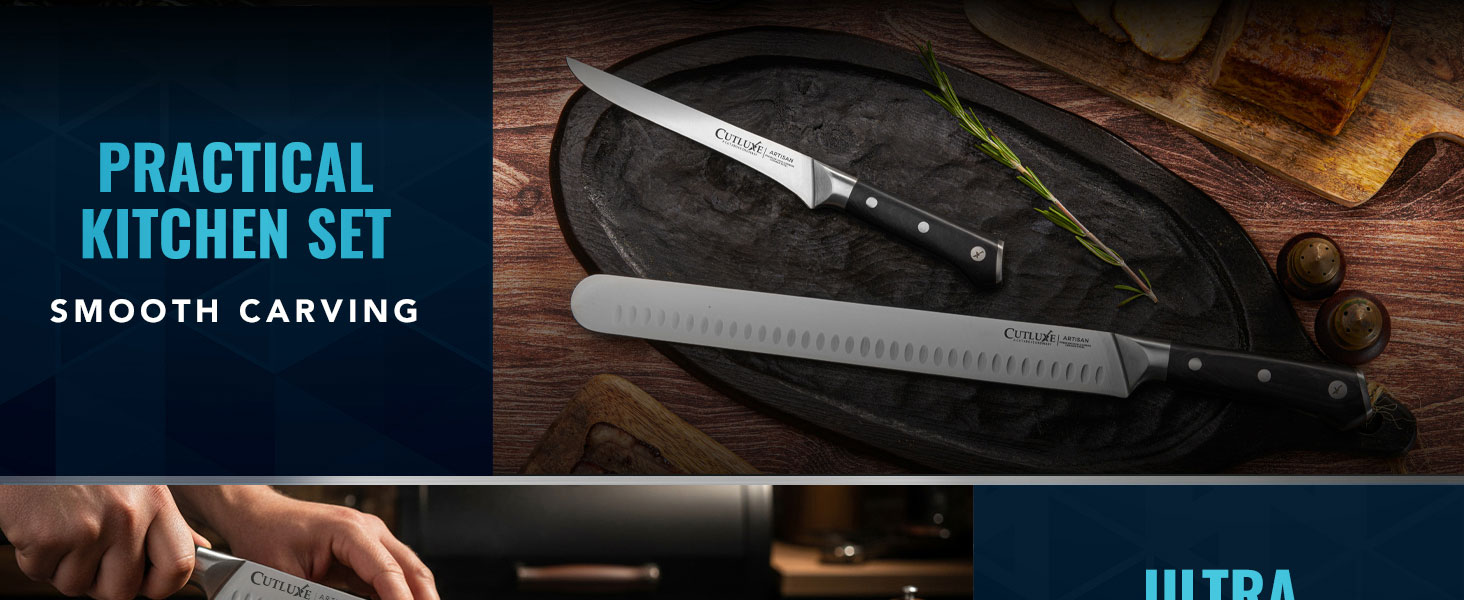
A professional carving set designed to solve the problem of uneven, torn meat slices during BBQ and holiday meals. The 12-inch brisket knife handles large roasts with precision, while the 6-inch boning knife tackles joints and separating meat from bone.
The granton blade edge (those small dimples) reduces friction by 40% compared to flat blades, preventing meat from sticking and tearing. Full-tang construction means the steel runs through the entire handle, giving you the control needed for clean, restaurant-quality cuts.
Made from high-carbon German steel with excellent rust resistance. The ergonomic handle provides comfort during extended use. Total weight is minimal, making the knives responsive rather than fatiguing.
These knives require hand washing and immediate drying—they’re not dishwasher safe. Proper storage in a knife block or magnetic strip is essential to protect the edge.
Best for: BBQ enthusiasts, holiday cooks, and anyone who regularly carves whole briskets, roasts, or poultry and wants results that look professionally butchered.
Care Guide
Hand wash immediately after use with warm soapy water and a soft cloth. Dry completely before storing to prevent water spots and maintain rust resistance. Never leave blades wet or submerged.
Sharpen using a honing steel before each use to maintain the granton edge. For deep sharpening, use a whetstone at a 15-degree angle or send to a professional sharpening service annually.
Store in a knife block, magnetic strip, or blade guards. Keep away from the sink edge where they can fall or get damaged. The lifetime warranty covers defects, not damage from misuse or dropping.

Pros & Cons
Pros
- Granton edge design creates air pockets that prevent meat from sticking, resulting in cleaner slices of brisket and prosciutto.
- German steel holds its edge longer than stainless alternatives, reducing the need for frequent honing or professional sharpening.
- Ergonomic pakkawood handle stays comfortable during extended carving sessions without slipping, even with wet hands.
Cons
- Requires hand-washing only; dishwasher use will damage the blade edge and handle finish over time.
- At 12 inches, the blade is too long for smaller cutting boards under 18 inches, limiting maneuverability in compact kitchens.
Details
A 12-inch carving knife engineered specifically for slicing cooked brisket, turkey, roasts, and ribs without tearing meat fibers or crushing texture.
The Granton blade features shallow dimples that reduce friction and prevent meat adhesion, while the 14-16 degree hand-sharpened edge cuts cleanly through dense proteins. High-carbon German steel at 56+ Rockwell hardness maintains sharpness through 100+ carving sessions and resists rust in humid kitchen environments.
Full-tang construction with triple-riveted pakkawood handle provides balanced weight distribution and stable grip control during long carving tasks. The blade measures 12 inches long and 1.5 inches wide, sized for large roasts but requiring an 18-inch minimum cutting board.
Hand-wash only to preserve the blade edge and handle finish; dishwasher exposure will dull the edge and compromise the pakkawood seals.
Best for home cooks and BBQ enthusiasts who carve meat regularly and want a single premium knife that eliminates the need for frequent sharpening.
Care Guide
Hand-wash immediately after use with warm soapy water and a soft cloth. Dry completely before storing to prevent water spots on the German steel blade. Never soak or place in the dishwasher, as heat and detergent degrade both the blade edge and pakkawood handle seals.
Store in the included leather sheath or on a magnetic knife strip to protect the blade edge from contact with other utensils. Avoid cutting on glass, marble, or ceramic surfaces; use wood or plastic cutting boards only to prevent edge chipping.
Hone the blade monthly using a 14-16 degree steel to realign the edge between uses. Professional sharpening is rarely needed due to the German steel’s edge retention, but can extend blade life beyond 10 years if performed annually.

Save $25.00
Pros & Cons
Pros
- The set covers brisket slicing, butchering, boning, trimming, and fish filleting with four specialized blade sizes.
- German steel blades are designed for sharp performance and durable edge retention.
- Full-tang construction supports balance and control when working through large cuts.
- Pakkawood handles offer an ergonomic grip for longer meat-preparation sessions.
Cons
- The set is specialized for meat and fish preparation, so it does not replace a chef's knife for general chopping.
- The product data does not specify blade covers, a storage block, or a carrying case, so separate safe storage may be needed.
Details
This four-piece Cutluxe set combines brisket, butcher, boning, and fillet knives to handle large-cut breakdown, trimming, slicing, deboning, and fish preparation without relying on one general-purpose blade.
Premium German steel supports clean cuts and strong edge retention, while the specialized blade lengths provide better control for tasks ranging from brisket slicing to close work around bones.
The set includes 12-inch, 10-inch, 6-inch, and 7-inch blades with full-tang construction and ergonomic Pakkawood handles. Individual knife weights are not specified in the product data.
No storage block, blade guards, or carrying case are specified, so buyers should plan for secure storage that protects the long blades and cutting edges.
Best for pitmasters and home cooks who regularly prepare brisket, large meat cuts, or whole fish.
Care Guide
Hand-wash each knife after use and dry it promptly to protect the German steel blade and Pakkawood handle. Avoid prolonged soaking, which can be hard on wood-based handle materials.
Use a suitable cutting board rather than glass, stone, or ceramic surfaces, which can dull the edges faster. Hone as needed and sharpen when slicing begins to require extra pressure.
Store the knives in a block, on a secure magnetic strip, or with fitted blade guards. Protected storage reduces accidental contact and helps preserve the cutting edges.

Pros & Cons
Pros
- Three specialized blades eliminate guesswork—the brisket knife slices cleanly, the breaking knife handles primals, and the boning knife reaches tight spots.
- High-carbon German steel resists rust and maintains sharpness through hundreds of cuts, even with frequent use and proper honing.
- Full-tang construction and Pakkawood handles provide a stable, non-slip grip that feels secure during aggressive cutting motions.
Cons
- Requires regular honing (included rod recommended separately) to maintain edge; German steel dulls faster than stainless if left unhoned.
- Hand-wash only; dishwasher use will damage the blade edge and handle finish, adding maintenance steps for busy cooks.
Details
A three-piece butcher knife set designed for breaking down whole cuts, trimming fat, and slicing finished meat. Solves the problem of using one dull chef’s knife for every task, which crushes meat fibers and wastes time.
The 12-inch brisket knife handles long, clean slices on cooked meat. The 10-inch breaking knife (cimeter shape) cuts through raw primals and connective tissue without binding. The 6-inch boning knife reaches into tight spaces for precise deboning and fat trimming.
High-carbon German steel holds an edge longer than stainless and resists rust when dried promptly. Full-tang Pakkawood handles stay comfortable during extended use and won’t absorb meat odors or harbor bacteria like wood handles.
These knives require hand washing and regular honing to maintain sharpness; they’re not dishwasher safe and will dull faster than stainless if left unhoned between uses.
Best for pitmasters, butchers, and home cooks who process whole cuts regularly and want one knife per job rather than compromising with a multi-purpose blade.
Care Guide
Wash by hand immediately after use with warm soapy water and a soft cloth. Dry each blade completely before storing to prevent rust spots on the high-carbon steel. Never soak or use a dishwasher, which dulls edges and damages the Pakkawood handle.
Hone blades weekly with a honing rod (sold separately) before heavy cutting sessions. This realigns the edge and extends the time between professional sharpening. A quick 10-second hone takes seconds and prevents the blade from crushing meat instead of slicing it cleanly.
Store knives in a knife block, on a magnetic strip, or with blade guards to protect the edge and prevent accidents. Avoid storing loose in drawers where they’ll bang against other tools and dull faster.
Pros & Cons
Pros
- The 2.5mm blade thickness paired with the hollow edge design handles both delicate julienne cuts and heavier chopping without flexing or wedging.
- Pakkawood handle construction offers a more sanitary and dimensionally stable grip than standard composite or natural wood handles.
- The 15-18 degree edge angle matches professional Japanese knife geometry, giving it a noticeably sharper out-of-box performance than German-style knives at this price.
- Versatile enough for meat, vegetables, fruit, and bread, making it a practical single-knife solution for small kitchens with limited storage.
Cons
- With zero verified reviews available, long-term edge retention and handle durability under daily use remain unconfirmed by real buyers.
- The 3-month refund window is shorter than the lifetime guarantees offered by competing brands at the same price point.
Details
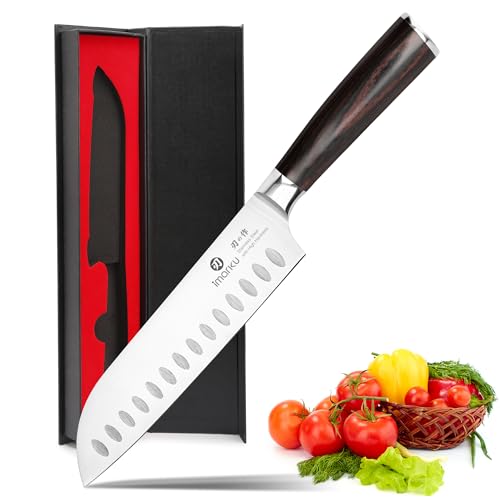
The imarku Santoku solves the sticking problem common with flat-edge knives by using a hollow scalloped blade that keeps sliced food from clinging during fast prep.
Its 15-18 degree hand-polished edge cuts with less force than wider-angle Western knives, which matters most when processing large volumes of vegetables or thin-sliced proteins.
Built from high carbon stainless steel at 2.5mm thickness with a Pakkawood handle, it balances rigidity and grip comfort across different hand sizes.
The brand upgrade notice means packaging and minor cosmetics may vary from product photos, though materials and construction are stated to be unchanged.
Best for home cooks who want one capable, low-maintenance knife that handles daily prep without occupying much counter or drawer space.
Care Guide
Hand-wash with warm soapy water immediately after use and dry thoroughly before storage. Dishwasher cycles degrade the Pakkawood handle and accelerate edge micro-chipping on high carbon steel.
Hone the blade on a ceramic rod every 3-4 uses to maintain the 15-18 degree edge angle. Sharpen on a whetstone at the same angle when honing no longer restores bite.
Store on a magnetic strip or in a knife block. Loose drawer storage causes edge-on-edge contact that dulls the blade faster than actual cooking use.
Editor’s Picks
| Category | Pick Type | Why It Makes Sense |
|---|---|---|
| Best Overall | Balanced meat knives | Strongest mix of construction, usability, cleanup, and owner satisfaction |
| Best Value | Practical meat knives | Keeps the core performance features while avoiding unnecessary upgrades |
| Best for Most Home Kitchens | Use-case focused option | Prioritizes the size, controls, material, or workflow that matters most for this search |
At a Glance: Comparison Table
| Pick Type | Steel / Edge | Handle Feel | Best For | Trade-Off |
|---|---|---|---|---|
| Best Overall | Forgiving stainless or semi-stainless | Neutral balance | Daily prep | Not the cheapest |
| Best Value | Durable stamped or simpler forged steel | Practical grip | Newer cooks | Less refined finish |
| Best Upgrade | Harder steel with cleaner edge retention | More precise balance | Frequent prep | Needs better care |
| Best Small Kitchen | Versatile mid-length profile | Easy control | Tight counters | Less reach |
| Best Specialty | Task-specific blade geometry | Purpose-built | Specific foods | Less universal |
How We Evaluated These Products
We evaluated meat knives options by starting with the product job: what the item must do well for most home kitchens, what trade-offs buyers usually accept, and which features are often overstated. From there, we compared visible specifications such as materials, dimensions, capacity, heat or power ratings where relevant, included accessories, warranty terms, and care instructions.
Aggregated owner feedback was used to identify repeated patterns rather than isolated anecdotes. A single dramatic review can be misleading, but repeated comments about dull factory edges, slippery handles, chipping, rust spots, awkward balance, unsafe storage, or difficult sharpening are useful signals. We gave more weight to recent reviews because product lines, coatings, accessories, and manufacturing details can change over time.
We also considered how the product fits into a full kitchen workflow. A Meat Knives can look excellent on a spec sheet and still be frustrating if it is too large to store, too slow to clean, incompatible with common accessories, or poorly matched to the buyer’s cooking habits. That is why this guide connects the main recommendation to related guides like best bread knife, best bread knife for sourdough, and best chef knife.
What Actually Matters:
Steel, hardness, and edge geometry
The steel and its heat treatment decide almost everything about how a meat knives performs over years of use. Softer stainless in the mid-50s HRC range is forgiving and quick to touch up, while harder Japanese-style steel holds a keener edge but chips more easily and wants careful boards. Look at the grind and blade profile too — a thin, well-tapered edge slices cleanly, whereas a thick shoulder wedges through food. For a related option, compare best bread knife before you commit.
Handle comfort and balance
Handle comfort is where a knife either disappears in your hand or fights you. Check how the handle fills a pinch grip, whether the spine and choil are eased instead of squared, and where the balance point sits relative to the bolster. A blade that balances near the finger guard feels nimble for detail work; a handle-heavy one feels planted for power cuts. Grip material matters for wet hands, so weigh textured composite against smooth polished wood. For a related option, compare best bread knife for sourdough before you commit.
Blade length and task fit
Blade length should follow the tasks you actually repeat, not the biggest option on the shelf. A longer blade covers more food per stroke and suits big-board prep, but it turns clumsy in a small kitchen or on a crowded counter. For most home kitchens, a mid-length profile usually handles the widest range of jobs before you reach for a specialist shape. For a related option, compare best chef knife before you commit.
Sharpening, storage, and upkeep
Upkeep is the hidden cost of any blade, so judge storage and sharpening before you buy. A knife stored loose in a drawer dulls and chips faster than one on a magnetic strip, in a block, or in an edge guard. Ask whether you will realistically hone it, send it out, or run it on a pull-through — the honest answer should steer you toward steel that matches your habits. For a related option, compare best chef knife budget before you commit.
Price tiers and long-term value
Price tiers for a meat knives rise fast, and past a point you pay for finish rather than cutting. The jump from a basic to a mid-tier blade usually buys better steel and fit; the jump to premium often buys hand-finishing and brand. For most home kitchens, spend where it changes daily use — edge retention and comfort — and skip cosmetic upgrades that never touch the food. For a related option, compare best chef knife for beginners before you commit.
Frequently Asked Questions
What should I look for in the best meat knives?
Start with fit for your routine: capacity, materials, cleaning, storage, and compatibility. Then compare owner-review patterns for repeated praise or complaints. For best meat knives, avoid buying only by star rating; the right meat knives should match most home kitchens and the way you actually cook.
Is a more expensive meat knives worth it?
It can be, but only when the upgrade improves something you will notice often: durability, control, cleaning, capacity, or comfort. If the higher price only adds accessories or cosmetic finish, a value pick may be smarter. Spend more when the category is used weekly or daily.
What size meat knives is best for most home kitchens?
The best size is the one that handles your normal use without making storage and cleanup annoying. Product photos can hide scale, so check exterior dimensions as well as usable capacity. For small kitchens or occasional use, a slightly smaller meat knives is often the better long-term choice.
How long should a good meat knives last?
A good meat knives should last long enough to justify its price when cared for according to the manufacturer instructions. Lifespan depends on materials, heat exposure, cleaning habits, moving parts, coatings, and storage. Repeated owner complaints about early failure are more important than one isolated review.
What mistakes should I avoid when buying meat knives?
The biggest mistake is buying the most feature-heavy option without checking whether those features solve your actual problem. Also avoid ignoring dimensions, care requirements, replacement parts, and compatibility. If maintenance sounds unrealistic for your household, choose a simpler product.
How does best meat knives compare with nearby options?
Nearby options can overlap, so use intent to decide. If your need is broad, start with the main meat knives category. If your need is specific, compare related guides such as best chef knife for cutting vegetables and best bread knife to avoid buying a product that is good generally but wrong for your setup.
Our Top Pick
For most shoppers, the best meat knives is the balanced option that gets the fundamentals right before adding extras. Prioritize the product with clear specifications, enough capacity for your normal routine, materials that match your maintenance habits, and repeated owner feedback showing reliable everyday use. The shortcode above contains the product set for this page; use the decision tree below to choose the right type within that set.
- Choose the Best Overall type if you want one safe meat knives for regular use.
- Choose the Best Value type if price matters more than premium finish.
- Choose the Best for Most Home Kitchens type if your use case is specific and frequent.
- Choose an upgrade only if better materials, controls, capacity, or durability will matter every week.



Write Your Review
No reviews yet. Be the first to share your experience!