

HomeWhisk earns commission from qualifying purchases made through links on this page. We research picks from specifications and owner reviews; we do not test products ourselves.
TL;DR — The best material for muffin pan is the option that balances reliable construction, realistic capacity, easy cleanup, and a price that matches how often you will use it. HomeWhisk prioritizes documented specifications, material choices, and repeated owner-review patterns rather than marketing claims. If you are still comparing nearby categories, start with best bakeware for cakes and best bakeware for cookies before narrowing your final pick.
The HomeWhisk editorial team researches kitchen equipment by comparing manufacturer specifications, material details, dimensions, warranty language, retailer listings, and aggregated owner reviews. For best material for muffin pan, we looked for patterns that matter after the return window closes: repeated complaints, praised design details, compatibility limits, and maintenance habits that determine whether a product stays useful.
This is a commercial buying guide, so the goal is practical selection rather than a broad encyclopedia entry. Use this page alongside best bakeware set and best baking sheet if your purchase overlaps adjacent tools or a larger kitchen setup.
Editor’s Picks
| Category | Pick Type | Why It Makes Sense |
|---|---|---|
| Best Overall | Balanced material | Strongest mix of construction, usability, cleanup, and owner satisfaction |
| Best Value | Practical material | Keeps the core performance features while avoiding unnecessary upgrades |
| Best for Muffin Pan | Use-case focused option | Prioritizes the size, controls, material, or workflow that matters most for this search |
At a Glance: Comparison Table
| Pick Type | Material | Rim / Surface | Best For | Trade-Off |
|---|---|---|---|---|
| Best Overall | Balanced build | Everyday size | Most homes | Not the lowest price |
| Best Value | Core materials | Practical capacity | Budget buyers | Fewer premium details |
| Best Upgrade | Heavier construction | Frequent use | Serious cooks | Higher cost |
| Best Compact | Space-saving design | Smaller batches | Small kitchens | Less capacity |
| Best Specialty | Focused feature set | Niche use | Specific needs | Less universal |
How We Evaluated These Products
We evaluated material options by starting with the product job: what the item must do well for muffin pan, what trade-offs buyers usually accept, and which features are often overstated. From there, we compared visible specifications such as materials, dimensions, capacity, heat or power ratings where relevant, included accessories, warranty terms, and care instructions.
Aggregated owner feedback was used to identify repeated patterns rather than isolated anecdotes. A single dramatic review can be misleading, but repeated comments about warping, uneven browning, coating wear, staining, sharp rims, poor oven fit, or difficult cleanup are useful signals. We gave more weight to recent reviews because product lines, coatings, accessories, and manufacturing details can change over time.
We also considered how the product fits into a full kitchen workflow. A Material can look excellent on a spec sheet and still be frustrating if it is too large to store, too slow to clean, incompatible with common accessories, or poorly matched to the buyer’s cooking habits. That is why this guide connects the main recommendation to related guides like best bakeware for cakes, best bakeware for cookies, and best bakeware set.
What Actually Matters:
Material, gauge, and heat transfer
Material and gauge drive how evenly a material bakes and how long it lasts. Heavier aluminum and steel resist the hot spots and warping that plague thin, flimsy sheets, but they take longer to come up to temperature. Match the gauge to your oven and patience: thick pans reward slow, even bakes, while lighter ones heat fast at the cost of uniformity. For a related option, compare best bakeware for cakes before you commit.
Rim design, flatness, and warping resistance
Rim design and flatness decide whether the pan stays true through hundreds of hot-to-cold cycles. A rolled or encapsulated rim adds rigidity that fights the twist and buckle you hear as a bang in a hot oven. Set the pan on a flat surface and look for a dead-flat base — a rocking or bowed pan browns unevenly and never quite recovers. For a related option, compare best bakeware for cookies before you commit.
Surface finish and release
Surface finish and release govern the daily annoyance of sticking and scrubbing. Weigh bare aluminum and steel, which brown beautifully but need greasing or liners, against nonstick and ceramic coatings that release easily but wear and dislike metal tools and high heat. The right finish depends on what you bake most and how gentle you are willing to be with it. For a related option, compare best bakeware set before you commit.
Size, storage, and oven fit
Size, storage, and oven fit are easy to overlook until the pan does not fit. Measure your oven’s usable width with room for air to circulate, and think about how the pan nests or hangs in your cabinets. For muffin pan, a slightly smaller pan that fits comfortably and stores without a fight beats an oversized one that bakes poorly against the walls. For a related option, compare best baking sheet before you commit.
Care routine and long-term value
Care routine and long-term value depend on how the material ages under real use. Coated pans simplify cleanup but have a finite lifespan; bare metal is nearly immortal but wants drying and the occasional scrub to stay rust-free and non-sticky. Choose the maintenance story you will actually follow, because the pan you care for correctly is the one that lasts. For a related option, compare best baking sheet for cookies before you commit.
Frequently Asked Questions
What should I look for in the best material?
Start with fit for your routine: capacity, materials, cleaning, storage, and compatibility. Then compare owner-review patterns for repeated praise or complaints. For best material for muffin pan, avoid buying only by star rating; the right material should match muffin pan and the way you actually cook.
Is a more expensive material worth it?
It can be, but only when the upgrade improves something you will notice often: durability, control, cleaning, capacity, or comfort. If the higher price only adds accessories or cosmetic finish, a value pick may be smarter. Spend more when the category is used weekly or daily.
What size material is best for muffin pan?
The best size is the one that handles your normal use without making storage and cleanup annoying. Product photos can hide scale, so check exterior dimensions as well as usable capacity. For small kitchens or occasional use, a slightly smaller material is often the better long-term choice.
How long should a good material last?
A good material should last long enough to justify its price when cared for according to the manufacturer instructions. Lifespan depends on materials, heat exposure, cleaning habits, moving parts, coatings, and storage. Repeated owner complaints about early failure are more important than one isolated review.
What mistakes should I avoid when buying material?
The biggest mistake is buying the most feature-heavy option without checking whether those features solve your actual problem. Also avoid ignoring dimensions, care requirements, replacement parts, and compatibility. If maintenance sounds unrealistic for your household, choose a simpler product.
How does best material for muffin pan compare with nearby options?
Nearby options can overlap, so use intent to decide. If your need is broad, start with the main material category. If your need is specific, compare related guides such as best baking sheet pans and best bakeware for cakes to avoid buying a product that is good generally but wrong for your setup.
Our Top Pick
For most shoppers, the best material is the balanced option that gets the fundamentals right before adding extras. Prioritize the product with clear specifications, enough capacity for your normal routine, materials that match your maintenance habits, and repeated owner feedback showing reliable everyday use. The shortcode above contains the product set for this page; use the decision tree below to choose the right type within that set.
- Choose the Best Overall type if you want one safe material for regular use.
- Choose the Best Value type if price matters more than premium finish.
- Choose the Best for Muffin Pan type if your use case is specific and frequent.
- Choose an upgrade only if better materials, controls, capacity, or durability will matter every week.
The Best Deals This Week*
-
Mini Muffin Baking for 24 Bite-Size Treats
$7.48
($9.98)Save $2.50 -
Redfly 2 Pack Silicone Muffin Pans for Baking
$8.07
($9.99)Save $1.92
*Deals are selected by our commerce team
Deeper Dive: Our Top Picks
Our Top Picks
CAKETIME
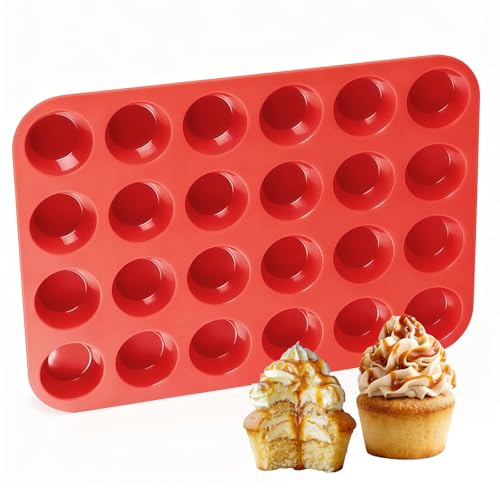
Mini Muffin Baking for 24 Bite-Size Treats: CAKETIME Silicone 24-Cup Pan
The CAKETIME silicone muffin pan makes 24 bite-size treats at once, with flexible nonstick cups that release easily with a finger press. It suits bakers making mini muffins, chocolates, cheesecakes, or other small portions who want dishwasher-safe cleanup and broad temperature versatility.
Pros and Cons
Pros
- The 24-cup layout supports efficient batch baking for small treats.
- Flexible silicone and a nonstick surface make release easier than rigid molds.
- The pan tolerates temperatures from -104 to 446 degrees Fahrenheit.
- It can be cleaned in the dishwasher after use.
Cons
- The flexible pan needs a metal tray or cookie sheet underneath before filling and moving it.
- Each cup holds only 0.6 ounces, so it is intended for mini portions rather than standard muffins.

Fimary
12-Cup Silicone Muffin Pan for Muffins and Cupcakes with Metal Frame
This 12-cup Fimary silicone muffin pan makes muffins, cupcakes, mini quiches, and egg bites easier to release, while its metal frame keeps the pan stable during baking. It suits home bakers who want flexible, freezer-to-oven bakeware that stores compactly and withstands temperatures up to 450°F.
Pros and Cons
Pros
- A metal reinforced frame provides more stability than a flexible silicone-only pan.
- The nonstick surface supports easier food release and cleanup.
- The 450°F heat rating allows regular oven use and freezer-to-oven transitions.
- The 12-cup capacity handles muffins, cupcakes, mini quiches, and egg bites in one batch.
Cons
- The listed cup dimensions are approximately 1.8 inches in diameter and 1.45 inches deep, so buyers wanting oversized muffins may find the portions limited.
- The product data does not specify the pan's weight.

Bake Choice
400-Count Mini Cupcake Liners for Nonstick Muffin Pan Baking
Bake Choice mini cupcake liners simplify portioned baking with food-grade, siliconized parchment that releases desserts cleanly. They suit bakers making mini cupcakes, cookies, tarts, or brownies who want 400 liners and heat resistance up to 428°F.
Pros and Cons
Pros
- Food-grade parchment with a siliconized coating provides a nonstick baking surface.
- The large 400-piece quantity reduces the need for frequent replenishment.
- The compact mini size fits mini muffin and cupcake pans.
- A kraft paper box helps protect the liners during shipping and storage.
Cons
- The 1.37-inch bottom diameter limits these liners to mini-size pans rather than standard cupcake pans.
- The maximum temperature rating is 428°F, so they are unsuitable for hotter baking applications.
Editors' Picks
CAKETIME Mini Muffin Baking for 24 Bite-Size Treats: CAKETIME Silicone 24-Cup Pan
CAKETIME
Mini Muffin Baking for 24 Bite-Size Treats: CAKETIME Silicone 24-Cup Pan
The CAKETIME silicone muffin pan makes 24 bite-size treats at once, with flexible nonstick cups that release easily with a finger press. It suits bakers making mini muffins, chocolates, cheesecakes, or other small portions who want dishwasher-safe cleanup and broad temperature versatility.
$7.48 at AmazonEditors' Favorite
Color: Red Size: 24-Cup Mini Dimensions: 9.399999990412 x 12.99999998674 x 0.699999999286 inches Weight: 0.0375 pounds Product Group: Kitchen Binding: Kitchen
Shop NowFimary 12-Cup Silicone Muffin Pan for Muffins and Cupcakes with Metal Frame
Fimary
12-Cup Silicone Muffin Pan for Muffins and Cupcakes with Metal Frame
This 12-cup Fimary silicone muffin pan makes muffins, cupcakes, mini quiches, and egg bites easier to release, while its metal frame keeps the pan stable during baking. It suits home bakers who want flexible, freezer-to-oven bakeware that stores compactly and withstands temperatures up to 450°F.
$9.99 at AmazonGreat Value
Color: Creamy Confetti Size: Standard: 12 Cups×1pack Dimensions: 14.5 x 9 x 1.45 Inches Weight: 0.22 pounds Product Group: Kitchen
Shop NowRedfly 2 Pack Silicone Muffin Pans for Baking & Cupcake Pan - 12 Cup Regular Size Silicone Molds, BPA Free Egg Bites Mold

Redfly
2 Pack Silicone Muffin Pans for Baking & Cupcake Pan - 12 Cup Regular Size Silicone Molds, BPA Free Egg Bites Mold
$8.07 at AmazonColor: Red Size: 2pcs: 12-Cup Regular Dimensions: 1.1 x 9.6 x 1.2 inches Weight: 0.110231131 pounds Product Group: Kitchen Binding: Kitchen
Shop NowBake Choice 400-Count Mini Cupcake Liners for Nonstick Muffin Pan Baking
Bake Choice
400-Count Mini Cupcake Liners for Nonstick Muffin Pan Baking
Bake Choice mini cupcake liners simplify portioned baking with food-grade, siliconized parchment that releases desserts cleanly. They suit bakers making mini cupcakes, cookies, tarts, or brownies who want 400 liners and heat resistance up to 428°F.
$6.99 at AmazonColor: Natural Size: Mini Dimensions: 1.37 x 1.37 x 0.9 inches Weight: 0.22 pounds Product Group: Kitchen Binding: Kitchen
Shop Now



Write Your Review
No reviews yet. Be the first to share your experience!