

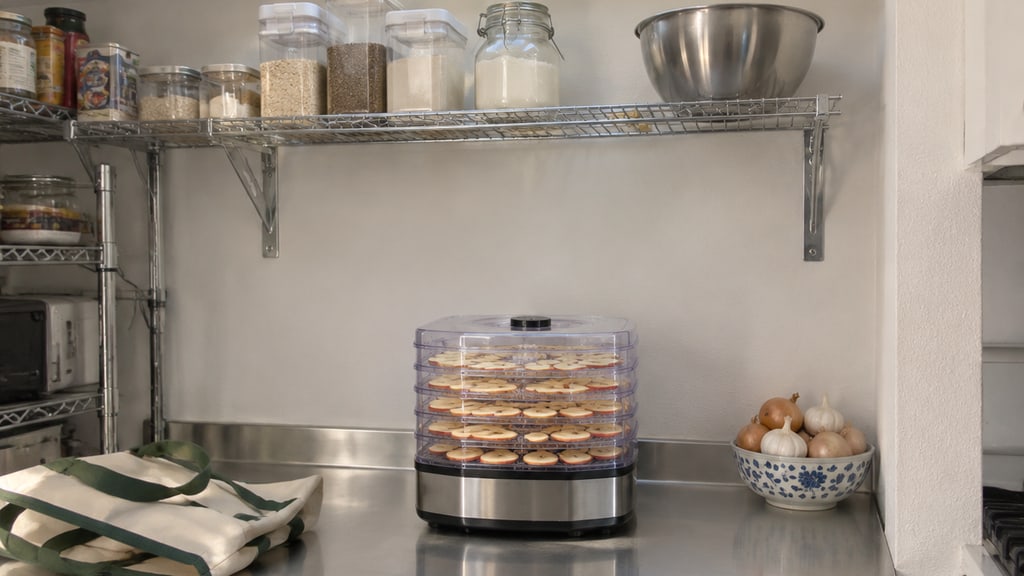
TL;DR — The best dehydrator for home use is the option that balances reliable construction, realistic capacity, easy cleanup, and a price that matches how often you will use it. HomeWhisk prioritizes documented specifications, material choices, and repeated owner-review patterns rather than marketing claims. If you are still comparing nearby categories, start with best 4 qt air fryer and best 6 qt air fryer before narrowing your final pick.
The HomeWhisk editorial team researches kitchen equipment by comparing manufacturer specifications, material details, dimensions, warranty language, retailer listings, and aggregated owner reviews. For best dehydrator for home use, we looked for patterns that matter after the return window closes: repeated complaints, praised design details, compatibility limits, and maintenance habits that determine whether a product stays useful.
This is a commercial buying guide, so the goal is practical selection rather than a broad encyclopedia entry. Use this page alongside best affordable air fryer and best affordable air fryer toaster oven if your purchase overlaps adjacent tools or a larger kitchen setup.
Editor’s Picks
| Category | Pick Type | Why It Makes Sense |
|---|---|---|
| Best Overall | Balanced dehydrator | Strongest mix of construction, usability, cleanup, and owner satisfaction |
| Best Value | Practical dehydrator | Keeps the core performance features while avoiding unnecessary upgrades |
| Best for Home Use | Use-case focused option | Prioritizes the size, controls, material, or workflow that matters most for this search |
At a Glance: Comparison Table
| Pick Type | Capacity | Controls | Best For | Trade-Off |
|---|---|---|---|---|
| Best Overall | Balanced build | Everyday size | Most homes | Not the lowest price |
| Best Value | Core materials | Practical capacity | Budget buyers | Fewer premium details |
| Best Upgrade | Heavier construction | Frequent use | Serious cooks | Higher cost |
| Best Compact | Space-saving design | Smaller batches | Small kitchens | Less capacity |
| Best Specialty | Focused feature set | Niche use | Specific needs | Less universal |
How We Evaluated These Products
We evaluated dehydrator options by starting with the product job: what the item must do well for home use, what trade-offs buyers usually accept, and which features are often overstated. From there, we compared visible specifications such as materials, dimensions, capacity, heat or power ratings where relevant, included accessories, warranty terms, and care instructions.
Aggregated owner feedback was used to identify repeated patterns rather than isolated anecdotes. A single dramatic review can be misleading, but repeated comments about weak motors, noisy operation, cracked plastic, confusing controls, awkward cleaning, overheating, or capacity claims that feel inflated are useful signals. We gave more weight to recent reviews because product lines, coatings, accessories, and manufacturing details can change over time.
We also considered how the product fits into a full kitchen workflow. A Dehydrator can look excellent on a spec sheet and still be frustrating if it is too large to store, too slow to clean, incompatible with common accessories, or poorly matched to the buyer’s cooking habits. That is why this guide connects the main recommendation to related guides like best 4 qt air fryer, best 6 qt air fryer, and best affordable air fryer.
What Actually Matters:
Capacity, wattage, and real counter footprint
Usable capacity and footprint rarely match the marketing number, so read the real dimensions. A model rated for a large batch can still cook unevenly if the basket or bowl is cramped, and a “compact” unit can still hog the counter once you account for lid clearance and cord. For home use, compare interior usable space and the space it claims when open, not just the headline quarts or watts. For a related option, compare best 4 qt air fryer before you commit.
Controls, presets, and repeatability
Controls and repeatability separate an appliance you trust from one you fight. Check whether presets map to things you actually cook, whether the dial or panel gives fine control, and whether it remembers or resets between uses. A machine that hits the same result every time is worth more than one with a long feature list you set once and never touch again. For a related option, compare best 6 qt air fryer before you commit.
Cleaning design and removable parts
Cleaning design makes or breaks how often the dehydrator earns its counter space. Look for removable, dishwasher-safe parts, smooth interiors without food traps, and a lid or basket that rinses without disassembly gymnastics. A powerful appliance that is a chore to wash gets used less, so treat easy teardown as a core spec rather than a bonus. For a related option, compare best affordable air fryer before you commit.
Noise, heat, and everyday usability
Noise, heat, and everyday usability are the frictions you only notice after purchase. A loud motor or a unit that vents heat across the counter changes when and where you are willing to run it. Check cord length, how far controls sit from a wall, and whether the exterior stays touch-safe — small ergonomics decide whether a dehydrator lives on the counter or in a cupboard. For a related option, compare best affordable air fryer toaster oven before you commit.
Durability, warranty, and value
Durability and value show up in the parts you cannot see on the box. Weigh the warranty length, the reputation of the motor or heating element, and whether replacement baskets and seals are sold at all. For home use, the better buy is often the model with a proven track record and available parts over a cheaper one that fails just past the return window. For a related option, compare best affordable blender before you commit.

Frequently Asked Questions
What should I look for in the best dehydrator?
Start with fit for your routine: capacity, materials, cleaning, storage, and compatibility. Then compare owner-review patterns for repeated praise or complaints. For best dehydrator for home use, avoid buying only by star rating; the right dehydrator should match home use and the way you actually cook.
Is a more expensive dehydrator worth it?
It can be, but only when the upgrade improves something you will notice often: durability, control, cleaning, capacity, or comfort. If the higher price only adds accessories or cosmetic finish, a value pick may be smarter. Spend more when the category is used weekly or daily.
What size dehydrator is best for home use?
The best size is the one that handles your normal use without making storage and cleanup annoying. Product photos can hide scale, so check exterior dimensions as well as usable capacity. For small kitchens or occasional use, a slightly smaller dehydrator is often the better long-term choice.
How long should a good dehydrator last?
A good dehydrator should last long enough to justify its price when cared for according to the manufacturer instructions. Lifespan depends on materials, heat exposure, cleaning habits, moving parts, coatings, and storage. Repeated owner complaints about early failure are more important than one isolated review.
What mistakes should I avoid when buying dehydrator?
The biggest mistake is buying the most feature-heavy option without checking whether those features solve your actual problem. Also avoid ignoring dimensions, care requirements, replacement parts, and compatibility. If maintenance sounds unrealistic for your household, choose a simpler product.
How does best dehydrator for home use compare with nearby options?
Nearby options can overlap, so use intent to decide. If your need is broad, start with the main dehydrator category. If your need is specific, compare related guides such as best affordable blender for smoothies and best 4 qt air fryer to avoid buying a product that is good generally but wrong for your setup.
Our Top Pick
For most shoppers, the best dehydrator is the balanced option that gets the fundamentals right before adding extras. Prioritize the product with clear specifications, enough capacity for your normal routine, materials that match your maintenance habits, and repeated owner feedback showing reliable everyday use. The shortcode above contains the product set for this page; use the decision tree below to choose the right type within that set.
- Choose the Best Overall type if you want one safe dehydrator for regular use.
- Choose the Best Value type if price matters more than premium finish.
- Choose the Best for Home Use type if your use case is specific and frequent.
- Choose an upgrade only if better materials, controls, capacity, or durability will matter every week.

OSTBA
Homemade Jerky and Fruit Snacks with the OSTBA 8-Tray Food Dehydrator
The OSTBA food dehydrator dries fruit, vegetables, herbs, jerky, and yogurt across eight trays, with 360° horizontal airflow as its biggest advantage. It suits home cooks making small batches who want precise 95–165°F temperature control and a timer extending up to 48 hours.
Pros and Cons
Pros
- Eight stainless steel trays provide useful capacity for household and small-batch food production.
- The digital controls offer precise temperature and timer adjustments for different ingredients.
- Four mesh sheets and a drip tray expand the included setup beyond the main drying trays.
- ETL certification and a 12-month warranty provide added support for household use.
Cons
- The 165°F maximum temperature may not suit recipes requiring higher-heat drying.
- Dimensions and weight are not provided, so buyers cannot confirm countertop or storage fit from the listed specifications.

Blulu
Fruit Dehydrating Made Easier: Blulu 8-Piece Round Silicone Dehydrator Sheets
Blulu's reusable silicone sheets keep fruit, vegetables, grains, fruit rolls, and jerky from sticking while making cleanup easier. Buy them if you want flexible 13 x 13-inch mats that can be washed, rolled, and cut to fit your dehydrator.
Pros and Cons
Pros
- BPA-free silicone provides a durable, heat-resistant surface for dehydrating and steaming.
- The sheets support multiple foods, including fruit, vegetables, grains, fruit peels, fruit rolls, and beef jerky.
- Hand washing or dishwasher cleaning gives buyers two practical cleanup options.
- Eight reusable sheets provide multiple liners for batch preparation.
Cons
- The 13 x 13-inch sheets may need cutting for smaller dehydrator trays.
- Product weight and compatibility with specific dehydrator models are not provided.

Excalibur
Preserve Harvests and Make Healthy Snacks with Excalibur Performance Series 6-Tray Food Dehydrator
The Excalibur Performance Series 6-Tray dehydrator preserves harvests, game, and snacks with 9.6 square feet of drying space and even airflow without tray rotation. It suits home cooks who need precise, extended drying because its LED controls set temperatures from 85°F to 165°F for up to 80 hours.
Pros and Cons
Pros
- Six stainless steel trays provide substantial drying capacity for household preservation projects.
- Hyperwave Pulse Technology and horizontal airflow are designed to distribute drying heat evenly.
- The glass door allows users to monitor food without opening the dehydrator.
- The wide temperature range and 80-hour operation support precise, extended drying.
Cons
- Its six-tray capacity may require more dedicated counter or storage space than a compact dehydrator.
- The available product data does not specify the dehydrator's dimensions or weight, making fit planning difficult.

NESCO
Homemade Jerky and Fruit Dehydrator, NESCO FD-5TC Snackmaster with 5 BPA-Free Trays
The NESCO FD-5TC dehydrates jerky, fruit, herbs, vegetables, and pet treats with adjustable temperature, timed operation, and airflow designed for even drying without tray rotation. It suits home cooks who want preservative-free snacks in small to medium batches with a compact appliance that stores neatly.
Pros and Cons
Pros
- Five BPA-free 12-by-9.5-inch trays support small to medium batches of homemade snacks.
- Adjustable temperature and a 1-to-24-hour timer provide control over different ingredients.
- Optimized airflow helps distribute heat evenly without requiring tray rotation.
- Compact nesting trays and built-in cord storage make cabinet storage easier.
Cons
- The five-tray capacity is better suited to small and medium batches than large-volume food preparation.
- The durable plastic housing may feel less substantial than a metal dehydrator.
OSTBA Homemade Jerky and Fruit Snacks with the OSTBA 8-Tray Food Dehydrator
OSTBA
Homemade Jerky and Fruit Snacks with the OSTBA 8-Tray Food Dehydrator
The OSTBA food dehydrator dries fruit, vegetables, herbs, jerky, and yogurt across eight trays, with 360° horizontal airflow as its biggest advantage. It suits home cooks making small batches who want precise 95–165°F temperature control and a timer extending up to 48 hours.
Check price on AmazonThe OSTBA Food Dehydrator removes moisture from fruit, vegetables, herbs, jerky, and yogurt while helping home cooks prepare shelf-stable snacks and ingredients.
Its 650W heater and 360° horizontal airflow distribute heat across all eight trays, reducing the need to rotate trays during a batch.
The double-layer stainless steel body improves heat retention, reduces noise, and helps keep the outer casing cooler during extended operation.
The 165°F maximum temperature may limit recipes that require higher heat, and the product listing does not provide dimensions or weight.
Best for home cooks making small batches of dried foods with precise digital controls.
Blulu Fruit Dehydrating Made Easier: Blulu 8-Piece Round Silicone Dehydrator Sheets
Blulu
Fruit Dehydrating Made Easier: Blulu 8-Piece Round Silicone Dehydrator Sheets
Blulu's reusable silicone sheets keep fruit, vegetables, grains, fruit rolls, and jerky from sticking while making cleanup easier. Buy them if you want flexible 13 x 13-inch mats that can be washed, rolled, and cut to fit your dehydrator.
Check price on AmazonThese reusable silicone mats line dehydrator trays to reduce sticking when drying fruit, vegetables, grains, fruit rolls, and beef jerky.
The non-stick surface supports easier food release, while the -40 to 220 degree Celsius range also suits steaming applications.
Each BPA-free sheet measures 13 x 13 inches, can be cut to size, rolls for storage, and is washable by hand or dishwasher. Weight is not listed.
Smaller trays may require trimming, and the product data does not identify specific compatible dehydrator models.
Best for home cooks who dehydrate varied foods and want reusable liners that simplify release and cleanup.
Use the mats for fruit slices, vegetables, grains, fruit peels, fruit rolls, and beef jerky in a dehydrator.
Trim a sheet to match a smaller tray, then roll it after washing for compact storage.
The silicone mesh can also be used as a reusable steaming mat when its size and shape suit the cookware.
Excalibur Preserve Harvests and Make Healthy Snacks with Excalibur Performance Series 6-Tray Food Dehydrator
Excalibur
Preserve Harvests and Make Healthy Snacks with Excalibur Performance Series 6-Tray Food Dehydrator
The Excalibur Performance Series 6-Tray dehydrator preserves harvests, game, and snacks with 9.6 square feet of drying space and even airflow without tray rotation. It suits home cooks who need precise, extended drying because its LED controls set temperatures from 85°F to 165°F for up to 80 hours.
Check price on AmazonThis electric dehydrator helps preserve seasonal produce, game, and homemade snacks while addressing the need for controlled, repeatable drying.
Hyperwave Pulse Technology and horizontal airflow distribute heat evenly, so users can dry food without rotating trays during the process.
Six stainless steel trays provide 9.6 square feet of drying space, while the glass door supports visual monitoring. Exact dimensions and weight are not provided.
The six-tray design may demand significant counter or storage space, especially in smaller kitchens.
Best for home cooks preserving harvests, making snacks, or drying game in larger batches.
NESCO Homemade Jerky and Fruit Dehydrator, NESCO FD-5TC Snackmaster with 5 BPA-Free Trays
NESCO
Homemade Jerky and Fruit Dehydrator, NESCO FD-5TC Snackmaster with 5 BPA-Free Trays
The NESCO FD-5TC dehydrates jerky, fruit, herbs, vegetables, and pet treats with adjustable temperature, timed operation, and airflow designed for even drying without tray rotation. It suits home cooks who want preservative-free snacks in small to medium batches with a compact appliance that stores neatly.
Check price on AmazonThe NESCO FD-5TC turns fresh ingredients into shelf-stable snacks, solving the need for homemade jerky, dried fruit, herbs, and pet treats without relying on preservatives.
Adjustable temperatures from 95°F to 160°F and a 1-to-24-hour timer let you match drying settings to different foods.
Five 12-by-9.5-inch BPA-free plastic trays handle small to medium batches, while nesting storage and cord storage reduce cabinet clutter.
The plastic housing is lightweight and designed for everyday cleanup, but the capacity may not suit large-batch preparation.
Best for home cooks making occasional batches of snacks, herbs, jerky, or pet treats.








Write Your Review
No reviews yet. Be the first to share your experience!