


HomeWhisk earns commission from qualifying purchases made through links on this page. We research picks from specifications and owner reviews; we do not test products ourselves.
TL;DR — The best chef knife for professionals is a high-performance blade that holds a keen edge through a long shift, resists chipping under heavy use, and feels balanced enough to run for hours without fatigue. Pros should prioritize premium steel with a hardness around 58-62 HRC, a comfortable full-tang handle, and an edge geometry matched to their cutting style. For related buys, see best japanese chef knife and best chef knife set.
The HomeWhisk editorial team researches kitchen equipment by analyzing manufacturer specifications, steel metallurgy and hardness data, and aggregated user reviews from Amazon, Reddit communities like r/chefknives, and professional cooking forums. For this guide we focused on the demands of a working kitchen, where a knife is used for hours a day, sharpened frequently, and expected to perform consistently under pressure rather than sit in a block at home.
Professional needs differ sharply from casual ones. A home cook may sharpen a few times a year; a line cook or chef hones daily and sharpens weekly, so edge retention, ease of re-sharpening, and long-term durability matter far more than looks or a bargain price. Our research compared how blades in this class balance hardness against toughness, and which ones professionals still reach for after years of service. If you are building out a station, our guides on best chef knife set and best knife sets cover complementary blades, while best bread knife fills a gap a chef knife cannot.
The Best Deals This Week*
-
8-Inch Chef's Knife for Everyday Prep
$44.21
($61)Save $16.79 -
SHAN ZU Damascus Chef Knife 8 inch
$49.98
($85.99)Save $36.01
*Deals are selected by our commerce team
Deeper Dive: Our Top Picks
Our Top Picks

imarku
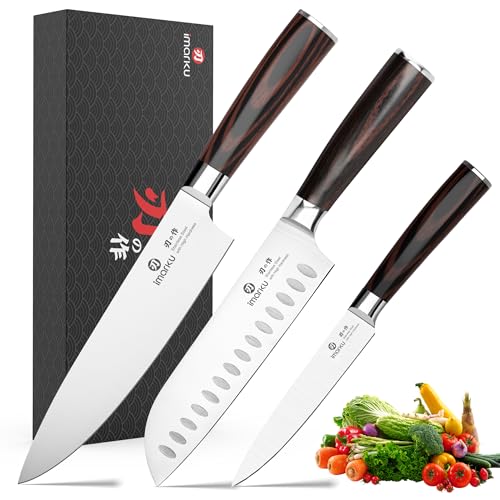
3-Piece Japanese Chef Knife Set with 32
This three-knife set delivers professional-grade slicing with hand-folded Damascus steel blades sharpened to 15 degrees and rated 57 HRC for lasting edge retention. Best for home cooks and chefs who want heirloom-quality Japanese cutlery without buying pieces individually.
Pros and Cons
Pros
- Traditional 108-step Japanese forging process produces visible Damascus patterns and exceptional edge geometry.
- Ergonomic handles reduce hand fatigue during extended chopping and dicing tasks.
- Stain-resistant steel requires only hand washing and towel drying to maintain performance.
Cons
- No protective sheaths or storage block included with the set.
- Hand-wash requirement adds a step compared to dishwasher-safe knife sets.

Victorinox
8-Inch Chef's Knife for Everyday Prep: Victorinox Swiss Classic Stainless Steel
This 8-inch Swiss Made chef's knife handles mincing herbs, chopping vegetables, and slicing meat with a sharp stainless steel blade for clean, controlled cuts. Buy it if you want a dishwasher-safe, ergonomically balanced knife that covers the bulk of daily kitchen tasks.
Pros and Cons
Pros
- Sharp stainless steel blade delivers precise, clean cuts across herbs, vegetables, and meat.
- Ergonomic non-slip handle and balanced design provide stable, comfortable control.
- Dishwasher-safe construction keeps maintenance quick and simple.
- Swiss Made quality from a knife maker with over 140 years of experience.
Cons
- Dishwasher cleaning can dull the edge over time, so hand washing is better for long-term sharpness.
- Sharpeners for upkeep are sold separately, adding to the overall cost.
Editors' Picks
imarku 3-Piece Japanese Chef Knife Set with 32
imarku
3-Piece Japanese Chef Knife Set with 32
This three-knife set delivers professional-grade slicing with hand-folded Damascus steel blades sharpened to 15 degrees and rated 57 HRC for lasting edge retention. Best for home cooks and chefs who want heirloom-quality Japanese cutlery without buying pieces individually.
$73.99 at AmazonEditors' Favorite
Brand Name: imarku Set Name: imarku 3 piece knife set Manufacturer: imarku Model Number: I-KS0784DB Unit Count: 3.0 Count Included Components: chef knife, santoku knife, utility knife Best Sellers Rank: #1,280 in Kitchen & Dining (See Top 100 in Kitchen & Dining) #116 in Kitchen Knife Sets ASIN: B0GK19NTQP Blade Edge: Plain Construction Type: Wood Composite Handle Blade Material Type: High Carbon Stainless Steel Handle Material: Pakkawood Is the item dishwasher safe?: No Material Type: High Carbon Stainless Steel BladeLength: 8.01 Inches Item Length: 13 Inches Size: 8 Color: Red Brown Blade Color: Silver Blade Material: High Carbon Stainless Steel Brand: imarku
Shop NowPAUDIN Kitchen Knife Set

Great Value
Color: Silver, Brown Size: 3-Piece Kitchen Knife Set Dimensions: 13.4 x 1.6 x 0.08 inches Weight: 1.09349281952 pounds Product Group: Kitchen
Shop NowVictorinox 8-Inch Chef's Knife for Everyday Prep: Victorinox Swiss Classic Stainless Steel
Victorinox
8-Inch Chef's Knife for Everyday Prep: Victorinox Swiss Classic Stainless Steel
This 8-inch Swiss Made chef's knife handles mincing herbs, chopping vegetables, and slicing meat with a sharp stainless steel blade for clean, controlled cuts. Buy it if you want a dishwasher-safe, ergonomically balanced knife that covers the bulk of daily kitchen tasks.
$44.21 at AmazonColor: Black Size: 8" Dimensions: 13.54 x 2.32 x 0.79 Inches Weight: 0.40344593946 pounds Product Group: Kitchen Binding: Kitchen
Shop NowSHAN ZU Damascus Chef Knife 8 inch, 67-Layer High Carbon Steel

Color: 67-Layer Damascus Steel Size: 8" Dimensions: 14.173228332 x 2.1653543285 x 0.09842519675 inches Weight: 0.1 pounds Product Group: Kitchen Binding: Home
Shop NowEditor’s Picks
| Category | Pick | Why |
|---|---|---|
| Best Overall | High-carbon steel gyuto/chef knife, ~60-61 HRC | Long edge retention, precise geometry, refined balance for all-day professional use |
| Best Value | Forged German-style pro chef knife | Tough, easy to sharpen, near-indestructible workhorse for heavy line duty |
| Best for Precision Work | Japanese-style thin-bladed gyuto | Harder steel, acute edge, cleanest cuts for detailed knife work and plating |
At a Glance: Comparison Table
| Pick Type | Steel / Hardness | Edge Angle | Handle | Balance | Best For |
|---|---|---|---|---|---|
| Best Overall | High-carbon stainless, ~60-61 HRC | 12-15° per side | Full-tang, riveted | Neutral to blade-forward | All-day professional prep |
| Best Value | Forged German stainless, ~56-58 HRC | 15-20° per side | Full-tang, bolstered | Blade-forward | Heavy chopping, tough tasks |
| Precision gyuto | Japanese steel, ~60-63 HRC | 10-15° per side | Wa or Western | Blade-forward, light | Detailed slicing, plating |
| Stain-resistant workhorse | Molybdenum-vanadium, ~58 HRC | 14-16° per side | Composite, ergonomic | Neutral | Wet, high-volume stations |
| Carbon-steel traditional | Carbon steel, ~61-64 HRC | 10-14° per side | Wa handle | Blade-forward | Purists who maintain patina |
How We Evaluated These Products
This guide is research-based. we synthesized manufacturer specifications, steel composition and hardness data, retailer listings, and recurring patterns in aggregated professional and enthusiast reviews to determine which chef knives hold up to the demands of a working kitchen.
For a professional, edge retention and edge stability are the specifications that matter most, so we weighted them heavily. A blade that dulls mid-shift or chips on a chicken bone costs time and consistency. We looked at Rockwell hardness (HRC), steel type, and geometry together, because hardness alone tells only part of the story: a very hard blade holds its edge longer but can be more brittle, while a slightly softer forged blade sacrifices some retention for toughness and easy field sharpening.
We also weighted ergonomics and durability. Recurring review themes such as hot spots on the handle, hand fatigue, blades that chip under lateral stress, and loose handle scales told us which knives frustrate professionals over time. Finally, we considered sharpenability, because pros re-sharpen constantly, and a steel that takes a keen edge quickly on a whetstone is worth more in a working kitchen than one that resists sharpening.
What Actually Matters:
Steel Composition and Hardness
For a professional, steel is the heart of the knife because it dictates how long the edge lasts, how sharp it can get, and how it is maintained. Blade hardness is measured on the Rockwell C scale (HRC), and professional-grade chef knives generally fall between 56 and 64 HRC. German-style forged knives sit lower, around 56 to 58 HRC, trading some edge retention for toughness and easy sharpening. Japanese-style knives run harder, often 60 to 63 HRC or more, holding a keen edge far longer but demanding more careful use.
Composition matters as much as hardness. High-carbon stainless steels balance edge retention with corrosion resistance, which suits the wet, fast environment of a professional line. Molybdenum and vanadium additions refine grain and boost wear resistance. True carbon steels can take the sharpest edge and are beloved by some pros, but they rust without diligent drying and develop a patina. Powdered or high-alloy steels push edge retention further still at a higher price.
The professional takeaway is to match steel to your habits and station. If you sharpen frequently and want a forgiving, tough blade for heavy chopping and bone-adjacent work, a forged German steel around 58 HRC is dependable. If you value the longest edge life and cleanest cuts and will treat the blade with care, a harder Japanese steel around 60 to 62 HRC rewards you.
Blade Geometry, Profile, and Cutting Style
Beyond steel, geometry determines how the knife actually cuts, and professionals feel these differences within minutes of use. Blade profile, the curve of the edge, shapes technique. German-style chef knives have a pronounced belly that favors a rocking motion for mincing herbs and garlic, while Japanese-style gyutos are flatter with less curve, suiting a push-pull or chopping stroke. A cook who rock-chops and one who push-cuts prefer different profiles, so profile should match your dominant motion.
Blade thickness and grind govern how cleanly the knife glides through food. Thin blades with an acute grind, common on Japanese knives, wedge less and produce cleaner slices through dense vegetables and proteins. Thicker German blades are more robust and better tolerate tough tasks, at the cost of a slightly more wedging cut. Edge angle follows the same logic: a narrow 10 to 15 degrees per side cuts more keenly but is more delicate, while 15 to 20 degrees is sturdier.
Blade length is a practical choice for high-volume prep. Most professionals favor an 8 to 10-inch chef knife, since a longer blade covers more food per stroke. A 10-inch blade speeds bulk prep but is less nimble for detailed work, while 8 inches is the versatile standard that balances reach and control. Consider complementary blades from best chef knife set for tasks a single chef knife handles less well.
Handle Design, Balance, and All-Day Comfort
In a professional setting a knife is held for hours, so handle comfort and balance move from nice-to-have to essential. The handle style splits broadly into Western and Japanese (wa) designs. Western handles are contoured, often with a full tang and rivets, and fill the palm for a secure grip that suits heavy use. Wa handles are lighter, typically octagonal or D-shaped, and shift balance toward the blade for a nimble feel favored in precision work. The right choice depends on grip preference and hand size.
Balance is where fatigue is won or lost. A well-balanced chef knife carries its balance point near the bolster or the pinch grip, so the blade feels like an extension of the hand. Blade-heavy knives aid chopping momentum but tire the wrist over a long shift, while handle-heavy knives feel nimble but require more effort. Professionals often prefer a neutral to slightly blade-forward balance that lets the knife do the work.
Material and construction affect durability and hygiene. Full-tang construction, where the steel runs the length of the handle, adds strength and balance and is standard on serious Western knives. Modern synthetic handles resist water and bacteria and are common in commercial kitchens. Aggregated reviews flag hot spots, slippery grips when wet, and loosening scales as the failures that matter most, so a comfortable, sealed, securely mounted handle is worth prioritizing.
Sharpening, Maintenance, and Edge Care
For a professional, a knife is only as good as the edge you can keep on it, so maintenance is a core buying factor rather than an afterthought. Harder steels hold their edge longer between sharpenings but take more time and skill to re-sharpen. Softer forged steels dull faster but sharpen quickly and tolerate frequent honing, which is why many high-volume cooks favor them for the sheer ease of bringing back a working edge in minutes.
Sharpening method matters at this level. Serious professionals sharpen on whetstones, which give full control over angle and edge geometry and can produce a keener edge than pull-through sharpeners, which grind away more metal. A honing steel or ceramic rod realigns the edge between sharpenings and should be used regularly, though very hard Japanese blades prefer a ceramic rod or light stone touch-up over an aggressive steel. Matching your sharpening kit to your blade’s hardness protects both the edge and the knife’s lifespan.
Everyday care preserves the investment. Hand wash and dry immediately, especially carbon steel, which rusts otherwise; never put a quality knife in the dishwasher. Cut on wood or soft polypropylene boards rather than glass, stone, or ceramic. Store the knife in a guard, on a magnetic strip, or in a slotted block. With disciplined maintenance, a professional-grade chef knife stays sharp through years of daily service; guides like best knife sets and best bread knife help round out a station that shares the same care routine.
Frequently Asked Questions
What makes a chef knife suitable for professionals?
A professional chef knife must hold a sharp edge through hours of continuous use, resist chipping under heavy prep, and stay comfortable enough to run for a full shift without fatigue. That means premium steel around 58 to 62 HRC, a balanced full-tang or well-weighted handle, and an edge geometry matched to your cutting style. Ease of re-sharpening matters greatly, since pros hone daily and sharpen often. Durability and consistency under pressure separate a true working knife from a home-kitchen blade.
Are Japanese or German chef knives better for pros?
Both are used professionally; the choice depends on your work and technique. German knives use softer, tougher steel that resists chipping, sharpens easily, and suits a rocking cut and heavy tasks, making them dependable workhorses. Japanese knives use harder steel with thinner, more acute edges that cut more cleanly and hold sharpness longer but require careful use and more skilled sharpening. Many pros own both: a German blade for tough, high-volume work and a Japanese gyuto for precision slicing and plating.
What blade hardness should a professional look for?
Most professional chef knives fall between 56 and 64 HRC, and the right target depends on priorities. Around 56 to 58 HRC gives a tough, forgiving, easy-to-sharpen blade ideal for heavy chopping and bone-adjacent tasks. Around 60 to 62 HRC holds a keen edge much longer and cuts more cleanly but demands careful use to avoid chipping. Above 62 HRC offers exceptional edge retention for precision work but is more brittle. Match the hardness to your sharpening habits and station.
How often should professionals sharpen their chef knife?
It varies with use and steel, but a working cook typically hones the edge daily with a rod to keep it aligned and sharpens on a whetstone every week or two, or whenever the edge stops biting. High-volume stations sharpen more often. Softer German steels need more frequent sharpening but restore quickly; harder Japanese steels hold longer between sessions but take more care to re-sharpen. Regular honing between sharpenings dramatically extends how long the edge stays working, reducing full sharpenings.
Is a full-tang knife necessary for professional use?
For a Western-style chef knife, full-tang construction is strongly preferred because the steel running the length of the handle adds strength, durability, and balance, and it stands up to years of heavy use. It is a mark of a serious working knife. Japanese wa-handled knives use a partial hidden tang by design and remain fully professional, achieving balance differently with a lighter handle. So full-tang is important for Western knives specifically, while quality Japanese knives are an accepted exception.
How should a professional care for a chef knife?
Hand wash and dry the knife immediately after use, never the dishwasher, and dry carbon steel promptly to prevent rust. Cut only on wood or soft polypropylene boards, avoiding glass, stone, or ceramic that dull and chip the edge. Hone regularly, sharpen on a whetstone suited to the blade’s hardness, and store the knife in a guard, on a magnetic strip, or in a slotted block. This routine keeps a premium blade performing through years of daily service.
Our Top Pick
After comparing steel composition, geometry, ergonomics, and aggregated professional feedback, a high-carbon steel chef knife around 60 to 61 HRC is the best choice for most professionals. It holds a keen edge through a long shift, cuts cleanly thanks to a refined geometry, and balances hardness against enough toughness to survive real kitchen use, while remaining sharpenable on a whetstone. It delivers the consistency and endurance a working kitchen demands without tipping into the brittleness of the hardest specialty steels.
Consider these decision points:
- If you want the best all-around professional blade, choose a high-carbon steel chef knife around 60 to 61 HRC with a balanced full-tang handle.
- If your station involves heavy chopping, a forged German-style knife around 58 HRC is tougher and easier to sharpen fast.
- If precision slicing and plating define your work, a harder Japanese-style gyuto around 60 to 63 HRC cuts cleanest, provided you treat it with care.
- If you are building a full station, pair your chef knife with blades from best chef knife set, best japanese chef knife, and best knife sets, plus a dedicated best bread knife.
The best chef knife for professionals is the one whose steel, geometry, and handle match your station and your sharpening discipline. Buy for edge retention, balance, and durability first, and a quality blade will perform for years.

Write Your Review
No reviews yet. Be the first to share your experience!