

TL;DR — The best basic espresso machine for most home kitchens is the option that balances reliable construction, realistic capacity, easy cleanup, and a price that matches how often you will use it. HomeWhisk prioritizes documented specifications, material choices, and repeated owner-review patterns rather than marketing claims. If you are still comparing nearby categories, start with best breville espresso machine and best budget coffee maker before narrowing your final pick.
The HomeWhisk editorial team researches kitchen equipment by comparing manufacturer specifications, material details, dimensions, warranty language, retailer listings, and aggregated owner reviews. For best basic espresso machine, we looked for patterns that matter after the return window closes: repeated complaints, praised design details, compatibility limits, and maintenance habits that determine whether a product stays useful.
This is a commercial buying guide, so the goal is practical selection rather than a broad encyclopedia entry. Use this page alongside best coffee and espresso maker combo and best coffee maker with grinder if your purchase overlaps adjacent tools or a larger kitchen setup.
The Best Deals This Week*
-
Espresso, Lattes and Cold Brew at Home
$109.99
($235.99)Save $126.00 -
Home Espresso, Lattes and Cold Brew with the VIOMI
$99.99
($119.99)Save $20.00
*Deals are selected by our commerce team
Deeper Dive: Our Top Picks
Our Top Picks

Canoly
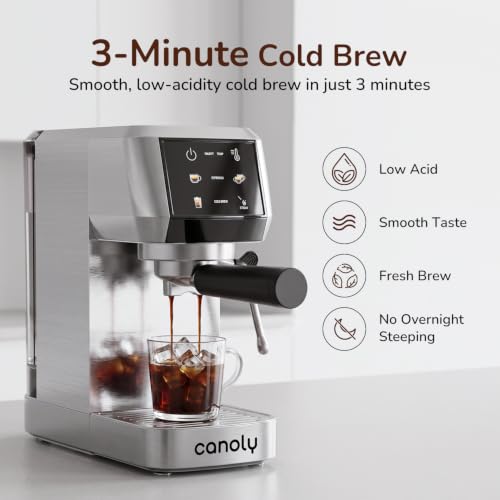
Espresso, Lattes and Cold Brew at Home: Canoly 2-in-1 20-Bar Coffee Machine
The Canoly 2-in-1 brews espresso and dedicated-pipeline cold brew, with the key advantage of making both hot and low-acid iced coffee from one compact machine. It suits home coffee drinkers who want espresso, cappuccinos, lattes, and cold brew without giving multiple appliances counter space.
Pros and Cons
Pros
- Its 2-in-1 design handles espresso-based drinks and dedicated cold brew in one countertop appliance.
- The 20-bar pump and stabilized temperature system are designed to deliver balanced, consistent espresso extraction.
- A powerful steam wand expands the drink range to cappuccinos, lattes, macchiatos, and other milk-based coffees.
- Fast preheating and touchscreen controls reduce setup time for daily use.
Cons
- Milk texturing uses a steam wand, so cappuccinos and lattes still require hands-on frothing.
- The product information does not state exact dimensions, weight, materials, or reservoir capacity, making fit and refill frequency harder to assess.

VIOMI
Home Espresso, Lattes and Cold Brew with the VIOMI T1A Pro 20-Bar Espresso Machine
The VIOMI T1A Pro prepares espresso, Americano, cold brew, lattes and cappuccinos, with 9-bar extraction and NTC temperature control as its biggest brewing advantage. It suits home baristas who want customizable drink volume, manual milk frothing and touchscreen operation in a compact machine.
Pros and Cons
Pros
- The 20-bar pump, low-pressure pre-infusion and NTC temperature control support consistent extraction.
- Touchscreen controls provide direct access to customizable coffee volume and multiple drink functions.
- The steam system supports textured milk foam for several café-style drinks.
- Its compact stainless steel design saves counter space while adding durable, easy-rinse components.
Cons
- Milk frothing is manual, so producing consistent microfoam requires some practice.
- Exact dimensions, water-tank capacity and machine weight are not provided in the available specifications.
Gaggia
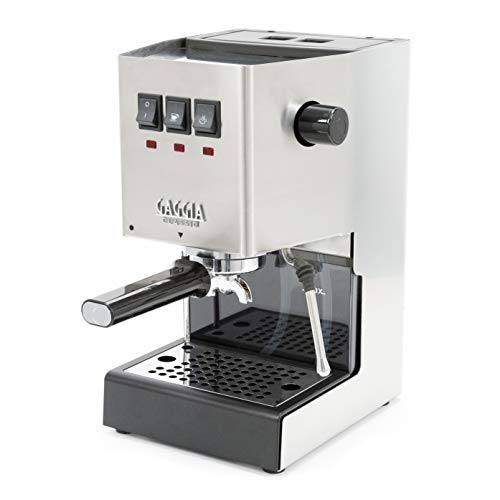
Home Espresso and Milk Drink Brewing with Gaggia RI9380/46 E24 Stainless Steel Espresso Machine
The Gaggia RI9380/46 E24 prepares 9-bar espresso with a commercial 58mm portafilter, giving home users a professional-style brewing platform. It suits hands-on espresso drinkers who value Italian-made steel construction and manual milk steaming.
Pros and Cons
Pros
- The machine uses a commercial-size 58mm stainless steel portafilter.
- Its commercial three-way solenoid valve improves post-extraction pressure management.
- The commercial steam wand supports hands-on milk texturing.
- The solid steel housing is made in Italy for buyers prioritizing metal construction.
Cons
- As a semi-automatic machine, it requires hands-on puck preparation and milk-steaming technique.
- The supplied product data does not list dimensions or weight, so buyers should verify available counter space before ordering.

AMZCHEF
Fast Home Lattes and Cappuccinos with AMZCHEF 20 Bar Espresso Machine
The AMZCHEF espresso machine brews espresso and froths milk, with a 1350W heating system that preheats in under 40 seconds. It suits home or office users who want touchscreen drink controls, compact storage, and simplified cleaning.
Pros and Cons
Pros
- Its compact stainless steel body saves counter space while providing a durable exterior for daily use.
- Rapid preheating makes it practical for preparing espresso before work or between office tasks.
- The included portafilter, filters, tamper, and removable water tank provide the core tools needed to begin brewing.
- Touchscreen controls and programmable brew time offer more convenience than basic switch-operated machines.
Cons
- Milk frothing and portafilter preparation are manual, so consistent results require some practice.
- Exact dimensions and weight are not included in the supplied specifications, making cabinet-clearance planning less certain.
Imusa
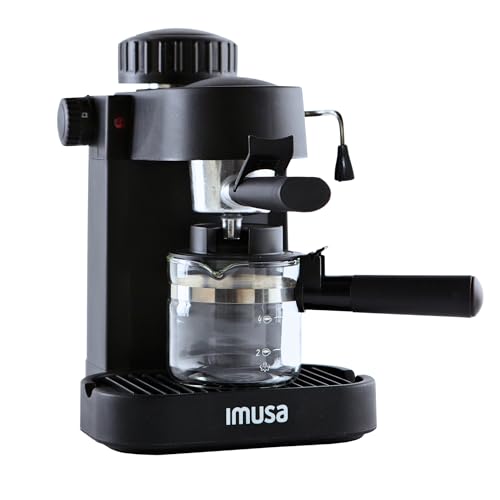
Brew 4 Cups of Espresso and Cappuccino at Home | IMUSA Electric Coffee Maker with Milk Frother
The IMUSA brews four cups of espresso per cycle and includes a built-in milk frother that converts regular milk into foam, covering both espresso and cappuccino output from a single machine. Coffee drinkers who want daily café-style beverages at home without a separate frother or a second appliance will find this machine handles both tasks in one compact unit.
Pros and Cons
Pros
- Four-cup capacity means fewer brewing rounds when preparing drinks for multiple people at once.
- Integrated milk frother eliminates the need to purchase a standalone frothing wand.
- Permanent filter basket removes the recurring cost and waste of disposable paper filters.
- Heat-resistant plastic construction reduces surface burn risk during and after brewing.
Cons
- Plastic construction will not retain heat as effectively as stainless steel-bodied espresso machines.
- Four-cup maximum may require multiple brewing cycles for larger households with heavy daily consumption.
Editors' Picks
Canoly Espresso, Lattes and Cold Brew at Home: Canoly 2-in-1 20-Bar Coffee Machine
Canoly
Espresso, Lattes and Cold Brew at Home: Canoly 2-in-1 20-Bar Coffee Machine
The Canoly 2-in-1 brews espresso and dedicated-pipeline cold brew, with the key advantage of making both hot and low-acid iced coffee from one compact machine. It suits home coffee drinkers who want espresso, cappuccinos, lattes, and cold brew without giving multiple appliances counter space.
$109.99 at AmazonEditors' Favorite
Color: Stainless Steel Size: Large Dimensions: 12.99 x 6.5 x 12.13 inches Weight: 8.65 Pounds Product Group: Kitchen
Shop NowVIOMI Home Espresso, Lattes and Cold Brew with the VIOMI T1A Pro 20-Bar Espresso Machine
VIOMI
Home Espresso, Lattes and Cold Brew with the VIOMI T1A Pro 20-Bar Espresso Machine
The VIOMI T1A Pro prepares espresso, Americano, cold brew, lattes and cappuccinos, with 9-bar extraction and NTC temperature control as its biggest brewing advantage. It suits home baristas who want customizable drink volume, manual milk frothing and touchscreen operation in a compact machine.
$99.99 at AmazonGreat Value
Color: Silver Size: Medium Dimensions: 12.5 x 6.2 x 12.5 inches Weight: 7.5 Pounds Product Group: Kitchen Binding: Kitchen
Shop NowGaggia Home Espresso and Milk Drink Brewing with Gaggia RI9380/46 E24 Stainless Steel Espresso Machine
Gaggia
Home Espresso and Milk Drink Brewing with Gaggia RI9380/46 E24 Stainless Steel Espresso Machine
The Gaggia RI9380/46 E24 prepares 9-bar espresso with a commercial 58mm portafilter, giving home users a professional-style brewing platform. It suits hands-on espresso drinkers who value Italian-made steel construction and manual milk steaming.
$451.21 at AmazonColor: Brushed Stainless Steel Size: Small Dimensions: 3.149606296 x 3.7401574765 x 5.5905511754 inches Weight: 20 pounds Product Group: Kitchen Binding: Kitchen
Shop NowAMZCHEF Fast Home Lattes and Cappuccinos with AMZCHEF 20 Bar Espresso Machine
AMZCHEF
Fast Home Lattes and Cappuccinos with AMZCHEF 20 Bar Espresso Machine
The AMZCHEF espresso machine brews espresso and froths milk, with a 1350W heating system that preheats in under 40 seconds. It suits home or office users who want touchscreen drink controls, compact storage, and simplified cleaning.
$84.99 at AmazonColor: Silver Size: 40 oz Dimensions: 12.01 x 11.93 x 5.87 inches Weight: 8.5 pounds Product Group: Kitchen Binding: Kitchen
Shop NowImusa Brew 4 Cups of Espresso and Cappuccino at Home | IMUSA Electric Coffee Maker with Milk Frother
Imusa
Brew 4 Cups of Espresso and Cappuccino at Home | IMUSA Electric Coffee Maker with Milk Frother
The IMUSA brews four cups of espresso per cycle and includes a built-in milk frother that converts regular milk into foam, covering both espresso and cappuccino output from a single machine. Coffee drinkers who want daily café-style beverages at home without a separate frother or a second appliance will find this machine handles both tasks in one compact unit.
$49.99 at AmazonColor: Black Size: 4 Cup Dimensions: 7.48 x 9.05 x 11.02 inches Product Group: Kitchen Binding: Kitchen
Shop NowEditor’s Picks
| Category | Pick Type | Why It Makes Sense |
|---|---|---|
| Best Overall | Balanced basic espresso machine | Strongest mix of construction, usability, cleanup, and owner satisfaction |
| Best Value | Practical basic espresso machine | Keeps the core performance features while avoiding unnecessary upgrades |
| Best for Most Home Kitchens | Use-case focused option | Prioritizes the size, controls, material, or workflow that matters most for this search |
At a Glance: Comparison Table
| Pick Type | Brew Workflow | Capacity | Best For | Trade-Off |
|---|---|---|---|---|
| Best Overall | Consistent daily workflow | Household size | Most users | Costs more |
| Best Value | Simple controls | Small to medium | Budget buyers | Fewer extras |
| Best Upgrade | More control | Frequent use | Coffee-focused homes | More maintenance |
| Best Compact | Small footprint | One to two users | Apartments | Lower capacity |
| Best Specialty | Niche drink workflow | Specific use | Targeted needs | Less versatile |
How We Evaluated These Products
We evaluated basic espresso machine options by starting with the product job: what the item must do well for most home kitchens, what trade-offs buyers usually accept, and which features are often overstated. From there, we compared visible specifications such as materials, dimensions, capacity, heat or power ratings where relevant, included accessories, warranty terms, and care instructions.
Aggregated owner feedback was used to identify repeated patterns rather than isolated anecdotes. A single dramatic review can be misleading, but repeated comments about temperature inconsistency, leaking, scale buildup, messy cleanup, grinder jams, weak extraction, or confusing controls are useful signals. We gave more weight to recent reviews because product lines, coatings, accessories, and manufacturing details can change over time.
We also considered how the product fits into a full kitchen workflow. A Basic Espresso Machine can look excellent on a spec sheet and still be frustrating if it is too large to store, too slow to clean, incompatible with common accessories, or poorly matched to the buyer’s cooking habits. That is why this guide connects the main recommendation to related guides like best breville espresso machine, best budget coffee maker, and best coffee and espresso maker combo.
What Actually Matters:
Brewing consistency and temperature control
Brew consistency comes down to how tightly the machine holds temperature and contact time from the first cup to the tenth. Watch for stable water temperature, even saturation, and steady pressure or a controlled pour rather than a headline feature. A brewer that drifts cool or channels water will taste different every morning, which is the opposite of what you want from a basic espresso machine. For a related option, compare best breville espresso machine before you commit.
Grinder or accessory workflow
Grind and accessory workflow decides how much friction stands between beans and a cup. If the basic espresso machine pairs with a grinder, check the burr type, retention, and how easily you can dial in a setting; if it takes pods or filters, factor their ongoing cost and availability. Fussy dosing and messy transfers add up over a daily routine, so favor a setup where the steps stay quick and repeatable. For a related option, compare best budget coffee maker before you commit.
Cleaning, scale, and daily maintenance
Cleaning and scale management quietly determine whether you keep using the machine. Look at how easily the brew path, basket, and reservoir come apart, and how often the manufacturer expects descaling in your water. Coffee gear that hides its cleaning access or demands frequent teardown tends to get neglected, and neglect shows up fast in the cup. For a related option, compare best coffee and espresso maker combo before you commit.
Counter space, capacity, and speed
Counter space, capacity, and speed have to match your household rhythm. A large-reservoir machine saves refills for a busy kitchen but eats real estate; a compact one frees the counter but needs topping up. For most home kitchens, size the capacity to how many cups you pull before the day settles, and check warm-up and brew time if mornings are rushed. For a related option, compare best coffee maker with grinder before you commit.
Value, warranty, and upgrade path
Value on a basic espresso machine is about the whole ownership arc, not the sticker. Weigh the warranty, the price and availability of gaskets, filters, and carafes, and whether there is a sensible upgrade path if your tastes grow. For most home kitchens, the smart pick is the one whose running costs and repairs stay reasonable long after the box is recycled. For a related option, compare best cold brew coffee maker before you commit.
Frequently Asked Questions
What should I look for in the best basic espresso machine?
Start with fit for your routine: capacity, materials, cleaning, storage, and compatibility. Then compare owner-review patterns for repeated praise or complaints. For best basic espresso machine, avoid buying only by star rating; the right basic espresso machine should match most home kitchens and the way you actually cook.
Is a more expensive basic espresso machine worth it?
It can be, but only when the upgrade improves something you will notice often: durability, control, cleaning, capacity, or comfort. If the higher price only adds accessories or cosmetic finish, a value pick may be smarter. Spend more when the category is used weekly or daily.
What size basic espresso machine is best for most home kitchens?
The best size is the one that handles your normal use without making storage and cleanup annoying. Product photos can hide scale, so check exterior dimensions as well as usable capacity. For small kitchens or occasional use, a slightly smaller basic espresso machine is often the better long-term choice.
How long should a good basic espresso machine last?
A good basic espresso machine should last long enough to justify its price when cared for according to the manufacturer instructions. Lifespan depends on materials, heat exposure, cleaning habits, moving parts, coatings, and storage. Repeated owner complaints about early failure are more important than one isolated review.
What mistakes should I avoid when buying basic espresso machine?
The biggest mistake is buying the most feature-heavy option without checking whether those features solve your actual problem. Also avoid ignoring dimensions, care requirements, replacement parts, and compatibility. If maintenance sounds unrealistic for your household, choose a simpler product.
How does best basic espresso machine compare with nearby options?
Nearby options can overlap, so use intent to decide. If your need is broad, start with the main basic espresso machine category. If your need is specific, compare related guides such as best espresso machine and best breville espresso machine to avoid buying a product that is good generally but wrong for your setup.
Our Top Pick
For most shoppers, the best basic espresso machine is the balanced option that gets the fundamentals right before adding extras. Prioritize the product with clear specifications, enough capacity for your normal routine, materials that match your maintenance habits, and repeated owner feedback showing reliable everyday use. The shortcode above contains the product set for this page; use the decision tree below to choose the right type within that set.
- Choose the Best Overall type if you want one safe basic espresso machine for regular use.
- Choose the Best Value type if price matters more than premium finish.
- Choose the Best for Most Home Kitchens type if your use case is specific and frequent.
- Choose an upgrade only if better materials, controls, capacity, or durability will matter every week.


Write Your Review
No reviews yet. Be the first to share your experience!