

HomeWhisk earns commission from qualifying purchases made through links on this page. We research picks from specifications and owner reviews; we do not test products ourselves.
TL;DR — The useful way to compare immersion blender vs panini press is to look at daily workflow, upkeep, and what each option does better. When this turns into a purchase decision, compare best immersion blender, best blender, and best french press before narrowing your shortlist.
The HomeWhisk approach is research-first: compare construction, usability, cleaning, and long-term complaints before recommending a direction. For appliance topics, we pay close attention to capacity, controls, cleanup, storage, reliability complaints, and whether the machine saves enough effort to justify the space.

Deeper Dive: Our Top Picks
Our Top Picks
COOLUMA
Large-Batch Soup and Sauce Blending: COOLUMA Commercial 750W Immersion Blender with 18-Inch Detachable Shaft and Variable Speed
This COOLUMA hand blender purees soups, thick sauces, and dressings directly in the stock pot, with 750W and speeds reaching 19,000 RPM clearing batches that would take several rounds in a countertop jar. Buy it if you run a small restaurant, deli, or catering kitchen that needs NSF-certified gear and a shaft long enough to reach the bottom of a full pot.
Pros and Cons
Pros
- Dual-button operation prevents accidental starts while the shaft sits in a hot pot.
- Continuous run function removes the need to hold a trigger through a long batch.
- ETL and NSF certification plus 304 stainless food-contact parts make it usable in inspected kitchens.
- Backed by a 12-month warranty with 24/7 customer service.
Cons
- The listing contradicts itself on shaft length and batch capacity, quoting 18 inch and 42 gallons in one place and 20 inch and 53 gallons in another, so measure your deepest pot and confirm before ordering.
- The shaft length and motor power are built for stock pots, making it awkward and splashy in a home-sized saucepan.

TK Tartle Kitchen
Commercial Immersion Blender for Restaurant Soups and Sauces: TK Tartle Kitchen 350W Heavy Duty with 10-Inch Shaft
This 350W immersion blender uses a 10-inch shaft to blend soups, sauces, and purees directly in deep stockpots, eliminating the batch transfers that slow down service. Restaurant kitchens and catering operations that need ETL and NSF certified equipment for daily volume work should buy it.
Pros and Cons
Pros
- The 10-inch shaft length is sized for professional stockpots and catering-size batches.
- Both ETL and NSF certifications are in place, which matters for commercial inspection and insurance requirements.
- At 350W the motor is aimed at continuous foodservice tasks rather than intermittent home use.
- Blending directly in the cooking vessel removes the hot-liquid transfer step that causes spills and burns.
Cons
- This unit has no customer reviews yet, so there is no long-term reliability feedback from other buyers.
- At 350W it sits below the wattage of larger commercial immersion units, so very thick or fibrous batches may need longer run times.
Waring
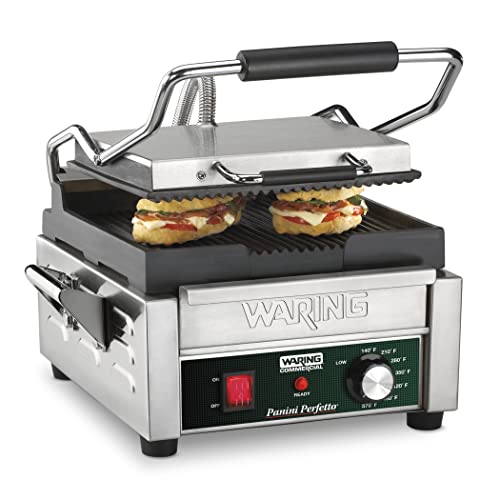
Commercial Panini Press for Thick Sandwiches and Grilled Meats: Waring 9.75" x 9.25" Cast-Iron Grill
This Waring press grills panini, burgers, chicken, and vegetables on ribbed cast-iron plates that reach 570 degrees Fahrenheit, with a hinged auto-balancing top plate that presses foods up to 3 inches thick evenly. It suits cafes, delis, and serious home cooks who need UL and NSF certified equipment that runs on a standard 120-volt outlet.
Pros and Cons
Pros
- Cast-iron plates retain heat between sandwiches, keeping output steady during a lunch rush.
- Runs on a standard 120-volt, 15-amp NEMA 5-15P outlet with no special electrical work required.
- UL and NSF certification clears it for use in licensed food service operations.
- Heat-resistant handles allow safe operation of the top plate mid-cycle.
Cons
- At 14-1/2 inches wide, 13-1/2 inches high, and 15-1/2 inches deep, it claims serious counter space and is not something you tuck into a cabinet between uses.
- The warranty runs only one year, which is short for equipment built and priced for commercial duty.

Courant
Immersion Blender for Smoothies
The Courant CHB-2001 blends smoothies, purees soups and crushes ice directly in the pot or cup with a 200-watt motor and rust-free stainless steel blade. It suits cooks who want two-speed control in a lightweight stick blender rather than hauling out a full-size countertop machine.
Pros and Cons
Pros
- Stainless steel blade construction resists rust better than coated alternatives.
- Two-speed control covers both soft purees and harder tasks like ice.
- Immersion design blends directly in pots and cups, cutting cleanup.
- Light weight and contoured handle reduce fatigue during use.
Cons
- At 200 watts, the motor is on the lower end for immersion blenders and will struggle with thick doughs or large batches.
- Listed accessories are limited, so there is no dedicated whisk or chopper attachment for other prep tasks.
Editors' Picks
COOLUMA Large-Batch Soup and Sauce Blending: COOLUMA Commercial 750W Immersion Blender with 18-Inch Detachable Shaft and Variable Speed
COOLUMA
Large-Batch Soup and Sauce Blending: COOLUMA Commercial 750W Immersion Blender with 18-Inch Detachable Shaft and Variable Speed
This COOLUMA hand blender purees soups, thick sauces, and dressings directly in the stock pot, with 750W and speeds reaching 19,000 RPM clearing batches that would take several rounds in a countertop jar. Buy it if you run a small restaurant, deli, or catering kitchen that needs NSF-certified gear and a shaft long enough to reach the bottom of a full pot.
$269.99 at AmazonEditors' Favorite
Color: Black Size: X -Heavy Duty 750W: 18" Shaft Dimensions: 4.92 x 9.84 x 38.19 Inches Weight: 9.45 Pounds Product Group: Kitchen
Shop NowTK Tartle Kitchen Commercial Immersion Blender for Restaurant Soups and Sauces: TK Tartle Kitchen 350W Heavy Duty with 10-Inch Shaft
TK Tartle Kitchen
Commercial Immersion Blender for Restaurant Soups and Sauces: TK Tartle Kitchen 350W Heavy Duty with 10-Inch Shaft
This 350W immersion blender uses a 10-inch shaft to blend soups, sauces, and purees directly in deep stockpots, eliminating the batch transfers that slow down service. Restaurant kitchens and catering operations that need ETL and NSF certified equipment for daily volume work should buy it.
$138.00 at AmazonGreat Value
Color: blue Size: 10 in Dimensions: 3.15 x 3.15 x 24.6 inches Product Group: Kitchen
Shop NowWaring Commercial Panini Press for Thick Sandwiches and Grilled Meats: Waring 9.75" x 9.25" Cast-Iron Grill
Waring
Commercial Panini Press for Thick Sandwiches and Grilled Meats: Waring 9.75" x 9.25" Cast-Iron Grill
This Waring press grills panini, burgers, chicken, and vegetables on ribbed cast-iron plates that reach 570 degrees Fahrenheit, with a hinged auto-balancing top plate that presses foods up to 3 inches thick evenly. It suits cafes, delis, and serious home cooks who need UL and NSF certified equipment that runs on a standard 120-volt outlet.
$702.00 at AmazonColor: Silver Size: Compact Cooking Surface Machines Dimensions: 15.5 x 11.5 x 9.25 inches Weight: 45.28 pounds Product Group: BISS Binding: Kitchen
Shop NowCourant Immersion Blender for Smoothies
Courant
Immersion Blender for Smoothies
The Courant CHB-2001 blends smoothies, purees soups and crushes ice directly in the pot or cup with a 200-watt motor and rust-free stainless steel blade. It suits cooks who want two-speed control in a lightweight stick blender rather than hauling out a full-size countertop machine.
$19.97 at AmazonColor: White Size: Blender Dimensions: 2.56 x 2.76 x 14.76 Inches Weight: 1.42 Pounds Product Group: Kitchen Binding: Kitchen
Shop NowImmersion blender vs Panini press: The Core Difference
Choosing between immersion blender and panini press is less about one being universally better and more about which one fits the jobs you repeat every week. Immersion blender is the more focused choice; panini press is usually easier to live with day to day. For product picks, compare best immersion blender, best blender, and best french press.
Head To Head
Best fit: Immersion blender makes sense when its specific strengths match the work you do most; panini press is better when you want broader everyday use.
Daily effort: compare cleaning, storage, and maintenance before you compare minor feature differences.
Value: paying more only helps if the difference shows up in your normal routine.
Risk: the wrong pick usually becomes annoying later — harder cleanup, awkward handling, or a tool that sits unused.
When Immersion blender Wins
Choose immersion blender when its main job lines up with your normal prep. Used for the right work, it feels more purposeful than the more general option. If you are shopping, our best immersion blender and best blender guides are the fastest way in.
When Panini press Wins
Panini press makes more sense when you value versatility and simpler upkeep. If panini press covers most of your cooking without fuss, the specialized option may be overkill.
Where Each One Wins
Reach for the more specialized option when its strengths line up with the work you do most. Choose the versatile one when everyday reliability matters more than a narrow advantage. Start your shortlist with best immersion blender, best blender, and best french press before narrowing by budget.
The Core Difference
Immersion blender vs panini press is less about one option being universally better and more about fit. The split usually comes down to speed under load, and capacity and footprint versus convenience and cost. For product picks, compare best immersion blender, best blender, and best french press.
Related Product Guides
If this topic is part of a buying decision, these are the HomeWhisk guides most closely tied to it:
- best immersion blender
- best blender
- best french press
- best air fryer
- best instant pot
- best stand mixer
- best toaster oven
Frequently Asked Questions
Should I choose immersion blender or panini press?
Neither wins outright — pick immersion blender for a more focused job, panini press for easier everyday versatility. Compare best immersion blender and best blender for real models.
What is the main difference between immersion blender and panini press?
It comes down to storage bulk versus convenience and cost. Match the winner to how often you cook and the gaskets that stop sealing you most want to avoid.
What should I avoid?
Avoid buying by brand alone, ignoring descaling water-based units, and oversizing for your space. Each invites gaskets that stop sealing down the line.
Who is this most useful for?
Mainly families cooking in volume, and meal-preppers batching food. If that is you, treat motor or heating-element power as a requirement rather than a nice-to-have.
What gear pairs well with it?
Start with a reliable core piece, then add as needs appear. Compare best immersion blender, best blender, and best french press for related choices.
The Bottom Line
For most home cooks, the best choice is the one that removes friction without adding maintenance you will ignore. Start with your use case, then cross-check best immersion blender, best blender, and best french press.



Write Your Review
No reviews yet. Be the first to share your experience!