

TL;DR — Blender vs panini press is less about a universal winner than about which option fits the way you cook. If you are comparing products, start with best blender, best french press, and best immersion blender; those guides give the model-level context behind this advice.
We looked at manufacturer details, material behavior, recurring owner-review patterns, and where this topic overlaps with related buying guides. For appliance topics, we pay close attention to capacity, controls, cleanup, storage, reliability complaints, and whether the machine saves enough effort to justify the space.

Pros & Cons
Pros
- Adjustable top plate height handles both thin flatbread wraps and stacked deli sandwiches.
- Non-stick ribbed surfaces and a dishwasher-safe drip tray keep post-cooking cleanup short.
- Brushed stainless steel housing with embedded elements is built for repeated daily use.
- Upright storage with cord wrap frees counter space between uses.
Cons
- The cooking plates are fixed rather than removable, so the grilling surface has to be cleaned in place on the counter.
- A single ribbed plate configuration means no flat griddle option for eggs or pancakes.
Details
A countertop panini press that grills pressed sandwiches and sears meats, solving the problem of soggy, unevenly heated sandwiches made in a skillet.
Adjustable height control sets the top plate above the bottom plate, so a thick roast beef stack cooks through without being flattened. Ribbed plates drain fat from burgers and chicken.
Brushed stainless steel body with PFOA-free non-stick plates, a locking storage clip, rear foot for upright storage, and integrated cord wrap for cabinet stowage.
Plates do not detach, so cleaning happens at the machine rather than at the sink.
Best for households making pressed sandwiches weekly who want plate height control and a compact stored footprint.
How to Use
Close the plates and preheat until the elements reach searing temperature. Set the height control to match your sandwich thickness before loading.
Butter or oil the outer bread surfaces, place the sandwich on the ribbed bottom plate, and lower the top plate to the preset height rather than pressing down hard.
For meats, angle the unit so rendered fat runs into the drip tray. Wipe the warm plates with a soft cloth, then run the tray through the dishwasher.
Pros & Cons
Pros
- Simultaneous top and bottom heating means no flipping and faster cooking than single-element presses.
- The wide 122°F to 572°F range covers everything from scrambled eggs to steak on one machine.
- Removable drip tray plus side vents make daily cleaning and heat management straightforward.
- Stainless steel body with a thickened enamel plate is built for commercial-frequency use.
Cons
- Grooved plates leave sear lines and are less suited to flat-surface jobs like pancakes or smash burgers than a smooth griddle.
- At 1800W, this draws real power and needs its own outlet on a busy circuit to avoid tripping breakers.
Details
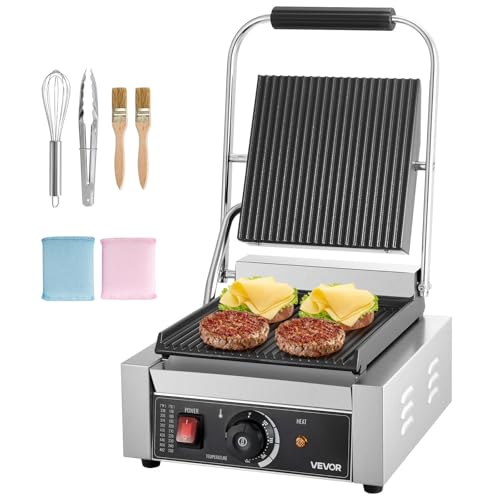
A countertop commercial press that grills paninis, burgers, bacon and steaks without a full griddle station or constant flipping.
Top and bottom grids heat at the same time across the 8.8 by 9.1 inch plate, and the knob dials 122°F to 572°F for eggs through steak.
Stainless steel exterior, thickened enamel-coated grooved plate, extended ABS handle that stays cool, non-slip feet and side heat vents.
The grooved plate marks food with sear lines, so it is not a substitute for a flat griddle surface.
Best for cafe, deli and food truck operators, or home cooks who want commercial heat control.
How to Use
Set the knob to your target temperature and wait for the LED indicator to signal the plates have reached heat. Around 350°F suits paninis, higher for steak sears.
Load the plate, lower the top and let both grids work. No flipping is needed since both sides cook at once.
Scrape residue off warm plates with the scraper, wipe with a dry cloth, then pull the oil tray and empty it after each session.

Pros & Cons
Pros
- Enamel coating over cast iron makes cleanup easier than raw cast iron while keeping the heat retention.
- Doubles as a steak and chicken grill, so it earns its storage space beyond sandwiches.
- Compact 8.5 by 8.25 inch size fits standard stovetop burners without crowding other pans.
- No cords or electricity needed, so it works on gas, electric, or camp heat.
Cons
- Cast iron at this size is heavy to lift and maneuver, especially when hot.
- Requires hand washing and immediate drying, and it must never soak, which rules out dishwasher convenience.
Details
The Norpro 963 is a two-piece enamel-coated cast iron panini press and grill that solves the problem of soggy, unevenly heated pressed sandwiches made in a skillet.
Grilling both surfaces at once cuts cooking time in half, so a panini finishes before the cheese overflows and the bread gets consistent marks edge to edge.
Measuring 8.5 by 8.25 inches with a 2.25 inch profile, the cast iron body holds heat through cold ingredients like thick chicken breasts and refrigerated bread.
The tradeoff is maintenance: hand wash, rinse, and dry immediately, and never let it soak or sit wet.
Best for home cooks who want cafe-style panini and seared meats without adding a countertop appliance.
Cooking Tips
Preheat both the base and the press over medium heat before food touches the surface. Cold cast iron steams bread instead of crisping it.
Brush the outside of your bread with oil or butter rather than the pan. The enamel releases better and you get a crisper crust.
For steaks and chicken, let the press do the work without shifting the meat. Moving it early breaks the sear and loses the grill marks.
Blender vs Panini press: The Core Difference
There is no automatic winner between blender and panini press. The better pick is the one that solves the job you actually repeat, without adding care you will avoid. For product picks, compare best blender, best french press, and best immersion blender.
Head To Head
Best fit: Blender makes sense when its specific strengths match the work you do most; panini press is better when you want broader everyday use.
Daily effort: compare cleaning, storage, and maintenance before you compare minor feature differences.
Value: paying more only helps if the difference shows up in your normal routine.
Risk: the wrong pick usually becomes annoying later — harder cleanup, awkward handling, or a tool that sits unused.
When Blender Wins
Choose blender when its main job lines up with your normal prep. Used for the right work, it feels more purposeful than the more general option. If you are shopping, our best blender and best french press guides are the fastest way in.
When Panini press Wins
Panini press makes more sense when you value versatility and simpler upkeep. If panini press covers most of your cooking without fuss, the specialized option may be overkill.
How They Compare
Performance: one side wins on cleaning access, the other on simplicity.
Maintenance: factor in checking the seals and gaskets, and descaling water-based units — the lower-effort option can win for daily use.
Cost: premium construction is worth it only when it changes real results.
Fit: the best choice matches your space, frequency, and tolerance for unresponsive controls.
Related Product Guides
If this topic is part of a buying decision, these are the HomeWhisk guides most closely tied to it:
- best blender
- best french press
- best immersion blender
- best air fryer
- best instant pot
- best stand mixer
- best toaster oven
Frequently Asked Questions
Should I choose blender or panini press?
Neither wins outright — pick blender for a more focused job, panini press for easier everyday versatility. Compare best blender and best french press for real models.
What is the main difference between blender and panini press?
It comes down to build quality of seals versus convenience and cost. Match the winner to how often you cook and the motors that bog down under load you most want to avoid.
What gear pairs well with it?
Start with a reliable core piece, then add as needs appear. Compare best blender, best french press, and best immersion blender for related choices.
What should I avoid?
Avoid buying by brand alone, ignoring wiping the interior after use, and oversizing for your space. Each invites motors that bog down under load down the line.
How do I keep it in good shape?
Build cleaning removable parts by hand, and descaling water-based units into normal cleanup. Light, consistent care prevents motors that bog down under load far better than occasional deep effort.
The Bottom Line
Blender vs panini press comes down to fit: how often you use the tool, how much care it needs, and whether it solves a real kitchen problem. If you are buying, compare best blender, best french press, and best immersion blender before you spend.




Write Your Review
No reviews yet. Be the first to share your experience!