

Can you put dehydrator in the dishwasher? Not the whole machine, never. The trays and any removable plastic parts often can go in, but only if your manual says so, and only on the top rack. The base with the heater, fan and controls stays out of the water completely.
This guide walks through which parts are usually safe, which ones aren’t, how to hand wash the rest, and how to deal with sticky jerky residue and fruit leather stains without ruining your machine.
What you can and can’t put in the dishwasher
A food dehydrator is really two things. There’s the base or housing, which holds the heating element, the fan and the electronics. Then there are the parts that touch food: trays, drip catchers, mesh sheets and sometimes a lid or door. Only the second group has any business near a dishwasher.
The base is electrical. Water in a heating element housing or a fan motor is a short circuit waiting to happen, and a dishwasher’s hot spray finds every seam. Wipe it with a damp cloth instead. Unplug it first and let it cool fully.
Trays are a different story. Many plastic trays are labeled top-rack safe, and stainless steel trays handle a dishwasher fine on most machines. But “many” isn’t “all.” Cheaper plastic can warp when the dishwasher’s heated dry cycle kicks in, and a warped tray won’t sit level, which means uneven drying.
If you’re shopping for a machine with easy cleanup in mind, the OSTBA Food Dehydrator with 8 Trays is one to look at. It’s a 650W unit with a 95 to 165°F temperature range and a 48-hour timer. Check the manufacturer’s care notes for the trays before you load them into the dishwasher.

OSTBA
Homemade Jerky and Fruit Snacks with the OSTBA 8-Tray Food Dehydrator
The OSTBA food dehydrator dries fruit, vegetables, herbs, jerky, and yogurt across eight trays, with 360° horizontal airflow as its biggest advantage. It suits home cooks making small batches who want precise 95–165°F temperature control and a timer extending up to 48 hours.
Pros and Cons
Pros
- Eight stainless steel trays provide useful capacity for household and small-batch food production.
- The digital controls offer precise temperature and timer adjustments for different ingredients.
- Four mesh sheets and a drip tray expand the included setup beyond the main drying trays.
- ETL certification and a 12-month warranty provide added support for household use.
Cons
- The 165°F maximum temperature may not suit recipes requiring higher-heat drying.
- Dimensions and weight are not provided, so buyers cannot confirm countertop or storage fit from the listed specifications.
OSTBA Homemade Jerky and Fruit Snacks with the OSTBA 8-Tray Food Dehydrator
OSTBA
Homemade Jerky and Fruit Snacks with the OSTBA 8-Tray Food Dehydrator
The OSTBA food dehydrator dries fruit, vegetables, herbs, jerky, and yogurt across eight trays, with 360° horizontal airflow as its biggest advantage. It suits home cooks making small batches who want precise 95–165°F temperature control and a timer extending up to 48 hours.
Check price on AmazonThe OSTBA Food Dehydrator removes moisture from fruit, vegetables, herbs, jerky, and yogurt while helping home cooks prepare shelf-stable snacks and ingredients.
Its 650W heater and 360° horizontal airflow distribute heat across all eight trays, reducing the need to rotate trays during a batch.
The double-layer stainless steel body improves heat retention, reduces noise, and helps keep the outer casing cooler during extended operation.
The 165°F maximum temperature may limit recipes that require higher heat, and the product listing does not provide dimensions or weight.
Best for home cooks making small batches of dried foods with precise digital controls.
How to check whether your trays are dishwasher safe
Don’t guess. Look in two places, in this order.
The manual or product page
Most manufacturers state it plainly: “trays are dishwasher safe, top rack only,” or “hand wash only.” If the manual is long gone, search the brand and model on the maker’s site. It takes two minutes.
Markings on the tray itself
Some plastic trays have a small dishwasher icon molded into the underside. A dishwasher icon is a good sign. No marking at all isn’t a yes. It’s a “check somewhere else.”
If you can’t confirm anything, hand wash. It’s slower, sure. But a replacement tray costs more time than a quick scrub.
How to load trays in the dishwasher the right way
Say your manual gives the green light. Here’s how to keep the trays in good shape.
Use the top rack only. The bottom rack sits near the heating element in most dishwashers, and that’s where plastic warps. Stand the trays upright or at an angle so water drains off them instead of pooling in the grid.
Scrape off food bits first. A tray with dried-on apple or jerky fat will come out of the dishwasher still dirty, and the leftovers can clog the spray arm filter. Pick the gentle or normal cycle, and skip the sanitize or heated-dry option if the plastic feels thin.
Stainless steel is far more forgiving. A bigger commercial-style machine like the Septree Commercial Food Dehydrator, an 18-tray unit with 2000W power and a full stainless steel build, uses metal trays that handle heat well. Even so, 18 trays won’t fit in one load, so plan on running a few cycles or hand washing in batches.

Septree
Batch Jerky, Biltong and Fruit Drying: Septree 18-Tray Commercial Food Dehydrator, 2000W Stainless Steel with 34.42 sq ft Capacity
This 2000W stainless cabinet dries 18 full trays at once across 34.42 square feet, so a whole hunting haul or orchard pick finishes in a single run instead of several. Buy it if you sell at markets, process game, or dry produce in bulk and need a machine rated to run continuously rather than a stackable countertop unit.
Pros and Cons
Pros
- Full food grade stainless construction and overheat protection support continuous seven day operation for small food businesses.
- The glass front door lets you check color and dryness without opening the chamber and losing heat.
- Ships complete with 18 silicone sheets, 4 fruit roll trays, drip tray, heat resistant gloves, storage containers and a recipe book.
- Operation stays under 50 dB, quiet enough to leave running in an open kitchen overnight.
Cons
- At 2000W it needs its own circuit, and sharing an outlet with other kitchen appliances can trip a breaker.
- The 15.67 inch trays and full cabinet footprint demand dedicated floor or shelf space since it is too heavy to store between uses.
Septree Batch Jerky, Biltong and Fruit Drying: Septree 18-Tray Commercial Food Dehydrator, 2000W Stainless Steel with 34.42 sq ft Capacity
Septree
Batch Jerky, Biltong and Fruit Drying: Septree 18-Tray Commercial Food Dehydrator, 2000W Stainless Steel with 34.42 sq ft Capacity
This 2000W stainless cabinet dries 18 full trays at once across 34.42 square feet, so a whole hunting haul or orchard pick finishes in a single run instead of several. Buy it if you sell at markets, process game, or dry produce in bulk and need a machine rated to run continuously rather than a stackable countertop unit.
Check price on AmazonA full size stainless dehydrating cabinet built for people whose harvest, hunt or product line outgrew a stackable countertop tray unit.
Eighteen trays give 34.42 square feet of drying area, and horizontal airflow heats all shelves at once so edges and center finish together.
Housing and trays are BPA free food grade stainless, trays measure 15.67 by 15.67 inches, and the liner and trays go in the dishwasher.
The 2000W draw and cabinet size mean this belongs on a dedicated circuit and a permanent spot, not a shared kitchen counter.
Best for jerky and biltong makers, market sellers and gardeners processing large seasonal volumes.
How to hand wash dehydrator trays
Hand washing works for every tray type, and it’s often faster than you’d think, especially right after use while food is still soft.
Soak first
Fill the sink with hot water and a squirt of dish soap. Let the trays sit for 10 to 15 minutes. Sticky fruit sugars and meat marinades loosen up fast in hot soapy water.
Scrub the mesh and grid
Use a soft brush or a non-scratch sponge. A bottle brush or an old toothbrush gets into the corners where mesh sheets meet the tray frame. Skip steel wool. It scratches plastic, and scratches hold onto bacteria and odors.
Dry completely
Air dry the trays on a rack, or wipe them with a clean towel. Trays stored damp can grow mildew, and the smell carries into your next batch of dried apples.
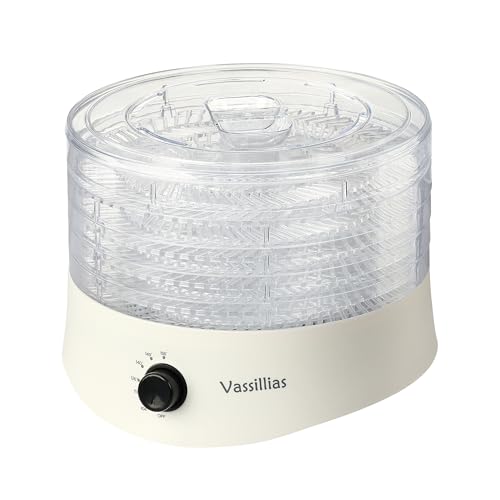
Small machines are the easiest to clean by hand. The vassillias Small Food Dehydrator Dryer is a compact option, so there’s less to wash and less to store. It’s the kind of machine that suits someone drying a single tray of herbs or fruit on a weekend.
vassillias
5-Tray Food Dehydrator for Jerky, Fruit and Herbs, vassillias Model 740MJY
The vassillias Model 740MJY dehydrates meat, jerky, fruit, vegetables, mushrooms and herbs with adjustable heat and a fan for consistent drying. It suits small kitchens and home snack makers who need five removable trays without taking up much countertop space.
Pros and Cons
Pros
- BPA-free, food-grade materials provide a suitable food-contact surface for everyday dehydrating.
- Five trays and a 0.79-inch gap provide useful capacity for home snack preparation.
- Adjustable temperature control accommodates both low-temperature herbs and higher-temperature jerky preparation.
- The automatic shutdown feature adds protection against overheating or short-circuit-related temperature problems.
Cons
- The product weight is not provided, so buyers cannot assess how easily it can be moved or stored.
- The 0.79-inch tray gap may limit use with thicker food pieces unless they are sliced thinner.
vassillias 5-Tray Food Dehydrator for Jerky, Fruit and Herbs, vassillias Model 740MJY
vassillias
5-Tray Food Dehydrator for Jerky, Fruit and Herbs, vassillias Model 740MJY
The vassillias Model 740MJY dehydrates meat, jerky, fruit, vegetables, mushrooms and herbs with adjustable heat and a fan for consistent drying. It suits small kitchens and home snack makers who need five removable trays without taking up much countertop space.
Check price on AmazonThe vassillias Model 740MJY is a compact five-tray dehydrator for turning meat, fruit, vegetables, mushrooms and herbs into longer-lasting snacks and ingredients.
Its adjustable 104°F to 158°F control and powerful fan help match heat and airflow to different foods while promoting consistent drying.
Each 10.23-inch tray has a 0.79-inch gap, and the BPA-free food-grade construction suits regular kitchen use. The product weight is not specified.
The tray spacing may require thinner slices for thicker foods, and the air outlet needs clearance from the wall during operation.
Best for home cooks with limited counter space who want to dehydrate several small batches at once.
Cleaning the base and the parts that can’t get wet
The base needs its own routine. Unplug the unit, let it cool, then wipe the outside with a cloth dampened with warm water and a drop of dish soap. Wring the cloth out well. It should feel barely damp, not wet.
For the inside of the chamber, a damp cloth does most of the work. Dried-on drips can be softened with a warm, wet paper towel left on the spot for a few minutes. Don’t spray cleaner directly into vents or onto the fan. Dust around the vents with a dry brush or a vacuum’s brush attachment every few uses.
Never submerge the base. Never run it under the tap. And don’t plug it back in until every surface is dry to the touch.
Dealing with odors and stains
Jerky leaves the biggest mark. Fat and marinade soak into plastic, and the trays can pick up a savory smell that lingers into your next batch of fruit. A dishwasher won’t always fix that, which is one more reason to wash by hand when you can.
Vinegar soak for smells
Mix equal parts white vinegar and warm water in the sink and soak the trays for 20 to 30 minutes. Rinse well afterward. Vinegar breaks down the greasy film that holds odors in place.
Baking soda paste for stains
Turmeric, tomato and berry stains tint plastic fast. Rub a paste of baking soda and a little water over the mark, wait a few minutes, then scrub softly. Sunlight helps too. Set the clean, dry trays near a bright window for an afternoon and the color often fades.
Keep jerky trays and fruit trays separate if your machine has spares. Small habit, big payoff.
Common mistakes to avoid
A few errors show up again and again with dehydrator care.
Putting the lid or door in the dishwasher without checking. Clear plastic doors can cloud or crack from repeated heat cycles. Some are fine, some aren’t. The manual decides.
Using the bottom rack. Heat from the dishwasher’s element is strongest down there. Top rack only.
Leaving trays dirty overnight. Dried sugar turns into something close to glue. Rinse trays soon after use, even if you wash them properly later.
Using harsh abrasives. They damage coatings and roughen plastic. Gentle wins.
Storing trays while damp. This is how mildew starts. Dry them fully first.
When to replace your dehydrator trays or the machine
Trays don’t last forever. Replace them if they’ve warped so they no longer sit flat, if they’ve cracked, or if the mesh has torn. Stained trays that still smell like last month’s garlic jerky after a good wash can be retired too, especially if you dry fruit next.
If the fan sounds rough, the unit heats unevenly, or the base has taken on water damage, it’s usually time for a new machine rather than a repair. When you do shop, our guides on the best dehydrator, the best food dehydrator and the best cheap dehydrator are good places to start. If you dry herbs, see the best dehydrator for herbs. For fruit, check the best dehydrator for fruit. On a tighter budget, the best dehydrator under $100 list narrows things down.
Look for removable trays, a simple housing and clear care instructions. Those three things make cleanup far less of a chore.
FAQ
Can you put a dehydrator in the dishwasher?
No, not the whole unit. The base holds the heater, fan and electronics, and water will damage them. Only removable trays and accessories may go in the dishwasher, and only when the manual says they’re dishwasher safe.
Are dehydrator trays dishwasher safe?
Many are, but not all. Stainless steel trays usually handle it well. Plastic trays vary, so check the manual or the markings on the tray. Use the top rack if you do run them.
How do you clean a dehydrator without a dishwasher?
Soak the trays in hot soapy water for 10 to 15 minutes, scrub gently with a soft brush, rinse and air dry. Wipe the base with a damp cloth while it’s unplugged and cool.
How do you remove sticky residue from dehydrator trays?
Soak in hot water with dish soap to loosen it. For stubborn spots, make a paste of baking soda and water, let it sit for a few minutes, then scrub with a soft brush. Avoid steel wool.
How often should you clean a dehydrator?
Wash the trays after every use. Wipe down the inside of the chamber whenever something drips, and clean the vents and fan area every few batches. Regular cleaning keeps flavors from carrying over between foods.








Write Your Review
No reviews yet. Be the first to share your experience!