

TL;DR — How to fix an immersion blender is not complicated, but it does reward a little patience and the right sequence. For product picks, the closest next steps are best immersion blender, best blender, and best air fryer.
Our view is based on product specs, material trade-offs, and repeated owner feedback — not one-off kitchen anecdotes or brand claims. For appliance topics, we pay close attention to capacity, controls, cleanup, storage, reliability complaints, and whether the machine saves enough effort to justify the space.


Save $2.00
Pros & Cons
Pros
- Copper motor rated at 1200W gives it enough torque for thick purees and fibrous vegetables.
- Five attachments plus a storage rack keep the whole set together in one drawer or on the counter.
- Dishwasher-safe blending shaft, whisk, chopper bowl and cup remove the hand-scrubbing step.
- Stepless speed control gives more texture control than fixed two-speed stick blenders.
Cons
- As a corded handheld unit, blending range is limited by cord length and outlet placement at the stove.
- The 700ml cup and 500ml chopper are small for large-batch cooking, so soup for a crowd needs blending in the pot instead.
Details
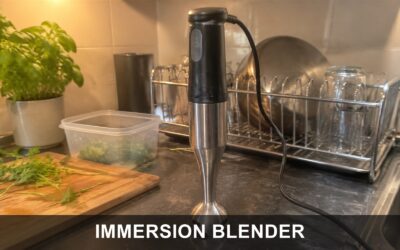
This is a corded stick blender that blends food inside the pot, bowl or cup it was cooked in, removing the transfer step that makes countertop blenders messy with hot soup.
The 1200W copper motor drives a stainless steel blade through squash soup, bean purees and frozen fruit smoothies, while the variable speed knob starts slow to limit splashing.
The set includes a whisk, 500ml chopper, milk frother, 700ml mixing cup and a storage rack; attachments are dishwasher safe and the motor housing wipes clean.
Container sizes cap batch work: the chopper and cup handle single-meal quantities, not big-batch prep.
Best for home cooks and new parents who want soups, baby food and whipped or frothed extras from one compact tool.
How to Use
Twist the blending shaft onto the motor body, submerge the blade fully before pressing the power button, and keep the head below the surface to stop splatter.
Start at the lowest speed on the knob, then increase gradually as the mixture breaks down. Move the shaft up and down slowly rather than stirring sideways.
Swap to the whisk for cream and egg whites, the chopper for onions and nuts, the frother for coffee. Unplug, detach, and put attachments in the dishwasher.

Pros & Cons
Pros
- Speed adjusts by how hard you press the button, giving fine control from a slow start to full turbo.
- Includes a 27 fl oz lidded beaker, so you can blend a smoothie and store the leftovers in the same vessel.
- Slip-resistant ergonomic handle allows steady one-handed operation while your other hand holds the pot.
- Three attachments cover blending, whisking, and frothing without buying add-ons.
Cons
- The corded design ties you to an outlet, which limits reach across a large kitchen island.
- At 500 watts it is built for soft foods and liquids, not ice crushing or heavy nut butters.
Details
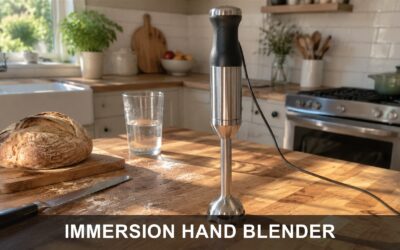
A corded handheld stick blender that purees soups, sauces, and smoothies in the pot or beaker, skipping the mess of pouring hot food into a countertop jar.
The 500-watt motor runs low, high, or turbo through button pressure, while the bell-shaped base reduces suction so thick bisques and hummus blend without splatter.
The blending arm uses stainless steel blades and detaches for the dishwasher. The 27 fl oz beaker with lid doubles as a mixing and storage cup, and the pan guard shields nonstick coatings.
Being corded, it needs outlet access, and the motor is tuned for soft ingredients rather than ice or frozen fruit.
Best for home cooks who make soups, dressings, and whipped or frothed drinks and want one compact tool instead of three.
How to Use
Twist on the blending arm, submerge the bell base fully before pressing the button, and keep it below the surface to avoid splashing. Press lightly to start slow, harder for turbo.
Swap to the whisk for cream and egg whites, or the frother for milk foam. Move the head in slow circles rather than up and down for even texture.
To clean, unplug and detach the attachment, then run it on low in a cup of warm soapy water. Attachments are dishwasher safe; never submerge the motor body.
Maintaining an Immersion Blender: The Essentials
Keeping a immersion blender in good working order comes down to catching small problems before they become permanent. Most issues — trapped residue in seams, and uneven cooking or heating — are reversible early and costly once ignored, so routine attention beats a rescue job.
Step By Step
1. Inspect the immersion blender for early signs of unresponsive controls. 2. Address the root cause, not just the symptom — usually a lapse in checking the seals and gaskets. 3. Restore the working surface or mechanism with the gentlest effective method. 4. Fold wiping the interior after use into your routine so the problem does not return.
Keeping It That Way
Maintenance beats repair. Fold letting the motor rest between heavy loads, checking the seals and gaskets, and wiping the interior after use into your routine and the appliance will stay reliable for years. Neglect any one of them and you invite trapped residue in seams back.
Before You Start
Match the method to the appliance in front of you. Fix an immersion blender is not hard, but the details matter — the wrong approach to descaling water-based units can shorten the life of otherwise good small kitchen appliances. For product picks, compare best immersion blender, best blender, and best air fryer.
How To Know You Did It Right
The result should be practical and repeatable: the appliance should work cleanly, feel controlled, and show no signs of trapped residue in seams. If the same issue returns quickly, the cause is usually a missed care step — not the tool itself.
What You Will Need
Keep it simple: the appliance itself, a clean workspace, and any basic supplies the material calls for. Set up before you start so you are not improvising mid-task.
Related Product Guides
If this topic is part of a buying decision, these are the HomeWhisk guides most closely tied to it:
- best immersion blender
- best blender
- best air fryer
- best instant pot
- best stand mixer
- best toaster oven
Frequently Asked Questions
What is the right way to maintain an immersion blender?
Keeping a immersion blender in good working order comes down to catching small problems before they become permanent. Do it consistently and you avoid unresponsive controls.
What gear pairs well with it?
Start with a reliable core piece, then add as needs appear. Compare best immersion blender, best blender, and best air fryer for related choices.
Is a premium appliance worth it?
Only if you use it enough to notice better control, durability, or cleanup regularly. Occasional users are well served by a mid-range pick like those in best air fryer.
Who is this most useful for?
Mainly meal-preppers batching food, and families cooking in volume. If that is you, treat motor or heating-element power as a requirement rather than a nice-to-have.
How do I keep it in good shape?
Build cleaning removable parts by hand, and descaling water-based units into normal cleanup. Light, consistent care prevents unresponsive controls far better than occasional deep effort.
The Bottom Line
The simplest takeaway: buy for your real routine, not the most impressive feature list. Match the immersion blender to your cooking frequency, cleanup habits, and storage, then use best immersion blender, best blender, and best air fryer to compare actual products.


Write Your Review
No reviews yet. Be the first to share your experience!