

TL;DR — When people ask about induction cooking pot, they are usually trying to make a buying or care decision without wasting money. This guide keeps the focus on what changes day-to-day use. When this turns into a purchase decision, compare best cookware sets, best stainless steel cookware set, and best cast iron skillet for beginners before narrowing your shortlist.
The HomeWhisk approach is research-first: compare construction, usability, cleaning, and long-term complaints before recommending a direction. For cookware topics, the big differences are heat behavior, material, cooktop fit, cleaning, weight, and how the pan or pot holds up after repeated use.

BEZIA
12-Quart Nonstick Stock Pot for Soup, Stock & Pasta: BEZIA Granite-Coated Induction Pot with Glass Lid
This 12-quart aluminum stock pot uses a PFOA and PFOS free granite nonstick coating that keeps stews, sauces, and pasta from scorching onto the base, so cleanup takes a rinse instead of a soak. It suits home cooks who batch-cook soup, stock, or chili for a family and want one pot that works on induction as well as gas and electric.
Pros and Cons
Pros
- PFOA and PFOS free granite coating for cooks who avoid traditional nonstick chemistry.
- Full induction compatibility at a size most induction-ready stockpots skip.
- Shatterproof glass lid with a steam vent reduces boil-over on rolling pasta water.
- Aluminum construction keeps a 12-quart pot light enough to lift and pour when full.
Cons
- The lid is not oven safe, so oven braises have to run uncovered or with foil.
- Granite nonstick coatings wear faster than bare stainless, so metal utensils and high-heat searing will shorten its life.
ciwete
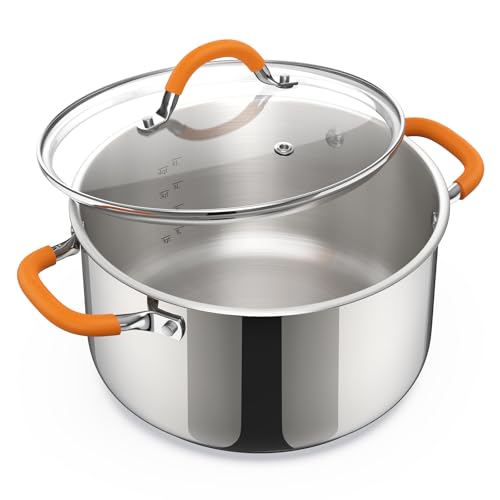
5.2-Quart Stainless Steel Stock Pot for Soups & Pasta - Ciwete Induction-Ready Soup Pot with Glass Lid
This 5.2-quart 18/10 stainless steel stock pot simmers soups, boils pasta, and makes sauces with a four-layer aluminum-iron base that spreads heat evenly and prevents scorching. Buy it if you cook on induction or switch between cooktops and want a mid-size pot that handles daily batch cooking and cleans up in the dishwasher.
Pros and Cons
Pros
- Compatible with induction, gas, electric, ceramic, and halogen cooktops for any kitchen.
- Thick four-layer base shortens cook time and distributes heat evenly across the bottom.
- Cool-touch riveted handles and vented glass lid make everyday use safer and mess-free.
- Backed by a 2-year warranty for added buyer confidence.
Cons
- At 5.2 quarts it is a mid-size pot, too small for large-batch stock or big-family portions.
- The glass lid is only heat resistant to 350F, below the pot's 500F oven rating.

CAROTE
5 Qt Ceramic Nonstick Stock Pot for Soups and Oatmeal: CAROTE Casserole Pot with Lid, PFOA Free
This 5-quart CAROTE stock pot uses a PFOA-free ceramic nonstick coating over a triple-ply die-cast body, so oatmeal, soups, and sauces release cleanly and wipe out with a cloth instead of a scrubber. It suits small households and beginner cooks who want one lightweight everyday pot for simmering and reheating without the maintenance a bare stainless or cast iron pot demands.
Pros and Cons
Pros
- Nonstick ceramic surface makes oatmeal and porridge cleanup fast, which is the job this pot is explicitly built around.
- Faster, more even heat-up from the triple-ply base reduces scorching along the bottom during long simmers.
- Lightweight die-cast body is easier to lift and pour from than a comparable stainless or enameled cast iron pot.
- Included lid traps heat for simmering and keeps food warm between servings.
Cons
- Ceramic nonstick coatings wear faster than stainless steel, so metal utensils, high heat, and dishwasher cycles will shorten its usable life.
- At 5 quarts it is a mid-size pot, too small for large stock batches, canning, or boiling a full pound of pasta comfortably.
BEZIA 12-Quart Nonstick Stock Pot for Soup, Stock & Pasta: BEZIA Granite-Coated Induction Pot with Glass Lid
BEZIA
12-Quart Nonstick Stock Pot for Soup, Stock & Pasta: BEZIA Granite-Coated Induction Pot with Glass Lid
This 12-quart aluminum stock pot uses a PFOA and PFOS free granite nonstick coating that keeps stews, sauces, and pasta from scorching onto the base, so cleanup takes a rinse instead of a soak. It suits home cooks who batch-cook soup, stock, or chili for a family and want one pot that works on induction as well as gas and electric.
$59.99 at AmazonEditors' Favorite
Color: Black Size: 12qt/11.8in Dimensions: 1 x 1 x 1 inches Weight: 6.71968974576 pounds Product Group: Kitchen Binding: Kitchen
Shop Nowciwete 5.2-Quart Stainless Steel Stock Pot for Soups & Pasta - Ciwete Induction-Ready Soup Pot with Glass Lid
ciwete
5.2-Quart Stainless Steel Stock Pot for Soups & Pasta - Ciwete Induction-Ready Soup Pot with Glass Lid
This 5.2-quart 18/10 stainless steel stock pot simmers soups, boils pasta, and makes sauces with a four-layer aluminum-iron base that spreads heat evenly and prevents scorching. Buy it if you cook on induction or switch between cooktops and want a mid-size pot that handles daily batch cooking and cleans up in the dishwasher.
$27.99 at AmazonGreat Value
Color: Silver Size: 5.2 Quarts Dimensions: 8.66 x 12.4 x 7.48 inches Product Group: Kitchen
Shop NowCAROTE 5 Qt Ceramic Nonstick Stock Pot for Soups and Oatmeal: CAROTE Casserole Pot with Lid, PFOA Free
CAROTE
5 Qt Ceramic Nonstick Stock Pot for Soups and Oatmeal: CAROTE Casserole Pot with Lid, PFOA Free
This 5-quart CAROTE stock pot uses a PFOA-free ceramic nonstick coating over a triple-ply die-cast body, so oatmeal, soups, and sauces release cleanly and wipe out with a cloth instead of a scrubber. It suits small households and beginner cooks who want one lightweight everyday pot for simmering and reheating without the maintenance a bare stainless or cast iron pot demands.
$24.99 at AmazonColor: Oatmeal Size: 5 Quarts Dimensions: 9.5 x 15 x 4.7 inches Weight: 2 pounds Product Group: Kitchen Binding: Kitchen
Shop NowWho Benefits Most
This matters most for induction-stovetop owners, and weeknight cooks who want low upkeep. If that is you, treat sidewall height, and base material and core as non-negotiable. Casual users can relax the requirements and prioritize price and storage instead.
The Short Answer
The short version of induction cooking pot: fit the pan to your real cooking, not to a feature list. The practical takeaway is that heat distribution matters more day to day than headline features. For product picks, compare best cookware sets, best stainless steel cookware set, and best cast iron skillet for beginners.
Common Misconceptions
The biggest myth is that the most expensive pan is automatically the best for you. In reality, the right choice depends on base material and core, and weight and maneuverability — plus your own habits. Another trap is buying by brand alone — the same maker sells both excellent and forgettable lines.
What To Look For
The keeper is the one you reach for without thinking; the drawer occupant is the one that asks too much for too little payoff. Those are the variables that decide whether it earns a spot in your kitchen or ends up unused. Ignore cosmetic upgrades until the fundamentals check out.
When It Is Worth Paying More
Spending up pays off when you use the pan often enough to notice better easier cleanup every week. If it only comes out occasionally, a mid-range pick is the smarter call. Match the money to frequency of use, not marketing.
Related Product Guides
If this topic is part of a buying decision, these are the HomeWhisk guides most closely tied to it:
- best cookware sets
- best stainless steel cookware set
- best cast iron skillet for beginners
- best non toxic cookware
- best dutch oven for bread baking
Frequently Asked Questions
What gear pairs well with it?
Start with a reliable core piece, then add as needs appear. Compare best cookware sets, best stainless steel cookware set, and best cast iron skillet for beginners for related choices.
How do I keep it in good shape?
Build letting the pan cool before washing, and skipping the dishwasher for nonstick into normal cleanup. Light, consistent care prevents coatings that flake early far better than occasional deep effort.
What matters most for induction cooking pot?
Focus on handle heat resistance, oven-safe temperature, and coating durability first. Those decide real performance; the rest is secondary. Compare best cookware sets and best stainless steel cookware set for options that get the basics right.
What should I avoid?
Avoid buying by brand alone, ignoring seasoning bare iron or carbon steel, and oversizing for your space. Each invites warping on high heat down the line.
What is the bottom line?
Match the pan to your real habits: buy for durability if it is daily, for value and storage if it is occasional.
The Bottom Line
For most home cooks, the best choice is the one that removes friction without adding maintenance you will ignore. Start with your use case, then cross-check best cookware sets, best stainless steel cookware set, and best cast iron skillet for beginners.




Write Your Review
No reviews yet. Be the first to share your experience!