

TL;DR — When people ask about induction cooktop pot, they are usually trying to make a buying or care decision without wasting money. This guide keeps the focus on what changes day-to-day use. Use this as the practical background, then check best cookware sets, best stainless steel cookware set, and best cast iron skillet for beginners for specific product options.
We treated this as an editor’s note for home cooks: what matters, what is optional, and which related product guides are worth checking before you buy. For cookware topics, the big differences are heat behavior, material, cooktop fit, cleaning, weight, and how the pan or pot holds up after repeated use.

HexClad
5-Quart Hybrid Saucepan for Sauces, Braising and Batch Cooking: HexClad Hybrid Nonstick Saucepan with Glass Lid
This 5-quart hybrid saucepan uses a laser-etched hexagonal surface that pairs stainless steel with TerraBond ceramic, so you can sear and simmer in the same pot without food welding to the base. Buy it if you cook one-pot meals or large-batch sauces and want a pan you can scrape with metal utensils and then put straight in the dishwasher.
Pros and Cons
Pros
- Hybrid surface handles browning and nonstick release in one pan, replacing the usual stainless-plus-nonstick pot pairing.
- Lifetime warranty against manufacturer defects when purchased from HexClad Cookware.
- At 10 inches wide and 4.5 inches deep, the 5-quart capacity suits batch sauces, grains and small braises.
- Three-pound weight is manageable for pouring and stirring compared with heavier clad or cast pots.
Cons
- The included tempered glass lid is only oven-safe to 400°F, so high-heat oven work means cooking uncovered or sourcing a stainless lid separately.
- The exposed stainless peaks still need preheating and enough fat to perform, so it does not behave like a fully coated nonstick pot.

P&P CHEF
4-Quart Stainless Steel Stock Pot for Soups and Pasta: P&P CHEF Tri-Ply Bottom Cooking Pot with Glass Lid
This 4-quart stainless steel stock pot uses a tri-ply aluminum-core base that spreads heat evenly across the bottom, so soups and sauces simmer without scorched spots. It suits households of two to four who want one induction-compatible pot for pasta, stews, and boiled vegetables without babysitting the burner.
Pros and Cons
Pros
- Aluminum-core tri-ply bottom delivers quick, even heating while keeping food-safe stainless steel as the only cooking surface.
- Wide silicone handle covers make carrying a full pot of stock to the sink safer than bare metal loop handles.
- Smooth rolled edges with no sharp corners or crevices make hand-washing quick and scratch-free.
- The 4-quart capacity handles a pound of pasta or a family-size batch of soup without crowding the pot.
Cons
- Not oven or microwave safe, so you cannot brown on the stove and finish a braise under heat.
- Only the bottom is tri-ply, so the thinner side walls heat less evenly than a fully clad pot.

Aufranc
2-Quart Tri-Ply Saucepan for Sauces, Grains and Small-Batch Cooking: AuFranc Stainless Steel Sauce Pan with Glass Lid
This 16cm tri-ply stainless steel saucepan heats evenly across induction, gas, halogen and electric hobs, with an uncoated 18/10 interior that will not flake or leach PTFE, PFOA or PFAS into food. It suits households of two to three cooking daily sauces, oatmeal, rice and reheats who want bare stainless durability instead of a nonstick pan they will replace in two years.
Pros and Cons
Pros
- Full tri-ply body rather than a disc base, which keeps heat even along the sides where sauces catch.
- 18/10 stainless resists scratching, warping, rusting and corrosion under regular high-heat use.
- Glass lid lets you track a simmer or a rice cook without lifting and losing steam.
- Arrives in boxed packaging, so it works as a gift without extra wrapping.
Cons
- The glass lid caps oven use at 210°F, so you must remove it before any real oven work at the pan's 480°F ceiling.
- Bare stainless needs preheating and fat before eggs or delicate fish, and it will stick if you rush that step.
The Best Deals This Week*
-
4-Quart Stainless Steel Stock Pot for Soups
$20.41
($21.99)Save $1.58 -
COOKER KING 2 Quart Stainless Steel Saucepan
$24
($26.67)Save $2.67
*Deals are selected by our commerce team
HexClad 5-Quart Hybrid Saucepan for Sauces, Braising and Batch Cooking: HexClad Hybrid Nonstick Saucepan with Glass Lid
HexClad
5-Quart Hybrid Saucepan for Sauces, Braising and Batch Cooking: HexClad Hybrid Nonstick Saucepan with Glass Lid
This 5-quart hybrid saucepan uses a laser-etched hexagonal surface that pairs stainless steel with TerraBond ceramic, so you can sear and simmer in the same pot without food welding to the base. Buy it if you cook one-pot meals or large-batch sauces and want a pan you can scrape with metal utensils and then put straight in the dishwasher.
$179.00 at AmazonEditors' Favorite
Color: Silver Size: 5-Quart Dimensions: 20.078740137 x 9.448818888 x 4.5669291292 inches Weight: 3 pounds Product Group: Kitchen Binding: Kitchen
Shop NowP&P CHEF 4-Quart Stainless Steel Stock Pot for Soups and Pasta: P&P CHEF Tri-Ply Bottom Cooking Pot with Glass Lid
P&P CHEF
4-Quart Stainless Steel Stock Pot for Soups and Pasta: P&P CHEF Tri-Ply Bottom Cooking Pot with Glass Lid
This 4-quart stainless steel stock pot uses a tri-ply aluminum-core base that spreads heat evenly across the bottom, so soups and sauces simmer without scorched spots. It suits households of two to four who want one induction-compatible pot for pasta, stews, and boiled vegetables without babysitting the burner.
$20.41 at AmazonGreat Value
Color: Silver Size: 4 Quarts Dimensions: 12.21 x 8.39 x 4.72 inches Weight: 3.04017459298 pounds Product Group: Kitchen
Shop NowAufranc 2-Quart Tri-Ply Saucepan for Sauces, Grains and Small-Batch Cooking: AuFranc Stainless Steel Sauce Pan with Glass Lid
Aufranc
2-Quart Tri-Ply Saucepan for Sauces, Grains and Small-Batch Cooking: AuFranc Stainless Steel Sauce Pan with Glass Lid
This 16cm tri-ply stainless steel saucepan heats evenly across induction, gas, halogen and electric hobs, with an uncoated 18/10 interior that will not flake or leach PTFE, PFOA or PFAS into food. It suits households of two to three cooking daily sauces, oatmeal, rice and reheats who want bare stainless durability instead of a nonstick pan they will replace in two years.
$19.99 at AmazonColor: Sliver Size: 2 Quarts Dimensions: 13 x 7 x 5.5 inches Weight: 1.76 pounds Product Group: Kitchen
Shop NowCOOKER KING 2 Quart Stainless Steel Saucepan, Nonstick Sauce Pan, Ceramic Suce Pot with Tempered Glass Lid, Induction Pot Compatible with All Cooktops, Dishwasher & Oven Safe(PFAS/PFOA/PTFE Free)
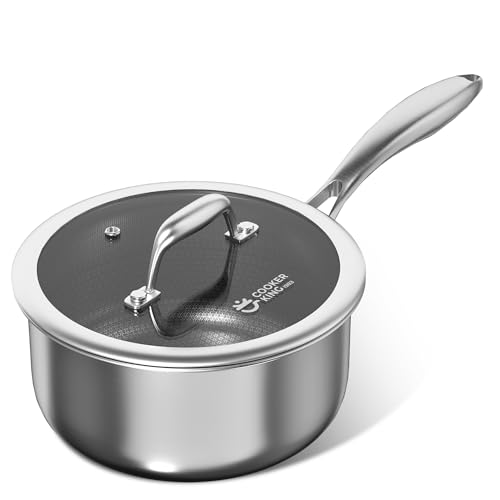
COOKER KING
2 Quart Stainless Steel Saucepan, Nonstick Sauce Pan, Ceramic Suce Pot with Tempered Glass Lid, Induction Pot Compatible with All Cooktops, Dishwasher & Oven Safe(PFAS/PFOA/PTFE Free)
$24.00 at AmazonColor: Silver Size: 2 Quarts Dimensions: 14.57 x 8.07 x 10.8 Inches Weight: 3.0203329894 pounds Product Group: Kitchen Binding: Kitchen
Shop NowThe Short Answer
The short version of induction cooktop pot: fit the pan to your real cooking, not to a feature list. The practical takeaway is that coating durability matters more day to day than headline features. For product picks, compare best cookware sets, best stainless steel cookware set, and best cast iron skillet for beginners.
What To Look For
Hold a pan to a short checklist: fit, control, cleanup, and durability. Those are the variables that decide whether it earns a spot in your kitchen or ends up unused. Ignore cosmetic upgrades until the fundamentals check out.
When It Is Worth Paying More
Spending up pays off when you use the pan often enough to notice better less frustration during prep every week. If it only comes out occasionally, a mid-range pick is the smarter call. Match the money to frequency of use, not marketing.
Common Misconceptions
The biggest myth is that the most expensive pan is automatically the best for you. In reality, the right choice depends on oven-safe temperature, and base material and core — plus your own habits. Another trap is buying by brand alone — the same maker sells both excellent and forgettable lines.
How To Get It Right
Think through the whole workflow: drying fully to prevent rust, seasoning bare iron or carbon steel, and letting the pan cool before washing. A pan that fits your routine and cleanup habits beats a technically superior one you fight with. We cover specific models in best cookware sets, best stainless steel cookware set, and best cast iron skillet for beginners.
Related Product Guides
If this topic is part of a buying decision, these are the HomeWhisk guides most closely tied to it:
- best cookware sets
- best stainless steel cookware set
- best cast iron skillet for beginners
- best non toxic cookware
- best dutch oven for bread baking
Frequently Asked Questions
Who is this most useful for?
Mainly cooks who sear and sauté often, and anyone building a first cookware set. If that is you, treat cooktop compatibility as a requirement rather than a nice-to-have.
Is a premium pan worth it?
Only if you use it enough to notice better control, durability, or cleanup regularly. Occasional users are well served by a mid-range pick like those in best cast iron skillet for beginners.
What is the bottom line?
Match the pan to your real habits: buy for durability if it is daily, for value and storage if it is occasional.
What gear pairs well with it?
Start with a reliable core piece, then add as needs appear. Compare best cookware sets, best stainless steel cookware set, and best cast iron skillet for beginners for related choices.
What should I avoid?
Avoid buying by brand alone, ignoring using low-to-medium heat on coatings, and oversizing for your space. Each invites hot spots that scorch down the line.
The Bottom Line
A good induction cooktop pot decision should feel obvious after you line up size, material, cleaning, and durability. If it is still a purchase question, the next step is best cookware sets, best stainless steel cookware set, and best cast iron skillet for beginners.




Write Your Review
No reviews yet. Be the first to share your experience!