

TL;DR — Food processor with blender is one of those kitchen questions where the useful answer is usually more practical than complicated. The right move depends on how you cook, what you already own, and how much maintenance you are willing to do. For product picks, the closest next steps are best air fryer, best blender, and best instant pot.
Our view is based on product specs, material trade-offs, and repeated owner feedback — not one-off kitchen anecdotes or brand claims. For appliance topics, we pay close attention to capacity, controls, cleanup, storage, reliability complaints, and whether the machine saves enough effort to justify the space.

Save $60.00
Pros & Cons
Pros
- Its 1500W motor supplies professional-grade power for crushing ice and processing frozen ingredients.
- Three included vessel formats support large batches, single servings, and food-processing tasks.
- The XL pitcher accommodates up to 64 ounces of liquid for serving multiple people.
- Four speed settings give users more control than a single fixed-speed blending system.
Cons
- The 72-ounce pitcher has a lower 64-ounce maximum liquid capacity, so buyers cannot fill it completely with liquids.
- Only four manual speed settings are listed, with no automatic blending programs specified.
Details
The Ninja UltraCrush Pro BP401 combines a countertop blender, single-serve blender, and food processor to replace separate appliances for frozen drinks, sauces, dips, salsa, and vegetable prep.
Its 1500W, 2-horsepower motor and Total Crushing Technology break down ice and frozen ingredients in the XL pitcher for smoother frozen drinks and smoothies.
The system includes a 72-ounce pitcher, an 18-ounce single-serve cup, and an 8-cup processor bowl. Materials, overall dimensions, and weight are not specified in the supplied product data.
The pitcher holds 72 ounces overall but is limited to 64 ounces for liquids, and the listed controls are four manual speeds rather than automatic programs.
Best for households that regularly prepare frozen drinks, portable smoothies, chopped vegetables, sauces, and dips with one powered system.
How to Use
Use the 72-ounce pitcher for frozen drinks and family-size smoothies, keeping liquid ingredients at or below the stated 64-ounce maximum.
Choose the 18-ounce cup for a single portable drink, or attach the 8-cup processor bowl when chopping vegetables or blending salsa, sauces, and dips.
Start on Low or Medium when combining ingredients, then move to High or Max when crushing ice or processing tougher frozen ingredients.

Save $16.00
Pros & Cons
Pros
- Separate bowls eliminate the need to wash between raw meat and vegetables, saving time during multi-recipe meal prep.
- Two-speed control handles delicate herbs on low and frozen nuts or tough meat on high without over-processing softer ingredients.
- Removable blades and dishwasher-safe bowls make cleanup faster than traditional food processors with fixed blade assemblies.
Cons
- Overheating protection kicks in during extended grinding sessions, requiring 3-5 minute cooldown breaks when processing large batches.
- Glass bowl adds weight and requires careful handling compared to all-plastic models, though it resists staining better than plastic.
Details
This electric food processor solves the cross-contamination problem that slows down cooks who prep both raw proteins and fresh produce in the same meal cycle.
The 450W copper motor spins bi-level blades fast enough to mince garlic in 3 seconds or grind raw chicken breast into ground meat in under 10 seconds. Two-speed control prevents over-processing delicate ingredients like fresh herbs while still powering through frozen fruit and hard nuts.
Build centers on an 8-cup borosilicate glass bowl for vegetables and an 8-cup stainless steel bowl for raw meat, both with BPA-free lids. The motor unit weighs 2.8 pounds and measures 9 x 6 x 6 inches when stored with one bowl attached.
The overheating protection system stops the motor after 60-90 seconds of continuous high-speed grinding, requiring a 3-5 minute rest before you can resume processing large batches.
Best for home cooks who prepare meals with both raw meat and fresh produce multiple times per week and want to eliminate mid-prep bowl washing.
How to Use
Lock the bowl onto the base by aligning the tabs and twisting clockwise until it clicks. Drop ingredients into the bowl in 2-cup batches for even chopping, never filling past the 6-cup line to prevent jamming.
Press and hold the top button for continuous chopping or pulse in 1-2 second bursts for coarse texture control. For ground meat, cube raw protein into 1-inch pieces first and use high speed with 8-10 one-second pulses instead of continuous grinding.
If the motor stops mid-task, unplug the unit and wait 4 minutes for the thermal protection to reset. Clean blades immediately after processing onions or garlic to prevent odor transfer between the glass and steel bowls.
Save $5.00
Pros & Cons
Pros
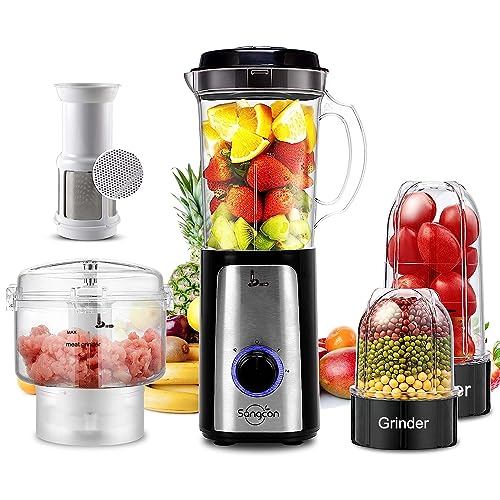
- Five functions and four vessel sizes cover blending, chopping, grinding, and individual drink preparation.
- ETL certification, a locking design, suction feet, and overheating protection support safer countertop use.
- BPA-free cups, bowl, and pitcher are removable and dishwasher safe for convenient cleanup.
- The included two-year warranty and stated 24-hour support response add useful ownership protection.
Cons
- Each processing cycle is limited to 60 seconds, so tougher or larger batches may require pauses between runs.
- Blending frozen fruit or very thick shakes may require added liquid for smoother processing.
Details
This 5-in-1 appliance combines a smoothie blender, food chopper, dry grinder, and personal drink setup, reducing the need for separate prep machines in a small kitchen.
Three dedicated blades handle distinct jobs: the cross blade blends liquids, the flat blade grinds coffee and spices, and the S-blade chops meat, vegetables, herbs, and nuts.
The BPA-free set includes a 47-ounce pitcher, 2.5-cup bowl, 18-ounce cup, and 11-ounce cup. Product weight is not specified, but suction feet help stabilize the motor base.
Continuous operation is limited to 60 seconds, and thick or frozen mixtures may need extra liquid and multiple cycles.
Best for family cooks, parents, and compact-kitchen users who need flexible daily prep from one appliance set.
How to Use
Select the cross blade for smoothies and sauces, the flat blade for coffee or dry spices, and the S-blade for meat, vegetables, herbs, nuts, or salsa.
Use low or high speed for steady processing, or pulse in short bursts for more control. Add liquid gradually when blending frozen fruit or thick shakes.
Keep each run under 60 seconds. For quick cleanup, pulse with water, then remove and rinse the vessels and blades or place dishwasher-safe parts in the dishwasher.

Pros & Cons
Pros
- One 800-watt motor unit supports both food-processing and countertop-blending tasks.
- The glass blender jar and BPA-free processor components offer different vessel options for daily prep.
- Manual controls provide two speeds plus pulse operation for adjusting texture.
- A three-year warranty and stated 12/7 brand support add post-purchase coverage.
Cons
- Manual two-speed control offers fewer preset programs than automated countertop appliances.
- The product data does not provide the unit's weight or countertop dimensions, which may matter for storage planning.
Details
The VegeNutrix combines an 88-ounce food processor and 70-ounce glass blender to reduce the need for separate appliances when preparing meals, smoothies and sauces.
An 800-watt motor reaches up to 25,000 RPM, while two manual speeds and pulse mode help adjust texture for dough, vegetables, ice and frozen fruit.
The set includes BPA-free processing components, a glass jar, stainless steel blades and a 12-cup bowl. Exact unit weight and countertop dimensions are not provided.
Its manual controls require more hands-on adjustment than appliances with automatic programs.
Best for cooks who want one appliance for batch food prep, blending and dough work.
How to Use
Secure the bowl or glass jar and lid until the interlocking safety system engages. Add ingredients within the stated capacity limits before selecting speed 1, speed 2 or pulse.
Use speed 1 for dough, mincing, slicing and shredding. Choose speed 2 for meats, sauces and dips, and use pulse for ice, nuts and frozen fruit.
Switch off and unplug the motor before changing blade assemblies or removing the vessel.
Pros & Cons
Pros
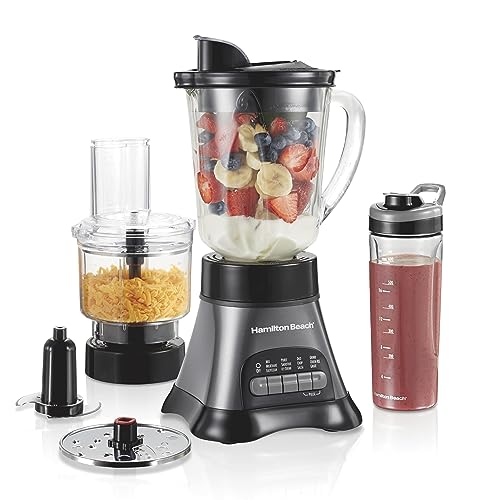
- The combination of a 40-ounce glass jar, travel cup and chopper attachment covers several common kitchen tasks.
- The glass jar is designed to withstand extreme temperatures, allowing hot and cold blending.
- The Wave~Action system is specifically designed to improve ingredient circulation around the blades.
- The chopper attachment adds slicing, shredding and chopping functions to a countertop blender.
Cons
- The 40-ounce jar may require multiple batches when preparing drinks or mixtures for larger groups.
- The glass jar is heavier and more breakable than a comparable plastic blending jar.
Details
The Hamilton Beach 58163 combines a blender, travel cup and 3-cup food chopper to reduce the need for separate appliances during drink and ingredient preparation.
Its 700-watt peak motor and Wave~Action system help process frozen ingredients and leafy greens into smoother shakes and smoothies.
The 40-ounce glass jar handles hot and cold liquids and includes a drip-reducing pour spout; the listed data does not provide total appliance weight.
The glass jar adds durability and temperature flexibility but is heavier and more breakable than plastic.
Best for households wanting one appliance for smoothies, shakes and small-batch food prep.
How to Use
Add liquids and softer ingredients first, then add leafy greens, frozen ingredients or ice to support smoother blending.
Use the 40-ounce glass jar for family-size drinks, the 20-ounce travel jar for portable servings and the 3-cup attachment for chopping, slicing or shredding.
Use the pour spout for controlled serving or streaming in oil while blending.
Who Benefits Most
This matters most for small-kitchen owners, and gadget-minimalists who want one do-it-all unit. If that is you, treat motor or heating-element power, and storage bulk as non-negotiable. Casual users can relax the requirements and prioritize price and storage instead.
What To Look For
The keeper is the one you reach for without thinking; the drawer occupant is the one that asks too much for too little payoff. Those are the variables that decide whether it earns a spot in your kitchen or ends up unused. Ignore cosmetic upgrades until the fundamentals check out.
How To Get It Right
Think through the whole workflow: wiping the interior after use, not overfilling past the max line, and letting the motor rest between heavy loads. A appliance that fits your routine and cleanup habits beats a technically superior one you fight with. We cover specific models in best air fryer, best blender, and best instant pot.
Common Misconceptions
The biggest myth is that the most expensive appliance is automatically the best for you. In reality, the right choice depends on preset controls, and motor or heating-element power — plus your own habits. Another trap is buying by brand alone — the same maker sells both excellent and forgettable lines.
The Short Answer
Food processor with blender usually comes down to one thing: matching the appliance to how you actually cook rather than to a spec sheet. The practical takeaway is that storage bulk matters more day to day than headline features. For product picks, compare best air fryer, best blender, and best instant pot.
Related Product Guides
If this topic is part of a buying decision, these are the HomeWhisk guides most closely tied to it:
Frequently Asked Questions
Is a premium appliance worth it?
Only if you use it enough to notice better control, durability, or cleanup regularly. Occasional users are well served by a mid-range pick like those in best instant pot.
What should I avoid?
Avoid buying by brand alone, ignoring checking the seals and gaskets, and oversizing for your space. Each invites unresponsive controls down the line.
What gear pairs well with it?
Start with a reliable core piece, then add as needs appear. Compare best air fryer, best blender, and best instant pot for related choices.
What matters most for food processor with blender?
Focus on cleaning access, motor or heating-element power, and digital versus dial controls first. Those decide real performance; the rest is secondary. Compare best air fryer and best blender for options that get the basics right.
What is the bottom line?
Match the appliance to your real habits: buy for durability if it is daily, for value and storage if it is occasional.
The Bottom Line
The simplest takeaway: buy for your real routine, not the most impressive feature list. Match the food processor with blender to your cooking frequency, cleanup habits, and storage, then use best air fryer, best blender, and best instant pot to compare actual products.

Write Your Review
No reviews yet. Be the first to share your experience!