

TL;DR — Grill cooking mats is one of those kitchen questions where the useful answer is usually more practical than complicated. The right move depends on how you cook, what you already own, and how much maintenance you are willing to do. For product picks, the closest next steps are best air fryer, best blender, and best instant pot.
Our view is based on product specs, material trade-offs, and repeated owner feedback — not one-off kitchen anecdotes or brand claims. For appliance topics, we pay close attention to capacity, controls, cleanup, storage, reliability complaints, and whether the machine saves enough effort to justify the space.

Pros & Cons
Pros
- Food-grade fiberglass construction is 100% PFOA-free.
- Rated to 500°F for short cooks and 260°F for extended sessions, covering most grilling and oven baking.
- Reusable across many cookouts and doubles indoors as a parchment paper replacement.
- Thickness is tuned to still transfer grill marks rather than steaming food flat.
Cons
- The 500°F ceiling only applies under 30 minutes, so high-heat searing and long hot cooks are off the table.
- Mats cannot touch heating elements directly, they must never be folded or creased, and trimmed edges can fray.
Details
A ten-pack of reusable non-stick sheets that sit on grill grates to stop small or delicate food from sticking, tearing, or dropping through the bars.
The PTFE coating handles marinated meats and sheds excess oil, while the mat thickness still conducts enough heat to leave grill marks on burgers and vegetables.
Built from food-grade PFOA-free fiberglass fabric, flexible enough to roll into a drawer and light enough to pack for camping, and trimmable with kitchen shears.
Heat limits are real: 500°F only for stints under 30 minutes, 260°F for longer cooks, and no direct contact with heating elements.
Best for grillers who cook fish, vegetables and pizza outdoors, or anyone using shared park and campground grates.
Best Uses
Use them for the foods that punish bare grates: fish fillets, shrimp, sliced vegetables, pizza and pancakes. Marinated meats work too, since the coating keeps sugary glazes from welding to the grill.
Assign separate mats to meat and produce so onion and fish flavors stay off tomorrow’s chicken. With ten sheets, you can also keep a set in the RV or camping bin.
Indoors, trim one to your baking sheet and use it in place of parchment. Wash while still warm, then hand wash or run it on the dishwasher top rack.
Pros & Cons
Pros
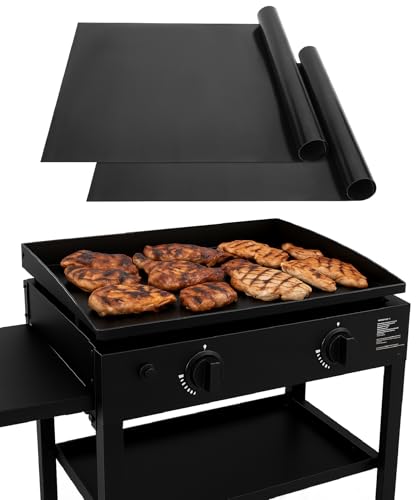
- Two mats per pack let you run one for meat and one for vegetables to avoid cross-contamination.
- Cuts through the mess of sticky glazes and barbecue sauce that normally weld onto grill bars.
- Wipes clean easily and stores flat or rolled without taking up cabinet space.
- Trimmable size adapts to smaller kettle grills or larger gas grill grates.
Cons
- The mat blocks direct flame contact, so you lose the char marks and smoky sear that grilling straight on the grates delivers.
- The 570°F ceiling means these are not suited to hard high-heat searing where grills run hotter.
Details
A two-pack of reusable grill mats that solve the two constant outdoor cooking problems: food sticking to grates and small pieces falling into the fire.
The PTFE-fiberglass coating releases delicate items like fish and asparagus intact, and the 570°F rating covers standard direct grilling temperatures.
Each mat measures 22 by 16 inches, thin enough to roll for storage, wide enough to cover most of a standard gas grill grate. BPA and PFOA free.
Because food never touches the metal, you will not get grate sear marks, and glaze-heavy cooks still need a wipe-down before the mat cools.
Best for grillers who cook fish, chopped vegetables, and sticky sauced meats and want their grates to stay clean.
Best Uses
Use them for flaky fish, shrimp, sliced peppers, onions, and anything else that normally falls through the grates or shreds when you flip it.
Run both mats at once to keep raw chicken separate from vegetables, then swap positions as items finish at different times.
Skip the mat when you want a hard sear on steaks. Grill those directly on the grates, then move them to the mat to rest.
Pros & Cons
Pros
- Made from BPA and PFOA free fiberglass mesh, so no coating chemicals transfer to food.
- Trimmable flat sheets store rolled or flat with no bulk in a grill drawer.
- Three-mat set means you can dedicate one to fish and keep the others free of odor transfer.
- Backed by a refund and replacement guarantee with around-the-clock support.
Cons
- The 500°F ceiling rules out high-heat searing, and the mats must stay 5 to 7 inches above open flames or they will scorch.
- Mesh openings still let small marinade drips and fine crumbs pass through, so it reduces rather than eliminates grate mess.
Details
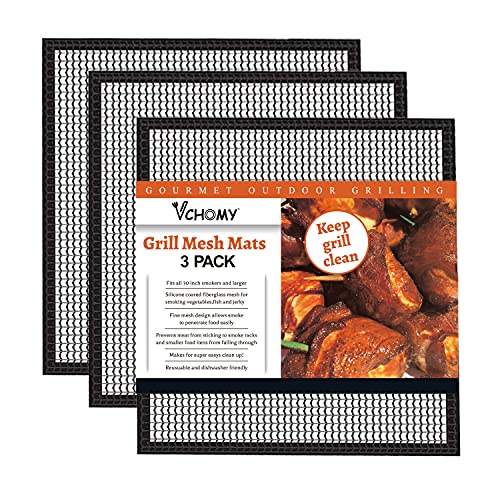
A three-pack of non-stick mesh sheets that lay over grill grates to stop shrimp, asparagus, sliced onions, and fish fillets from falling into the fire.
The open weave is the key difference from solid grill mats: smoke and direct heat still reach the food, so you get char and grill flavor rather than a griddle effect.
Built from PTFE coated fiberglass, each sheet measures 11.8 by 13.8 inches, weighs almost nothing, and can be cut smaller to fit a compact or round grate.
Heat tolerance stops at 500°F, and the mats need clearance of 5 to 7 inches from open flame, so they suit indirect and medium-heat cooking rather than a hard sear.
Best for backyard grillers who cook a lot of small, delicate, or chopped foods and are tired of losing them through the grates.
Best Uses
Use them for shrimp, scallops, thin fish fillets, chopped vegetables, and even eggs. These are the foods that normally require a basket or foil packet.
Bring one indoors for oven roasting or air fryer batches of vegetables, where the non-stick surface keeps caramelized sugars from bonding to the pan.
Set them over the cooler zone of a pellet or charcoal grill, then move food directly onto the bare grate for the final minute if you want sear marks.
How To Get It Right
Think through the whole workflow: checking the seals and gaskets, wiping the interior after use, and cleaning removable parts by hand. A appliance that fits your routine and cleanup habits beats a technically superior one you fight with. We cover specific models in best air fryer, best blender, and best instant pot.
When It Is Worth Paying More
Spending up pays off when you use the appliance often enough to notice better day-to-day handling every week. If it only comes out occasionally, a mid-range pick is the smarter call. Match the money to frequency of use, not marketing.
Common Misconceptions
The biggest myth is that the most expensive appliance is automatically the best for you. In reality, the right choice depends on storage bulk, and speed under load — plus your own habits. Another trap is buying by brand alone — the same maker sells both excellent and forgettable lines.
What To Look For
Judge a appliance by how it feels in normal use, how easy it is to clean, and whether it solves the job you bought it for. Those are the variables that decide whether it earns a spot in your kitchen or ends up unused. Ignore cosmetic upgrades until the fundamentals check out.
Why It Matters
You feel noise level, motor or heating-element power, and build quality of seals in the results far more than the price tag suggests. That is why two appliances that look alike can feel completely different in use — one saves time, the other quietly adds friction to every task. If you are shopping, our best air fryer and best blender guides are the fastest way in.
Related Product Guides
If this topic is part of a buying decision, these are the HomeWhisk guides most closely tied to it:
Frequently Asked Questions
Who is this most useful for?
Mainly families cooking in volume, and meal-preppers batching food. If that is you, treat motor or heating-element power as a requirement rather than a nice-to-have.
What is the bottom line?
Match the appliance to your real habits: buy for durability if it is daily, for value and storage if it is occasional.
What should I avoid?
Avoid buying by brand alone, ignoring wiping the interior after use, and oversizing for your space. Each invites unresponsive controls down the line.
What matters most for grill cooking mats?
Focus on cleaning access, motor or heating-element power, and capacity and footprint first. Those decide real performance; the rest is secondary. Compare best air fryer and best blender for options that get the basics right.
How do I keep it in good shape?
Build letting the motor rest between heavy loads, and not overfilling past the max line into normal cleanup. Light, consistent care prevents uneven cooking or heating far better than occasional deep effort.
The Bottom Line
The simplest takeaway: buy for your real routine, not the most impressive feature list. Match the grill cooking mats to your cooking frequency, cleanup habits, and storage, then use best air fryer, best blender, and best instant pot to compare actual products.









Write Your Review
No reviews yet. Be the first to share your experience!