

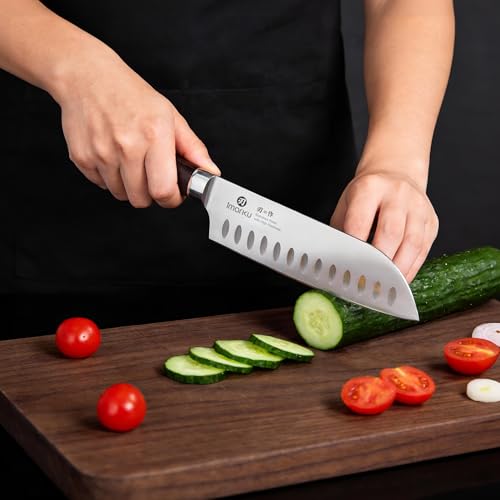
TL;DR — A carbon steel santoku is a Japanese general-purpose knife (santoku means “three virtues”: slicing, dicing, and mincing) forged from high-carbon steel rather than stainless. The high carbon content lets it take a harder, thinner, sharper edge that holds longer than most stainless blades, but the trade-off is that carbon steel reacts with air, moisture, and acids, so it rusts and develops a patina unless you keep it dry. The santoku shape has a flat edge, a tall blade, and a rounded “sheepsfoot” tip for straight push-cuts. For picks, see our best santoku knife guide.
The HomeWhisk editorial team researches kitchen equipment by analyzing steel metallurgy, blade geometry, manufacturer specifications, and aggregated owner feedback from communities like Reddit r/chefknives. The explanation below reflects how carbon steel and the santoku profile actually behave in the hand and over years of use.
A carbon steel santoku sits at the intersection of two ideas: a versatile Japanese blade shape and a traditional high-performance steel. Understanding it means understanding both what the santoku profile is designed to do and why carbon steel cuts differently, sharpens differently, and demands more care than the stainless knives most home cooks own. This guide covers the shape, the metallurgy, the real trade-offs, and how to care for one, so you can decide whether it belongs in your kitchen. For picks and comparisons, see our best santoku knife and best chef knife guides.
What “Santoku” Means and What the Shape Does
The santoku is a Japanese kitchen knife whose design drives how it cuts, so start with the geometry.
The name translates roughly to “three virtues” or “three uses,” referring to its competence at slicing, dicing, and mincing. Compared with a Western chef’s knife, a santoku is:
- Shorter, usually 5 to 7 inches, which makes it nimble and easy to control.
- Flatter along the edge, with much less belly (curve), so it favors a straight up-and-down push-cut or chop rather than the rock-chopping motion of a French chef’s knife.
- Tipped with a “sheepsfoot” profile, where the spine curves down sharply to meet a blunt, rounded tip. That gives good tip-down control for precision work.
- Taller at the heel, giving knuckle clearance and a broad face useful for scooping.
- Often ground with a thinner blade and a steeper, more acute edge angle than Western knives.
Many santokus also have a “Granton” edge (scalloped dimples along the blade) that creates air pockets to reduce food sticking to the sides.
What Carbon Steel Is and Why It Cuts Differently
The “carbon steel” part is a metallurgy choice with real consequences for the edge.
Steel is iron alloyed with carbon. In knife terms, “carbon steel” (also called high-carbon or non-stainless steel) contains a higher proportion of carbon and little to no chromium, whereas stainless steel contains at least about 10.5% chromium, which forms a corrosion-resistant oxide layer.
That difference matters because:
- Hardness: Carbon steel can be hardened to a higher Rockwell rating (often 60 to 64+ HRC on Japanese blades) than most Western stainless (54 to 58 HRC). Harder steel supports a thinner, more acute edge.
- Edge sharpness and retention: A harder, finer grain takes a keener edge and holds it longer between sharpenings.
- Ease of sharpening: Paradoxically, carbon steel is often easier to sharpen to a screaming edge because it’s less “gummy” than tough stainless, and it responds beautifully to whetstones.
- The catch: Without chromium’s protective layer, carbon steel oxidizes readily. It rusts if left wet and reacts with acidic foods.
Japanese carbon steels like White (Shirogami) and Blue (Aogami) paper steels are prized among enthusiasts precisely for taking an extremely sharp, easily maintained edge.
The Trade-Offs: Performance vs. Maintenance
Choosing carbon steel is a deliberate trade of convenience for edge quality. Here’s the honest balance.
Advantages:
- Sharper out of the gate and sharper achievable ceiling than typical stainless.
- Longer edge retention at a given angle.
- Easier and faster to hone and sharpen on stones.
- A thin, hard blade glides through produce and proteins with less wedging.
Disadvantages:
- Rust and corrosion: Leave it wet, or in the sink, and it will spot with rust.
- Patina: Carbon steel darkens over time into a gray-blue patina as it reacts with food. This is normal, food-safe, and even mildly protective, but some find it unsightly.
- Reactivity with acids: Cutting lemons, onions, or tomatoes can cause immediate discoloration and can leave a faint metallic taste on the food until a patina forms.
- Chipping: A very hard edge is more brittle. Twisting, prying, or cutting bone and frozen food can chip it.
If low maintenance is your priority, a stainless santoku or a Western chef’s knife is the sensible pick. Our best santoku knife and best chef knife guides cover both stainless and carbon options.
Carbon Steel Santoku vs. Stainless Santoku vs. Chef’s Knife
Knowing where it fits against the alternatives helps you decide.
- Vs. stainless santoku: Same shape and cutting style. Carbon wins on sharpness, edge retention, and sharpening ease; stainless wins on rust resistance and low maintenance. For a set-and-forget knife, stainless; for a maintained performer, carbon.
- Vs. a chef’s knife: The chef’s knife is longer with more curve, built for rock-chopping and larger tasks; the santoku is shorter and flatter, built for push-cuts and precise dicing. Many cooks own both. See our best chef knife guide for the comparison, and our best knife sets guide if you want a coordinated lineup.
- Specialty blades: A santoku is a generalist and shouldn’t replace task knives. Use a serrated blade for crusty bread (see our best bread knife guide) and a flexible blade for breaking down proteins (see our best boning knife guide).
Note that carbon steel pans and carbon steel knives are related in material only; a carbon steel pan is seasoned like cast iron. If you enjoy the material’s character in cookware too, our best carbon steel pan for cooking guide covers it.
How to Care for a Carbon Steel Santoku
Carbon steel is high-maintenance only relative to stainless; the routine is quick once it’s a habit.
1. Hand wash only, immediately after use. Never leave it in the sink or run it through a dishwasher. 2. Dry it completely with a towel the moment you finish; standing water is what causes rust. 3. Wipe during acidic tasks. When cutting citrus, onions, or tomatoes, wipe the blade periodically to limit discoloration and metallic transfer. 4. Let a patina form, or force one. A gray-blue patina protects the steel; many owners speed it up by wiping the blade with hot vinegar or cutting an onion. Don’t scrub the patina off. 5. Oil for storage. If storing for a while, wipe the blade with a thin film of food-safe mineral oil (or camellia oil) to block moisture. 6. Hone and sharpen on whetstones. Carbon steel responds best to Japanese water stones; maintain the acute edge angle the blade was ground to. A honing routine keeps it sharp for years.
Frequently Asked Questions
Is a carbon steel santoku better than stainless?
It depends on what you value. Carbon steel takes a sharper, harder, thinner edge that holds longer and is easier to sharpen on stones, which is why enthusiasts favor it. Stainless steel resists rust and stains and needs almost no special care, which suits most home cooks. Neither is universally “better.” If you’ll dry the blade after every use and enjoy maintaining an edge, carbon rewards you. If you want to wash it and move on, choose stainless. Our best santoku knife guide covers both.
Why does my carbon steel knife change color?
That’s patina, and it’s normal and desirable. Carbon steel lacks the chromium that keeps stainless bright, so it reacts with air, moisture, and food acids, oxidizing into a gray, blue, or brown film across the blade. Far from a defect, a stable patina is food-safe and forms a mild protective barrier that actually slows further rusting. Rust, by contrast, is orange, flaky, and appears when the blade is left wet; that you should prevent and remove. Let the patina develop and don’t polish it away.
What is a Japanese carbon steel knife made of?
Traditional Japanese carbon steels include White steel (Shirogami) and Blue steel (Aogami), high-purity carbon steels refined for hardness and fine grain. Blue steel adds small amounts of tungsten and chromium for better edge retention and slightly more toughness, while White steel is prized for taking an exceptionally keen, easily sharpened edge. Both harden to roughly 60 to 64+ HRC. Many Japanese knives are also “san-mai,” a hard carbon core clad in softer stainless or iron to combine a sharp edge with added durability and some rust protection on the sides.
Can I cut acidic foods like tomatoes and lemons with it?
You can, but with awareness. Acidic foods react quickly with bare carbon steel, discoloring the blade and potentially leaving a faint metallic taste on the food, especially before a patina forms. To minimize this, wipe the blade during and after cutting acidic ingredients and dry it promptly. Once a stable patina develops, reactivity drops considerably. If you cut a lot of citrus and tomatoes and dislike the fuss, a stainless santoku avoids the issue entirely.
Is a santoku good for meat?
A santoku handles boneless meat well; its flat edge and thin blade slice cleanly through chicken breast, steak, and fillets. What it should not do is cut through bone, joints, or frozen meat, since the hard, thin edge can chip. For breaking down whole poultry or separating meat from bone, a flexible boning knife is the right tool, see our best boning knife guide. Use the santoku for boneless slicing and dicing, and keep a dedicated blade for heavier butchery.
How do I keep a carbon steel santoku from rusting?
Keep it dry. Hand wash it immediately after use, dry it completely with a towel, and never leave it wet or soaking in the sink. Wipe the blade during acidic tasks, let a protective patina develop rather than scrubbing it off, and apply a thin film of food-safe mineral or camellia oil before long-term storage. Store it in a way that protects the edge and allows airflow rather than sealed damp in a drawer. Done consistently, this keeps rust away for the life of the knife.
The Bottom Line
A carbon steel santoku pairs a versatile Japanese blade shape (flat edge, tall face, rounded tip, built for push-cuts and precise dicing) with a high-carbon steel that takes a harder, sharper, longer-lasting, easily sharpened edge than typical stainless. The price of that performance is maintenance: carbon steel rusts, reacts with acids, and develops a patina, so it must be washed by hand and dried immediately. It’s an excellent knife for cooks who value a keen edge and don’t mind the care routine, and a poor fit for anyone who wants a wash-and-forget blade, where stainless is smarter. For picks and alternatives, see our best santoku knife, best chef knife, and best knife sets guides.
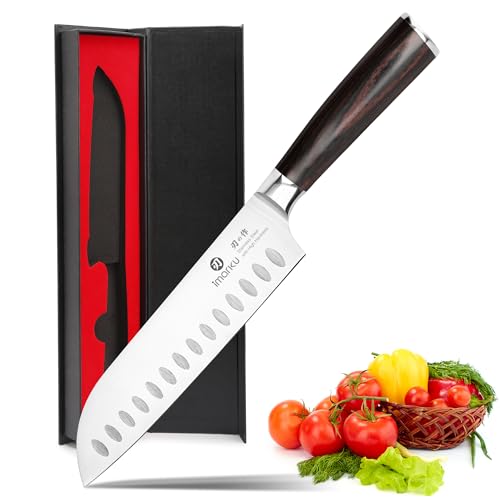
imarku
7-Inch Santoku Knife for Precision Slicing, Dicing & Mincing – High Carbon Japanese Steel with Pakkawood Handle
The imarku 7-inch Santoku knife combines a hollow scalloped edge and 15-18 degree hand-polished bevel to reduce drag and prevent food from sticking during high-volume prep work. Home cooks and apartment dwellers who want a restaurant-capable knife without the steep price will find it covers meat, vegetables, and bread with a single blade.
Pros and Cons
Pros
- The 2.5mm blade thickness paired with the hollow edge design handles both delicate julienne cuts and heavier chopping without flexing or wedging.
- Pakkawood handle construction offers a more sanitary and dimensionally stable grip than standard composite or natural wood handles.
- The 15-18 degree edge angle matches professional Japanese knife geometry, giving it a noticeably sharper out-of-box performance than German-style knives at this price.
- Versatile enough for meat, vegetables, fruit, and bread, making it a practical single-knife solution for small kitchens with limited storage.
Cons
- With zero verified reviews available, long-term edge retention and handle durability under daily use remain unconfirmed by real buyers.
- The 3-month refund window is shorter than the lifetime guarantees offered by competing brands at the same price point.

Zwilling
Henckels Santoku Knife 7-inch Hollow Edge German Stainless Steel
This 7-inch Santoku excels at mincing, slicing, and dicing with its hollow-edge blade that prevents food sticking during prep. Buy it if you want a durable, balanced Japanese-style knife that handles everyday vegetable work without the premium price tag.
Pros and Cons
Pros
- Hollow-edge grantons genuinely prevent cucumber and tomato slices from sticking to the blade mid-cut.
- German stainless steel holds its edge through repeated use on harder vegetables like carrots and beets.
- Fully forged construction creates noticeable weight and balance that makes repetitive dicing feel controlled and effortless.
Cons
- At 7 inches, it's smaller than Western chef's knives, requiring more frequent repositioning on larger vegetables.
- Dishwasher safe, but hand washing extends blade life and prevents potential handle loosening over time.

HOSHANHO
7-Inch Japanese Santoku Chef Knife | HOSHANHO High Carbon Stainless Steel
This 7-inch santoku slices vegetables, meat, and fish with a 15-degree blade angle that delivers thinner, more precise cuts than standard chef knives. Home cooks and professional chefs alike benefit from the triple-layer laminated steel construction that stays sharp longer and resists corrosion.
Pros and Cons
Pros
- The triple-layer laminated steel with 10Cr15CoMoV Japanese steel reaches 62HRC hardness, delivering edge retention that outlasts standard stainless blades.
- Ergonomic pakkawood handle provides secure grip and control without hand fatigue during extended prep sessions.
- 15-degree blade angle and hand-sharpened edge produce cleaner cuts through delicate vegetables and proteins compared to wider blade angles.
Cons
- Hand-washing required; dishwasher use will degrade the blade edge and handle finish over time.
- Requires regular honing to maintain the 15-degree angle; the initial sharpness will gradually diminish with normal kitchen use.

MercerCulinary
Mercer Genesis 7-Inch Santoku Knife: Professional Slicing & Mincing
This fully forged German steel santoku delivers razor-sharp precision for slicing vegetables and mincing herbs with its Granton edge that releases food cleanly. Buy it if you prep vegetables daily and want a professional-grade knife that won't require constant sharpening.
Pros and Cons
Pros
- Granton edge prevents food from sticking to the blade, making thin slicing of cucumbers, tomatoes, and fish noticeably faster than standard chef's knives.
- Ergonomic handle with substantial bolster reduces wrist strain during extended prep sessions and feels secure even when wet.
- Professional-grade construction at under $50 delivers the same German steel and forging process used in culinary schools.
Cons
- Requires hand-washing only; dishwasher use will damage the blade and handle, adding a maintenance step most busy cooks dislike.
- Santoku's shorter blade length and rectangular shape take practice if you're accustomed to Western chef's knives, requiring a learning curve.

Henckels Forged Accent 2-Piece Santoku Knife Set | German Stainless Steel
This 2-piece santoku set delivers razor-sharp German engineering for mincing, slicing, and dicing with effortless precision and lasting edge retention. Buy it if you prep vegetables daily and want knives that stay sharp without constant maintenance.
Pros and Cons
Pros
- Forged bolster transitions seamlessly from blade to handle, eliminating weak points that cause blade wobble during cutting.
- Satin-finished blade holds its edge noticeably longer than stamped knives, reducing the need for frequent sharpening.
- Two-knife set covers both precision work and larger prep tasks without requiring a full block of specialty knives.
Cons
- Santoku blade shape has a steeper learning curve than traditional chef's knives if you're accustomed to rocking motions.
- German stainless steel requires hand-washing to maintain edge longevity, despite being dishwasher-safe.
imarku 7-Inch Santoku Knife for Precision Slicing, Dicing & Mincing – High Carbon Japanese Steel with Pakkawood Handle
imarku
7-Inch Santoku Knife for Precision Slicing, Dicing & Mincing – High Carbon Japanese Steel with Pakkawood Handle
The imarku 7-inch Santoku knife combines a hollow scalloped edge and 15-18 degree hand-polished bevel to reduce drag and prevent food from sticking during high-volume prep work. Home cooks and apartment dwellers who want a restaurant-capable knife without the steep price will find it covers meat, vegetables, and bread with a single blade.
$39.99 at AmazonEditors' Favorite
Color: Brown and Silver Size: 7" Dimensions: 12 x 3 x 1 inches Weight: 0.43 pounds Product Group: Kitchen Binding: Kitchen
Shop NowZwilling Henckels Santoku Knife 7-inch Hollow Edge German Stainless Steel
Zwilling
Henckels Santoku Knife 7-inch Hollow Edge German Stainless Steel
This 7-inch Santoku excels at mincing, slicing, and dicing with its hollow-edge blade that prevents food sticking during prep. Buy it if you want a durable, balanced Japanese-style knife that handles everyday vegetable work without the premium price tag.
$79.95 at AmazonGreat Value
Brand Name: ZWILLING J.A. Henckels Manufacturer: ZWILLING UPC: 035886185930 Global Trade Identification Number: 00035886185930 Model Number: 31170-181 Manufacturer Part Number: 31170-181 -OPEN BOX Manufacturer Warranty Description: Lifetime Warranty Against Manufacturer'S Defects Item Type Name: Hollow Edge Santoku Knife Unit Count: 1.0 Count Included Components: Hollow Edge Santoku Knife Best Sellers Rank: #92,282 in Kitchen & Dining (See Top 100 in Kitchen & Dining) #244 in Bread Knives ASIN: B00068J2A0 Customer Reviews: 4.6 4.6 out of 5 stars (1,418) 4.6 out of 5 stars Blade Material Type: Stainless Steel Handle Material: Stainless Steel,Steel Is the item dishwasher safe?: No Material Type: ZWILLING Carbon No Stain Steel BladeLength: 7 Inches Item Weight: 6.4 ounces Item Length: 16 Inches Size: 7" Color: Stainless Steel Blade Color: Silver Blade Edge: Hollow Ground Construction Type: Forged Blade Material: Stainless Steel Brand: ZWILLING J.A. Henckels
Shop NowHOSHANHO 7-Inch Japanese Santoku Chef Knife | HOSHANHO High Carbon Stainless Steel
HOSHANHO
7-Inch Japanese Santoku Chef Knife | HOSHANHO High Carbon Stainless Steel
This 7-inch santoku slices vegetables, meat, and fish with a 15-degree blade angle that delivers thinner, more precise cuts than standard chef knives. Home cooks and professional chefs alike benefit from the triple-layer laminated steel construction that stays sharp longer and resists corrosion.
$52.99 at AmazonBrand Name: HOSHANHO Manufacturer: HOSHANHO UPC: 714757571477 Model Number: 7 inch Santoku Knife Manufacturer Part Number: HSHES-2022-002 Item Type Name: 7 inch Santoku Chef Knife Unit Count: 1.0 Count Included Components: 7 inch Santoku Knife Best Sellers Rank: #13,746 in Kitchen & Dining (See Top 100 in Kitchen & Dining) #29 in Chef's Knives ASIN: B0C1BQTQKL Customer Reviews: 4.7 4.7 out of 5 stars (1,742) 4.7 out of 5 stars Blade Edge: Plain Construction Type: Forged Blade Material Type: High Carbon Stainless Steel Handle Material: Pakkawood Is the item dishwasher safe?: No Material Type: High Carbon Stainless Steel BladeLength: 7 Inches Item Weight: 11.2 ounces Item Length: 7 Inches Size: 7" Color: Silver Blade Color: Silver Blade Material: High Carbon Stainless Steel Brand: HOSHANHO
Shop NowMercerCulinary Mercer Genesis 7-Inch Santoku Knife: Professional Slicing & Mincing
MercerCulinary
Mercer Genesis 7-Inch Santoku Knife: Professional Slicing & Mincing
This fully forged German steel santoku delivers razor-sharp precision for slicing vegetables and mincing herbs with its Granton edge that releases food cleanly. Buy it if you prep vegetables daily and want a professional-grade knife that won't require constant sharpening.
$39.95 at AmazonBrand Name: Mercer Culinary Manufacturer: Mercer Tool Corp. UPC: 749628445519 765301903244 Global Trade Identification Number: 00765301903244 Model Number: M20707 Manufacturer Part Number: M20707 Manufacturer Warranty Description: Lifetime limited manufacturer's warranty Item Type Name: Genesis Unit Count: 1.0 Count Included Components: Mercer Culinary Genesis 7-Inch Forged Santoku Knife Best Sellers Rank: #3,706 in Kitchen & Dining (See Top 100 in Kitchen & Dining) #15 in Santoku Knives ASIN: B000IBVD4I Customer Reviews: 4.8 4.8 out of 5 stars (1,577) 4.8 out of 5 stars Blade Material Type: High Carbon Steel Handle Material: Santoprene Is the item dishwasher safe?: No Material Type: Stainless steel and manmade BladeLength: 7 Inches Item Weight: 2.99 ounces Item Length: 14.05 Inches Size: 7" Color: Black Blade Color: Silver Blade Edge: Plain Construction Type: Forged Blade Material: High Carbon Steel Brand: Mercer Culinary
Shop NowHenckels Forged Accent 2-Piece Santoku Knife Set | German Stainless Steel
Henckels Forged Accent 2-Piece Santoku Knife Set | German Stainless Steel
This 2-piece santoku set delivers razor-sharp German engineering for mincing, slicing, and dicing with effortless precision and lasting edge retention. Buy it if you prep vegetables daily and want knives that stay sharp without constant maintenance.
$49.95 at AmazonBrand Name: HENCKELS Manufacturer: Henckels UPC: 035886649906 Model Number: 1021241 Manufacturer Part Number: 1021241 Item Type Name: Asian Knife Set Unit Count: 2.0 Count Included Components: 5" HE Santoku, 7" HE Santoku Best Sellers Rank: #41,522 in Kitchen & Dining (See Top 100 in Kitchen & Dining) #14 in Santoku Knives ASIN: B09RTDZ14W Customer Reviews: 4.6 4.6 out of 5 stars (284) 4.6 out of 5 stars Blade Edge: Plain Construction Type: Forged Blade Material Type: Stainless Steel Handle Material: Stainless Steel Is the item dishwasher safe?: Yes Material Type: Stainless Steel BladeLength: 5 Inches Item Weight: 9.07 g Item Length: 5 Inches Size: 2-pc Color: Black Blade Color: Silver Blade Material: Stainless Steel Brand: HENCKELS
Shop Now




Write Your Review
No reviews yet. Be the first to share your experience!