

TL;DR — A good answer to fruit and vegetable juicer starts with real kitchen habits, not a perfect spec sheet. Most readers need a clear way to avoid the wrong tool, not another list of features. Use this as the practical background, then check best air fryer, best blender, and best instant pot for specific product options.
We treated this as an editor’s note for home cooks: what matters, what is optional, and which related product guides are worth checking before you buy. For appliance topics, we pay close attention to capacity, controls, cleanup, storage, reliability complaints, and whether the machine saves enough effort to justify the space.

Pros & Cons
Pros
- BPA-free Tritan components hold up to daily use and leave no plastic aftertaste in juice or nut milk.
- Quiet operation makes early-morning green juice possible without disturbing anyone else in the house.
- A 5-year warranty and customer support response within 8 hours back the purchase long-term.
- The included recipe book gives first-time cold press owners a starting point beyond basic carrot juice.
Cons
- Masticating juicers run slower than centrifugal models, so a large batch of celery juice takes real time at the chute.
- This is a newer listing with no established review history, so long-term motor and auger reliability are unproven.
Details
A vertical single-auger cold press juicer built for people who want high-yield juice from hard and fibrous produce without pre-chopping everything into small pieces.
The dual-stage auger crushes then presses, and the 350W motor delivers 230nm of torque, enough for raw carrots, ginger knobs, and packed handfuls of kale.
Contact parts use BPA-free Tritan with a one-piece stainless steel filter, so there is no mesh basket to scrub and no plastic taste transfer.
Slow extraction is the tradeoff: this machine prioritizes yield and nutrient retention over speed, so it will not match a centrifugal juicer on throughput.
Best for daily green-juice drinkers who also want nut milk and sorbet from one appliance.
How to Use
Assemble in three steps, set your glass under the juice spout and a bowl under the pulp chute, then feed produce slowly and let the auger pull it down.
Alternate soft and hard items to keep the auger clear. If leafy greens wrap the screw, hold REV for a few seconds, then resume forward.
For nut milk, soak nuts first. For sorbet, feed frozen fruit in small pieces. Rinse parts immediately after use with the included brush.
Pros & Cons
Pros
- The 3-inch feed chute handles whole fruits and most vegetables without any pre-cutting, making daily juicing noticeably faster.
- Dual electronic speed control adapts to both soft leafy greens and hard root vegetables without switching machines.
- The titanium-reinforced disc and Italian micro mesh basket are stainless steel, built for consistent extraction and long-term durability.
- The built-in froth separator means juice pours clean without needing to skim or stir before drinking.
Cons
- Centrifugal operation runs louder than slow-press juicers, which is a real consideration if you juice early in the morning in a shared home.
- High-speed spinning generates heat that can reduce some heat-sensitive nutrients compared to cold-press models, a trade-off centrifugal juicers inherently carry.
Details
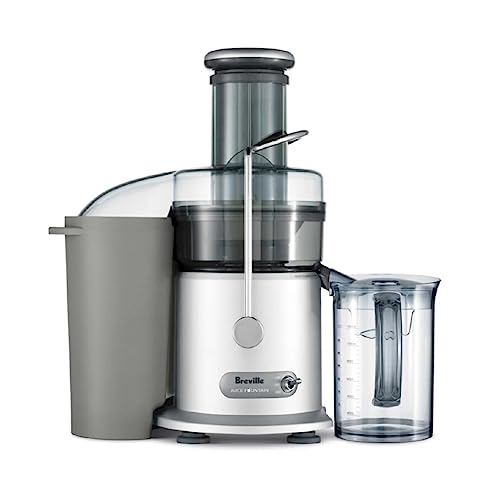
The Breville JE98XL is an 850W centrifugal juicer that eliminates the main friction in daily juicing: prep time. Its 3-inch wide chute accepts whole apples, oranges, and beets directly.
The titanium-reinforced disc and Italian-made micro mesh filter basket extract maximum juice per piece of produce. Two electronic speed settings match extraction to produce hardness without guessing.
The filter basket and disc are stainless steel. The juice jug holds 35.2 fl oz with an integrated froth separator. The pulp container holds 2.6 quarts before it needs emptying.
Centrifugal juicers generate heat through high-speed spinning, which can reduce some heat-sensitive nutrients compared to cold-press models. Worth knowing if nutrient preservation is a priority.
Best for home cooks who juice daily and want fast setup, whole-fruit convenience, and easy cleanup without investing in a cold-press machine.
How to Use
Lock the filter basket into place before plugging in. Set your speed before feeding produce: low for kale, spinach, and soft citrus; high for carrots, beets, and firm apples.
Feed produce steadily through the 3-inch chute using the pusher and do not force it. Alternating dense and soft produce helps clear the filter and keeps extraction speed consistent throughout the session.
Unplug and disassemble immediately after juicing before pulp dries on the mesh. Use the included cleaning brush to clear the basket, then wipe the motor base with a damp cloth only.

Pros & Cons
Pros
- The extra-large feed chute minimizes time spent cutting produce before juicing.
- The 800-watt motor is designed to juice a broad range of hard and soft foods.
- The pulp bin, juice bowl, lid, and pusher are dishwasher safe.
- Hamilton Beach backs the juicer with a 3-year limited warranty.
Cons
- The listing does not specify the juicer's materials, overall dimensions, or weight, which makes storage planning harder.
Details
This centrifugal juicer turns fruits and vegetables into juice while reducing the chopping required before extraction.
The 3-inch feed chute accepts whole apples, bunches of celery, and handfuls of carrots, while the 800-watt motor handles hard and soft produce.
An 80-ounce pulp bin supports larger batches, and the pulp bin, juice bowl, lid, and pusher are dishwasher safe.
The listing does not provide material, weight, or overall size details, so countertop storage requirements are unclear.
Best for home juicers who want faster produce prep and simpler cleanup.
How to Use
Wash your produce, place the juice bowl and pulp bin, then feed produce through the 3-inch chute while using the pusher as needed.
Use the juicer for hard and soft foods such as apples, oranges, cucumbers, carrots, celery, and leafy greens.
After juicing, disassemble the removable parts, place the dishwasher-safe components in the dishwasher, and use the included brush to clean the strainer.

Pros & Cons
Pros
- The extra-large chute reduces preparation time for many whole fruits and vegetables.
- The large hopper lets users load a full recipe before starting the machine.
- The 3-in-1 design makes juice, nut milk, and fruit sorbet with one smart strainer.
- The quick-release design and included brush make routine washing more manageable.
Cons
- The 60 RPM slow-extraction design prioritizes juice yield and lower oxidation over the speed of centrifugal juicers.
- The product data does not list its weight, so buyers cannot assess how easy it will be to move or store.
Details
The TUUMIIST is a cold press juicer for making fresh juice, nut milk, and fruit sorbet while reducing cutting, refilling, and cleanup work.
Its 6.5-inch chute fits whole apples, while the 100-ounce hopper supports hands-free batch juicing for family-sized recipes.
The 350W motor runs at 60 RPM, and the BPA-free parts include a quick-release design for daily kitchen use. Weight is not listed.
The slower extraction process takes longer than a centrifugal juicer, and the specifications do not state the unit’s storage footprint.
Best for families and batch juicers who value versatile recipes, large capacity, and simpler cleanup.
How to Use
Load washed produce through the 6.5-inch chute, using whole apples when they fit safely. Fill the 100-ounce hopper with the ingredients for your batch.
Run the 60 RPM extraction cycle and collect the juice. Use the same smart strainer for nut milk or fruit sorbet without changing parts.
When finished, detach the quick-release components and clean them with the included brush before the next use.
How To Get It Right
Think through the whole workflow: descaling water-based units, not overfilling past the max line, and checking the seals and gaskets. A appliance that fits your routine and cleanup habits beats a technically superior one you fight with. We cover specific models in best air fryer, best blender, and best instant pot.
The Short Answer
Fruit and vegetable juicer usually comes down to one thing: matching the appliance to how you actually cook rather than to a spec sheet. The practical takeaway is that digital versus dial controls matters more day to day than headline features. For product picks, compare best air fryer, best blender, and best instant pot.
Why It Matters
The variables that decide the outcome — digital versus dial controls, capacity and footprint, and preset controls — are the ones buyers most often overlook. That is why two appliances that look alike can feel completely different in use — one saves time, the other quietly adds friction to every task. If you are shopping, our best air fryer and best blender guides are the fastest way in.
Common Misconceptions
The biggest myth is that the most expensive appliance is automatically the best for you. In reality, the right choice depends on cleaning access, and capacity and footprint — plus your own habits. Another trap is buying by brand alone — the same maker sells both excellent and forgettable lines.
Related Product Guides
If this topic is part of a buying decision, these are the HomeWhisk guides most closely tied to it:
Frequently Asked Questions
Is a premium appliance worth it?
Only if you use it enough to notice better control, durability, or cleanup regularly. Occasional users are well served by a mid-range pick like those in best instant pot.
What gear pairs well with it?
Start with a reliable core piece, then add as needs appear. Compare best air fryer, best blender, and best instant pot for related choices.
Who is this most useful for?
Mainly busy weeknight cooks, and gadget-minimalists who want one do-it-all unit. If that is you, treat build quality of seals as a requirement rather than a nice-to-have.
What matters most for fruit and vegetable juicer?
Focus on noise level, build quality of seals, and preset controls first. Those decide real performance; the rest is secondary. Compare best air fryer and best blender for options that get the basics right.
How do I keep it in good shape?
Build descaling water-based units, and not overfilling past the max line into normal cleanup. Light, consistent care prevents motors that bog down under load far better than occasional deep effort.
The Bottom Line
A good fruit and vegetable juicer decision should feel obvious after you line up size, material, cleaning, and durability. If it is still a purchase question, the next step is best air fryer, best blender, and best instant pot.





Write Your Review
No reviews yet. Be the first to share your experience!