

TL;DR — Half baking sheet is one of those kitchen questions where the useful answer is usually more practical than complicated. The right move depends on how you cook, what you already own, and how much maintenance you are willing to do. When this turns into a purchase decision, compare best baking sheets, best mixing bowls, and best kitchen scale before narrowing your shortlist.
The HomeWhisk approach is research-first: compare construction, usability, cleaning, and long-term complaints before recommending a direction. For baking tools, sizing, material, accuracy, cleaning, and storage usually decide whether a tool stays useful or gets replaced.


Pros & Cons
Pros
- Ceramic nonstick surface means less scrubbing and no seasoning routine.
- Standard half-sheet footprint of 17.7 by 12.4 inches fits most home ovens and recipe instructions.
- The four-piece set covers baking and cooling in one purchase.
- Rated oven safe to 450 degrees F, enough for most roasting and baking recipes.
Cons
- The 450 degree F ceiling rules out high-heat roasting and broiler finishing.
- Ceramic nonstick coatings wear faster than bare steel, especially under metal utensils and repeated dishwasher cycles.
Details
A four-piece bakeware set: two steel half-sheet pans with ceramic nonstick coating plus two wire cooling racks sized to sit inside them. It solves stuck-on food and single-tray bottlenecks.
The nonstick surface releases cookies and caramelized vegetables cleanly, and the steel pan spreads heat evenly so one side of the tray does not brown first.
Pans measure 17.7 by 12.4 by 1.1 inches, racks 16.7 by 11.7 inches. Lightweight steel keeps loaded pans manageable, and everything is dishwasher safe.
The 450 degree F limit means no broiling or high-heat roasting, and ceramic coatings lose slickness over time.
Best for home bakers and meal preppers who cook in batches and want low-effort cleanup.
Cooking Tips
Set the rack inside the pan for bacon, wings, and roasts so fat drains and air circulates underneath, giving you crisp undersides without flipping.
Keep the oven at or below 450 degrees F and skip the broiler. Use silicone or wooden utensils to protect the ceramic coating.
Run both pans at once on separate racks and rotate them halfway through for even browning across batches of cookies or sheet-pan dinners.

Save $9.00
Pros & Cons
Pros
- NSF certification signals commercial-kitchen durability standards rather than light home-use construction.
- Aluminum body heats fast and evenly for consistent baking results across the full pan surface.
- Rolled edges add rigidity and give you a secure grip when pulling hot pans from the oven.
- Six matching pans stack neatly and cover baking, roasting, prepping, and storage in one purchase.
Cons
- Hand-wash only, since dishwasher detergent discolors bare aluminum.
- Uncoated aluminum is not truly non-stick, so delicate items still need parchment or a light grease.
Details
A six-pack of half-size aluminum sheet pans for anyone who runs out of trays halfway through a baking session or a week of meal prep.
Food-grade aluminum spreads oven heat evenly, so a full tray of cookies browns consistently instead of burning at the back corners.
Each pan measures 18 by 13 by 1 inches with rolled rims that stiffen the panel and resist warping at temperatures up to 500°F.
Bare aluminum reacts with dishwasher detergent, so these are hand-wash only and will darken with acidic foods over time.
Best for batch bakers, meal preppers, and home cooks who want commercial-style pans in quantity.
Cooking Tips
Line with parchment for cookies and sticky glazes. The mirror finish releases well, but bare aluminum still grabs sugar and cheese.
Give roasted vegetables a single uncrowded layer across the full 18 by 13 inch surface, and rotate pans between racks halfway through for even browning.
Skip acidic marinades and tomato sauces sitting directly on the metal, and wash by hand with warm soapy water while the pan is still warm.

Pros & Cons
Pros
- Pure aluminum provides strong heat conductivity for more even baking results.
- The encapsulated galvanized steel rim helps prevent warping.
- The 17.1 by 12.1-inch interior offers useful capacity for batch baking and roasting.
- Its rust-resistant construction is designed for long-lasting kitchen use.
Cons
- The large 17.9 by 12.9-inch exterior requires adequate oven and storage space.
- No nonstick coating is specified, so some foods may need greasing or parchment for easier release.
Details
This half sheet gives home cooks a durable surface for cookies, pastries, roasted vegetables, and other oven recipes that benefit from even heat.
Pure aluminum conducts heat efficiently for consistent browning, while the galvanized steel rim helps preserve the pan’s shape during repeated baking.
The interior measures 17.1 by 12.1 by 1 inch, with a 17.9 by 12.9-inch exterior. Its aluminum construction resists rust, though product weight is not specified.
No nonstick coating is listed, so delicate foods may need parchment or a light coating of grease.
Best for home bakers and cooks who want a roomy, long-lasting sheet pan for regular oven use.
Cooking Tips
Use the broad surface for cookies, biscuits, sheet-pan vegetables, and roasted foods that need room to spread without crowding.
Leave space between ingredients to encourage browning, and use parchment or grease when releasing delicate or sticky foods.
Check the pan’s large exterior dimensions before storing it or using it in a compact oven.
Save $1.80
Pros & Cons
Pros
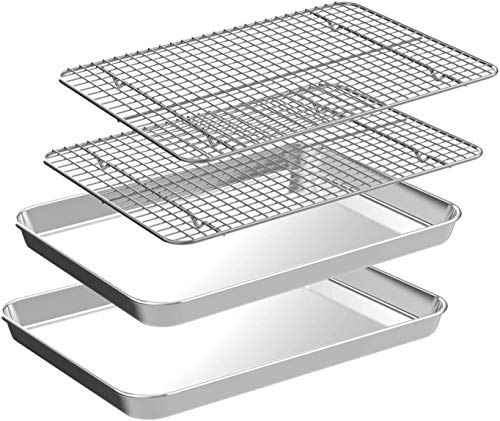
- Commercial-grade stainless steel with no coating to peel, chip, or degrade over time.
- Racks and pans share the same 18×12 footprint, so they nest correctly without gaps or wobble.
- Dishwasher safe, and hand cleanup needs only soapy water and a light scrub when grease is removed after each use.
- Doubles for BBQ prep, picnic serving, jelly rolls, and cheesecake beyond standard sheet pan baking.
Cons
- Bare stainless steel is not truly nonstick, so delicate cookies and sticky glazes still need parchment or a light oil coating.
- The lightweight build helps with handling but offers less thermal mass than heavy aluminum pans, so dark or thin batters can brown faster at the edges.
Details
A four-piece bakeware set of two half sheet pans and two matching cooling racks, built for cooks tired of nonstick coatings flaking off cheap trays.
The racks drop inside the pans to lift food above rendering fat, which crisps bacon and chicken wings on all sides instead of leaving soggy undersides.
Each piece measures 18x12x1 inches in uncoated commercial-grade stainless steel with rolled edges for grip, staying flat under heat and stacking thin for storage.
Bare steel is not a nonstick surface, so sticky doughs and sugary glazes need parchment paper or oil to release cleanly.
Best for home bakers and meal preppers who want a coating-free set that survives metal utensils and years of oven use.
Cooking Tips
Line the pan with parchment for cookies and roasted vegetables. Skip the liner when you want browned fond for pan sauces, and deglaze the steel directly with stock or wine.
Set the rack inside for bacon, wings, and meatballs so fat drains below and every side crisps. Use the second rack on the counter to cool baked goods without steaming their bottoms.
Wipe grease off while pans are still warm to prevent baked-on residue. For stubborn spots, soak in soapy water or scrub with baking soda paste rather than abrasive pads.

Pros & Cons
Pros
- Heavy gauge aluminized steel construction resists the buckling and pinging that plague lightweight pans at high heat.
- Non-stick release means less parchment paper and faster cleanup after roasting or cookie batches.
- The rolled edge makes the pan easy to grip and transfer safely when full.
- Micro-textured baking surface promotes even browning rather than hot spots in the pan center.
Cons
- Non-stick coatings degrade under metal utensils and high-heat broiling, so this needs gentler handling than a bare aluminum pan.
- Clear coated non-stick surfaces are generally best washed by hand, which is a step back from fully dishwasher-safe uncoated pans.
Details
A standard half sheet pan built for the common frustration of unevenly baked cookies and roasted vegetables that stick to the tray.
Heavy gauge aluminized steel paired with a micro-textured surface moves heat quickly across the pan, so a full tray of cookies browns at a similar rate front to back.
The food-grade non-stick silicone coating handles caramelized glazes and cheese, while rolled edges add rim rigidity and a secure grip for oven-to-rack transfers.
Limitation: the non-stick layer will not survive metal spatulas, aggressive scrubbing, or sustained broiler heat the way an uncoated pan would.
Best for home bakers and weeknight roasters who want reliable release and even browning without babysitting the oven.
Cooking Tips
Preheat the pan for roasting vegetables and proteins. Contact with hot aluminized steel starts the sear immediately and keeps moisture from pooling under the food.
Leave space between items. Crowding traps steam and defeats the even heat distribution the micro-textured surface is designed to deliver.
Use silicone or wooden utensils and hand wash with a soft sponge. Metal edges and abrasive pads shorten the life of the non-stick coating.

Pros & Cons
Pros
- Fluted design prevents sticking and creates better air circulation than flat pans, making release effortless even without greasing.
- Reinforced rims stay flat and rigid at high roasting temperatures where budget pans buckle and warp.
- Made in the USA with heavy duty aluminized steel that outlasts thin imported sheet pans by years.
Cons
- The textured surface requires hand washing in crevices, adding a few extra seconds compared to completely smooth pans.
- At just over 17 inches wide, these half sheets fit standard home ovens but may be tight in compact or older models.
Details
This is a set of two half sheet pans engineered to solve the warping and uneven baking problems that plague cheap cookie sheets.
The fluted surface design increases airflow beneath cookies and roasted foods while reducing contact area for superior release. The Americoat silicone nonstick coating lets baked goods slide off without scraping or soaking.
Each pan measures 17.25 x 12.25 inches on the baking surface with 1-inch rims. Heavy gauge aluminized steel construction with steel wire reinforcement in the rim prevents warping up to 450°F. Made in Pennsylvania by a family business operating since 1959.
The corrugated texture requires slightly more effort to clean in the grooves compared to completely flat pans, though most residue wipes away easily.
Best for home bakers and cooks who want commercial durability and consistent results across cookies, sheet cakes, roasted vegetables, and weeknight dinners.
Cooking Tips
Preheat these pans in the oven for crispier results on roasted potatoes, brussels sprouts, and bacon. The aluminized steel holds heat well and creates better browning than room-temperature pans.
Rotate pans halfway through baking when using both on separate racks. The even heat distribution minimizes hot spots, but oven position still affects browning on top versus bottom.
Skip parchment paper for most recipes since the Americoat coating releases cleanly. Use parchment only when a recipe produces heavy caramelized drips that might bake onto the textured surface.
Common Misconceptions
The biggest myth is that the most expensive baking tool is automatically the best for you. In reality, the right choice depends on nesting or storage shape, and measurement accuracy — plus your own habits. Another trap is buying by brand alone — the same maker sells both excellent and forgettable lines.
What To Look For
Judge a baking tool by how it feels in normal use, how easy it is to clean, and whether it solves the job you bought it for. Those are the variables that decide whether it earns a spot in your kitchen or ends up unused. Ignore cosmetic upgrades until the fundamentals check out.
When It Is Worth Paying More
Spending up pays off when you use the baking tool often enough to notice better day-to-day handling every week. If it only comes out occasionally, a mid-range pick is the smarter call. Match the money to frequency of use, not marketing.
The Short Answer
Cut through it and half baking sheet is a fit question — the baking tool has to match how you cook. The practical takeaway is that measurement accuracy matters more day to day than headline features. For product picks, compare best baking sheets, best mixing bowls, and best kitchen scale.
How To Get It Right
Think through the whole workflow: skipping abrasive scrubbers, storing flat to prevent bending, and drying fully before storage. A baking tool that fits your routine and cleanup habits beats a technically superior one you fight with. We cover specific models in best baking sheets, best mixing bowls, and best kitchen scale.
Who Benefits Most
This matters most for weekend bakers, and high-volume holiday bakers. If that is you, treat measurement accuracy, and nesting or storage shape as non-negotiable. Casual users can relax the requirements and prioritize price and storage instead.
Related Product Guides
If this topic is part of a buying decision, these are the HomeWhisk guides most closely tied to it:
- best baking sheets
- best mixing bowls
- best kitchen scale
- best cutting board
- best food storage containers
Frequently Asked Questions
Is a premium baking tool worth it?
Only if you use it enough to notice better control, durability, or cleanup regularly. Occasional users are well served by a mid-range pick like those in best kitchen scale.
What should I avoid?
Avoid buying by brand alone, ignoring lining with parchment, and oversizing for your space. Each invites uneven browning down the line.
Who is this most useful for?
Mainly high-volume holiday bakers, and anyone scaling recipes by weight. If that is you, treat release performance as a requirement rather than a nice-to-have.
What gear pairs well with it?
Start with a reliable core piece, then add as needs appear. Compare best baking sheets, best mixing bowls, and best kitchen scale for related choices.
What is the bottom line?
Match the baking tool to your real habits: buy for durability if it is daily, for value and storage if it is occasional.
The Bottom Line
For most home cooks, the best choice is the one that removes friction without adding maintenance you will ignore. Start with your use case, then cross-check best baking sheets, best mixing bowls, and best kitchen scale.





Write Your Review
No reviews yet. Be the first to share your experience!