

TL;DR — Induction ready is one of those kitchen questions where the useful answer is usually more practical than complicated. The right move depends on how you cook, what you already own, and how much maintenance you are willing to do. For product picks, the closest next steps are best air fryer, best blender, and best instant pot.
Our view is based on product specs, material trade-offs, and repeated owner feedback — not one-off kitchen anecdotes or brand claims. For appliance topics, we pay close attention to capacity, controls, cleanup, storage, reliability complaints, and whether the machine saves enough effort to justify the space.

Save $24.00
Pros & Cons
Pros
- Independent lab verification of the PFAS-free claim is stronger evidence than the marketing language most ceramic brands use.
- Works across gas, electric, and induction cooktops thanks to the bonded steel plate on every piece.
- Lightweight forged bodies reduce wrist strain compared with heavy cast or clad sets.
- Ceramic surface resists discoloration, so pans keep their finish after repeated high-heat use.
Cons
- Nuwave concedes the coating is not chemically nonstick, so release will not match PTFE pans and will fade faster with high heat or metal utensils.
- The set carries a premium price for aluminum cookware, and the listing does not clearly state which pieces and sizes are included.
Details
A forged aluminum cookware set for cooks who want nonstick release without PTFE, PFOA, lead, or cadmium in their pans.
The Gen10 Duralon Blue ceramic coating releases eggs and delicate fish with minimal oil and will not off-gas if a pan is left empty over a hot burner.
Forged bodies stay light in the hand, while a bonded anti-warp stainless plate keeps bases flat and adds induction compatibility on every piece.
Ceramic coatings degrade faster than PTFE, so expect release to soften over time, especially with high heat, aerosol sprays, or metal utensils.
Best for health-focused home cooks replacing an aging Teflon set, particularly on induction.
Cooking Tips
Cook on low to medium heat. Ceramic transfers heat fast, so a medium burner sears as well as high heat does on stainless and protects coating life.
Add oil or butter to a cool pan, then heat. Preheating dry bakes residue into the ceramic, which is the fastest way to lose nonstick release.
Use wood, silicone, or nylon utensils, skip cooking sprays, and let pans cool before washing. Hot water on a hot pan warps the bonded base.
Pros & Cons
Pros
- Saves the cost of replacing an existing moka pot collection after an induction kitchen upgrade.
- Single-piece steel build with no handle, coating, or moving parts to fail.
- Doubles as a heat diffuser for small pots that scorch on direct high heat.
- Simple operation: plate on the hob, pot on the plate, medium heat.
Cons
- The plate retains heat after the hob is off and needs time to cool before handling or storing.
- At 130mm it is too small for larger saucepans and pans, limiting it to moka pots and compact cookware.
Details
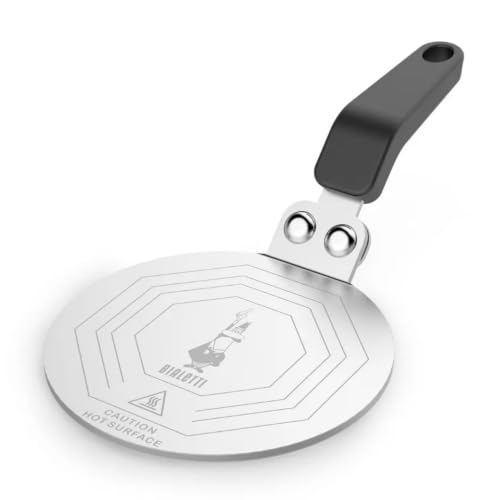
An induction interface disc that solves one problem: aluminum moka pots and non-magnetic pots that an induction hob refuses to detect.
The hob heats the steel plate, and the plate passes that heat to the pot above it. The octagonal surface pattern keeps the base seated during brewing.
Fully steel, 130mm across, sized for Bialetti moka pots up to 12 cups and small pots. No coating to chip and dishwasher safe.
Heat transfer through a plate is slower than direct induction contact, so brew times run longer than on gas.
Best for moka pot owners who moved into an induction kitchen and want to keep the pot they already use.
Best Uses
Brewing with an aluminum Bialetti on induction: set the plate down, center the moka pot, run the hob at medium heat rather than high.
Remove the pot from the plate as soon as coffee is up. Leaving it on stored heat keeps extracting and turns the cup bitter.
Also useful as a diffuser under small pots for milk, sauces, or anything that scorches when heat hits the base directly.

Pros & Cons
Pros
- The hybrid surface combines stainless steel and ceramic nonstick performance in one cooking surface.
- The pan is oven-safe up to 900°F, giving cooks more flexibility for stovetop-to-oven recipes.
- The included tempered glass lid helps monitor food without lifting the lid.
- Its tri-ply aluminum-core construction is designed for faster, more even heating.
Cons
- The tempered glass lid is oven-safe only up to 400°F, although the pan itself is rated to 900°F.
- The 10-inch cooking surface and three-pound weight may feel limiting for large batches or cooks who prefer lightweight pans.
Details
This 10-inch skillet combines frying, sautéing, and one-pot cooking in a single pan, helping reduce the need for separate cookware during everyday meals.
Its laser-etched hybrid surface pairs stainless steel with TerraBond ceramic coating for searing capability and easier food release during cleanup.
Tri-ply construction with an aluminum core supports even heating, while the three-pound body offers a substantial feel for daily cooking.
The pan reaches oven temperatures up to 900°F, but its tempered glass lid is limited to 400°F.
Best for everyday cooks who want one induction-ready skillet for family dinners and stovetop-to-oven recipes.
Cooking Tips
Use the 10-inch surface for frying, sautéing, and one-pot meals where moderate capacity is sufficient for everyday portions.
Move the pan from a compatible stovetop into the oven when needed, keeping the tempered glass lid below 400°F.
Use metal utensils when helpful, then place the dishwasher-safe pan in the dishwasher for simpler cleanup.

Pros & Cons
Pros
- The PFOA-free nonstick coating supports easier cooking and cleanup.
- The removable handle improves storage flexibility for small kitchens and RVs.
- The set works with induction, gas, and ceramic hobs.
- The cookware is designed to stack and is oven safe.
Cons
- The listing does not provide pot and pan dimensions or weights, making capacity planning difficult.
- The handle must be removed for the compact storage and cleaning benefits.
Details
This 23-piece Astercook cookware set addresses crowded cabinets with detachable handles and stackable cookware for compact kitchens and RVs.
The nonstick coating supports easier food release and cleanup, while the secure locking handle provides a stable grip during stovetop cooking.
Aluminum construction keeps the set focused on practical daily use, with compatibility across induction, gas, and ceramic cooktops.
The listing does not specify individual cookware dimensions, weights, or oven-safe temperature limits.
Best for space-conscious cooks who need versatile cookware across multiple cooktop types.
Cooking Tips
Lock the detachable handle securely before lifting or moving cookware, and remove it when stacking or washing the pieces.
Use the set on induction, gas, or ceramic cooktops as intended, and follow the manufacturer’s guidance for oven use.
Take advantage of the nonstick surface by cleaning promptly after cooking to keep food residue from building up.
Why It Matters
The variables that decide the outcome — storage bulk, digital versus dial controls, and noise level — are the ones buyers most often overlook. That is why two appliances that look alike can feel completely different in use — one saves time, the other quietly adds friction to every task. If you are shopping, our best air fryer and best blender guides are the fastest way in.
The Short Answer
The short version of induction ready: fit the appliance to your real cooking, not to a feature list. The practical takeaway is that motor or heating-element power matters more day to day than headline features. For product picks, compare best air fryer, best blender, and best instant pot.
Who Benefits Most
This matters most for small-kitchen owners, and meal-preppers batching food. If that is you, treat build quality of seals, and noise level as non-negotiable. Casual users can relax the requirements and prioritize price and storage instead.
Common Misconceptions
The biggest myth is that the most expensive appliance is automatically the best for you. In reality, the right choice depends on build quality of seals, and preset controls — plus your own habits. Another trap is buying by brand alone — the same maker sells both excellent and forgettable lines.
What To Look For
Judge a appliance by how it feels in normal use, how easy it is to clean, and whether it solves the job you bought it for. Those are the variables that decide whether it earns a spot in your kitchen or ends up unused. Ignore cosmetic upgrades until the fundamentals check out.
Related Product Guides
If this topic is part of a buying decision, these are the HomeWhisk guides most closely tied to it:
Frequently Asked Questions
Who is this most useful for?
Mainly families cooking in volume, and meal-preppers batching food. If that is you, treat capacity and footprint as a requirement rather than a nice-to-have.
What matters most for induction ready?
Focus on motor or heating-element power, speed under load, and storage bulk first. Those decide real performance; the rest is secondary. Compare best air fryer and best blender for options that get the basics right.
What is the bottom line?
Match the appliance to your real habits: buy for durability if it is daily, for value and storage if it is occasional.
How do I keep it in good shape?
Build wiping the interior after use, and checking the seals and gaskets into normal cleanup. Light, consistent care prevents motors that bog down under load far better than occasional deep effort.
Is a premium appliance worth it?
Only if you use it enough to notice better control, durability, or cleanup regularly. Occasional users are well served by a mid-range pick like those in best instant pot.
The Bottom Line
The simplest takeaway: buy for your real routine, not the most impressive feature list. Match the induction ready to your cooking frequency, cleanup habits, and storage, then use best air fryer, best blender, and best instant pot to compare actual products.



Write Your Review
No reviews yet. Be the first to share your experience!