

TL;DR — Mini grill is one of those kitchen questions where the useful answer is usually more practical than complicated. The right move depends on how you cook, what you already own, and how much maintenance you are willing to do. When this turns into a purchase decision, compare best air fryer, best blender, and best instant pot before narrowing your shortlist.
The HomeWhisk approach is research-first: compare construction, usability, cleaning, and long-term complaints before recommending a direction. For appliance topics, we pay close attention to capacity, controls, cleanup, storage, reliability complaints, and whether the machine saves enough effort to justify the space.

Save $3.10
Pros & Cons
Pros
- Folded footprint and light stainless build make it realistic to carry to a park, beach, or campsite on foot.
- Unfolded legs brace the body in a triangular stance, which keeps it steady on picnic tables and uneven ground.
- Dual side vents give you actual control over burn rate instead of guesswork.
- Removable rack and dedicated charcoal groove keep ash contained and washing simple.
Cons
- The 2.6 inch depth limits charcoal capacity, so long cooks need a mid session refuel rather than one loaded burn.
- There is no lid, which rules out closed roasting and makes real smoking difficult despite the smoker label.
Details
This is a folding tabletop charcoal grill for people who want live fire cooking where no kitchen exists, on a campsite table, balcony, or patch of beach.
Five vents on each side regulate airflow, so coals catch quickly and heat reaches the rack edges where food usually undercooks on cheap portables.
Stainless steel throughout resists rust and warping, the cooking area measures 17 by 11.6 inches, and the 2.6 inch body folds down to a flat, carryable slab.
Without a lid and with shallow charcoal depth, it handles quick direct heat cooking far better than slow roasting or extended smoking.
Best for campers, tailgaters, and small apartment cooks grilling for three to seven people who need the grill to disappear when finished.
Cooking Tips
Bank coals toward one half of the charcoal groove. The empty side becomes a holding zone for food that is cooked through while the rest finishes.
Open all ten side vents while lighting, then close the downwind side partway once coals ash over to slow the burn and stretch a single load.
Stick to fast cuts sized for direct heat, hot dogs, thin steaks, fish fillets, bacon, and corn. Lift the rack out to soak while the firebox cools.
Pros & Cons
Pros
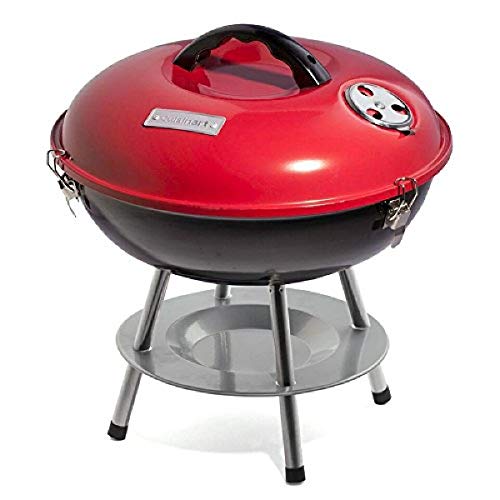
- At four pounds, this tabletop charcoal grill is easy to carry for camping and tailgating.
- Adjustable dual vents support more precise temperature management than a grill with fixed airflow.
- Three lid locks make transport more secure and help contain the grill between uses.
- The enamel-coated firebox, ash base, and chrome-plated grate make cleanup more manageable.
Cons
- Its 196-square-inch cooking area is better suited to compact meals than large group cooking.
- Charcoal grilling requires managing fuel, airflow, and ash after use.
Details
This compact charcoal grill solves the need for portable outdoor cooking when a full-size grill is impractical.
Dual vents help regulate airflow for low-and-slow cooking or higher-heat grilling, while the 196-square-inch grate accommodates compact meals.
The chrome-plated grate resists rust, and the enamel-coated firebox with ash base supports easier cleanup. Its four-pound weight improves portability.
The 196-square-inch surface limits how much food you can cook at once for larger groups.
Best for campers, tailgaters, and small-space grillers who value portability and vent control.
Best Uses
Use it for camping, tailgating, balcony-free patio cooking, and other settings where carrying a full-size grill is inconvenient.
Adjust the dual vents to manage airflow, using lower settings for slower cooking and greater airflow for higher heat.
Lock the lid before transport, then remove ash after cooking to keep cleanup and storage more manageable.

Save $2.10

Pros & Cons
Pros
- The porcelain-coated grates offer rust resistance and easier cleaning.
- The 190-square-inch cooking area provides useful capacity in a portable format.
- Minimal assembly and included step-by-step instructions simplify setup.
- The steel body and high-temperature finish support durability.
Cons
- The single-burner design limits temperature-zone control for foods requiring different heat levels.
- The 90-day warranty is short compared with many longer-term appliance warranties.
Details
This portable propane grill solves the need for compact outdoor cooking when a full-size grill will not fit or is unnecessary.
The single-burner cooking system and 190 square inches of space support straightforward grilling for smaller meals.
Steel construction, a high-temperature finish, and porcelain-coated grates help resist rust during regular outdoor use.
The single burner limits simultaneous high and low heat zones, and the 90-day warranty is brief.
Best for apartment cooks, campers, and small households needing a compact propane grill.
How to Use
Complete the minimal assembly using the included step-by-step guide, then connect the grill to a compatible liquid propane supply.
Preheat before cooking and arrange food across the 190-square-inch grate according to the space required.
After grilling, let the grate cool before cleaning it to preserve the porcelain coating and simplify maintenance.

When It Is Worth Paying More
Spending up pays off when you use the appliance often enough to notice better cleaner results every week. If it only comes out occasionally, a mid-range pick is the smarter call. Match the money to frequency of use, not marketing.
Common Misconceptions
The biggest myth is that the most expensive appliance is automatically the best for you. In reality, the right choice depends on speed under load, and preset controls — plus your own habits. Another trap is buying by brand alone — the same maker sells both excellent and forgettable lines.
Who Benefits Most
This matters most for small-kitchen owners, and busy weeknight cooks. If that is you, treat capacity and footprint, and speed under load as non-negotiable. Casual users can relax the requirements and prioritize price and storage instead.
How To Get It Right
Think through the whole workflow: cleaning removable parts by hand, checking the seals and gaskets, and letting the motor rest between heavy loads. A appliance that fits your routine and cleanup habits beats a technically superior one you fight with. We cover specific models in best air fryer, best blender, and best instant pot.
What To Look For
Hold a appliance to a short checklist: fit, control, cleanup, and durability. Those are the variables that decide whether it earns a spot in your kitchen or ends up unused. Ignore cosmetic upgrades until the fundamentals check out.
Why It Matters
The variables that decide the outcome — storage bulk, speed under load, and cleaning access — are the ones buyers most often overlook. That is why two appliances that look alike can feel completely different in use — one saves time, the other quietly adds friction to every task. If you are shopping, our best air fryer and best blender guides are the fastest way in.
Related Product Guides
If this topic is part of a buying decision, these are the HomeWhisk guides most closely tied to it:
Frequently Asked Questions
What should I avoid?
Avoid buying by brand alone, ignoring letting the motor rest between heavy loads, and oversizing for your space. Each invites uneven cooking or heating down the line.
How do I keep it in good shape?
Build cleaning removable parts by hand, and wiping the interior after use into normal cleanup. Light, consistent care prevents lingering odors far better than occasional deep effort.
What matters most for mini grill?
Focus on speed under load, cleaning access, and motor or heating-element power first. Those decide real performance; the rest is secondary. Compare best air fryer and best blender for options that get the basics right.
What is the bottom line?
Match the appliance to your real habits: buy for durability if it is daily, for value and storage if it is occasional.
Who is this most useful for?
Mainly busy weeknight cooks, and gadget-minimalists who want one do-it-all unit. If that is you, treat speed under load as a requirement rather than a nice-to-have.
The Bottom Line
For most home cooks, the best choice is the one that removes friction without adding maintenance you will ignore. Start with your use case, then cross-check best air fryer, best blender, and best instant pot.



Write Your Review
No reviews yet. Be the first to share your experience!