

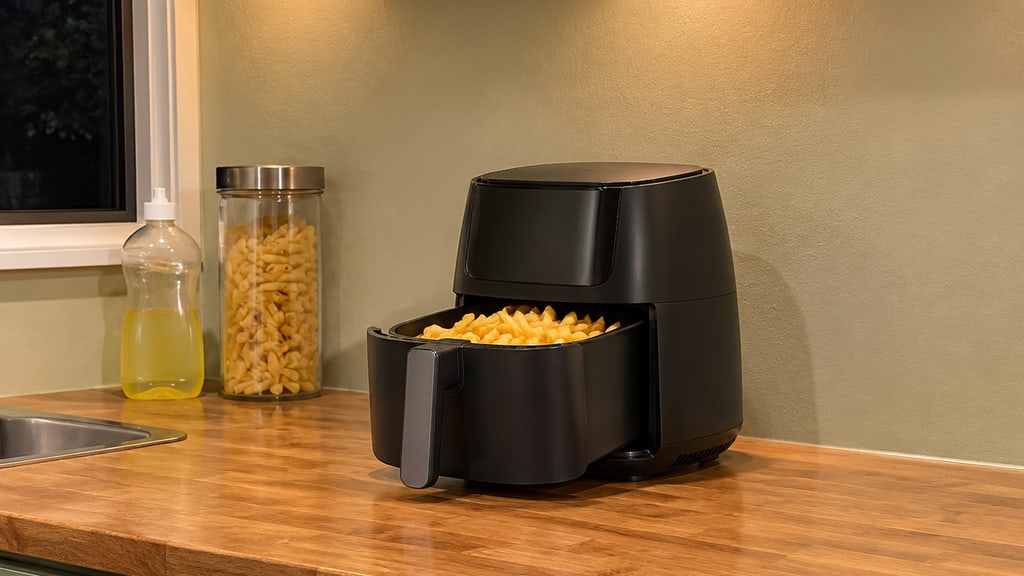
Here’s the thing nobody tells you when you unbox one: an air fryer doesn’t fry anything. Pop the lid, look inside, and you’ll see a heating coil and a fan. That’s it. What you’ve actually bought is a small, aggressive convection oven that happens to have a great marketing team. Once that clicks, everything else about the machine — why it crisps, why it disappoints, why your fries come out soggy in the middle — starts to make sense.
What’s really going on inside
Two parts do the work. A heating element sits near the top, usually a coiled wire that glows and pushes the internal air up to around 400°F. Right next to it spins a fan, and the fan is the whole trick. In a regular oven, hot air kind of loafs around and heats your food slowly. In an air fryer, that fan slams the hot air downward and around at high speed, and moving air transfers heat far faster than still air does. It’s the same reason a windy 40°F day feels colder than a calm one — air in motion pulls heat much more efficiently.
The basket matters just as much. It’s perforated, so the circulating air reaches the bottom and sides of your food, not just the top. Lay a chicken thigh on a flat oven tray and only the exposed surface browns. Drop it in a mesh basket with air ripping past every side, and the whole thing crisps at once. No oil bath, no submerging, no bubbling vat. Just fast, dry, hot air hitting food from all directions.
So why does it taste “fried”?
Three things happen at the surface. First, the moving hot air dries out the outer layer of the food fast — surface moisture is the enemy of crunch, and the fan strips it away quickly. Second, once that surface hits high heat and dries, you get the Maillard reaction: the chemistry between amino acids and sugars that browns a steak, toasts bread, and builds that deep, savory, roasted flavor. Deep frying gets there too, just by a different road. Third, a light spray of oil helps conduct heat evenly across the surface and speeds up the browning, which is why a quick mist of oil makes a real difference and a full coating just makes a mess.
Notice what’s missing: there’s no oil soaking into the food. That’s the honest health angle. You’re not eliminating some magic frying process — you’re just skipping the oil bath and browning with hot air instead. The texture is close but not identical. Deep-fried food has crunch all the way through because it cooks in fat; air-fried food is crisp on the surface and roasted underneath.
The mistake that ruins everything: crowding
If you take one thing away, make it this. The single biggest reason air-fried food turns out soggy or unevenly cooked is that people pile too much in the basket. When food is stacked or crammed edge to edge, the hot air can’t circulate. The pieces touching each other never get airflow, so instead of crisping they steam in their own moisture. You end up with a batch that’s browned on top and pale, limp, and half-cooked underneath.
Cook in a single layer with gaps between pieces. If that means two batches instead of one, do two batches — it’s faster than you’d guess because the machine’s already hot. And shake the basket or flip food halfway through. Because the heat comes mostly from above, the tops brown faster than the bottoms; a mid-cook shake evens it out. This is also why capacity claims are optimistic. A “6-quart” basket does not mean six quarts of fries done right. It means six quarts of space, and you should fill maybe half of it if you want everything crisp.
The other quirks worth knowing
These machines are loud. That fan is the point, and it isn’t subtle — expect something between a hairdryer and a microwave running the whole cook. Fatty foods can smoke, too. Bacon, sausages, well-marbled burgers: the fat drips down onto the hot element and burns, and suddenly your kitchen smells like a cookout gone wrong. A little water in the drawer bottom under fatty foods cuts down on the smoke. And even with a shake, cheaper models cook unevenly, so learn your particular unit’s hot spots.
There are two body styles. Basket models — the drawer you pull out — are compact, heat up fast, and crisp small batches beautifully, which is what most people want. Oven-style units are larger, hold racks, and cook more at once, but they take longer to preheat and don’t circulate air quite as tightly around each piece. If it’s mostly you, or you and one other person, a basket unit is almost always the smarter pick.
Turning the mechanics into a buy
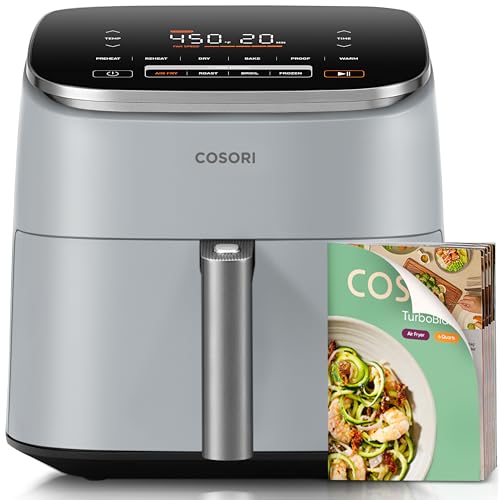
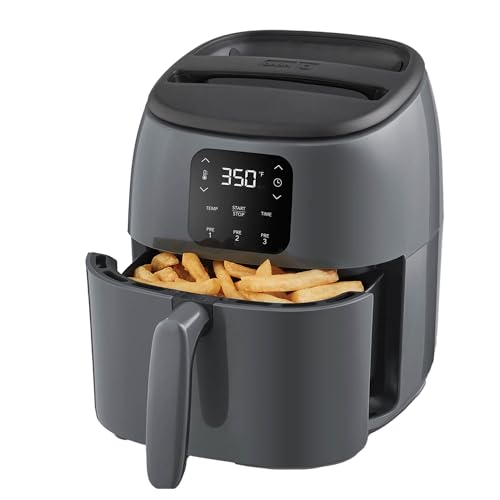
Once you know it’s really about airflow, you can shop by what actually drives results: a strong fan, a genuinely usable basket size for your household, and a temperature range that reaches at least 400°F for proper browning. Philips built the first consumer air fryer, and the market’s since filled out with Ninja, Instant, and Cosori all making solid units. A well-reviewed mid-size basket model like the Cosori TurboBlaze 6-quart hits the useful middle: enough room for two to three people, a fan strong enough to crisp without babysitting, and a ceramic-coated basket that’s easier to clean than the nonstick coatings that flake over time.
Two cheap add-ons punch above their price. Because cook times vary so much by food and by machine, a reference like the Silreck magnetic cooking-times cheat sheet saves you the guesswork of “was it 12 minutes or 18 for wings?” And since fatty drippings are the main cleanup headache, reusable silicone basket liners catch the grease — just don’t cover the whole basket floor, or you’ll block the airflow that makes the thing work in the first place. Leave the perforations exposed, cook in single layers, shake halfway, and you’ll get the results the box promised.

Silreck
Air Fryer Cooking Times at a Glance: Silreck SCG001 Magnetic Cheat Sheet Booklet
This 7" x 6" magnetic booklet sticks to your fridge and lists air fryer temperatures and times for over 120 foods across six categories, so you stop guessing or hunting through your phone mid-cook. It suits new air fryer owners and anyone cooking a lot of frozen or mixed batches who wants a wipe-clean reference within arm's reach of the appliance.
Pros and Cons
Pros
- Compact 7" x 6" footprint fits on a fridge door or side panel without covering other items.
- Plastic pages and reinforced construction hold up to daily kitchen handling better than paper charts.
- Covers frozen foods as its own category, which is where most air fryer cooking actually happens.
- Backed by a lifetime warranty from the brand.
Cons
- Cook times are general guidelines, so results still vary by air fryer wattage, basket size, and how full you load it.
- It is a reference chart rather than a cookbook, so there are no recipes, ingredient lists, or step-by-step methods.

Golden Associate
Air Fryer Cleanup Without Scrubbing: Golden Associate Square Silicone Liners, 2-Pack, 9-Inch Top and 8-Inch Bottom, Reusable Food-Grade Basket Inserts
These two square silicone inserts sit inside a 9.1 to 9.9 inch air fryer basket so grease and baked-on food land in the liner instead of the basket coating. Buy them if you run a square-basket air fryer several times a week and want to skip scraping, since both liners are dishwasher safe and rated to 428 degrees Fahrenheit.
Pros and Cons
Pros
- Nine inch square top and eight inch square bottom fit most square baskets measuring 9.1 to 9.9 inches inside.
- Reusable construction replaces disposable parchment liners batch after batch.
- Handles and flexible walls make it simple to lift out food and pour off rendered fat.
- Non-stick surface releases cheese, marinades, and batters without soaking.
Cons
- Only fits square baskets in a narrow size range, so round or oval air fryers are out and you must measure first.
- Cannot stay in the basket during preheat because the exposed heating element can scorch the silicone and cause smoke.
Cosori TurboBlaze 6 Qt Air Fryer, Ceramic Coating, 9-in-1, Light Gray
Editors' Favorite
Color: Light Gray Size: 6QT Dimensions: 14.4 x 11.9 x 11.8 inches Weight: 13.2 Pounds Product Group: Kitchen Binding: Kitchen
Shop NowSilreck Air Fryer Cooking Times at a Glance: Silreck SCG001 Magnetic Cheat Sheet Booklet
Silreck
Air Fryer Cooking Times at a Glance: Silreck SCG001 Magnetic Cheat Sheet Booklet
This 7" x 6" magnetic booklet sticks to your fridge and lists air fryer temperatures and times for over 120 foods across six categories, so you stop guessing or hunting through your phone mid-cook. It suits new air fryer owners and anyone cooking a lot of frozen or mixed batches who wants a wipe-clean reference within arm's reach of the appliance.
$6.49 at AmazonGreat Value
Color: Air Fryer Cooking Guide Size: 0.40 X 6 X 6.5 Dimensions: 0.1968503935 x 5.905511805 x 6.4960629855 inches Weight: 0.13007273458 pounds Product Group: Kitchen Binding: Kitchen
Shop NowGolden Associate Air Fryer Cleanup Without Scrubbing: Golden Associate Square Silicone Liners, 2-Pack, 9-Inch Top and 8-Inch Bottom, Reusable Food-Grade Basket Inserts
Golden Associate
Air Fryer Cleanup Without Scrubbing: Golden Associate Square Silicone Liners, 2-Pack, 9-Inch Top and 8-Inch Bottom, Reusable Food-Grade Basket Inserts
These two square silicone inserts sit inside a 9.1 to 9.9 inch air fryer basket so grease and baked-on food land in the liner instead of the basket coating. Buy them if you run a square-basket air fryer several times a week and want to skip scraping, since both liners are dishwasher safe and rated to 428 degrees Fahrenheit.
$12.99 at AmazonColor: Red Size: 9'' square Dimensions: 8.99999999082 x 8.99999999082 x 0.09842519675 Inches Weight: 0.89948602896 Pounds Product Group: Kitchen
Shop Now




Write Your Review
No reviews yet. Be the first to share your experience!