

TL;DR — For meal prep, the best chef knife is a well-balanced 8-inch blade in high-carbon stainless steel with a comfortable, grippy handle that resists fatigue across long batch sessions. Prioritize edge retention, easy resharpening, and a blade profile that releases food cleanly. The $60-120 range covers most needs. For broader context, our best chef knife guide compares the full category, and best chef knife under 100 focuses on value.
Meal prep is a volume game. Sunday afternoons spent breaking down five pounds of vegetables, portioning proteins, and filling a week of containers put demands on a knife that occasional cooking never does. The HomeWhisk team analyzed a range of chef knives against the specific pressures of batch work: sustained comfort, edge stability across hundreds of cuts, and blade geometry that keeps sliced food from sticking and stacking on the blade.

We compared blade steel composition, hardness ratings, handle ergonomics, weight balance, and aggregated user reviews from Amazon and Reddit r/chefknives, weighting feedback from cooks who describe long prep sessions rather than one-off use. For readers assembling a fuller kit, our best knife sets roundup and best japanese chef knife guide cover complementary directions worth considering alongside the picks below.
Farberware
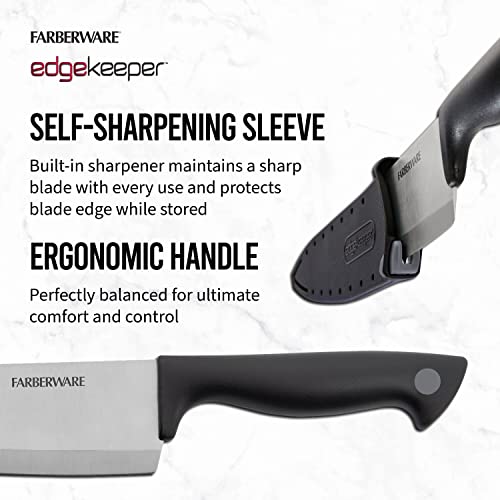
Everyday Slicing and Dicing: Farberware EdgeKeeper 8-Inch Chef Knife
The Farberware EdgeKeeper 8-inch chef knife slices, dices, minces, and prepares proteins while its self-sharpening cover helps maintain the cutting edge. Home cooks who want one versatile prep knife with protected drawer storage should consider it.
Pros and Cons
Pros
- The built-in sharpener helps maintain the edge without requiring a separate sharpening tool.
- High-carbon stainless steel supports lasting sharpness and precise cutting.
- The 8-inch blade handles a broad range of common kitchen tasks.
- The ergonomic polypropylene handle is designed to reduce hand fatigue during prep work.
Cons
- Farberware specifies hand washing with mild detergent and immediate drying, so it requires more care than a dishwasher-friendly knife.
- The product data does not provide a weight, making it difficult to judge how substantial it will feel before purchase.
Farberware Everyday Slicing and Dicing: Farberware EdgeKeeper 8-Inch Chef Knife
Farberware
Everyday Slicing and Dicing: Farberware EdgeKeeper 8-Inch Chef Knife
The Farberware EdgeKeeper 8-inch chef knife slices, dices, minces, and prepares proteins while its self-sharpening cover helps maintain the cutting edge. Home cooks who want one versatile prep knife with protected drawer storage should consider it.
$11.75 at AmazonEditors' Favorite
Color: Black/Gray Size: 8" Dimensions: 1.8 x 4.1 x 14.9 inches Weight: 0.4625 pounds Product Group: Kitchen Binding: Kitchen
Shop NowVictorinox Fibrox Chef's Knife, 5-Inch, Black

Great Value
Color: Black Size: 5" Dimensions: 10 x 1.25 x 0.75 inches Weight: 0.180625 pounds Product Group: Kitchen Binding: Kitchen
Shop NowHENCKELS Solution Razor-Sharp 2-Piece Compact Chef Knife Set, German Engineered Knife Informed by over 100 Years of Mastery

HENCKELS
Solution Razor-Sharp 2-Piece Compact Chef Knife Set, German Engineered Knife Informed by over 100 Years of Mastery
$19.99 at AmazonColor: Black Size: 2-pc Dimensions: 4.8 x 0.94 x 12.2 inches Weight: 0.47 pounds Product Group: Kitchen Binding: Kitchen
Shop NowEditor’s Picks
| Category | Pick | Why |
|---|---|---|
| Best Overall for Meal Prep | Balanced 8-inch high-carbon stainless chef knife | Holds an edge across long sessions, resharpens easily, comfortable full-tang handle |
| Best Value | Lightweight stamped stainless chef knife | Low fatigue over batch work, grippy handle, strong price-to-performance |
| Best for High-Volume Chopping | Full-tang German-style workhorse | Extra mass and durability for dense produce and repeated rough-chopping |
At a Glance: Comparison Table
| Product Type | Blade Steel | Hardness | Handle | Edge Angle | Best For |
|---|---|---|---|---|---|
| Balanced 8-inch chef knife | High-carbon stainless | HRC 56-58 | Full-tang composite | 15° per side | All-purpose meal prep |
| Lightweight stamped chef knife | X50CrMoV15 stainless | HRC 55-57 | Textured thermoplastic | 15° per side | Long low-fatigue sessions |
| German-style workhorse | 1.4116 stainless | HRC 57-58 | Triple-riveted composite | 14-15° per side | Dense produce, batch chopping |
| Japanese-style gyuto | Clad high-carbon core | HRC 60-61 | Composite or wa-handle | 12-14° per side | Precise slicing, food release |
| Compact 7-inch chef knife | High-carbon stainless | HRC 56-58 | Ergonomic composite | 15° per side | Smaller boards, control |
How We Evaluated These Products
Our evaluation is grounded in documented research, not claims of personal kitchen use. we relied on manufacturer specifications, metallurgical data, and aggregated community review analysis.
Steel and hardness analysis. We reviewed published alloy designations (1.4116, X50CrMoV15, and clad high-carbon cores), Rockwell hardness (HRC) ratings, and chromium content, since these determine both corrosion resistance and how long an edge lasts across a long prep session.
Handle and balance documentation. For meal prep specifically, we recorded handle material, weight, and stated balance point, because forearm and grip fatigue accumulate over hundreds of consecutive cuts.
Aggregated review analysis. We analyzed Amazon and Reddit r/chefknives feedback, giving weight to reviewers who describe batch cooking, container prep, and repeated weekly use. Review sets with more than 500 data points were weighted more heavily than small samples.
Durability reporting. For products with multi-year ownership histories, we tracked recurring complaints and consistent praise to separate reliable signals from outliers, focusing on edge degradation and handle integrity over time.
What Actually Matters:
Edge Retention Across Long Sessions
For meal prep, edge retention is the single most important attribute, because the difference between a knife that stays sharp through five pounds of onions and one that starts tearing halfway through is felt directly in the container. Edge retention is a function of steel hardness and alloy composition. High-carbon stainless alloys like X50CrMoV15 and 1.4116, typically hardened to HRC 56-58, offer a practical balance: they hold a working edge through a full prep session without the brittleness that harder steels bring.
Japanese-style gyutos hardened to HRC 60-61 hold their edge measurably longer between sharpenings, which appeals to cooks who prep large volumes weekly. The trade-off documented across Reddit r/chefknives is that harder steel is more vulnerable to chip damage if it contacts bone, a hard cutting board, or a stray staple in produce packaging. For most home meal preppers who cut on wood or plastic, the softer German range is more forgiving and easier to bring back to sharp.
What matters practically is not just how long the edge lasts, but how gracefully it degrades. Manufacturer specifications and aggregated reviews suggest that mid-hardness stainless knives lose sharpness gradually and respond immediately to a honing rod, letting you refresh the edge mid-session in seconds. Harder steels stay sharp longer but, once dulled or chipped, require a whetstone and more technique to restore. For a weekly batch-cooking rhythm, a knife that can be honed quickly between sessions keeps the workflow moving and the cuts clean from the first onion to the last.
Handle Comfort and Fatigue
Meal prep sessions can run 45 minutes to two hours, and handle ergonomics determine whether that ends in sore hands. The two dominant handle materials in this category are composite (polyoxymethylene and similar) and textured thermoplastics. Composite handles are dense and dimensionally stable, resisting moisture and warping over years of use. Textured thermoplastic handles, common on lightweight stamped knives, add grip security when hands are wet from washing produce, a real advantage during prep-heavy sessions noted repeatedly in aggregated Amazon reviews.
Handle shape matters as much as material. A rounded, slightly contoured handle that supports a pinch grip, with thumb and forefinger on the blade just ahead of the bolster, gives the most control and reduces the need to squeeze hard, which is the main source of hand fatigue. Overly square or slick handles force a tighter grip and accelerate soreness. Cooks with larger hands often report preferring the fuller German-style handle, while smaller-handed cooks tend to favor thinner profiles.
Full-tang construction, where the steel runs the length of the handle, contributes to durability and a balanced feel. Reports from long-term owners consistently favor full-tang knives for longevity under heavy weekly use, since there is no glued partial-tang joint to loosen over hundreds of prep sessions and dishwasher-adjacent exposure to moisture.
Weight and Balance for Batch Chopping
The right weight for meal prep depends on what you cut most. Heavier knives in the 8-9 ounce range carry momentum through dense produce like squash, sweet potatoes, and cabbage, letting the blade’s mass do the work rather than your arm. For cooks who batch-process hard vegetables, that momentum reduces effort per cut. Lighter knives in the 5-7 ounce range reduce cumulative fatigue and allow faster, more precise work on softer items and repetitive dicing.
Balance point is where the mass sits relative to the pinch grip. A knife balanced at or just ahead of the bolster feels neutral in the hand and does not tip forward or back, which matters when you are making the same cut hundreds of times. Aggregated reviews from Amazon and Reddit r/chefknives show a clear multi-year trend toward lighter, well-balanced knives for high-volume home prep, with cooks reporting less forearm fatigue after switching from heavier classics. For a mixed meal-prep workload, a well-balanced 7-8 ounce knife is the most versatile starting point.
Food Release and Blade Profile
Nothing slows meal prep like sliced vegetables gluing themselves to the blade in a stack you have to shake off every few cuts. Food release is governed by blade geometry, specifically how thin the blade is behind the edge and whether the face is flat, hollow-ground, or slightly convex. Thinner blades behind the edge, common on Japanese-style gyutos, part food cleanly and reduce sticking, which aggregated reviews consistently praise for potato, carrot, and cucumber prep.
Blade curvature affects cutting motion. A flatter profile suits push-cutting and the chop-and-scrape rhythm of container prep, while a more curved belly favors rocking cuts for herbs and aromatics. An 8-inch blade with moderate curve handles both. Blade height, measured heel to spine, also helps meal prep: a taller blade gives knuckle clearance on a full board and makes a better scoop for transferring chopped vegetables to a bowl or container, a small ergonomic detail that adds up across a long session.
Frequently Asked Questions
What size chef knife is best for meal prep?
An 8-inch chef knife is the most versatile choice for meal prep. It is long enough to slice through large vegetables and portion proteins in single strokes, which speeds up high-volume work, while remaining maneuverable on standard home cutting boards. Cooks with smaller boards or who prioritize control sometimes prefer a 7-inch blade, which retains most of the utility with slightly better handling. Aggregated reviews from Amazon and Reddit r/chefknives show the 8-inch as the clear favorite for batch cooking, with the 7-inch as a reasonable alternative for compact kitchens.
Is a Japanese or German knife better for meal prep?
Both work well, and the right answer depends on your maintenance habits. German-style stainless knives at HRC 56-58 are tougher and more forgiving, easy to hone mid-session and resharpen with basic tools. Japanese-style gyutos at HRC 60-61 hold their edge longer and release food more cleanly thanks to thinner geometry, which helps with high-volume vegetable prep, but they are more prone to chipping and require more careful sharpening. For most home meal preppers, a German-style knife is the lower-maintenance choice; committed cooks who want maximum sharpness may prefer Japanese.
How often should I sharpen a chef knife used for meal prep?
If you prep several times a week, plan on a full resharpening once or twice a year, with regular honing in between. Honing realigns the edge without removing metal and takes seconds; doing it before each prep session keeps the knife feeling consistently sharp. Reports from long-term owners identify neglected honing as the most common reason a knife feels dull prematurely. Harder Japanese steels can go longer between full sharpenings but need a whetstone rather than a pull-through sharpener when the time comes.
Do I need a heavy knife for chopping lots of vegetables?
Not necessarily. Heavier knives carry momentum that helps with dense produce like squash and cabbage, but they also cause faster fatigue over long sessions. Lighter knives reduce arm strain and allow quicker, more precise repetitive cuts. Aggregated reviews show a strong trend toward lighter, well-balanced knives for home meal prep. A well-balanced 7-8 ounce knife handles the full range of prep tasks without tiring your hand, making it a better all-around choice than a heavy blade for most people.
Can one chef knife handle all my meal prep?
For most meal prep, a single quality 8-inch chef knife covers the large majority of tasks: chopping, slicing, dicing, and portioning. The main exceptions are slicing crusty bread and delicate work better suited to a paring knife. If your prep routine includes bread, a dedicated serrated blade is worth adding; see our best bread knife guide. Otherwise, a well-maintained chef knife is genuinely the workhorse that handles nearly everything in a weekly batch-cooking routine.
Our Top Pick
After analyzing steel composition, hardness data, handle ergonomics, weight balance, and aggregated owner feedback focused on high-volume use, a well-balanced 8-inch high-carbon stainless chef knife at HRC 56-58 with a full-tang composite handle stands out as the best chef knife for meal prep. It holds a working edge across a long batch session, hones back to sharp in seconds, and stays comfortable through hundreds of consecutive cuts.
Match the pick to your prep style:
- If you want low fatigue over long sessions and a grippy handle for wet-hand work, a lightweight stamped stainless knife is the better fit.
- If you routinely break down dense produce in bulk, a heavier full-tang German-style workhorse carries momentum through the work.
- If you prioritize clean food release and maximum sharpness and are willing to sharpen carefully, a Japanese-style gyuto rewards the extra maintenance.
- If your board is small or you value control over reach, a compact 7-inch chef knife keeps most of the utility with better handling.
The best chef knife for meal prep is the one that stays sharp, stays comfortable, and keeps your Sunday session moving. Any of these directions will outperform a typical block-set blade, and with regular honing and periodic sharpening, will serve as a weekly workhorse for years. For a coordinated kit, our best knife sets guide covers pairings that complement a dedicated prep knife.






Write Your Review
No reviews yet. Be the first to share your experience!