

TL;DR — The best chef knife for chopping herbs has a thin, keenly sharp blade with a gently curved belly for rocking, and enough length to mince a big bunch in a few passes without bruising delicate leaves. Prioritize a hard, thin-edged blade and a comfortable pinch grip over heft. If you want the broader category or a specialist blade, see best chef knife and best japanese chef knife.
The HomeWhisk editorial team researches kitchen equipment by analyzing manufacturer specifications, steel and edge data, and aggregated user reviews from Amazon, Reddit’s r/chefknives, and cooking communities. We look for repeated signals across many sources to identify which knives excel at the specific task of chopping herbs.

Herbs are a demanding test for a chef knife precisely because they are so delicate. A dull or thick blade crushes basil, parsley, and cilantro instead of slicing them, tearing the cell walls, blackening the cut edges, and pressing out the aromatic oils you wanted on the plate. The knife that chops herbs well is sharp, thin behind the edge, and shaped to rock smoothly through a pile of leaves. For this guide we compared five knives on edge sharpness and steel hardness, blade geometry and profile, handle comfort, and long-term owner feedback. If you are building out a knife kit more broadly, our roundups on best chef knife and best knife sets cover the adjacent purchases.

Matsato
Everyday Kitchen Prep Knife: Matsato Osuren 6.3-Inch Japanese Stainless Steel Chef Knife
The Matsato Osuren handles slicing, chopping, and cutting vegetables, meat, and herbs, with balanced control as its biggest advantage. It suits home cooks and professional food preparation users who want one versatile stainless steel knife for daily kitchen tasks.
Pros and Cons
Pros
- Sharp stainless steel construction supports dependable cutting performance.
- Balanced design helps with control while slicing and chopping.
- Versatile use covers vegetables, meat, herbs, and general kitchen preparation.
- The 6.3-inch size is suited to everyday food preparation.
Cons
- It is not dishwasher safe and requires hand washing and immediate drying.
- The product data does not specify the knife's weight.
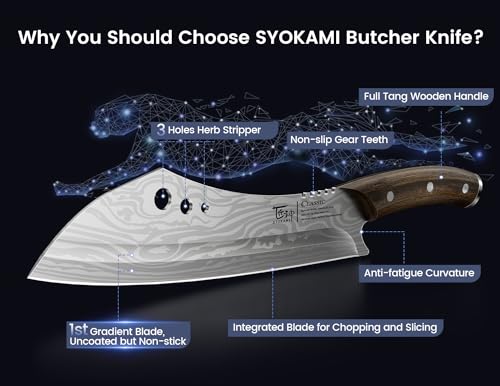
SYOKAMI butcher knife for meat cutting, 10 Inch Cleaver with Herb Stripper, Japanese Style High Carbon Steel Kitchen Chef Knife for Chopping & Slicing, Full Tang Wood Handle, Damascus Pattern

SYOKAMI
butcher knife for meat cutting, 10 Inch Cleaver with Herb Stripper, Japanese Style High Carbon Steel Kitchen Chef Knife for Chopping & Slicing, Full Tang Wood Handle, Damascus Pattern
Check price on AmazonMatsato Everyday Kitchen Prep Knife: Matsato Osuren 6.3-Inch Japanese Stainless Steel Chef Knife
Matsato
Everyday Kitchen Prep Knife: Matsato Osuren 6.3-Inch Japanese Stainless Steel Chef Knife
The Matsato Osuren handles slicing, chopping, and cutting vegetables, meat, and herbs, with balanced control as its biggest advantage. It suits home cooks and professional food preparation users who want one versatile stainless steel knife for daily kitchen tasks.
Check price on AmazonThe Matsato Osuren is a 6.3-inch chef knife for slicing, chopping, and cutting vegetables, meat, herbs, and other ingredients with one versatile kitchen tool.
Its sharp stainless steel blade supports reliable daily cutting, while the balanced design helps improve control during routine prep.
Stainless steel supports durability, and the 6.3-inch size suits common home cooking tasks. The product data does not provide a weight specification.
This knife is not dishwasher safe, so it requires hand washing with mild soap, immediate drying, and dry storage.
Best for home cooks and food preparation users seeking a balanced, multi-purpose chef knife.
Editor’s Picks
| Category | Pick | Why |
|---|---|---|
| Best Overall | Thin-bladed Japanese-style gyuto from the list below | Keen, hard edge and flat-to-gentle curve slices herbs cleanly |
| Best Value | Sharp thin-edged Western chef knife | Clean herb cuts and everyday versatility at a fair price |
| Best for Fine Mincing | Lightweight knife with a curved belly | Rocks efficiently through delicate leaves without bruising |
At a Glance: Comparison Table
| Factor | Why It Matters for Herbs | What to Look For |
|---|---|---|
| Edge sharpness | A keen edge slices instead of crushing | Thin, acute factory edge; hard steel that holds it |
| Steel hardness | Harder steel takes and keeps a finer edge | HRC 59-62 for a crisp, long-lasting edge |
| Blade profile | Shape governs rocking and clean mincing | Gentle curved belly with a flat section for rocking |
| Blade thinness | Thin blades part leaves without bruising | Thin stock behind the edge; not a thick German heel |
| Handle and balance | Long herb prep should not tire the hand | Comfortable pinch grip; light, balanced feel |
How We Evaluated These Products
This guide is research-based. The HomeWhisk team reviewed manufacturer specifications for steel type, hardness, and edge geometry, along with dimensions, retailer listings, and owner-review patterns, to identify which chef knives show the strongest combination of clean cutting and long-term durability for herb work. We synthesize repeated signals across many sources.
We paid particular attention to the review themes most relevant to herbs: how cleanly a knife slices delicate leaves, how long its edge stays keen, whether the blade profile suits rocking and mincing, and how the knife feels during extended prep. Aggregated feedback from Amazon and Reddit’s r/chefknives is especially useful here because enthusiast communities discuss edge retention and geometry in detail. Review sets with several hundred data points were weighted more heavily than small samples, and we compared retail feedback against community discussion to separate consistent signals from outliers.
What Actually Matters:
Edge Sharpness and Steel Hardness
Nothing matters more for chopping herbs than a genuinely sharp edge, because herbs punish dullness immediately. A keen blade severs the leaf cleanly in one pass; a dull one presses and drags, crushing the tissue so that basil and parsley bruise, blacken at the cut, and weep their aromatic oils onto the board instead of staying on the food. The visible result is the difference between bright, distinct ribbons of herb and a dark, clumped, watery mess. Sharpness is therefore the first specification to chase.
Steel hardness, measured on the Rockwell scale (HRC), is closely tied to sharpness because harder steel can take and hold a finer, more acute edge. Manufacturer specifications for Japanese-style knives typically list HRC in the 60-62 range, versus 56-58 for classic German steel. That harder steel is what lets a thin blade be ground to a very acute edge angle — often 12-15 degrees per side — and keep it. Aggregated reviews from Amazon and r/chefknives consistently note that harder, thinner Japanese-style knives slice herbs more cleanly and hold that keenness longer between sharpenings. The trade-off is that harder steel is more brittle and less forgiving of abuse like scraping the board edge-first or hitting bone, so it demands slightly more careful handling. For herb work specifically, where you are only ever cutting soft leaves and stems, the fragility is a minimal concern and the fine edge is a real advantage.
Blade Profile: Rocking and Flat-Section Mincing
The shape of the blade determines how efficiently you can chop and mince herbs. Herbs are usually reduced by one of two motions: rocking the knife through a pile with the tip anchored on the board, or lifting-and-chopping. A blade with a gently curved belly excels at rocking — the curve lets the edge roll continuously through the pile so you can mince a bunch of parsley into fine flecks quickly, pivoting on the tip. Western chef knives generally have more belly curve, which many cooks find intuitive for rocking herbs.
Japanese gyutos typically have a flatter profile with a subtle curve near the tip. That flatter section favors a push-cut or a shallower rock and produces very clean, precise cuts, which suits chiffonading basil or slicing chives into even lengths. Neither profile is wrong; they simply reward slightly different techniques. Aggregated reviews and r/chefknives discussion suggest cooks who rock heavily prefer more belly, while those who push-cut prefer the flatter Japanese profile. Blade length also plays in: an 8-inch blade lets you mince a large bunch in a couple of passes, while a shorter 6-to-7-inch blade offers more nimble control for small quantities. For most herb-focused cooks, a blade with at least a modest curve in the 7-to-8-inch range covers both rocking and slicing. If you want a dedicated all-rounder alongside a specialist, the best chef knife guide covers general-purpose picks.
Blade Thinness and Clean Cuts
Beyond the edge itself, how thin the blade is behind the edge — the “blade road” or grind — has an outsized effect on herbs. A thin blade wedges apart soft leaves with almost no resistance, while a thick blade pushes them aside and crushes them even if the very edge is sharp. This is why a keenly sharpened but thick, wedge-profiled German knife can still bruise herbs: the shoulder of the blade meets the leaf before the cut is complete. Thin stock behind the edge lets the cut finish cleanly and keeps delicate leaves intact.
Manufacturer specifications sometimes list spine thickness, and thinner-ground Japanese-style knives generally measure less at the spine and taper more aggressively toward the edge than heavy Western knives. Aggregated reviews from r/chefknives frequently describe thin-bladed knives as “falling through” produce, and herbs are the most extreme case of a food that benefits from that low resistance. The practical guidance is to favor a knife described as thin, light, and laser-like over one described as heavy or robust when herbs are a priority. The same thinness that makes a knife glide through a tomato is exactly what preserves the structure of a basil leaf. There is a limit — extremely thin blades can flex and are more delicate — but for soft herb work, thinner is decidedly better, and it pairs naturally with the harder, keener steel discussed above.
Handle Comfort, Balance, and Weight
Chopping herbs often means repetitive motion over a period of minutes — mincing a large bunch, chiffonading a stack of leaves, working through several herbs for a sauce — so handle comfort and balance matter more than for a quick single cut. A knife that fatigues the hand or wrist encourages sloppy technique, which then leads to bruised herbs and uneven cuts. The most controlled hold for herb work is the pinch grip, where the thumb and forefinger pinch the blade just ahead of the handle, and the best knives are balanced so that the pinch point sits near the center of gravity.
Weight is a matter of preference, but for herbs a lighter knife is usually the better tool. Delicate leaves need finesse, not force, and a light, nimble blade rocks and pivots with less effort over a long mincing session. Manufacturer specifications list weight, and Japanese-style knives tend to be noticeably lighter than heavy German knives. Aggregated reviews from Amazon and r/chefknives show a clear trend toward lighter knives for precise, repetitive prep, with many cooks reporting less fatigue. Handle material also affects security: a grippy composite or a well-shaped wa-handle holds firm even when hands are damp from washed herbs. Choose a handle that fits your hand comfortably in a pinch grip and a blade light enough to work delicately, and long herb sessions become effortless rather than tiring.
Frequently Asked Questions
What knife is best for chopping herbs?
A sharp, thin-bladed chef knife with a gently curved belly is the best all-around tool for chopping herbs. The keen, thin edge slices delicate leaves cleanly instead of crushing them, and the curve lets you rock through a pile to mince quickly. A Japanese-style gyuto with hard steel excels for clean, precise cuts, while a lightweight Western chef knife with more belly curve suits heavy rocking. For most cooks a 7-to-8-inch blade balances mincing capacity with control.
Why does my knife bruise or blacken herbs?
Bruising and blackening happen when the blade crushes rather than slices the leaf, rupturing cell walls and releasing oils that oxidize and darken. The two usual causes are a dull edge and a blade that is too thick behind the edge. A dull knife drags and presses; a thick blade wedges leaves apart and crushes them even when sharp. The fix is a keenly sharpened, thin-bladed knife used with a clean slicing or rocking motion rather than a chopping mash. Keeping the edge sharp is the single biggest improvement.
Is a Japanese or German knife better for herbs?
Both work, but they suit different techniques. Japanese-style knives have harder steel, thinner blades, and a flatter profile, giving very clean, precise cuts that excel at slicing and push-cutting herbs — ideal if you value keenness and edge retention. German knives have softer, tougher steel and more belly curve, which favors heavy rocking and forgives rougher handling. For the cleanest herb cuts most enthusiasts lean Japanese, but a thin, sharp German knife with a good curve also does the job well. Match the choice to your cutting style.
How sharp does a chef knife need to be for herbs?
Very sharp. Herbs are the most sharpness-sensitive food a chef knife handles, so the edge should be keen enough to slice through a leaf under the knife’s own weight with no pressing. This usually means maintaining a fine edge with regular honing and periodic sharpening on a whetstone. A knife that feels “kitchen sharp” for cutting vegetables may still bruise basil. If your herbs are darkening at the cut, the edge almost certainly needs refreshing, regardless of how the knife performs on firmer produce.
What size chef knife is best for herbs?
An 8-inch blade is the most versatile for herb work, letting you mince a large bunch in just a couple of passes while still being manageable. A 7-inch blade offers a bit more nimble control for smaller quantities and tighter boards, and many cooks find it a comfortable balance. Shorter blades around 6 inches give the most control for small amounts but require more passes on big bunches. For a mix of large and small herb tasks, a 7-to-8-inch blade with a curved belly is the practical sweet spot.
Can I use a santoku instead of a chef knife for herbs?
Yes. A santoku’s flatter profile and thin, hard blade make clean, precise cuts and it slices herbs well, though its limited belly curve favors push-cutting and chopping over the continuous rocking motion many cooks use for mincing. If you prefer a lift-and-chop or push-cut technique, a santoku is an excellent herb knife. If you rely on rocking to mince, a chef knife with more curve will feel more natural. Both benefit from the same thin, keen edge that herbs demand.
Our Top Pick
The best chef knife for chopping herbs is a thin-bladed, keenly sharp knife with a gently curved belly and comfortable balance. Herbs reward a fine, acute edge on thin steel above all else, because that combination slices delicate leaves cleanly instead of crushing and blackening them. For most cooks a hard-steel, thin Japanese-style gyuto in the 7-to-8-inch range delivers the cleanest herb cuts and holds its edge, while a light, sharp Western chef knife with more curve is an excellent choice for those who rock heavily.
Match the pick to your technique:
- If you value the cleanest, most precise cuts and edge retention, choose a hard-steel, thin-bladed Japanese-style gyuto.
- If you rock the knife heavily to mince, prioritize a blade with a pronounced curved belly and a light, nimble feel.
- If you want one knife for herbs and everything else, pick a thin, sharp 8-inch chef knife with a moderate curve.
- If your herbs keep bruising, sharpen before you shop — a keen edge solves the problem more often than a new knife does.
Buy for edge keenness and blade thinness first. For related decisions, compare best chef knife, best japanese chef knife, and best chef knife under 100 before you commit.




Write Your Review
No reviews yet. Be the first to share your experience!