

TL;DR — The best chef knife for slicing meat is a long-bladed knife, ideally 9 to 10 inches, with a thin, hard blade and a gentle curve or flatter profile that lets you draw the edge through in one smooth stroke rather than sawing. A harder steel around 58-61 HRC holds a keen edge through fibrous cuts, and a slightly taller blade clears large roasts. If you slice a lot of cooked roasts and briskets, also weigh a dedicated slicer; see best chef knife and best knife sets.
The HomeWhisk editorial team researches kitchen equipment by analyzing manufacturer specifications, steel and hardness data, blade geometry, and aggregated user reviews from Amazon, Reddit communities like r/chefknives, and long-term owner reports. For this guide we compared chef knives specifically for slicing meat, weighing blade length, steel hardness, edge geometry, weight, and handle security, the factors that determine whether a knife glides through a roast or crushes and tears it.

Slicing meat cleanly is a different demand than general chopping. It rewards blade length for long single strokes, a thin keen edge that parts fibers without shredding, and enough control to cut even slices off a large roast or portion raw proteins precisely. Our research focused on the geometry and steel that produce clean slices, and on where a general chef knife is enough versus where a dedicated slicing knife earns a place. If you are building a broader kit, our guides on best chef knife set and best knife sets cover the multi-piece options that pair with a good slicer.

PAUDIN
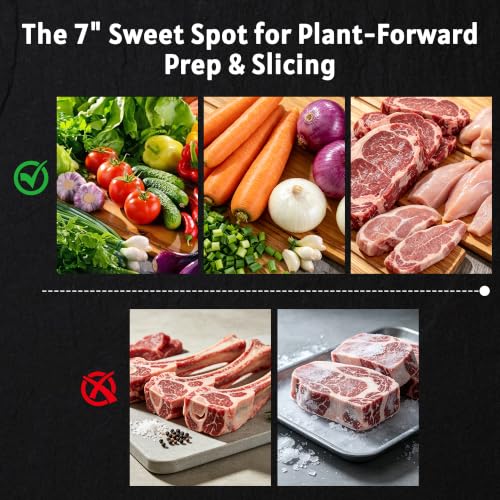
Vegetable Chopping and Boneless Meat Slicing: PAUDIN 7-Inch Damascus Nakiri Knife, 62 HRC
The PAUDIN 7-inch Nakiri handles straight chopping, fine slicing, dicing, and mincing with a 13° edge that reduces cutting resistance. It suits home cooks seeking a substantial, ambidextrous knife for vegetables, fruit, herbs, and boneless meat.
Pros and Cons
Pros
- The 9-layer Damascus-clad blade uses a 10Cr15CoMoV high-carbon steel core rather than a laser-etched surface pattern.
- The symmetrical double-bevel edge accommodates both right-handed and left-handed cooks.
- A broad Nakiri profile helps produce straight cuts when push-cutting vegetables on a board.
- The knife includes a protective sheath, presentation box, and lifetime warranty.
Cons
- The knife requires hand washing and immediate drying, so it demands more care than dishwasher-safe kitchen tools.
- It is unsuitable for bones, frozen meat, or twisting cuts, and its substantial heft may not suit cooks who prefer lightweight knives.
TJ POP Meat Cleaver Knife 7.5 Inch, Ultra Sharp Chinese Chef's Knives, Full-tang Chopping Knife, 30Cr13 Steel Blade Thickness 2.5 mm, TJ SEGA Series TC1705
TJ POP
Meat Cleaver Knife 7.5 Inch, Ultra Sharp Chinese Chef's Knives, Full-tang Chopping Knife, 30Cr13 Steel Blade Thickness 2.5 mm, TJ SEGA Series TC1705
$9.99 at AmazonEditors' Favorite
Color: TC1705 Size: 7.5" Dimensions: 12.32 x 3.54 x 1 inches Weight: 0.7165023515 Pounds Product Group: Kitchen
Shop NowPAUDIN Vegetable Chopping and Boneless Meat Slicing: PAUDIN 7-Inch Damascus Nakiri Knife, 62 HRC
PAUDIN
Vegetable Chopping and Boneless Meat Slicing: PAUDIN 7-Inch Damascus Nakiri Knife, 62 HRC
The PAUDIN 7-inch Nakiri handles straight chopping, fine slicing, dicing, and mincing with a 13° edge that reduces cutting resistance. It suits home cooks seeking a substantial, ambidextrous knife for vegetables, fruit, herbs, and boneless meat.
$29.99 at AmazonGreat Value
Color: 7 Inch Nakiri Knife Size: 7 Inch Nakiri Knife Dimensions: 12 x 0.08 x 1.96 inches Weight: 0.63 pounds Product Group: Kitchen
Shop NowHENCKELS Statement Razor-Sharp 8-inch Slicing Knife, German Engineered Informed by 100+ Years of Mastery, Black/Stainless Steel

HENCKELS
Statement Razor-Sharp 8-inch Slicing Knife, German Engineered Informed by 100+ Years of Mastery, Black/Stainless Steel
$27.95 at AmazonColor: Black/Stainless Steel Size: 8" Dimensions: 15.75 x 3.5 x 1 Inches Weight: 0.45 pounds Product Group: Kitchen Binding: Kitchen
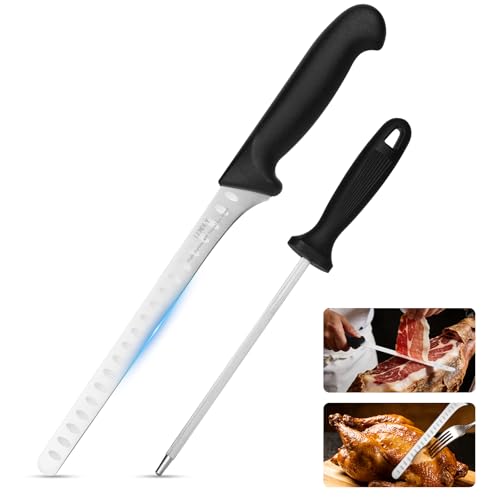
Shop NowLenDLY Carving Knife for Meat & 10-inch Knife Sharpener Set - Brisket Slicing Knife with Razor Sharp High Carbon Stainless Steel Blade, Ergonomic Handle - Premium Turkey Butcher Knife
LenDLY
Carving Knife for Meat & 10-inch Knife Sharpener Set - Brisket Slicing Knife with Razor Sharp High Carbon Stainless Steel Blade, Ergonomic Handle - Premium Turkey Butcher Knife
$8.69 at AmazonColor: Silver Size: M Dimensions: 13.3 x 0.98 x 0.98 inches Weight: 0.15 Pounds Product Group: Kitchen
Shop NowFox Valley Traders Knife with Adjustable Slicing Guide by Chef's Pride

Color: Stainless Steel, Black Size: 4.5" Weight: 0.44 pounds Product Group: Kitchen
Shop NowEditor’s Picks
| Category | Pick | Why |
|---|---|---|
| Best Overall | 9-10 inch hard-steel chef knife | Long blade and keen hard edge for smooth single-stroke slices through roasts |
| Best Value | 8-inch chef knife with thin edge | Reliable slicing for everyday cuts at a lower price, easy to maintain |
| Best for Precision | Japanese-style gyuto | Very hard, thin, sharp blade for clean cuts on delicate and raw proteins |
At a Glance: Comparison Table
| Pick Type | Steel | Hardness (HRC) | Blade Length | Edge / Profile | Best For |
|---|---|---|---|---|---|
| Best Overall | High-carbon stainless | 58-61 | 9-10 in | Thin, gentle curve | Slicing roasts and large cuts |
| Best Value | Stainless | 55-57 | 8 in | Standard bevel | Everyday meat slicing |
| Japanese Gyuto | High-carbon/VG-style | 60-63 | 8-9.5 in | Very thin, acute | Precision cuts, delicate proteins |
| German-Style | X50CrMoV stainless | 56-58 | 8-10 in | Durable, slightly curved | Tough cuts, forgiving upkeep |
| Dedicated Slicer | Stainless | 56-59 | 10-12 in | Narrow, often granton | Carving cooked roasts and brisket |
How We Evaluated These Products
This guide is research-based. we synthesized manufacturer steel and hardness specifications, blade geometry data, retailer listings, and recurring patterns in aggregated owner reviews to determine which chef knives slice meat cleanly and hold their edge over years of use.
Because slicing meat depends heavily on the edge, we scrutinized steel composition and hardness. Harder steels, measured on the Rockwell C scale, take and hold a finer edge, which matters when parting muscle fibers and connective tissue without tearing. We compared how different steels balance edge retention against ease of sharpening, since a knife that dulls mid-roast or that home cooks cannot resharpen fails at the task regardless of its specs.
We also weighted geometry and recurring complaints heavily. Blade length, height, and thickness determine whether a knife can slice a large cut in one stroke, and recurring owner reports reveal what matters over time: edges chipping on bone, handles growing slippery when wet, blades that need frequent honing, and balance that tires the hand.
What Actually Matters:
Blade Length and Profile for Long Strokes
Blade length is the first thing that matters for slicing meat, because clean slices come from long, smooth strokes rather than short sawing motions. A blade that spans the full width of a roast lets you draw the edge through in a single pass, which produces even slices and a clean surface. Sawing back and forth with a short blade tears the meat’s surface and gives ragged slices. For this reason, a 9 or 10-inch chef knife slices large cuts more cleanly than a standard 8-inch, and dedicated carving slicers run even longer at 10 to 12 inches.
Blade profile shapes how the knife moves through meat. A gentle curve toward the tip allows a rocking-then-drawing motion, while a flatter profile favors long push-and-pull slices. For slicing raw proteins and carving cooked roasts, a relatively flat section with a smooth draw is ideal, since it maintains contact through the whole stroke. German-style chef knives carry more belly curve, which suits rocking chops but requires a longer blade to slice large cuts cleanly. Japanese gyutos are flatter and thinner, favoring precise slicing.
Steel Hardness and Edge Retention
Steel and its hardness determine how sharp the knife gets and how long it stays that way, which is central to slicing meat cleanly. Hardness is measured on the Rockwell C scale (HRC). Harder steels, roughly 60-63 HRC on many Japanese knives, take a very fine, acute edge and hold it longer, so they part fibers cleanly through a long slicing session. Softer steels, around 55-58 HRC typical of German knives, hold an edge less long but are tougher and more forgiving, resisting chips and easier to bring back with a honing steel.
The trade-off is edge retention versus resilience and ease of maintenance. A very hard blade slices beautifully and stays sharp, but its acute edge can chip if it hits bone or is used to pry, and it needs proper sharpening rather than just honing to restore. A softer, tougher blade tolerates rougher handling and quick touch-ups on a steel, at the cost of dulling sooner. For slicing meat specifically, a harder steel in the high 50s to low 60s HRC is generally the better choice for clean cuts.
Steel composition affects corrosion resistance and sharpenability alongside hardness. High-carbon stainless steels balance edge-taking with rust resistance and are the practical default for most home cooks. For slicing meat, which involves moisture and sometimes acidic marinades, a high-carbon stainless blade in a moderately hard temper offers the best mix of keen edge, edge retention, and low-fuss maintenance.
Edge Geometry, Thickness, and Grind
Edge geometry decides how easily the blade parts meat, and it is where thin beats thick for slicing. A thin blade with a narrow edge angle wedges the meat apart less and glides through with minimal resistance, giving clean slices. A thick, wide blade acts more like a wedge, pushing fibers apart and tearing rather than cutting. Japanese-style knives are ground thin with acute edge angles, often around 12-15 degrees per side, which makes them excellent slicers. German knives are ground a bit thicker at wider angles near 18-20 degrees, trading some slicing finesse for durability.
The grind, how the blade tapers from spine to edge, reinforces this. A blade that thins gradually and consistently toward the edge slices with less drag than one that stays thick until just above the edge. Some slicing and carving knives add granton edges, the shallow oval dimples along the blade, which create small air pockets that reduce suction and keep thin slices from sticking. That feature is most useful on dedicated slicers for cooked roasts.
Sharpening interacts with geometry. A thin, acute edge slices best but is more delicate and needs careful maintenance on stones to preserve the angle. For slicing meat, favor a thinner blade and a keener angle, but be honest about your sharpening habits: if you will only use a honing steel and occasional pull-through sharpening, a slightly more robust edge will serve you better than an ultra-acute one you cannot maintain.
Handle Security, Weight, and Balance
Handle security matters more for slicing meat than for many tasks, because meat and its juices make hands and handles slippery, and a firm grip keeps slices even and safe. A handle with some texture or contour that locks the hand in place is safer than a smooth, rounded one that turns slick when wet. Full-tang construction, where the steel runs the length of the handle, generally provides a secure, balanced feel, and quality riveted or molded handles resist loosening over years of use.
Weight and balance shape control and fatigue over a long carving job. Heavier German-style knives carry momentum that helps power through tough cuts but tire the hand during extended slicing. Lighter Japanese-style knives feel nimble and precise, favoring control on delicate proteins, though some cooks find them less authoritative on large roasts. Most control for slicing comes from a pinch grip, thumb and forefinger on the blade just ahead of the handle, so a knife with a smooth spine and a well-shaped bolster makes long precise strokes easier. When choosing, weigh whether you prefer the heft and forgiveness of a German knife or the agility and keen edge of a Japanese one. Compare fuller lineups in best japanese chef knife and best chef knife under 100.
Frequently Asked Questions
What length chef knife is best for slicing meat?
For slicing meat, longer is generally better, so a 9 or 10-inch chef knife outperforms a standard 8-inch on large cuts. A longer blade lets you draw the edge through a roast in one smooth stroke rather than sawing, which gives cleaner, more even slices. Dedicated carving slicers run even longer, 10 to 12 inches, for big roasts and brisket. If you mostly slice smaller portions and want one versatile knife, an 8-inch works, but for large cuts the extra length makes a noticeable difference.
Is a Japanese or German knife better for slicing meat?
Both work well, with different strengths. Japanese gyutos are thinner, harder, and sharper, so they slice cleanly with less effort and hold a keen edge, which suits precise cuts and delicate proteins. German knives are heavier, tougher, and more forgiving, tolerating rougher handling and bone contact and needing simpler upkeep. For the cleanest slices, a harder Japanese-style blade has the edge; for durability and easy maintenance, a German knife wins. Choose based on how precisely you slice and how much sharpening you are willing to do.
Can a chef knife replace a dedicated slicing knife?
For most home cooks, a good long chef knife handles slicing meat well and avoids buying a single-purpose tool. A 9 or 10-inch chef knife slices roasts and portions raw proteins cleanly. A dedicated slicer earns its place if you regularly carve very large cooked roasts or brisket, since its longer, narrower blade, often with a granton edge, makes long clean slices without the meat sticking. If large carving is occasional, a chef knife is enough; if it is frequent, add a slicer from a set.
What steel hardness holds the best edge for meat?
A hardness in the high 50s to low 60s on the Rockwell C scale is the sweet spot for slicing meat. Harder steels around 60-63 HRC take a very fine edge and hold it through long slicing sessions, giving the cleanest cuts, but they are more prone to chipping and need proper sharpening. Softer steels around 55-58 HRC dull sooner but resist chips and are easy to touch up. High-carbon stainless in a moderately hard temper balances a keen, lasting edge with practical maintenance for most cooks.
How do I keep a slicing knife sharp?
Hone the edge regularly with a honing steel to realign it before and during use, which keeps a sharp knife slicing cleanly between actual sharpenings. Sharpen on whetstones or a quality sharpener when honing no longer restores the edge, matching the tool to the blade’s edge angle. Cut on wood or plastic boards rather than glass or stone, which dull edges fast, and hand wash and dry the knife promptly rather than using a dishwasher. Careful storage in a block or on a magnetic strip protects the edge too.
Does blade thickness matter for slicing meat?
Yes, thinner blades slice meat more cleanly. A thin blade with a narrow edge angle glides through with little resistance and parts fibers cleanly, while a thick, wide blade acts like a wedge and tears the meat as it pushes fibers apart. This is why thin Japanese-style knives slice so well. The trade-off is that thinner, more acute edges are more delicate and need careful maintenance, so choose a thin blade if you slice a lot and are willing to keep it sharp and avoid bone.
Our Top Pick
After comparing blade length, steel hardness, edge geometry, and handle security, a 9 to 10-inch chef knife in a hard high-carbon stainless steel with a thin, keen edge is the best chef knife for slicing meat for the widest range of home cooks. The extra length enables clean single-stroke slices through roasts, a hardness in the high 50s to low 60s HRC holds a sharp edge through fibrous cuts, and a thin blade parts fibers without tearing. A secure handle keeps slices even when hands are slick.
Consider these decision points:
- If you want the best all-around meat slicer, choose a 9 to 10-inch hard-steel chef knife with a thin, keen edge.
- If value matters and you slice mostly everyday cuts, a well-made 8-inch chef knife with a thin edge does the job for less.
- If you cut delicate or raw proteins precisely, a thin, hard Japanese-style gyuto from best japanese chef knife slices cleanest.
- If you frequently carve large cooked roasts or brisket, add a dedicated granton slicer alongside your chef knife, or build out a best chef knife set.
The best chef knife for slicing meat is the one whose length and keen edge let you draw clean slices in a single stroke. Buy for a long, thin, hard blade and a secure grip first, keep it honed and sharp, and see best chef knife for the broader field, best chef knife under 100 for value options, and best bread knife to round out your slicing lineup.





Write Your Review
No reviews yet. Be the first to share your experience!