

TL;DR — A forged knife is shaped from a heated steel bar, making it heavier, sturdier, and often bolstered; a stamped knife is cut from a steel sheet, making it lighter and cheaper. Neither is strictly “better” — forged suits those wanting heft and durability, stamped suits those wanting a light, affordable, nimble blade. Modern stamped knives can be excellent, so the steel and edge matter more than the method. The HomeWhisk team compared the two against aggregated feedback. For picks, see our best chef knife guide.
The HomeWhisk editorial team researches kitchen equipment by analyzing manufacturer specifications, manufacturing methods, and aggregated user reviews from major retailers and cooking communities. Our recommendations are based on what the products actually deliver, not what brands promise.

“Forged” is often used as a marketing badge of quality, and “stamped” as a mark of cheapness — but the reality is more nuanced. Here’s the real difference and which to choose. For picks, see our best chef knife guide.
Generic
Faster Meat and Vegetable Prep with Generic Premium Hand-Forged Chef's Knife and Cleaver Set
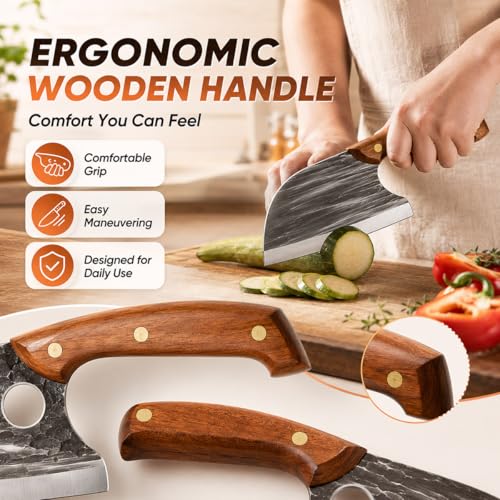
This two-piece knife set uses sharp V-edges and textured hand-forged blades to reduce cutting resistance during meat, vegetable, fruit, pizza, and herb preparation. It suits home cooks who want versatile everyday knives with finger-hole control and an ergonomic wooden handle.
Pros and Cons
Pros
- The V-edge supports smooth cutting across meat, vegetables, fruits, pizza, and herbs.
- Textured blade surfaces can make slicing ingredients less frustrating by reducing sticking.
- Finger-hole construction and wooden handles improve grip control and maneuverability.
- The set combines two versatile knives for common home-kitchen preparation tasks.
Cons
- The product data does not provide blade dimensions, overall lengths, or knife weights.
- The Generic branding gives buyers less information about the manufacturer's long-term support or specifications.

Toferner
Hand Forged Folding Knife for Camp and Picnic Food Prep: Toferner Celtic Ram with Genuine Leather Neck Case
The Toferner Celtic Ram is a hand forged spring steel folding knife sized for trail and picnic food work like bread, cheese, and cured sausage, and its balanced, non-flexing blade holds an edge through repeated cuts. Buy it if you collect hand forged blades or want a belt-carried camp knife with genuine leather handle and sheath, not if you need a washable everyday kitchen knife.
Pros and Cons
Pros
- Hand forged spring steel construction resists bending under lateral pressure during tough cuts.
- Both the handle wrap and the sheath are genuine leather rather than bonded substitutes.
- Ships ready to carry with the leather case included, so no separate sheath purchase is needed.
- Distinctive Celtic ram styling works as a gift for knife and antique collectors.
Cons
- This is an outdoor and collector knife, not a kitchen knife: the short folding blade and leather handle rule out cutting board work and any dishwasher contact.
- Carbon spring steel and leather both need drying and periodic oiling, so upkeep is higher than a stainless kitchen blade.

HUNTING HUNTS
Rustic Carving and Camp Prep Knife: HUNTING HUNTS Celtic HK-005 Hand Forged Carbon Steel Fixed Blade with Leather Neck Sheath
This hand forged carbon steel fixed blade handles small kitchen jobs like slicing hard cheese, trimming twine and portioning cured meat, with a hardened edge that stays sharp longer than soft stainless. Buy it if you want a rustic board and prep knife that also carries to the grill or campsite in its leather neck sheath, and you accept drying it by hand after every use.
Pros and Cons
Pros
- Hand forged carbon steel takes a keen edge and is easy to resharpen at home without special equipment.
- Stitched leather sheath with a snug fit and neck loop protects the edge and allows a smooth one hand draw.
- Low weight and short handle stay comfortable through extended detail cutting.
- Functions as both a usable tool and a display piece for Celtic, bushcraft and collector buyers.
Cons
- Non stainless carbon steel spots and rusts if left wet, so it cannot go in a dishwasher or sit in a sink.
- Light duty geometry and short blade limit it to small tasks; it will not replace a chef knife for bulk vegetable prep.
Generic Faster Meat and Vegetable Prep with Generic Premium Hand-Forged Chef's Knife and Cleaver Set
Generic
Faster Meat and Vegetable Prep with Generic Premium Hand-Forged Chef's Knife and Cleaver Set
This two-piece knife set uses sharp V-edges and textured hand-forged blades to reduce cutting resistance during meat, vegetable, fruit, pizza, and herb preparation. It suits home cooks who want versatile everyday knives with finger-hole control and an ergonomic wooden handle.
Check price on AmazonThis two-piece chef knife and cleaver set addresses everyday prep needs, from chopping vegetables and herbs to slicing fruit, pizza, and boneless meat.
The sharp V-edge helps reduce cutting resistance, while the textured blade surface helps limit food sticking during slicing and chopping.
Hand-forged blades, ergonomic wooden handles, and finger-hole control support balanced handling and comfortable daily use.
Buyers should note that blade dimensions, total size, and weight are not listed in the product data.
Verdict: best for home cooks seeking versatile knives for routine slicing, chopping, and dicing.
Toferner Hand Forged Folding Knife for Camp and Picnic Food Prep: Toferner Celtic Ram with Genuine Leather Neck Case
Toferner
Hand Forged Folding Knife for Camp and Picnic Food Prep: Toferner Celtic Ram with Genuine Leather Neck Case
The Toferner Celtic Ram is a hand forged spring steel folding knife sized for trail and picnic food work like bread, cheese, and cured sausage, and its balanced, non-flexing blade holds an edge through repeated cuts. Buy it if you collect hand forged blades or want a belt-carried camp knife with genuine leather handle and sheath, not if you need a washable everyday kitchen knife.
Check price on AmazonA hand forged folding pocket knife in Celtic ram styling, built for food work away from the kitchen: trail lunches, campsite prep, picnic bread and cheese.
The spring steel blade is forged and balanced to resist flexing, and its long holding edge means fewer sharpening stops on multi day trips.
Genuine leather covers the handle and the belt loop sheath, giving a warm outdoor grip at a carry weight that folds into a pocket.
It is not a kitchen knife: the blade is short, the leather handle cannot be soaked, and spring steel needs drying after every food contact.
Best for collectors of hand forged blades and campers who want one decorative knife that still cuts.
HUNTING HUNTS Rustic Carving and Camp Prep Knife: HUNTING HUNTS Celtic HK-005 Hand Forged Carbon Steel Fixed Blade with Leather Neck Sheath
HUNTING HUNTS
Rustic Carving and Camp Prep Knife: HUNTING HUNTS Celtic HK-005 Hand Forged Carbon Steel Fixed Blade with Leather Neck Sheath
This hand forged carbon steel fixed blade handles small kitchen jobs like slicing hard cheese, trimming twine and portioning cured meat, with a hardened edge that stays sharp longer than soft stainless. Buy it if you want a rustic board and prep knife that also carries to the grill or campsite in its leather neck sheath, and you accept drying it by hand after every use.
Check price on AmazonA compact hand forged fixed blade with a Celtic inspired profile, built for the small cutting jobs a full size chef knife handles awkwardly: trimming twine, slicing hard cheese, splitting herb bundles, opening packaged goods.
The hardened carbon steel edge bites harder than budget stainless and strops back quickly, so it keeps cutting through rind, cordage and cardboard without a full resharpening.
Traditional forged build with a rustic patina finish and a stitched black leather neck sheath, light enough to hang on a hook or carry out to the grill without bulk.
Carbon steel is not stainless. Acidic foods and standing water will spot the blade within hours, so it needs a wipe and full dry after every use.
Best for the cook who wants a rustic prep, board and camp kitchen knife rather than a low maintenance daily driver.
How Each Is Made
The entire difference starts with manufacturing, and understanding it explains the resulting feel and price.
Forged knives are made by heating a bar of steel and pounding/pressing it into shape (traditionally by a blacksmith, now often by machine). The forging process shapes a single piece of steel into the blade, bolster, and tang. This typically produces a thicker, heavier blade, often with a bolster (the thick junction between blade and handle) and a full tang. Forging is more labor- and material-intensive, so forged knives generally cost more.
Stamped knives are made by cutting (stamping) the blade shape out of a large sheet of steel, like a cookie cutter, then grinding, sharpening, and attaching a handle. This produces a thinner, lighter blade, usually without a bolster. Stamping is faster and cheaper, so stamped knives generally cost less.
The core difference in one line: forged = shaped from a steel bar (heavier, sturdier, pricier); stamped = cut from a sheet (lighter, cheaper). Everything else — weight, bolster, feel, price — flows from this. Importantly, the method affects the blade’s body and feel, not necessarily its sharpness or steel quality, which is a separate factor. Our best chef knife guide covers both types.
Forged Knives: Heft and Durability
Forged knives have real advantages for cooks who want a substantial, robust knife. Here’s their case.
Heavier and sturdier: the forging process and thicker blade give forged knives more heft and a feeling of solidity and durability. Many cooks prefer this weight for confident chopping — the knife’s mass helps power through dense foods.
Bolster: most forged knives have a bolster (thick metal between blade and handle), which adds balance, provides a finger guard for safety, and gives a substantial feel. Some cooks love the bolster; others find a full bolster interferes with sharpening the heel and prefer a half-bolster or none.
Balance: the weight distribution, often aided by the bolster, gives forged knives a balanced feel in the hand that many find pleasant for rocking cuts.
Durability perception: the thicker, solid construction feels (and often is) very durable and long-lasting.
Trade-offs: forged knives are heavier (tiring for some, less nimble), cost more, and a full bolster can complicate full-edge sharpening. The weight is a preference — great for those who want heft, less ideal for those who want a light blade.
Best for: cooks who want a substantial, sturdy, balanced knife with a traditional feel and don’t mind the weight or price. Forged knives are common at the higher end and among German-style brands. See our best chef knife guide.
Stamped Knives: Light and Affordable
Stamped knives have shed their old “cheap” reputation — modern ones can be excellent. Here’s their case.
Lighter and nimble: the thinner blade makes stamped knives lighter and more agile, which many cooks (especially those who find heavy knives tiring, or who prefer Japanese-style nimbleness) actually prefer. Lighter isn’t worse — it’s a different, often-preferred feel.
More affordable: stamped knives cost less to make, so you get a good knife for less money, or a better steel/edge for the same budget you’d spend on a forged knife’s heft.
Modern quality: manufacturing has improved dramatically. Many high-quality knives today are stamped, including well-regarded Japanese knives and respected Western brands. A good stamped knife with quality steel and a sharp edge outperforms a mediocre forged one. The method no longer determines quality the way it once did.
Trade-offs: stamped knives are lighter (a downside if you want heft), usually have no bolster (less finger protection and balance for some, though also easier heel sharpening), and cheap stamped knives can be flimsy — though that’s a quality issue, not an inherent stamping flaw.
Best for: cooks who want a light, nimble, affordable knife, prefer Japanese-style feel, or want to put their budget into steel and sharpness rather than heft. Many excellent modern knives are stamped. See our best chef knife guide.
The key reframe: don’t dismiss stamped knives as inferior. The steel quality, edge, and how the knife feels in your hand matter more than forged-vs-stamped. A quality stamped knife is a great buy.
Frequently Asked Questions
What’s the difference between a forged and stamped knife?
A forged knife is made by heating and shaping a bar of steel, producing a heavier, thicker, sturdier blade often with a bolster (the thick blade-handle junction) — and costing more. A stamped knife is cut from a sheet of steel like a cookie cutter, making it thinner, lighter, usually bolster-free, and cheaper. The method mainly affects weight, bolster, feel, and price, not necessarily the steel quality or sharpness. Neither is inherently better; they suit different preferences.
Is a forged knife better than a stamped knife?
Not inherently — it depends on preference. Forged knives offer heft, sturdiness, a bolster, and a balanced traditional feel, preferred by cooks who like a substantial knife. Stamped knives are lighter, more nimble, and more affordable, preferred by cooks who want agility or Japanese-style feel or to spend budget on steel over heft. Modern stamped knives can be excellent. The steel quality, edge, and how the knife feels in your hand matter more than the manufacturing method.
Are stamped knives lower quality?
Not anymore. Stamped knives once had a cheap reputation, but modern manufacturing produces many high-quality stamped knives, including respected Japanese knives and Western brands. A quality stamped knife with good steel and a sharp edge outperforms a mediocre forged one. Cheap stamped knives can be flimsy, but that’s a quality issue, not a flaw of stamping itself. Judge a knife by its steel, edge, and feel — not by whether it’s forged or stamped. Stamped no longer means inferior.
Why do forged knives cost more?
Because forging is more labor- and material-intensive: heating a steel bar and pounding or pressing it into shape (including the bolster and tang) takes more work and steel than stamping a blade from a sheet. That higher production cost is passed to the price. The extra cost buys heft, a bolster, and sturdy construction — valuable if you want those traits, but not a guarantee of a sharper or better-cutting knife than a quality stamped blade. You’re paying for the body and feel, not necessarily edge performance.
Do I need a bolster on my knife?
It’s a preference, not a necessity. A bolster (the thick metal between blade and handle, common on forged knives) adds balance, a finger guard for safety, and a substantial feel that many cooks like. However, a full bolster can interfere with sharpening the knife’s heel, so some cooks prefer a half-bolster or none (common on stamped knives), which allows full-edge sharpening and a lighter feel. Neither is required for a good knife — choose based on whether you value the balance and guard or prefer easier sharpening.
Should I buy a forged or stamped chef’s knife?
Choose by feel and budget. Buy forged if you want a heavier, sturdier, balanced knife with a bolster and traditional heft, and don’t mind the higher price. Buy stamped if you want a lighter, nimble, more affordable knife, prefer Japanese-style agility, or want to spend your budget on steel and sharpness rather than weight. Both can be excellent — hold them if you can, since feel is personal, and prioritize steel quality and edge over the manufacturing method. See our best chef knife guide.
Related buying guides: best bread knife, best chef knife under 100 and best chef knife set.
The Bottom Line
Forged and stamped describe how a knife is made, not how good it is. Forged knives are shaped from a steel bar — heavier, sturdier, often bolstered, and pricier — suiting cooks who want heft and a traditional balanced feel. Stamped knives are cut from a sheet — lighter, nimble, bolster-free, and cheaper — and modern ones can be excellent, suiting cooks who want agility or value. Neither is inherently better; the steel quality, edge, and how the knife feels in your hand matter far more than the method. Don’t dismiss stamped knives — judge by the whole knife. See our best chef knife and best knife sets guides.



Write Your Review
No reviews yet. Be the first to share your experience!