

TL;DR — A burr grinder crushes beans to a uniform, adjustable size for even extraction and better-tasting coffee; a blade grinder chops randomly into inconsistent chunks and dust, giving a muddier cup. For anyone who cares about coffee flavor, a burr grinder is the clear upgrade — and it’s essential for espresso. Blade grinders are cheap and better than pre-ground, but consistency is where they fall short. The HomeWhisk team compared the two on grind quality, consistency, and value. For picks, see our best coffee grinder guide.
The HomeWhisk editorial team researches kitchen equipment by analyzing manufacturer specifications, grinding mechanisms, and aggregated user reviews from major retailers and coffee communities. Our recommendations are based on what the products actually deliver, not what brands promise.
If you’re choosing your first grinder or wondering whether to upgrade, the burr-versus-blade question has a clear answer for most people. Here’s why, and the exceptions. For choosing a specific model, see our best coffee grinder guide.

Cuisinart
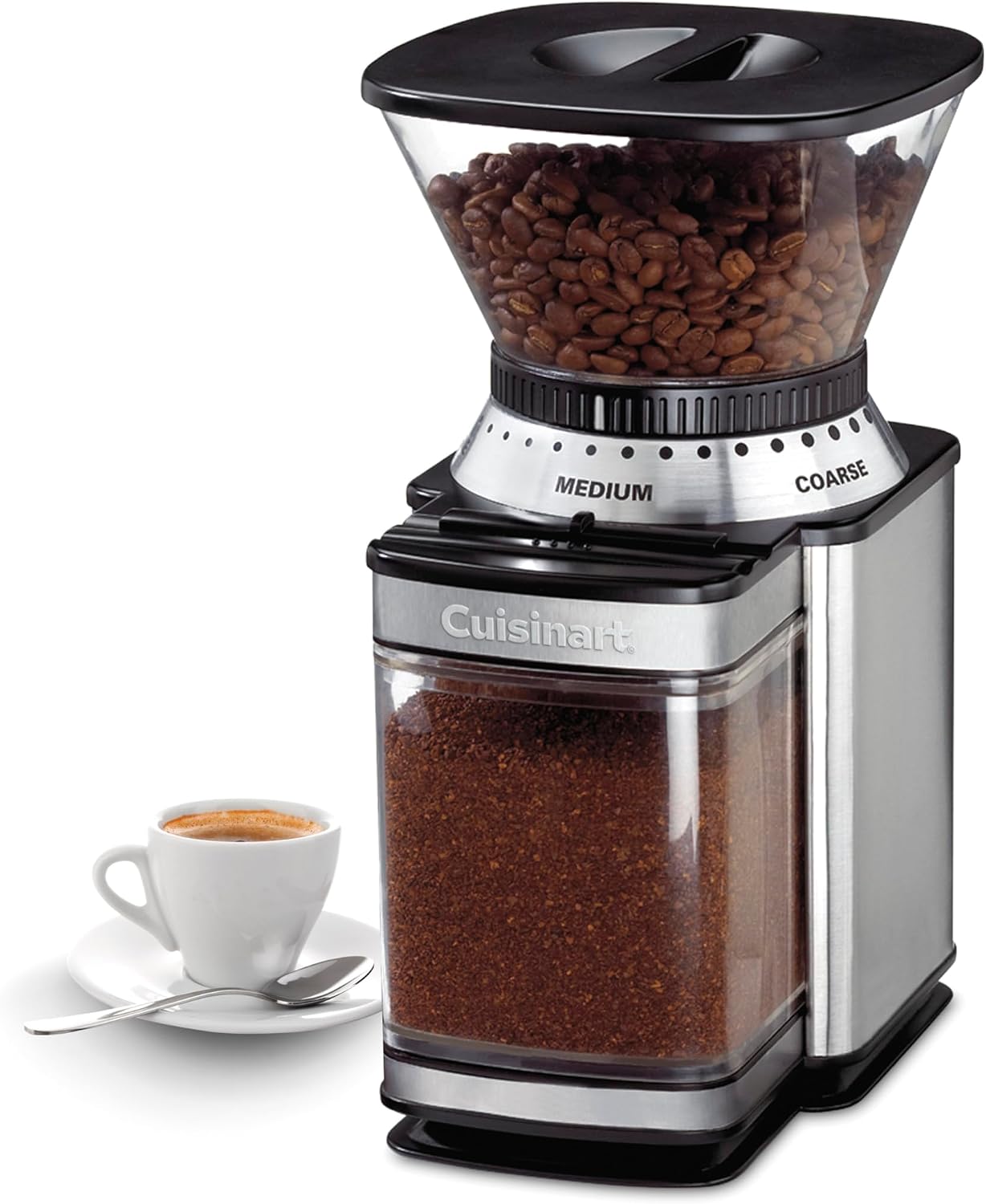
DBM-8P1 Burr Coffee Grinder with 18 Grind Settings for Fresh Ground Beans at Home
This electric burr grinder delivers consistent grounds across 18 settings from espresso-fine to French press coarse, with automatic shutoff and removable parts for quick cleanup. Buy it if you brew multiple coffee styles and want fresh-ground flavor without manual grinding or messy blade choppers.
Pros and Cons
Pros
- 18-position grind selector covers every brew method from Turkish coffee to cold brew, eliminating the need for multiple grinders.
- One-touch operation with separate power bar and electric timer requires no manual monitoring once started.
- Removable hopper and chamber design allows thorough cleaning between bean types to prevent flavor crossover.
- Black stainless finish resists fingerprints and matches most kitchen appliances without showing wear quickly.
Cons
- Static buildup can cause fine grounds to cling to the chamber walls, requiring a tap or brush sweep after each grind.
- Hopper holds only 3.2 ounces of beans despite the 18-cup capacity claim, so you may need to refill mid-grind for large batches.
Cuisinart
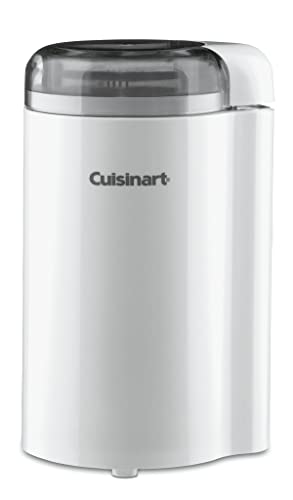
Fresh Coffee for Up to 12 Cups: Cuisinart DCG-20N One-Touch Blade Grinder
The Cuisinart DCG-20N grinds up to 70g of whole coffee beans in its stainless steel bowl, giving you enough grounds for up to 12 cups with one-touch operation. It suits households that want simple, larger-batch coffee grinding with a safety interlock and easy-clean parts.
Pros and Cons
Pros
- The 70g capacity handles a full batch for up to 12 cups.
- The stainless steel bowl and blades are designed for everyday kitchen use.
- The safety interlock prevents operation unless the lid is securely closed.
- An included instruction book and limited 18-month warranty add practical support.
Cons
- The product data does not list adjustable grind settings, which may limit precision for different brewing methods.
- Dimensions and weight are not provided, so countertop and storage planning may require checking the product listing.
Cuisinart DBM-8P1 Burr Coffee Grinder with 18 Grind Settings for Fresh Ground Beans at Home
Cuisinart
DBM-8P1 Burr Coffee Grinder with 18 Grind Settings for Fresh Ground Beans at Home
This electric burr grinder delivers consistent grounds across 18 settings from espresso-fine to French press coarse, with automatic shutoff and removable parts for quick cleanup. Buy it if you brew multiple coffee styles and want fresh-ground flavor without manual grinding or messy blade choppers.
Check price on AmazonThe Cuisinart DBM-8P1 is an electric burr grinder that solves the stale pre-ground coffee problem by grinding whole beans seconds before brewing, maximizing flavor and aroma.
Its flat burr mill crushes beans between two abrasive surfaces rather than chopping them, producing uniform particle sizes that extract evenly. The 18-position dial adjusts grind coarseness to match your brewing method, from fine espresso to coarse French press.
The grinder features an 8 oz removable bean hopper, a grind chamber that holds grounds for up to 18 five-ounce cups, and a one-touch power bar with automatic shutoff. Housing is black stainless steel with cord storage and an included scoop-brush.
The hopper capacity is smaller than advertised cup yield suggests, so brewing for a crowd requires refilling beans mid-cycle. Static also causes fine grounds to stick inside the chamber.
Best for home brewers who use multiple brewing methods and want consistent results without the effort of manual grinders or the uneven chop of blade models.
Cuisinart Fresh Coffee for Up to 12 Cups: Cuisinart DCG-20N One-Touch Blade Grinder
Cuisinart
Fresh Coffee for Up to 12 Cups: Cuisinart DCG-20N One-Touch Blade Grinder
The Cuisinart DCG-20N grinds up to 70g of whole coffee beans in its stainless steel bowl, giving you enough grounds for up to 12 cups with one-touch operation. It suits households that want simple, larger-batch coffee grinding with a safety interlock and easy-clean parts.
Check price on AmazonThe Cuisinart DCG-20N is a one-touch electric blade grinder that turns whole coffee beans into grounds for home brewing, solving the need to prepare multiple cups in one batch.
Its 70g capacity can handle enough beans for up to 12 cups, while the high-powered motor and stainless steel blades support efficient grinding.
The stainless steel bowl and blades are suited to regular kitchen use. The bowl and lid are easy to clean, and cord storage helps keep the appliance compact between uses.
No adjustable grind settings, dimensions, or weight are listed, so buyers seeking precise grind control or specific storage measurements should verify those details.
Best for home coffee drinkers who want simple, larger-batch grinding without complicated controls.
For a concrete comparison, the Cuisinart DBM-8P1 is a burr coffee grinder and the Cuisinart DCG-20N is a blade coffee grinder. These are complete machines for coffee beans. Compare the grind adjustment, batch size and cleanup described in their current listings; this guide does not claim a measured performance test of these two models.
How Each One Works
The mechanical difference between the two is the root of every quality difference, so start here.
A blade grinder works like a mini food processor: a spinning blade chops the beans as they bounce around a chamber. The longer you run it, the finer it gets — but the blade chops randomly, hitting some pieces many times (turning them to dust) and others barely (leaving chunks). You can’t set a specific grind size; you just run it longer or shorter and hope.
A burr grinder crushes beans between two abrasive surfaces (the burrs) set a precise, adjustable distance apart. Beans are fed through and ground to a uniform size determined by the burr gap. Every particle passes through the same gap, so they come out consistent — and you set an exact grind size (coarse to fine) by adjusting the gap.
The fundamental difference: blade = random chopping, no size control; burr = uniform crushing, precise size control. This single mechanical distinction drives everything about why burr grinders make better coffee — it’s not marketing, it’s physics.
Why Consistency Matters So Much
The reason grind uniformity matters comes down to how coffee extracts — and it’s the whole case for burr grinders.
Coffee flavor comes from hot water dissolving compounds out of the grounds (extraction), and extraction speed depends on particle size: small particles extract fast, large particles extract slow.
With a blade grinder’s mix of dust and chunks:
- The dust over-extracts — water pulls too much from it, releasing bitter, harsh flavors.
- The chunks under-extract — water can’t get enough from them, leaving sour, weak, grassy flavors.
- Both happen in the same cup, so you get a muddy, unbalanced brew that’s simultaneously bitter and sour. No brewing skill can fix an inconsistent grind.
With a burr grinder’s uniform grounds:
- All particles are the same size, so they extract evenly — no over- or under-extraction.
- The result is a balanced, clean, flavorful cup that actually tastes like the beans.
This is why coffee people obsess over grinders: a uniform grind is the foundation of good extraction, and no amount of expensive beans or a fancy brewer compensates for an inconsistent one. Consistency, more than any other factor, is why burr beats blade. Our best coffee grinder guide covers burr options.
Precision and Versatility
Beyond consistency, the burr grinder’s adjustability makes it far more versatile across brewing methods.
Burr grinders let you dial in the exact grind for each brew method, because you set the burr gap:
- Coarse for French press and cold brew
- Medium for drip
- Medium-fine for pour over
- Fine for espresso
Each method needs a specific grind size (see our grind-size guides), and a burr grinder hits each precisely and repeatably — the same setting gives the same grind every time.
Blade grinders can’t do this reliably. You approximate coarseness by grinding time, but you can’t set or repeat an exact size, and you can never get the uniform fine grind espresso demands. This makes blade grinders essentially unusable for espresso and a compromise for pour over, where grind precision matters.
Espresso is the hard line: espresso requires a fine, uniform, precisely-adjustable grind to create the right resistance against 9 bars of pressure. Only a good burr grinder (often a dedicated espresso grinder) can produce it. If you make or plan to make espresso, a burr grinder isn’t optional — see our best espresso machine under 200 guide, which pairs with a burr grinder.
For anyone brewing multiple methods or aspiring to espresso, the burr grinder’s precision and repeatability are decisive.
When a Blade Grinder Is Okay (and Cost)
Blade grinders aren’t worthless — there are cases where they make sense, and cost is a real factor.
A blade grinder is acceptable if:
- You’re on a tight budget (they’re much cheaper) and just want fresher coffee than pre-ground.
- You only make drip or French press casually and aren’t chasing optimal flavor.
- You also use it for spices (blade grinders double well as spice grinders).
Even a blade grinder beats pre-ground coffee for freshness, so it’s a step up from buying ground coffee. It’s not “bad” — it’s just a compromise on consistency.
Cost comparison:
- Blade grinders are inexpensive — a low-cost entry point.
- Burr grinders cost more, with a range from affordable entry-level burr grinders up to premium models. The good news: even an entry-level burr grinder dramatically outperforms a blade grinder on consistency, so you don’t need to spend a lot to get the core benefit.
The honest recommendation: if coffee flavor matters to you at all, stretch for an entry-level burr grinder over a blade grinder — the consistency improvement is the single biggest upgrade to home coffee, often more impactful than a better brewer. If budget is truly fixed and tiny, a blade grinder still beats pre-ground. But for most people, a burr grinder is worth the extra cost. See our best coffee grinder guide for options across budgets.
Frequently Asked Questions
Is a burr grinder really better than a blade grinder?
Yes, clearly, for coffee flavor. A burr grinder crushes beans to a uniform, consistent size, so they extract evenly and produce a balanced, clean cup. A blade grinder chops randomly into a mix of dust and chunks that extract unevenly — the dust turns bitter, the chunks stay sour — giving a muddy, unbalanced brew. This consistency difference is the single biggest factor in grind quality, and no brewing skill fixes an inconsistent grind. For anyone who cares about taste, burr is the clear winner.
Can I make espresso with a blade grinder?
No, not properly. Espresso requires a fine, uniform, precisely-adjustable grind to create resistance against the machine’s 9-bar pressure, and a blade grinder can’t produce a consistent fine grind or let you set an exact size. The result is shots that run too fast and taste weak and sour. Espresso genuinely requires a good burr grinder (often a dedicated espresso grinder). If you make or plan to make espresso, budget for a burr grinder alongside the machine — it’s not optional.
Is a blade grinder better than pre-ground coffee?
Yes. Even though a blade grinder produces an inconsistent grind, grinding fresh beans just before brewing preserves aroma and flavor that pre-ground coffee loses within minutes of grinding. So a blade grinder is a real step up from buying pre-ground, offering fresher coffee at low cost. It’s a reasonable budget choice for casual drip or French press. That said, a burr grinder improves on it further by adding grind consistency on top of freshness.
How much more does a burr grinder cost?
Burr grinders cost more than blade grinders, but the range is wide — entry-level burr grinders are affordable, while premium and espresso-capable models cost significantly more. The key point: even an inexpensive entry-level burr grinder dramatically outperforms a blade grinder on consistency, so you get the core benefit without spending a lot. You only need to pay premium prices for espresso-grade precision or high-volume durability. For most people, an affordable burr grinder is the sweet spot.
What’s wrong with an inconsistent grind?
Inconsistent grind (dust plus chunks, from a blade grinder) causes uneven extraction. The fine dust over-extracts, releasing bitter, harsh flavors, while the coarse chunks under-extract, giving sour, weak, grassy notes — and both happen in the same cup, producing a muddy, unbalanced brew that’s simultaneously bitter and sour. Because extraction depends on particle size, uniform grounds are essential for balanced flavor. No amount of good beans or brewing technique compensates for an inconsistent grind, which is why it matters so much.
Should I upgrade from a blade to a burr grinder?
If you care about coffee flavor, yes — it’s one of the highest-impact upgrades in home coffee, often more noticeable than a better brewer or pricier beans. Moving from a blade grinder’s inconsistent grind to a burr grinder’s uniform one gives a cleaner, more balanced, better-tasting cup across every brew method, and unlocks espresso if you want it. Even an affordable entry-level burr grinder delivers most of the benefit. If your budget allows, the upgrade is well worth it.
Related buying guides: best coffee maker with grinder, best grind and brew coffee maker and best cold brew coffee maker.
The Bottom Line
Burr and blade grinders differ mechanically — burr crushes beans to a uniform, adjustable size, blade chops randomly into dust and chunks — and that drives everything. A uniform grind extracts evenly for a balanced, clean cup; an inconsistent grind extracts unevenly for a muddy, bitter-and-sour brew that no skill fixes. Burr grinders also let you dial in exact grind sizes for each brew method and are essential for espresso. Blade grinders are cheap and beat pre-ground, fine for casual budget use, but for anyone who cares about flavor, a burr grinder — even an affordable one — is the clear, high-impact upgrade. See our best coffee grinder and best espresso machine under 200 guides.




Write Your Review
No reviews yet. Be the first to share your experience!