

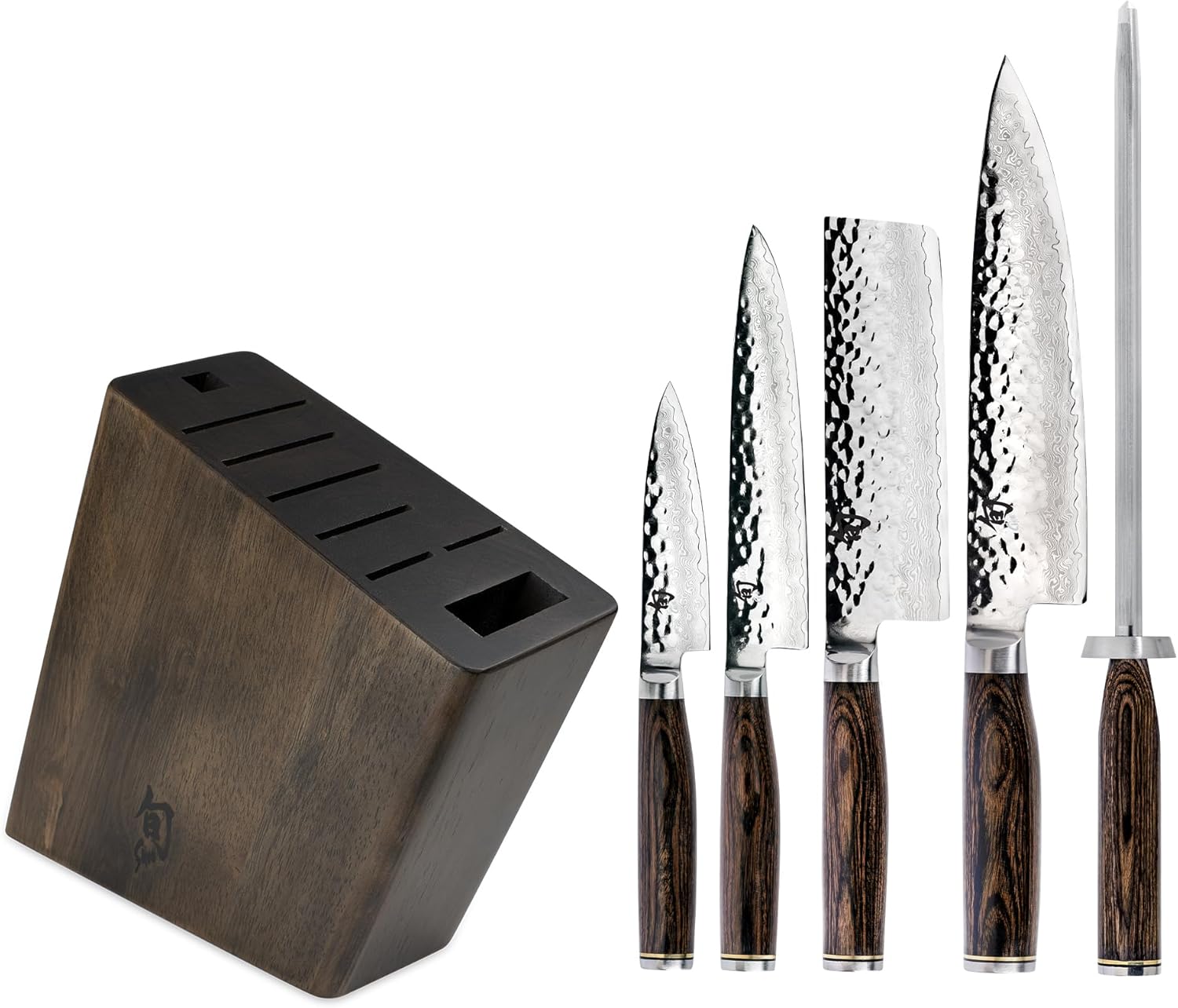
Pick up a German chef’s knife and then a Japanese gyuto, and the difference registers in your hand before you ever touch food. The gyuto is lighter, the spine thinner, the edge closer to a razor than a wedge. That gap is not marketing. It comes straight from the steel and the geometry, and once you understand what is happening at the metal level, choosing a Japanese knife set stops being a guessing game and starts being a set of deliberate tradeoffs you actually control.
The metallurgy that makes a Japanese knife a Japanese knife
Hardness is the headline. Most Western knives sit around 56 to 58 on the Rockwell C scale. Japanese blades are hardened further, usually 60 to 64 HRC. Harder steel holds a keen edge far longer, which is why a good gyuto can glide through a month of dinners while your old stamped knife needs the honing rod every night. The catch is that hardness buys edge retention at the cost of toughness. Steel this hard is more brittle, so you do not pry apart squash or hack through chicken bones with it. Treat it like a scalpel, not a hatchet.
The second factor is edge angle. A typical Western blade is ground to roughly 20 degrees per side. A Japanese edge is far more acute, often 12 to 15 degrees per side, and sometimes finer on a single-bevel blade. That thin, aggressive geometry is what lets the knife part an onion with almost no wedging. It only works because the hard steel can support such a slim edge without rolling. Soft steel ground that thin would fold on the first carrot.
Then there is construction. Many Japanese knives are laminated, called san-mai, where a hard, brittle core steel is sandwiched between softer, springier outer layers. The core takes and keeps the edge, while the jacket adds a little forgiveness so the whole blade does not shatter. The wavy Damascus pattern you see on so many sets is usually this cladding, folded to show contrast. It looks striking, but the pattern lives on the outside; the cutting performance comes from that thin strip of core steel you can barely see. Add a lighter, more forward balance point and thinner stock overall, and you get a tool built for precise push and pull cuts rather than the rocking chop a curved German belly encourages.
Steel choices: stainless, semi-stainless, and carbon
The steel in the core decides most of how a set will behave and how much maintenance it demands. VG-10 is the workhorse stainless you will meet most often in the 150 to 400 dollar range. It takes a sharp edge, resists rust well enough for a busy home kitchen, and forgives the occasional wet knife left in the sink. If you want one set that a whole household can use without ceremony, VG-10 or something in its family is the sane pick.
Carbon steel is a different relationship. Shirogami (white carbon) and Aogami (blue carbon) sharpen more easily, take a scarier edge, and reward a skilled hand with cleaner cuts than most stainless can manage. The price is rust. Cut an acidic tomato and leave the blade sitting, and you will see a patina form within minutes and orange spots not long after. Carbon knives want to be wiped dry between tasks and oiled before storage. I love mine, but I would not hand one to a guest and expect it to survive the evening. If you fall between the two camps, semi-stainless steels like Ginsan or the SG2 and R2 powder steels split the difference, offering carbon-like sharpening with far better corrosion resistance.
What actually belongs in a Japanese set
Forget the 15-slot block. A real Japanese set is a small number of specialists. The gyuto is the all-purpose chef’s knife, usually 210 or 240mm, and it does maybe 80 percent of your work: proteins, larger vegetables, general slicing. If you buy one knife, buy this one. The santoku is the shorter, flatter-profiled cousin, around 165 to 180mm, popular with cooks who have smaller hands or less counter space and prefer an up-and-down chop to a rock.
The nakiri is where people who cook a lot of vegetables fall in love. It is a flat, rectangular blade built to drop straight down through cabbage, daikon, and stacks of scallions with full contact from heel to tip, so nothing stays connected by that last stubborn hinge. The petty is the small utility knife, roughly 120 to 150mm, for shallots, garlic, trimming, and the fiddly jobs a big blade bullies. A gyuto, a nakiri, and a petty is, honestly, a set most home cooks would never outgrow. Add a santoku only if someone in the house prefers it to the gyuto, and add a sujihiki (a long, slim slicer) only if you carve roasts or break down fish often.
Single bevel, double bevel, and the handle question
Nearly every set aimed at home cooks is double-beveled, ground on both sides like a Western knife, just thinner and more acute. That is what you want unless you have a specific reason otherwise. Single-bevel knives, the traditional yanagiba and deba, are ground flat on one side and are astonishing for sushi and fish work, but they are handed (built for right or left) and demand real sharpening skill. They are a specialist purchase, not a starter set.
Handles split into two styles. Western-style handles are riveted, contoured, and heavier, which shifts balance back toward your hand and feels familiar. Wa handles, the traditional Japanese kind, are lighter, usually octagonal or D-shaped wood, and push the balance forward onto the blade. A Wa handle makes the knife feel nimble and lets you choke up for control, but it also means the knife is blade-heavy, which some people read as tip-heavy and awkward at first. Neither is better. Hold both if you can, because balance preference is deeply personal and no spec sheet decides it for you.
Care, sharpening, and the rules you cannot break
Hard, thin edges have three enemies: the dishwasher, hard cutting boards, and lateral force. Wash by hand and dry immediately, always. Cut only on wood or soft poly boards; glass, stone, and ceramic will chip that fine edge on contact. Never twist or pry, and keep the knife off bones and frozen food. Chipping is the most common death for a beautiful gyuto, and it is almost always avoidable.
Sharpening is where owning Japanese knives changes your habits. The steel is too hard for a pull-through sharpener, which will tear the edge apart. You learn to use whetstones, typically a 1000-grit for setting the edge and a 3000 to 6000-grit for finishing. It sounds intimidating and it is not; twenty minutes with a stone once a month keeps a home set frighteningly sharp, and there is a quiet satisfaction to it that a honing rod never gives. If a whetstone genuinely will not fit your life, buy stainless steel and factor in occasional professional sharpening. Do not buy carbon and then neglect it.
How to actually choose
Start with steel honesty. If nobody in the house will hand-dry a blade every time, stay stainless. Then buy pieces, not a box; a matched three-knife set from one maker is fine, but a curated gyuto plus nakiri plus petty from a good smith beats a bloated block of filler every time. Match blade length to your board and your reach, favor a double bevel and whichever handle balance felt right in your hand, and spend the money on the gyuto since it carries the workload. A 300 dollar gyuto and two modest companions will serve you better than three mediocre knives at the same total price. Buy less, buy sharper, and learn to keep it that way.
Are Japanese knives too delicate for everyday cooking?
No, as long as you match the steel to your habits and respect what the geometry cannot do. A stainless VG-10 or SG2 set handles daily home cooking without drama; it just asks that you keep it off bones, frozen blocks, and hard boards, and that you skip the dishwasher. The delicacy people worry about is really about the thin, acute edge chipping under abuse, not the knife falling apart. Cut vegetables and proteins on wood, wipe it dry, and a Japanese blade will outperform a Western one for years while feeling far more precise in the process.
Do I need to learn whetstone sharpening before buying a set?
Not before, but soon after, if you choose harder or carbon steels. The hardness that makes these blades hold an edge also makes pull-through sharpeners destructive, so a whetstone is the correct tool. The learning curve is gentler than it looks: a combination 1000/6000-grit stone, a few online lessons, and one afternoon of practice on an old knife will get you to a usable edge. If that genuinely is not realistic, buy stainless and plan on paying a professional to touch up the edge once or twice a year rather than skipping maintenance entirely.
Is a matched set better than buying individual knives?
Usually not, and this is where Japanese knives differ from Western blocks. A three-piece boxed set from a single maker can be a fine value and gives you a consistent look and feel, but the block-of-fifteen model exists to pad the count with pieces you will rarely touch. You get more from choosing a strong gyuto, adding a nakiri if you cook vegetables often, and finishing with a petty for small work. Buying individually also lets you mix handle styles and steels to suit each task, which a one-size set cannot do.
Pros & Cons
Pros
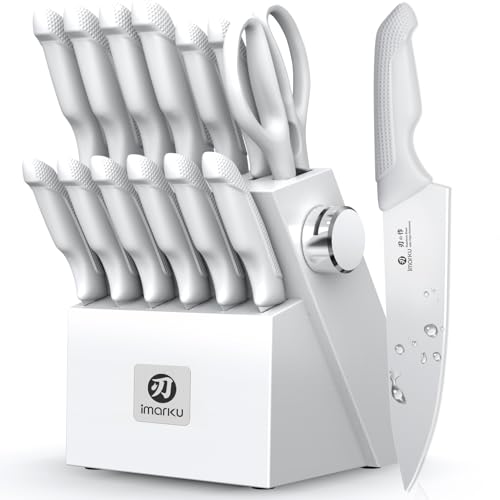
- Includes six serrated steak knives, kitchen shears, and seven cooking knives for broad everyday coverage.
- High-carbon stainless steel construction is designed to retain sharpness and resist rust.
- The cushioned ergonomic grip provides a firm hold during wet-hand food preparation.
- The FSC-certified solid wood block includes built-in sharpening and organized storage.
Cons
- Individual knife weights are not provided, so shoppers cannot assess heft before buying.
- The set may arrive with either the classic or updated brand logo, although the listed materials and construction remain the same.
Details
This 14-piece imarku set consolidates essential cutting tools into one block, solving the problem of buying chef, bread, paring, utility, and steak knives separately.
High-carbon stainless steel blades are designed to stay sharp and resist rust, supporting smoother slicing of meats, vegetables, fruits, and bread.
The set includes 8-inch chef and slicing knives, a 7-inch Santoku, 8-inch bread knife, 5-inch utility knife, 3.5-inch paring knife, six 4.5-inch steak knives, shears, and a solid wood block.
Individual knife weights are not listed, so buyers seeking a specific balance or heavier feel should confirm those details before purchasing.
Best for first-time homeowners and home cooks who want organized storage and broad meal-prep coverage.
Care Guide
Use the built-in block sharpener periodically to help maintain the blades’ cutting edge during regular kitchen use.
Keep the knives organized in the solid wood block after use, and dry them thoroughly to support the stainless steel’s rust resistance.
Use each knife for its intended task, such as the bread knife for loaves and serrated steak knives for cooked steaks.

Pros & Cons
Pros
- The 3-piece selection provides distinct blades for proteins, vegetables, and smaller ingredients.
- ATS-34 steel offers a hard, fine-grain blade material suited to precise kitchen cutting.
- The walnut handle, finger groove, and full-tang design support comfortable, controlled handling.
- The coated matte finish is designed to resist peeling or fading during regular use.
Cons
- The knives require hand washing and prompt drying rather than dishwasher cleaning.
- Product data does not provide blade dimensions or total weight, so buyers cannot assess fit and heft in advance.
Details
The DRGSKL set combines a chef knife, utility knife, and meat cleaver to address routine slicing, chopping, protein preparation, and smaller ingredient tasks.
ATS-34 steel and multi-stage wet grinding create a precise edge for controlled cuts, while the black titanium coating is designed to simplify cleanup and preserve the matte finish.
A hand-polished walnut handle, sculpted finger groove, metal spacer, and full-tang structure provide grip control, balance, and durability. Blade dimensions and total weight are not provided.
These knives need hand washing and quick drying after each use, so they are not a low-maintenance dishwasher option.
Best for home cooks and culinary professionals seeking a coordinated Japanese-style set for varied daily prep.
Care Guide
Hand wash each knife after use with mild soap, then dry it promptly to help maintain the ATS-34 steel, walnut handle, and coated finish.
Avoid leaving the knives soaking in water, and store them where the edges will not strike other utensils.
Use the chef knife for general prep, the utility knife for smaller ingredients, and the meat cleaver for heavier chopping tasks.

Save $24.64
Pros & Cons
Pros
- The 5-layer 9CR18MOV steel reaches HRC 62 for strong hardness and edge retention.
- The octagonal rosewood handles provide non-slip control and reduce hand fatigue.
- The blade-forward balance supports efficient chopping motions and precise cutting.
- The storage block helps keep the knives organized between uses.
Cons
- The product data does not specify the number of knives or individual blade sizes.
- The premium steel and rosewood construction require careful hand care to preserve their finish and performance.
Details
This FAMCÜTE set gives home cooks balanced knives for chopping, slicing, and everyday ingredient preparation while keeping them organized in the included block.
Five-layer 9CR18MOV steel reaches HRC 62, helping the blades stay sharp through extended use and resist corrosion and rust.
The rosewood octagonal handles are lightweight, sturdy, and non-slip, while the blade-forward balance supports controlled chopping with less hand fatigue.
Individual knife sizes and the total number of knives are not listed, so buyers cannot verify the set’s exact coverage before purchase.
Best for home cooks and gift buyers seeking a balanced Japanese-style set with a storage block.
Care Guide
Hand-wash and dry the knives promptly to protect the high-hardness steel and rosewood handles from moisture-related wear.
Use a suitable cutting surface and avoid forcing the blades through hard materials to preserve their sharp edge.
Return each knife to the block after drying so the blades stay organized and protected between cooking sessions.

Pros & Cons
Pros
- Exceptional sharpness out of the box cuts through tough vegetables and delicate herbs without crushing or bruising.
- Balanced weight distribution in the rosewood handle reduces hand and wrist strain during long cooking sessions.
- Four complementary knives handle everyday tasks, eliminating the need to buy multiple single knives separately.
- Hand-forged construction with visible grain pattern creates a premium feel that justifies daily kitchen use.
Cons
- Requires hand washing and immediate drying to prevent corrosion; dishwasher use will damage the blade and handle.
- Rosewood handle needs occasional conditioning with food-grade oil to maintain appearance and prevent cracking over years of use.
Details
A four-piece Japanese knife set engineered to solve the problem of dull, frustrating prep work by combining traditional hand-forging with modern high-carbon steel.
The 8-inch gyuto blade cuts through proteins and vegetables with minimal resistance, while the 3-layer laminated steel core (9CR18MOV at 58±2 HRC hardness) maintains its edge through hundreds of cuts. The ultra-thin 2.5mm blade design preserves food texture and moisture better than standard Western knives.
Each knife features a rosewood octagonal handle hand-crafted for balance and ergonomics, reducing wrist tension during extended prep. The set includes an 8-inch gyuto, 7-inch santoku, 7-inch nakiri, and 5.5-inch petty knife in a sandalwood presentation box.
Limitation: requires hand washing and immediate drying to prevent corrosion of the high-carbon steel blade.
Best for home cooks and professional chefs who prepare food daily and want precision cutting performance without commercial kitchen pricing.
Care Guide
Hand wash immediately after use with warm soapy water and dry completely with a soft cloth. High-carbon steel oxidizes quickly when wet, so never leave the blade damp or store in a damp environment.
Condition the rosewood handle monthly with food-grade mineral oil or beeswax to prevent drying and cracking. Apply oil along the grain, wipe excess, and let sit for 30 minutes before using.
Store knives separately in a knife block or on a magnetic strip to protect the blade edge and prevent accidental damage to the handle. Hone the blade weekly with a honing steel before use to maintain alignment; sharpen professionally every 6-12 months depending on use frequency.

Pros & Cons
Pros
- The set includes five specialized knives, poultry shears, and a sharpening rod for broad kitchen coverage.
- Japanese high-carbon steel with stated 58±2 HRC hardness is designed to support edge durability.
- Hand-forged blades and hammered patterns provide a distinctive appearance while helping food release.
- Gift-ready packaging and the included roll bag make the set practical for presentation and storage.
Cons
- The product data does not list individual blade dimensions or the total set weight.
- A seven-piece set may be more equipment than buyers who only need one dedicated meat knife.
Details
The Huusk 7-piece set solves the problem of using one general knife for every task by combining meat, poultry, fish, produce, and sharpening tools in one organized kit.
The cleaver and boning knife support tougher meat preparation, while the 15-degree edges are designed to reduce resistance during slicing.
Blades use Japanese high-carbon steel with stated 58±2 HRC hardness, hand-forged hammered patterns, natural wood handles, and finger guards. Individual blade dimensions and total weight are not listed.
The broad lineup increases versatility, but buyers seeking a compact single-knife setup may find seven pieces unnecessary.
Best for home cooks, barbecue enthusiasts, and gift buyers who want a dedicated meat-preparation set with multiple blade styles.
Care Guide
Use the sharpening rod to maintain the stated 15-degree edge when cutting begins to feel less efficient.
Store the knives in the included roll bag so the blades remain organized and separated during storage or transport.
Because the set uses high-carbon steel and natural wood handles, follow the manufacturer’s care instructions for cleaning and storage.


Write Your Review
No reviews yet. Be the first to share your experience!