

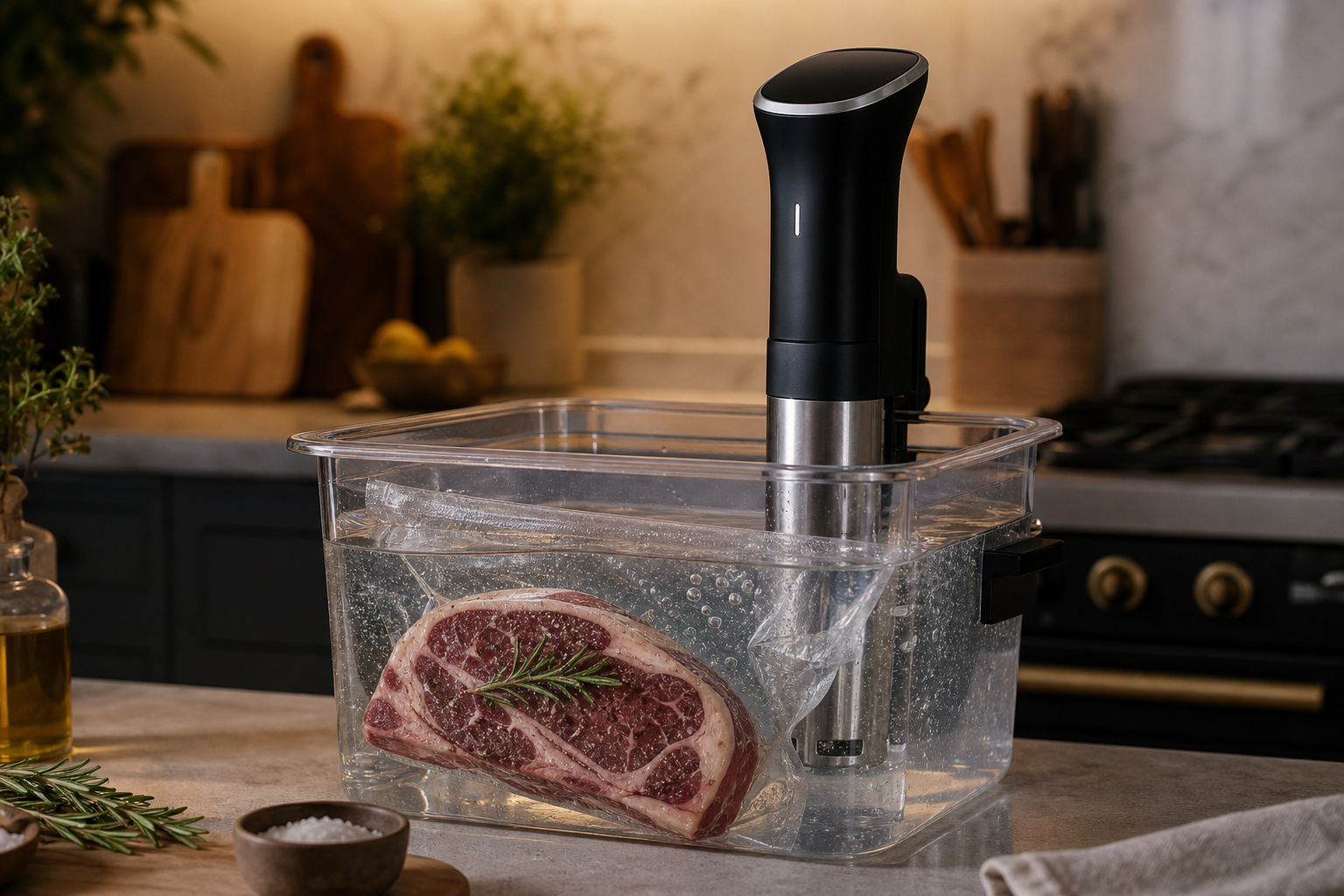
TL;DR — Sous vide cooks vacuum-sealed food in a precisely temperature-controlled water bath, locking in moisture and eliminating overcooking. The French phrase translates to “under vacuum,” and the technique pairs a sealed bag with a circulator that holds water within 0.1°C of your target. A 130°F steak stays at 130°F whether you pull it at one hour or four — the meat physically cannot overcook because the water isn’t hotter than where you want the food to land.
The Best Deals This Week*
-
Anova Sous Vide Precision Cooker 3.0 WiFi
$168.96
($229)Save $60.04 -
Anova Culinary Sous Vide Precision Cooker Pro
$332.99
($459)Save $126.01
*Deals are selected by our commerce team
Deeper Dive: Our Top Picks
Our Top Picks
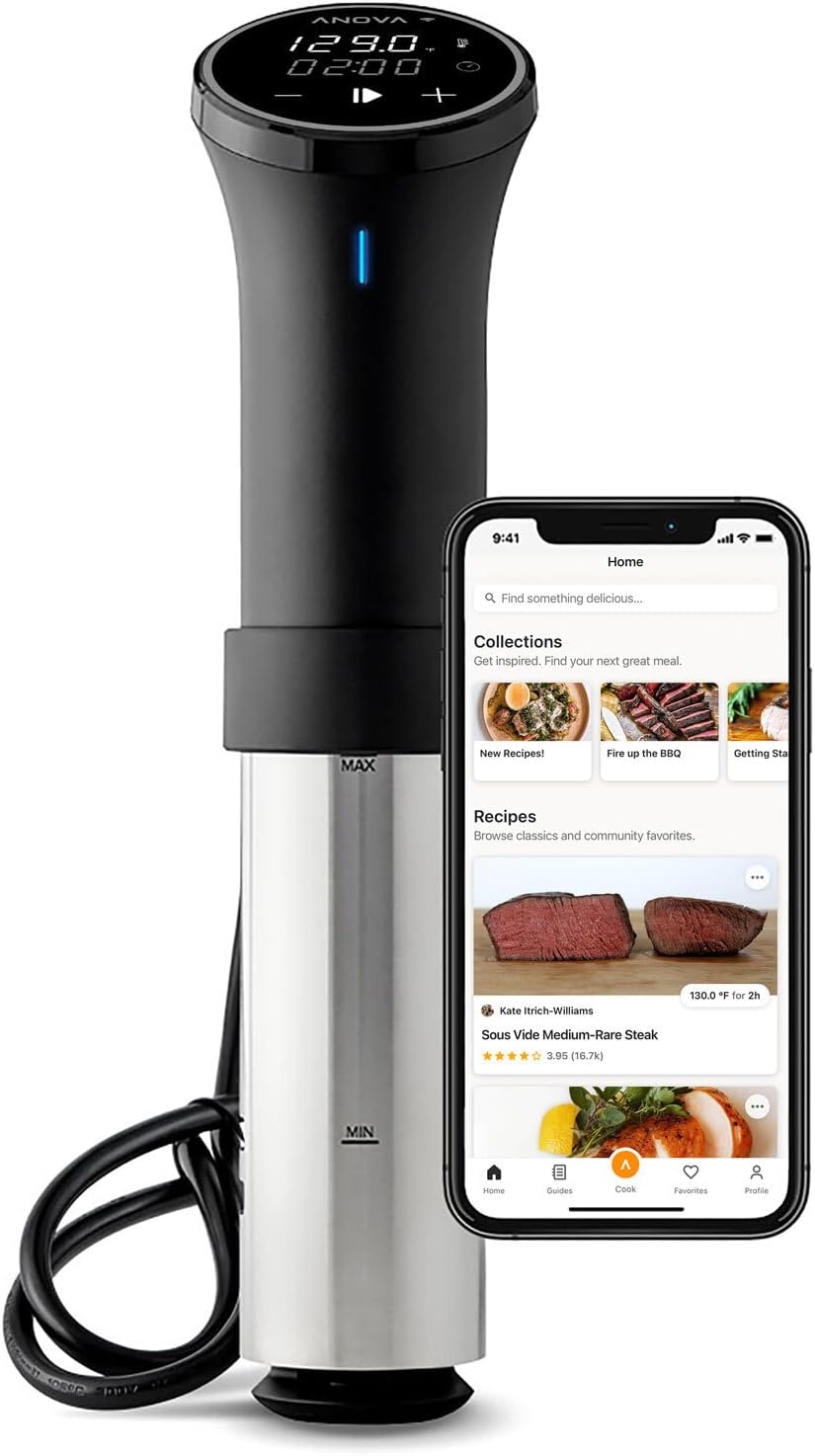
Anova Sous Vide Precision Cooker 3.0 WiFi: Restaurant-Quality Steaks and Proteins at Home
This 1100-watt sous vide circulator holds water temperature within 0.2°F to eliminate overcooked meat and deliver edge-to-edge perfect doneness every time. Home cooks who want steakhouse results without constant monitoring should consider this third-generation model with dual-band WiFi and an upgraded two-line display.
Pros and Cons
Pros
- Maintains temperature accuracy to 0.2°F, which is precise enough to cook a perfect medium-rare steak at 129°F without any gray band.
- The adjustable clamp and removable skirt make this cooker compatible with most existing cookware and easy to clean after use.
- Dual-band WiFi connectivity is more stable than the previous model, reducing dropped connections during long cooks.
Cons
- The paid app subscription costs $1.99 per month for recipe access and cook history, though basic time and temperature control remain free.
- At 1100 watts, this model heats slower than the 1200-watt Pro version when cooking for large groups in oversized containers.

Anova
Culinary Sous Vide Precision Cooker Pro 1200W: Restaurant-Grade Precision for Home Kitchens
The Anova Precision Cooker Pro circulates water at exact temperatures to deliver edge-to-edge doneness on steaks, chicken, fish, and vegetables without any risk of overcooking. Serious home cooks and meal preppers who want restaurant-quality results with zero guesswork should consider this commercial-grade unit.
Pros and Cons
Pros
- 1200-watt heating element brings water to temperature faster than lower-powered models, cutting down wait time before you can start cooking.
- Stainless steel body resists corrosion and handles the humidity and heat of continuous kitchen use better than plastic alternatives.
- WiFi connectivity works with both iOS and Android, letting you monitor and adjust cooks from anywhere in your home.
Cons
- The included app charges $1.99 per month or $9.99 per year after a two-week trial if you want access to guided recipes and cook history tracking.
- At nearly $200, this model costs significantly more than entry-level sous vide circulators, though it delivers commercial durability in return.

Inkbird
WiFi Sous Vide Cooker for Restaurant-Quality Steaks at Home - INKBIRD ISV-100W 1000W Immersion Circulator
The INKBIRD ISV-100W delivers precise temperature control within 0.1°C and app-based remote monitoring, letting you cook perfect steaks and chicken while handling other tasks. Home cooks who want consistent, restaurant-quality results without constant supervision should consider this 1000-watt circulator.
Pros and Cons
Pros
- WiFi connectivity and app control let you monitor and adjust cooks from another room or while running errands.
- The 1000-watt heating element reaches target temperature faster than lower-wattage models, especially with larger water volumes.
- Timer supports up to 99 hours for long cooks like brisket or pork shoulder that need 24+ hours to tenderize.
Cons
- No waterproof rating means you must keep the control head completely clear of splashes and steam during use.
- Temperature range starts at 77°F, preventing low-temperature applications like yogurt or fermentation that require 68-75°F holds.

Anova Sous Vide Precision Cooker Nano 2.0 - Restaurant Quality Results at Home
The Anova Precision Cooker Nano circulates water at exact temperatures to deliver edge-to-edge perfectly cooked steaks, chicken, and fish without any risk of overcooking. Home cooks who want professional results without mastering complex techniques should buy this affordable entry into sous vide cooking.
Pros and Cons
Pros
- Produces consistently tender, evenly cooked results across all protein types from steaks to chicken breasts without constant monitoring.
- Compact 12.8-inch design stores easily in drawers and attaches securely to any pot with a simple fixed clamp.
- Bluetooth connectivity and app control let you start, monitor, and adjust cooking remotely with real-time notifications.
- Water-resistant durable plastic construction cleans easily after each use and withstands up to 3,000 hours of continuous operation.
Cons
- Bluetooth-only connectivity limits range compared to WiFi models, requiring you to stay within roughly 30 feet of the cooker.
- Fixed clamp design cannot be removed for compact storage or adjusted for unusually shaped containers like the higher-end models.
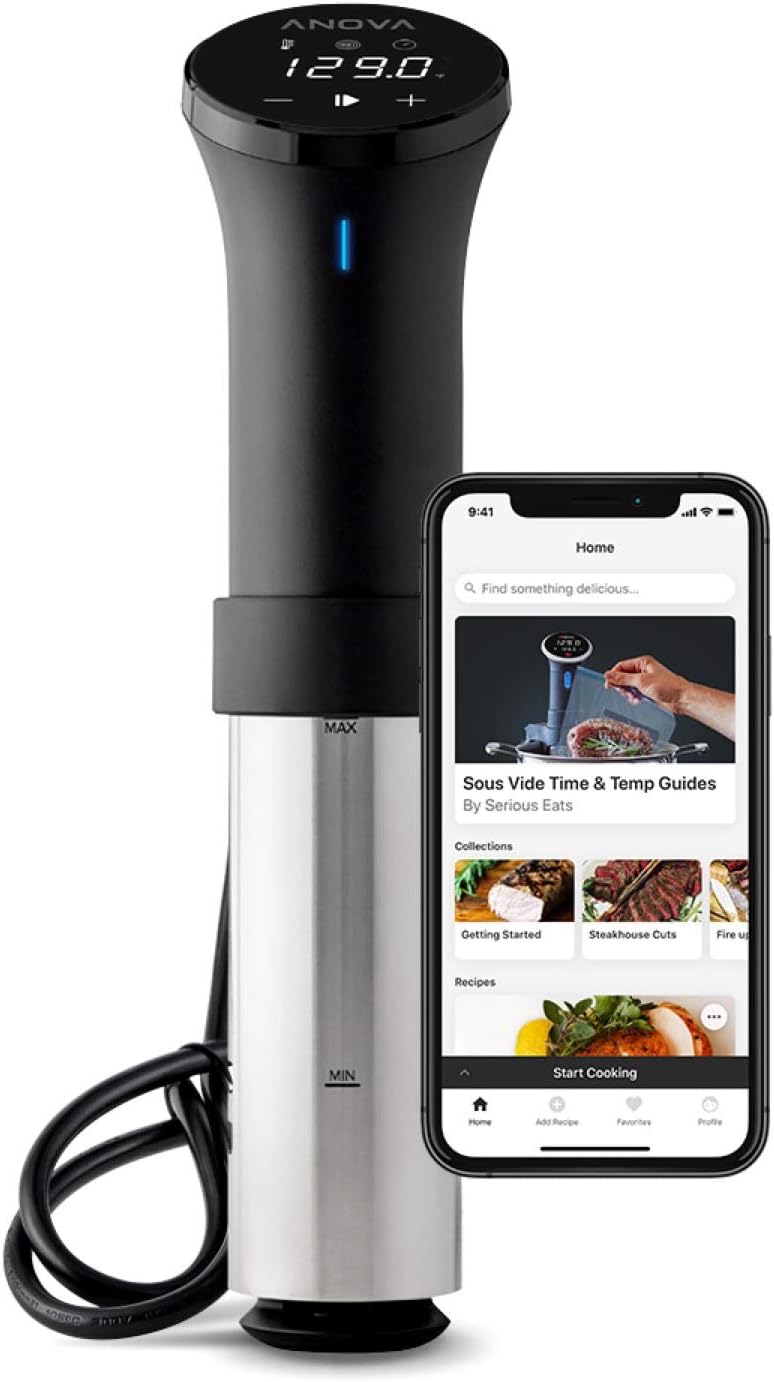
Anova Sous Vide Precision Cooker 2.0 WiFi 1000W - Restaurant-Quality Cooking at Home
The Anova Precision Cooker 2.0 circulates water at exact temperatures to deliver edge-to-edge perfection on steaks, chicken, and vegetables without constant monitoring. Home cooks who want foolproof results and app-guided recipes should choose this over traditional stovetop methods.
Pros and Cons
Pros
- Consistent results across different proteins and vegetables eliminate guesswork and reduce food waste from ruined meals.
- WiFi connectivity and app control let you start or adjust cooking remotely, adding flexibility to busy schedules.
- Adjustable clamp fits containers of various sizes, giving you more cooking capacity options than fixed-clamp models.
Cons
- Requires vacuum-sealed bags or zip-top bags for most recipes, adding an extra prep step and ongoing supply cost.
- Cooking times are significantly longer than traditional methods, with some cuts requiring multiple hours to reach target doneness.
Editors' Picks
Anova Sous Vide Precision Cooker 3.0 WiFi: Restaurant-Quality Steaks and Proteins at Home
Anova Sous Vide Precision Cooker 3.0 WiFi: Restaurant-Quality Steaks and Proteins at Home
This 1100-watt sous vide circulator holds water temperature within 0.2°F to eliminate overcooked meat and deliver edge-to-edge perfect doneness every time. Home cooks who want steakhouse results without constant monitoring should consider this third-generation model with dual-band WiFi and an upgraded two-line display.
$168.96 at AmazonEditors' Favorite
Wattage: 1100 watts Voltage: 120 Volts Control Method: Touch Upper Temperature Rating: 197 Degrees Fahrenheit Smart Home Compatibility: Smart Home Compatible Lower Temperature Rating: 32 Degrees Fahrenheit Item Dimensions D x W x H: 4.1"D x 3.07"W x 12.8"H Capacity: 16 Liters Item Weight: 1.92 Pounds Material: Stainless Steel Color: Silver Brand Name: Anova Culinary UPC: 850043914051 Global Trade Identification Number: 00850043914051 Manufacture Year: 2021 Warranty Description: 2 year manufacturer Model Number: AN525-US00 Part Number: AN525-US00 Manufacturer: Anova Culinary Item Type Name: Sous Vide Cooker Included Components: Precision Cooker Unit Count: 1.0 Count Best Sellers Rank: #3,319 in Kitchen & Dining (See Top 100 in Kitchen & Dining) #2 in Sous Vide Machines ASIN: B0BQ9F56WV Customer Reviews: 4.5 4.5 out of 5 stars (1,432) 4.5 out of 5 stars Product Dimensions: 4.1"D x 3.07"W x 12.8"H
Shop NowAnova Culinary Sous Vide Precision Cooker Pro 1200W: Restaurant-Grade Precision for Home Kitchens
Anova
Culinary Sous Vide Precision Cooker Pro 1200W: Restaurant-Grade Precision for Home Kitchens
The Anova Precision Cooker Pro circulates water at exact temperatures to deliver edge-to-edge doneness on steaks, chicken, fish, and vegetables without any risk of overcooking. Serious home cooks and meal preppers who want restaurant-quality results with zero guesswork should consider this commercial-grade unit.
$332.99 at AmazonGreat Value
Wattage: 1200 watts Voltage: 120 Volts Control Method: App Upper Temperature Rating: 197 Degrees Fahrenheit Smart Home Compatibility: Smart Home Compatible Lower Temperature Rating: 32 Degrees Fahrenheit Item Dimensions D x W x H: 2.4"D x 3.5"W x 13.8"H Capacity: 50 Liters Item Weight: 3 Pounds Material: Stainless Steel Color: Black and Silver Brand Name: anova UPC: 851607006526 Global Trade Identification Number: 00851607006526 Manufacture Year: 2020 Warranty Description: 2 year manufacturer Model Number: | Part Number: AN600-US00 Manufacturer: Anova Culinary Item Type Name: Sous Vide Precision Cooker Pro Included Components: Precision Cooker and Clamp Best Sellers Rank: #9,492 in Kitchen & Dining (See Top 100 in Kitchen & Dining) #6 in Sous Vide Machines ASIN: B07QFC6LN6 Customer Reviews: 4.5 4.5 out of 5 stars (2,439) 4.5 out of 5 stars Product Dimensions: 2.4"D x 3.5"W x 13.8"H
Shop NowInkbird WiFi Sous Vide Cooker for Restaurant-Quality Steaks at Home - INKBIRD ISV-100W 1000W Immersion Circulator
Inkbird
WiFi Sous Vide Cooker for Restaurant-Quality Steaks at Home - INKBIRD ISV-100W 1000W Immersion Circulator
The INKBIRD ISV-100W delivers precise temperature control within 0.1°C and app-based remote monitoring, letting you cook perfect steaks and chicken while handling other tasks. Home cooks who want consistent, restaurant-quality results without constant supervision should consider this 1000-watt circulator.
$95.99 at AmazonWattage: 1000 Voltage: 120 Volts Control Method: App Upper Temperature Rating: 212 Degrees Fahrenheit Smart Home Compatibility: Smart Home Compatible Lower Temperature Rating: 77 Degrees Fahrenheit Item Dimensions D x W x H: 2.36"D x 2.36"W x 16.14"H Capacity: 15 Liters Material: Metal Color: Black Brand Name: Inkbird UPC: 652722827740 Warranty Description: 365 Model Number: ISV-100W Part Number: ISV-100W Manufacturer: Inkbird Item Type Name: Inkbird Sous Vide Precision Cooker Included Components: Vide Precision Cooker Unit Count: 1.0 Count Best Sellers Rank: #5,604 in Kitchen & Dining (See Top 100 in Kitchen & Dining) #3 in Sous Vide Machines ASIN: B07RNWJZNR Customer Reviews: 4.5 4.5 out of 5 stars (5,310) 4.5 out of 5 stars Product Dimensions: 2.36"D x 2.36"W x 16.14"H Brand: Inkbird
Shop NowAnova Sous Vide Precision Cooker Nano 2.0 - Restaurant Quality Results at Home
Anova Sous Vide Precision Cooker Nano 2.0 - Restaurant Quality Results at Home
The Anova Precision Cooker Nano circulates water at exact temperatures to deliver edge-to-edge perfectly cooked steaks, chicken, and fish without any risk of overcooking. Home cooks who want professional results without mastering complex techniques should buy this affordable entry into sous vide cooking.
$68.00 at AmazonWattage: 800 watts Voltage: 120 Volts Control Method: App Upper Temperature Rating: 197 Degrees Fahrenheit Lower Temperature Rating: 32 Degrees Fahrenheit Item Dimensions D x W x H: 4.1"D x 2.2"W x 12.8"H Item Weight: 1.7 Pounds Material: Food Safe Plastic Color: Black Brand Name: Anova Culinary UPC: 851607006427 702872656650 600186763036 Global Trade Identification Number: 00851607006427 Warranty Description: 2 year warranty Model Number: AN400-US00 Part Number: AN400-US00 Manufacturer: Anova Culinary Item Type Name: Sous Vide Cooker Included Components: 1 Anova Precision Cooker Nano Unit Count: 1.0 Count Best Sellers Rank: #1,935 in Kitchen & Dining (See Top 100 in Kitchen & Dining) #1 in Sous Vide Machines ASIN: B07C7PW3PC Customer Reviews: 4.6 4.6 out of 5 stars (15,011) 4.6 out of 5 stars Product Dimensions: 4.1"D x 2.2"W x 12.8"H Brand: Anova Culinary
Shop NowAnova Sous Vide Precision Cooker 2.0 WiFi 1000W - Restaurant-Quality Cooking at Home
Anova Sous Vide Precision Cooker 2.0 WiFi 1000W - Restaurant-Quality Cooking at Home
The Anova Precision Cooker 2.0 circulates water at exact temperatures to deliver edge-to-edge perfection on steaks, chicken, and vegetables without constant monitoring. Home cooks who want foolproof results and app-guided recipes should choose this over traditional stovetop methods.
$98.44 at AmazonWattage: 1000 watts Voltage: 110 Volts Control Method: App Upper Temperature Rating: 197 Degrees Fahrenheit Lower Temperature Rating: 32 Degrees Fahrenheit Item Dimensions D x W x H: 3.07"D x 3.07"W x 12.8"H Capacity: 8 Liters Item Weight: 1.98 Pounds Material: Plastic, Stainless Steel Color: Black and Silver Brand Name: Anova Culinary UPC: 851607006618 851607006601 Global Trade Identification Number: 00851607006601, 00851607006618 Manufacture Year: 2020 Warranty Description: 2 Year manufacturer Model Number: AN500-US00 Part Number: AN500-US00 Manufacturer: Anova Item Type Name: Sous Vide Cooker Unit Count: 1.0 Count Best Sellers Rank: #8,727 in Kitchen & Dining (See Top 100 in Kitchen & Dining) #5 in Sous Vide Machines ASIN: B07WQ4M5TS Customer Reviews: 4.6 4.6 out of 5 stars (12,103) 4.6 out of 5 stars Product Dimensions: 3.07"D x 3.07"W x 12.8"H
Shop NowAbout These Recommendations
The technique above is the point of this guide; the products are here because they help. We have not tested them ourselves — we did not buy or use this gear. The recommendations come from comparing specifications and materials against the patterns in verified owner reviews, so treat them as a shortlist worth researching rather than a verdict from our own kitchen.
Availability and prices change often, so check the current listing before buying. We earn a commission on purchases made through links on this page, which never affects what we recommend.
The Short Answer
Sous vide cooking is the technique of sealing food in a plastic bag, dropping it in a water bath, and using an immersion circulator to hold that water at the exact internal temperature you want the food to reach. The whole point of sous vide cooking is removing the timing guesswork that makes a great steak or a juicy chicken breast hard to nail twice in a row. Time replaces guesswork. A medium-rare steak hits 130°F in roughly an hour and stays edge-to-edge rosy with no gray band. Chicken breast goes from chalky to silky at 145°F. Eggs poach to custard at 63°C. The picks in our best sous vide guide cover circulators from $90 entry models to commercial-grade units, and they all do the same core job — pump and heat water with enough precision that the bag becomes a tiny, perfectly held oven.
How Sous Vide Works
Sous vide cooking starts with three pieces of hardware: a circulator, a container of water, and a sealed bag. An immersion circulator clips to the side of any heat-safe container — a stockpot, a polycarbonate tub, even a beer cooler. Inside the device, a small impeller pulls water past a heating element, and a thermistor reads the water temperature several times per second. A PID controller adjusts the heater to hold the bath within roughly 0.1°C of your setpoint. The flow ring around the bottom of the wand circulates the water so the temperature is uniform top to bottom, with no hot spots near the element and no cold zones at the surface.
Food goes into a bag — vacuum-sealed if you have a chamber sealer or FoodSaver, water-displacement-sealed in a zip-top freezer bag if you don’t. Air pockets are the enemy because they insulate and let the bag float, so the bag needs to be fully submerged and free of trapped air. Once it’s in the water and clipped to the side or weighted down, physics does the work.
Here’s what makes the technique fundamentally different from a pan or oven. In conventional cooking, your heat source is hotter than your target — a 500°F oven cooking chicken to 165°F. Heat penetrates from the surface inward, and timing is a race against the outer layers turning into shoe leather while the core comes up. With sous vide, the heat source is the target. Water at 145°F cannot push the chicken past 145°F no matter how long it sits there. The bag reaches thermal equilibrium with the bath — typically 45 to 90 minutes for a portion of meat — and then it holds.
This means no carryover cooking, no temperature spike, no overshoot. A steak pulled at 90 minutes and a steak pulled at three hours read the same internal temperature. The longer cook does soften connective tissue over time, which is why tough cuts benefit from extended baths, but the doneness on the temperature scale doesn’t budge.
Why Restaurants Adopted It First
The technique traces back to two French chefs working independently in the 1970s. Georges Pralus developed sealed water-bath cooking at Restaurant Troisgros in 1974 as a way to reduce shrinkage on expensive foie gras — vacuum-sealing and gentle heating cut yield loss from roughly 40% down to under 5%. Around the same time, biochemist Bruno Goussault at the Centre Européen des Sciences du Goût was researching how meat proteins respond to controlled low-temperature cooking. Goussault worked with chef Joël Robuchon throughout the 1980s, refining specific time-and-temperature pairings for cuts ranging from short rib to lamb shoulder.
Goussault’s tables became the technical foundation for what’s now called modernist cuisine. Thomas Keller adopted sous vide at The French Laundry in the 1990s. Heston Blumenthal built menus around it at The Fat Duck. By the early 2000s, virtually every Michelin-starred kitchen ran at least one immersion circulator, because the consistency advantages are enormous when you’re plating 200 covers a night and every steak has to arrive at the same doneness.
Early sous vide cooking equipment for restaurants ran from the 1970s through the 2000s and cost between $1,500 and $5,000. PolyScience, Julabo, and Grant Instruments dominated the professional market with cabinet-style baths the size of a microwave. Home cooks who wanted to experiment improvised with rice cookers, coolers, and analog thermometers — Dave Arnold and Nathan Myhrvold both documented hacks in the late 2000s.
The category broke open in 2014 when Anova launched its Bluetooth-connected immersion circulator on Kickstarter for $179. Suddenly the same precision was clipping to a home stockpot. Joule followed in 2016 with a smaller wand controlled entirely by phone, and Breville bought the company in 2019. By 2020, sous vide had moved from chef’s secret to a standard tool sitting in a kitchen drawer next to the immersion blender.
What Sous Vide Is Best For
Proteins are where sous vide cooking earns its reputation. A ribeye cooked at 131°F for two hours then seared 45 seconds per side in a screaming cast iron skillet hits edge-to-edge medium-rare with a crust that took less time than the rest of dinner. Chicken breast at 145°F for an hour comes out silky and faintly translucent — utterly different from the dry, fibrous version most home cooks produce. Pork tenderloin at 140°F stays pink and juicy, killing the old conventional-wisdom doneness of 160°F that came from a 1970s trichinosis scare the FDA officially walked back in 2011.
Tough cuts respond best of all. Short rib at 135°F for 48 hours converts the collagen to gelatin while keeping the muscle fibers tender and rare — a textural combination conventional braising can’t produce. Brisket at 155°F for 36 hours, chuck roast at 133°F for 24 hours, lamb shoulder at 144°F for 18 hours. The bath does the work of a low-and-slow smoker without any drying out. A finishing sear or quick blast under a broiler handles the crust.
Eggs are a category of their own. A 63°C egg cooked for 45 minutes produces a set white and a jammy yolk with no shell-cracking guesswork. A 75°C egg for 13 minutes gives you a fully soft-boiled finish. Hollandaise made by tempering yolks in a sealed bag at 75°C is foolproof — no scrambled eggs from a wandering pot of water on the stove.
Vegetables benefit when you want flavor concentration. Carrots at 185°F for an hour, sealed with butter and thyme, intensify because the water never washes flavor off the surface the way boiling does. Asparagus, beets, and root vegetables all work, though leafy greens turn olive-drab from chlorophyll degradation and aren’t worth the trouble. A multi-cooker handles most one-pot vegetable jobs more efficiently — the best Instant Pot in our best instant pot roundup handles potatoes, lentils, and stocks in 30 minutes flat where sous vide would take two hours.
What Sous Vide Won’t Do
For all its strengths, sous vide cooking has clear limits. Sous vide doesn’t sear. Maillard browning needs surface temperatures around 300°F to 350°F, and your bath cap at roughly 200°F. Every protein cook ends with a hot finish — cast iron, blowtorch, charcoal chimney, broiler, or grill — to develop the crust. Skipping the sear leaves meat looking and tasting bagged, because the surface stays gray and the bag holds back the flavor compounds that come from browning.
It doesn’t bake. Bread, cookies, and cakes need dry heat above 300°F for structure development, leavening reactions, and crust formation. Cheesecake works in a sealed jar because it’s essentially a custard, but anything that has to rise or brown belongs in an oven.
It doesn’t crisp skin. Chicken thighs cooked at 165°F come out tender and juicy, but the skin renders into a flabby, rubbery layer until you finish in a hot pan or under a salamander. Duck breast, salmon, and pork belly all need a post-bath skin treatment to render fat and develop crackle.
For thin steaks under two inches, the time math also stops favoring sous vide. A one-inch ribeye on a charcoal grill is done in seven minutes including rest. The same steak sous vide needs 45 minutes in the bath plus the sear. The bath wins on consistency and on thicker cuts; the grill wins on speed and on smoke flavor. Match the tool to the job.
Common Mistakes
- Skipping the post-bath sear. A steak straight from the bag looks like wet meat. The surface is gray, the texture is soft, and the flavor compounds from browning are missing entirely. Pat the protein bone-dry with paper towels — water on the surface steams instead of searing — and finish in a screaming-hot cast iron pan or with a propane torch. Forty-five seconds per side is enough. Skipping this step is the single biggest reason first-time users come away unimpressed.
- Letting bags float. Air pockets in the bag, or air trapped between the bag and the food, make the bag bob to the surface where the temperature is lower and inconsistent. Use the water-displacement method — lower a zip-top bag slowly into the bath, letting water pressure push air out before sealing the last inch above the surface. Weighted magnets, binder clips on the rim, or a kitchen-grade sous vide rack keep stubborn bags submerged.
- Cooking poultry below 130°F for any length of time. USDA pasteurization tables depend on temperature and time. A chicken breast at 145°F is safe after about 30 minutes because the combination of heat and duration kills salmonella as effectively as the conventional 165°F instant-kill. Below 130°F, no holding time makes the food safe. Don’t improvise the temperature on poultry, ground meat, or pork without checking a verified pasteurization chart.
- Using thin grocery-store zip-tops for long cooks. Cheap polyethylene bags can leach plasticizers at sustained temperatures above 150°F, and some are not rated for cooking at all. Stick with bags marked food-safe for sous vide use — most major freezer-grade Ziploc bags work for cooks under 158°F, and vacuum-rated chamber bags handle the longer high-temperature runs without concern.
- Cooking food and then leaving it in the bath at low temperature. Holding a chicken breast at 145°F for two hours is fine. Holding it at 110°F for two hours is not — that’s smack in the middle of the bacterial growth zone. Either keep the bath above 130°F for the entire cook, or chill the bagged food in ice water and refrigerate before resuming. Treat the bath like a cooking environment, not a warming drawer.
Related Questions
Do I need a vacuum sealer for sous vide?
No. For cooks under four hours, the water-displacement method with a freezer-grade zip-top bag works fine — slowly lower the open bag into the water, let pressure push the air out, and seal. A vacuum sealer becomes worth the $80 to $150 once you’re doing 24-hour-plus cooks (the bag seal weakens over time) or cooking in batches you want to freeze. Chamber sealers are nicer than external models because they handle liquids in the bag, but they’re $400-plus and overkill for most home use.
How long can food cook in a sous vide?
Doneness is set by temperature, but texture changes with time. A steak holds at the same medium-rare from one hour to four hours; past about six hours, the muscle fibers start to soften into mush. Tough cuts like short rib improve over 24 to 72 hours as collagen converts to gelatin. Chicken breast peaks around two hours and turns pasty past five. Each cut has a sweet spot — check a published time-temp chart for whatever you’re cooking.
What temperature for medium-rare steak?
130°F to 134°F gives a true medium-rare with rosy edge-to-edge color. 129°F edges into medium-rare-leaning-rare; 135°F crosses into medium. Hold time of one to four hours for steaks up to two inches thick. Sear hard and fast at the end — patted dry, in a smoking pan with a thin film of high-smoke-point oil, 45 seconds per side plus the edges.
Can sous vide make food unsafe?
Yes, if you ignore time-temperature pasteurization rules. Cooking food in the 40°F to 130°F danger zone for extended periods grows bacteria. Sous vide is safe when the bath is held above 130°F and the food is cooked for the duration required to pasteurize that protein at that temperature. Douglas Baldwin’s pasteurization tables, available free online, are the standard reference and what most circulator apps base their built-in timings on.
Is the meat texture different?
Yes. Meat from sous vide cooking is more uniformly tender top-to-bottom and has none of the gradient cooking conventional methods produce — no gray ring around a pink center, no overdone outer layer. The trade-off is the surface texture, which is why the post-bath sear matters. Some people find chicken breast almost too tender at 140°F and prefer 150°F for a firmer bite. Steak texture is unanimously regarded as a win once the crust is properly developed.
Related buying guides: best cookware sets, best moka pot and best copper cookware.
Recommended Tools
The circulators below cover the range from first-time-buyer entry points to commercial-spec wands for cooks who run long batches weekly. All of them hold the bath within 0.1°C, push enough flow to keep an eight-quart tub uniform, and clip to standard pots. The differences come down to wattage (faster heat-up at 1,000W versus 800W), app integration, and waterline tolerance. Any of them turn a stockpot and a zip-top bag into the same cooking environment that produced the steaks at Per Se.


Write Your Review
No reviews yet. Be the first to share your experience!