

It is 8 p.m. on a weeknight, two people are at the table, and somebody wants cheesecake. A standard 9-inch pan bakes twelve slices of it, which in this house means the last wedge gets eaten the following Tuesday, five days after the graham crust went soft. The dessert was never the problem. The size was.
A 6-inch springform occupies a narrow gap the bigger pans ignore. It turns a full recipe into a four-serving dessert, fits inside a countertop oven that rejects anything wider than eight inches, slips onto a trivet beneath an Instant Pot lid, and freezes slice by slice without hogging a shelf. Everything below walks through those situations in turn, along with what the small diameter changes about bake times, temperatures, and the pan itself.
Cheesecake for Two, Not Cheesecake All Week
Slice a 9-inch New York-style cheesecake into twelve wedges and a two-person household faces arithmetic nobody enjoys: dessert every night for six days, or half the work scraped into the trash. The same recipe halved in a 6-inch pan produces four generous slices, Friday night’s treat finished by Sunday while the crumb is still dense and properly cold. Yield tracks area rather than diameter, which is why the small pan takes noticeably less than half the batter even though it looks close in the hand.
Couples and solo bakers get the clearest benefit here, but portioning matters too. A taller, narrower cake cuts into slim wedges that read as restaurant portions, and any survivors wrap individually and freeze for a month without going grainy. One slice thaws overnight in the refrigerator and tastes freshly cut the next evening.
A Cheap Way to Test a Recipe Before It Matters
Recipe developers figured this trick out decades ago: iterate small. A 9-inch classic leans on five bricks of cream cheese and close to an hour of prep, while a half batch built for the 6-inch needs two and a half bricks, one egg plus a yolk in place of three, and costs a few dollars to ruin instead of ten. Deciding whether a browned-butter crust works, whether a new brand of cream cheese weeps, or whether your oven runs hot belongs in the small pan first.
Converting the bake is where people slip. Fill the 6-inch with roughly half the 9-inch batter and cut oven time by 20 to 25 percent, so a cake that ran 60 minutes full-size finishes nearer 45, and start checking fifteen minutes earlier than instinct suggests. Because a narrower cake browns on top before its center sets, dropping the temperature 25 degrees (325°F down to 300°F) is the standard fix for cracked tops. Write down whatever you change; half batches are cheap enough to repeat, which is the entire point.
Toaster Ovens, Apartments, and Summer Kitchens
Measure the interior of a large countertop oven, most of which offer eleven to thirteen usable inches of width, and a 9-inch springform with its side clips simply cannot go in. The 6-inch slides in with room around it, which makes the toaster oven a legitimate dessert machine in apartments, dorm rooms, RVs, and any kitchen where firing the big oven for one modest cake sounds miserable in July.
Compact ovens punish careless temperatures because their heating elements sit close to the rack. Run about 25 degrees cooler than the printed recipe, rotate the pan 180 degrees at the halfway point, and lay foil loosely over the top if the surface browns ahead of schedule. Preheat drops from twenty minutes to six, the kitchen stays cool, and the crust crisps rather than steams.
Pressure-Cooker Cheesecakes Are Built Around This Size
Spend ten minutes in any pressure-cooker community and the pattern repeats: cheesecake recipes written for the Instant Pot assume a 6-inch pan, nearly without exception. The core setup never varies much, either. Pour 1.5 cups of water into the liner, lower the wrapped pan onto the included trivet or a folded foil sling, close the lid, and let trapped steam bake the custard more gently than circulating oven air ever manages.
Under pressure the foil wrap stops being optional. Steam hunts for gaps, and an unwrapped springform weeps water into the crust until it turns sodden; two overlapping sheets of standard foil pressed up the sides, or a single sheet of heavy-duty, seal the seam completely. A classic filling in a 3-inch-deep pan needs roughly 26 to 32 minutes at high pressure followed by a natural release, since venting quickly is exactly how cheesecakes sink and crack. Seven-inch pans serve 8-quart pots, but in the common 6-quart model the 6-inch is the size that clears both the walls and the lid without a fight.
Freezer Batches, Icebox Desserts, and Gifts
Batch thinking is where the size quietly shines. Bake two or three 6-inch cheesecakes in an afternoon, say vanilla bean, espresso-chocolate, and key lime, slice them, wrap each piece in plastic and a freezer bag, and the freezer holds a month of single-serve desserts that thaw overnight. Frozen mousses and icebox cakes set in the same pan unmold cleanly too, because the latch releases a firm-frozen cylinder without smearing the layers.
Gift bakers lean on the same math. Four small cakes across different flavors cost roughly the effort of one enormous one and let each recipient try variety instead of committing to a single taste for a week; every 6-inch feeds four to six people, which matches the reality of most households on your list. Teachers, neighbors, holiday hosts. Nobody has ever complained that a cheesecake was too small.
Build Quality Details Worth Checking Before You Buy
Latch design separates keepers from cabinet clutter. Budget pans rely on thin stamped tabs that flex outward as batter climbs the wall mid-bake, and a latch that pops open at minute thirty dumps the water bath onto the oven floor and collapses the cake’s center. Heavier wire-bail or reinforced lever clamps hold shut under that load; handle one in person if possible and notice whether closing it takes real force.
Before its first job, leak-test the pan: latch it empty, fill it with water, and set it on a dry towel for ten minutes. A damp towel means seepage, which even decent pans show with thin batters, so plan on foil beneath the pan for water-bath bakes regardless. Coating is the other decision. Nonstick releases cleanly but scratches the moment you cut a slice in the pan, and the surface wears within a few years; bare steel wants a parchment round under the crust yet browns it darker and seasons with use instead of flaking.
Depth settles the rest. A 2-inch-deep 6-inch handles shallow tortes, icebox desserts, and fruit-topped styles; the increasingly standard 3-inch depth matters for tall New York fillings and for pressure cooking, where a half batch rises close to the rim. Either way the capacity rule stands: a 6-inch holds roughly half of a same-depth 9-inch recipe, never the whole thing.
Frequently Asked Questions
Can I bake a full 9-inch recipe in a 6-inch springform?
No, unless scrubbing burnt batter off the oven floor sounds appealing. A same-depth 9-inch pan carries roughly twice the volume of a 6-inch, so a full recipe overflows long before the middle sets. Halve the mixture and bake any surplus in buttered ramekins alongside; they finish 10 to 15 minutes sooner and release with a spoon. The 6-inch cake itself needs about 20 to 25 percent less time than the printed instructions, so start checking well before the stated minimum.
Does an Instant Pot cheesecake need the pan wrapped in foil?
Yes, always. Pressure cooking surrounds the pan with steam, and steam migrates through the seam between base and ring faster than most cooks expect, soaking the crust. Wrap the pan from the bottom up and over the rim using two overlapping sheets of standard foil or one sheet of heavy-duty, then set it on the trivet above about 1.5 cups of water. A foil sling under the pan makes lowering and lifting far easier. The oven-style water bath is unnecessary here, because the cooker supplies its own moisture.
Should I buy a 2-inch or a 3-inch deep 6-inch pan?
Choose 3 inches if you plan to make New York-style cheesecake or use a pressure cooker, because tall fillings need headroom to rise without breaching the rim and the deeper pan still clears an Instant Pot lid when lowered on a sling. The shallower 2-inch version suits thin fruit-topped styles, tortes, and frozen desserts where height is not the goal. Extra depth also forgives scaling mistakes, since a slightly overfilled 3-inch pan has somewhere to go. Most current models ship at 3 inches anyway, so the choice mostly disappears unless you shop secondhand.
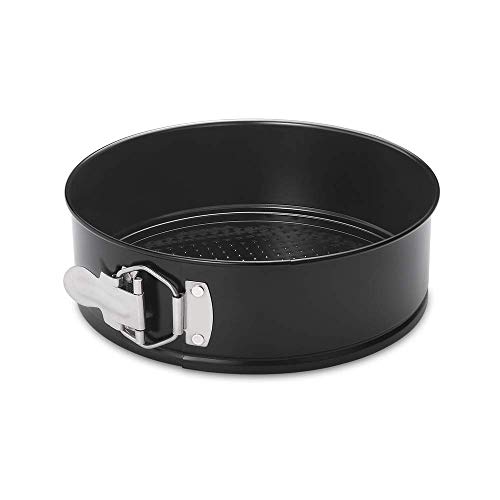
HIWARE
6-Inch Cheesecake Pan for Instant Pot and Oven, HIWARE Non-Stick Springform Pan
The HIWARE 6-inch springform pan releases cheesecakes and other desserts easily with its double-layer non-stick coating and removable bottom. It suits bakers using a 3-quart Instant Pot or anyone needing a compact pan that withstands oven temperatures up to 450°F.
Pros and Cons
Pros
- The double-layer non-stick coating supports cleaner dessert release.
- The stainless steel springform buckle is designed to resist cracking or falling off.
- The pan is oven-safe up to 450°F and compatible with a 3-quart Instant Pot.
- Its compact 6-inch size works well for small-batch baking.
Cons
- The 6-inch capacity is limited for full-size cakes or larger family portions.
- Hand washing is recommended, so cleanup requires more care than dishwasher-safe bakeware.

Wilton
Small-Batch Cheesecake and Tart Baking: Wilton Everyday Non-Stick Springform Pan, 6 in.
This 6-inch Wilton springform pan makes small cheesecakes and tarts easier to release, while its non-stick surface speeds cleanup. Buy it for small households or gatherings needing desserts for about 6 to 8 people and a PFAS-free pan.
Pros and Cons
Pros
- The non-stick surface supports easy release and simpler cleanup.
- PFAS-free construction provides a useful material choice for routine baking.
- The compact 6-inch size is suited to small cheesecakes and tarts.
- Dishwasher-safe design offers flexible cleanup options.
Cons
- The 6-inch capacity is limited for larger gatherings or full-size recipes.
- Hand washing is recommended to help maintain the non-stick coating.
HIWARE 6-Inch Cheesecake Pan for Instant Pot and Oven, HIWARE Non-Stick Springform Pan
HIWARE
6-Inch Cheesecake Pan for Instant Pot and Oven, HIWARE Non-Stick Springform Pan
The HIWARE 6-inch springform pan releases cheesecakes and other desserts easily with its double-layer non-stick coating and removable bottom. It suits bakers using a 3-quart Instant Pot or anyone needing a compact pan that withstands oven temperatures up to 450°F.
$11.99 at AmazonEditors' Favorite
Color: Black Size: 6-Inch Dimensions: 2.2 x 6 x 2.2 Inches Weight: 0.50926782522 pounds Product Group: Kitchen Binding: Kitchen
Shop NowWilton Small-Batch Cheesecake and Tart Baking: Wilton Everyday Non-Stick Springform Pan, 6 in.
Wilton
Small-Batch Cheesecake and Tart Baking: Wilton Everyday Non-Stick Springform Pan, 6 in.
This 6-inch Wilton springform pan makes small cheesecakes and tarts easier to release, while its non-stick surface speeds cleanup. Buy it for small households or gatherings needing desserts for about 6 to 8 people and a PFAS-free pan.
$10.97 at AmazonGreat Value
Color: Silver Size: 6 IN Dimensions: 6 x 3 x 6 inches Weight: 0.6283174467 Pounds Product Group: Kitchen Binding: Kitchen
Shop Now




Write Your Review
No reviews yet. Be the first to share your experience!