

Read enough owner reviews for any 2 in one coffee maker and the same four complaints surface. The pod side works for a year and then stops. The carafe coffee tastes thin no matter how much ground coffee goes into the basket. Yesterday’s flavoured pod turns up in this morning’s black cup. And when something breaks, both halves break together.
None of those are manufacturing flukes. They all trace to one design decision: two brewing methods sharing a single water tank, a single heater, a single pump and a single control board. Each failure below is a symptom of that sharing, and deciding which ones you can live with is the entire purchase.
The Thin Carafe Coffee Is Not Your Fault
Drip extraction has a narrow window. Water needs to arrive at the grounds between 195 and 205°F and stay in that band for the full 4 to 6 minutes the bed is soaking. Fall below it and the pleasant acids and sugars come out of the coffee at a different rate than everything else, which sounds abstract until you taste it: thin body, a sour edge at the front of the sip, a finish that vanishes.
A single-serve shot wants nearly the opposite. It needs a short, forceful burst of hot water through a small compressed puck, done in 30 to 60 seconds. Heating systems asked to do both jobs get sized as a compromise, and the compromise almost always lands on the carafe side. A thermoblock that can flash water fast enough for a pod typically delivers 185 to 190°F into a full basket, because it never had the thermal mass to hold temperature through a long, slow pour.
A shortfall of ten degrees is why two extra scoops do not help. You are not short on coffee, you are short on the heat needed to dissolve what is already sitting in the basket. Machines with a genuine boiler instead of a flash heater hold the band better, and the ones that manage it are noticeably heavier. Weight is the tell.
One Pump Doing Two Different Jobs
The pump has the same split personality. Drip brewing wants a slow even shower spread across the whole bed at low pressure. A pod needs real force behind a much smaller amount of water. Most designs answer this with one pump and a diverter valve that routes flow to whichever side you selected, then tune the pump to a middle setting that fully satisfies neither.
That valve deserves more attention than it gets, because it actuates on every single brew and it lives in the hot, mineral-heavy part of the plumbing. Once it starts leaking internally the symptoms read as unrelated faults: a pod cup that comes out short, a carafe that fills to 7 cups when you asked for 8, a puddle under the base. Machines built with two independent water paths run 40 to 80 dollars more, and that gap is the most defensible money in this category.
Yesterday’s Hazelnut in This Morning’s Black Coffee
One reservoir feeding both sides means water sits in shared tubing between uses, and whatever was dissolved in the last brew sits there with it. For plain coffee that is mostly harmless. For flavoured pods it is a genuine problem, because the oils carrying hazelnut, vanilla and caramel are not water soluble in any useful sense. They cling to the inside of silicone line and release slowly for weeks.
Anyone who runs flavoured pods midweek and then brews a black pot on Sunday tastes it straight away, and three or four flushes with clean water barely move the needle. The fixes are structural rather than procedural: separate reservoirs, or a dedicated line for the single-serve side that never touches the drip path. If flavoured pods are part of your routine, treat this as a filter on the shortlist, not a quirk to manage later.
The Pod Side Fails First, and Scale Is Why
Scale forms wherever hot water sits, which in a combined machine is everywhere. What differs is how much deposit each path tolerates before it quits. A drip shower head has openings wide enough to pass a toothpick through, so it keeps spraying through a surprising amount of buildup. The needle that punctures a pod, and the channel behind it, are measured in fractions of a millimetre, and a film thin enough to ignore in the shower head chokes that needle completely.
On water above roughly 120 ppm of dissolved minerals, the single-serve function can stop working inside four to eight months while the carafe side still brews normally. Nearly everyone reads that as a broken pod mechanism. It is a clogged one, and it had been clogging the entire time the other half kept working fine.
Cleaning access does not rescue you either. Two mechanisms packed into one shell means more crevices and fewer parts you can pull out and rinse under a tap. A descaling run only cleans the path the solution actually travels, so the cycle has to happen twice, once per side, and in practice most owners only ever descale the side that annoyed them.
Where the Compromises Actually Land
Something has to surrender interior volume to make room for a pod mechanism, and it is nearly always the drip half. A standalone machine of the same footprint brews 12 cups; the combined version usually tops out at 8 to 10. The shower head shrinks with it, dropping from a wide plate with six or eight outlets to a narrow one with two or three, and the basket gets shallower, so the bed of grounds sits wider and thinner.
All three changes push in the same direction: water finding a channel through the bed instead of soaking all of it. There is an easy diagnostic. Lift the lid the moment brewing stops and look at the grounds. A wet crater in the centre with dry, loose coffee around the rim means the spray pattern is too narrow for the basket, and nothing you do on your end will fix that geometry.
Then there is the hot plate. Plenty of these park the carafe on a warmer holding 175 to 185°F, and coffee left there goes flat and bitter within 20 to 30 minutes as the aromatics cook off. Thermal carafe versions avoid the problem outright, and they are worth going out of your way to find.
The Honest Verdict on One Box Instead of Two
Everything above is irritating. The shared control board is the part that costs real money. One brain runs both sides, one pump feeds both sides, and when either quits you lose both ways of making coffee in the same afternoon. Two separate appliances fail independently, each replacement costs less than the combined unit, and you still have coffee the next morning. On reliability alone that is not a close call.
What a combined machine genuinely wins is counter space and outlets. One footprint serves both the single cup before a 7 a.m. shift and the full pot that happens when four people are home on Saturday. In a small kitchen where the second appliance would live in a cupboard and never come out, that is a real advantage rather than a consolation prize.
Buy one if the counter is tight, if the household truly splits between solo cups and full pots, and if you will run descaling solution through both paths every two to three months. Skip it if you are particular about drip extraction, if your tap water is hard, or if flavoured pods are in the rotation. Those are the three cases where the shared architecture will bother you weekly.
Questions Owners Ask
Why is the carafe coffee weaker than it was on my old drip machine?
Temperature, almost every time. Your old machine had a heater sized for exactly one job and could hold 195 to 205°F across a 5 minute brew, while a shared system also tuned to flash-heat a single cup often runs the carafe side at 185 to 190°F. Under-extraction at that temperature reads as thin with a sour front, and it gets worse as the batch gets larger. Adding grounds makes the cup muddier without making it stronger. A bold or strong button usually just slows the flow to lengthen contact time, which recovers part of the loss but not all of it.
Can I stop flavoured pods from tainting my regular coffee?
Not reliably, if both sides share a reservoir and the tubing behind it. Flavour oils coat the inside of that shared line and keep releasing for weeks, so a few tanks of clean water only dilute the effect rather than removing it. A full descaling cycle through both paths does more than water alone, since the acid strips residue as well as mineral deposit, but even that is partial. The dependable answer is hardware: a model with two separate reservoirs or a dedicated single-serve line, or keeping flavoured pods on a machine that only brews single cups.
How often should I descale a 2 in one coffee maker?
Every two to three months above 120 ppm, every four to six months on soft water, and the part that matters is sending the solution down both brew paths instead of one. Run it as a pod-side brew until the tank is about half empty, then switch and push the remainder through the carafe side. Follow with two full tanks of plain water on each path so nothing sour carries into the next cup. The single-serve needle clogs first by a wide margin, so if you only have patience for one side, make it that one.

Hamilton Beach
2-Way Drip Coffee Maker for Full Pots and Single-Serve Cups
This Hamilton Beach coffee maker brews either a full carafe or a single cup from ground coffee, with six settings for regular, bold, hot, and iced coffee. It suits households with changing coffee needs because separate water reservoirs and 24-hour programming simplify both brewing options.
Pros and Cons
Pros
- The AquaFlow showerhead spreads water across the brew basket to support thorough coffee-ground saturation.
- The included mesh scoop makes single-serve brewing with loose ground coffee straightforward.
- Separate reservoirs make switching between a single cup and a full pot more convenient.
- The compact design combines two brewing formats while using less counter space than separate machines.
Cons
- The single-serve side uses loose ground coffee and is not compatible with K-Cup pods.
- Materials, weight, and exact dimensions are not provided, so countertop fit and portability are harder to assess.

Ninja Single Serve Coffee Maker with Built-In Frother - Brews Pods & Grounds, 4 Styles, 56oz Reservoir
This compact Ninja brewer handles both K-Cup pods and ground coffee with four brew styles and a built-in frother for coffeehouse drinks at home. Best for small kitchens or anyone who wants pod convenience plus the flavor control of fresh grounds without owning two machines.
Pros and Cons
Pros
- Dual brewing system handles both pods and grounds with consistent results, giving you flexibility based on time and taste preferences.
- Thermal Flavor Extraction technology maintains precise temperature control for both brewing methods, extracting full flavor without bitterness.
- Compact footprint with built-in storage fits easily on crowded counters while keeping components organized.
Cons
- The 56-ounce reservoir requires frequent refilling if you regularly brew large 24-ounce mugs for multiple people.
- Frother must be manually operated and cleaned separately after each use, adding an extra step to your morning routine.
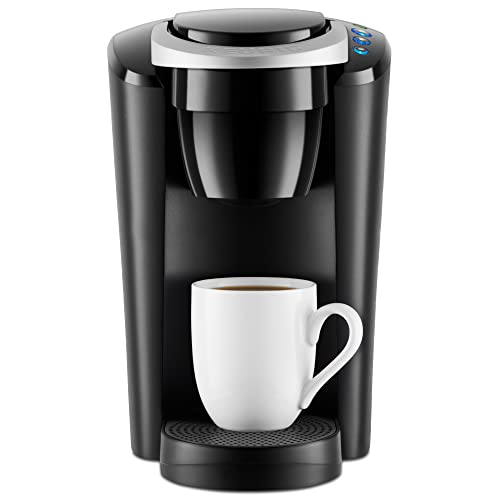
Keurig
Fast Single-Serve Coffee for Small Kitchens: Keurig K-Compact Coffee Maker with 3 Brew Sizes
The Keurig K-Compact brews 6, 8, or 10 oz. K-Cup servings in minutes, with Smart Start removing the need to wait before choosing a size. It suits small households, offices, and busy coffee drinkers who want quick brewing from a compact machine with a removable reservoir.
Pros and Cons
Pros
- The compact design and multi-cup reservoir balance counter-space savings with fewer refills.
- Coffee brews in minutes using simple pod insertion and cup-size controls.
- The two-hour automatic shutoff helps reduce unnecessary energy use.
- The removable drip tray accommodates taller travel mugs and makes spills easier to manage.
Cons
- The 36 oz. reservoir may need frequent refilling in households that brew several large servings each day.
- Only 6, 8, and 10 oz. brew settings are listed, so buyers wanting larger single servings have limited options.

AIRMSEN
Fast Multi-Serve or Single-Cup Brewing: AIRMSEN 12-Cup Programmable Dual Coffee Maker
The AIRMSEN dual coffee maker brews up to 12 cups, K-Cup pods, or ground coffee, with its biggest advantage being one machine for multiple serving sizes and preferences. It suits households and offices that need scheduled morning coffee, quick individual servings, or a full carafe without using separate machines.
Pros and Cons
Pros
- The dual setup handles 4, 6, 8, 10, or 12 cups plus single servings.
- The touchscreen lets you adjust cup size, water volume, and coffee grounds.
- The removable filter assembly and drip-free glass carafe simplify daily cleanup.
- The 1000W dual boiler system supports fast multi-serve and single-serve brewing.
Cons
- The single-serve side has a separate 15oz water tank, so it requires more frequent refilling for larger drinks.
- The product data does not provide a listed unit weight, which may matter when positioning it on a countertop.
The Best Deals This Week*
-
Ninja Single Serve Coffee Maker with Built-In
$99.98
($129.99)Save $30.01 -
Fast Single-Serve Coffee for Small Kitchens
$69.99
($99.99)Save $30.00 -
Fast Multi-Serve or Single-Cup Brewing
$89.99
($109.27)Save $19.28
*Deals are selected by our commerce team
Hamilton Beach 2-Way Drip Coffee Maker for Full Pots and Single-Serve Cups
Hamilton Beach
2-Way Drip Coffee Maker for Full Pots and Single-Serve Cups
This Hamilton Beach coffee maker brews either a full carafe or a single cup from ground coffee, with six settings for regular, bold, hot, and iced coffee. It suits households with changing coffee needs because separate water reservoirs and 24-hour programming simplify both brewing options.
$89.99 at AmazonEditors' Favorite
Color: Black Size: 12 Cup Dimensions: 11.5 x 10.2 x 14.1 inches Weight: 7.4 Pounds Product Group: Kitchen Binding: Kitchen
Shop NowNinja Single Serve Coffee Maker with Built-In Frother - Brews Pods & Grounds, 4 Styles, 56oz Reservoir
Ninja Single Serve Coffee Maker with Built-In Frother - Brews Pods & Grounds, 4 Styles, 56oz Reservoir
This compact Ninja brewer handles both K-Cup pods and ground coffee with four brew styles and a built-in frother for coffeehouse drinks at home. Best for small kitchens or anyone who wants pod convenience plus the flavor control of fresh grounds without owning two machines.
$99.98 at AmazonGreat Value
Other Special Features of the Product: Auto Shut-Off, Lightweight, Milk Frother Coffee Maker Type: Drip Coffee Machine Specific Uses For Product: Iced Coffee Operation Mode: Fully Automatic Wattage: 1550 watts Voltage: 120 Volts Human Interface Input: Buttons Coffee Input Type: Pods and Grounds Smart Home Compatibility: Not Smart Home Compatible Power Source: Electricity Compatible Coffee Pods: K-Cup Filter Type: Reusable Capacity: 56 Fluid Ounces Item Dimensions D x W x H: 13.07"D x 5.51"W x 13.31"H Item Weight: 6.23 Pounds Number of Items: 1 Unit Count: 1.0 Count Brand Name: Ninja Included Components: Coffee Maker, Built-in frother, Filter, Ninja Scoop, Ninja pod adapter, removable brew basket Model Name: Ninja PB051ST Model Number: PB051ST Global Trade Identification Number: 10622356665596 Manufacturer: Ninja Warranty Description: 1 Year UPC: 622356665599 Part Number: PB051ST Item Type Name: Pod & Grounds Specialty Single-Serve Coffee Maker, K-Cup Pod Compatible, Brews Grounds, Compact Design, Built-In Milk Frother, 56-oz. Reservoir, 6-oz. Cup to 24-oz. Mug Sizes, Stone Best Sellers Rank: #1,245 in Home & Kitchen (See Top 100 in Home & Kitchen) #4 in Single-Serve Brewers ASIN: B0DJFBF3SH Customer Reviews: 4.3 4.3 out of 5 stars (10,973) 4.3 out of 5 stars Color: Standard-Stone Style: Modern Material: Metal, Plastic Brand: Ninja Product Dimensions: 13.07"D x 5.51"W x 13.31"H Special Feature: Auto Shut-Off, Lightweight, Milk Frother
Shop NowKeurig Fast Single-Serve Coffee for Small Kitchens: Keurig K-Compact Coffee Maker with 3 Brew Sizes
Keurig
Fast Single-Serve Coffee for Small Kitchens: Keurig K-Compact Coffee Maker with 3 Brew Sizes
The Keurig K-Compact brews 6, 8, or 10 oz. K-Cup servings in minutes, with Smart Start removing the need to wait before choosing a size. It suits small households, offices, and busy coffee drinkers who want quick brewing from a compact machine with a removable reservoir.
$69.99 at AmazonColor: Black Size: Compact Dimensions: 13.2 x 8.2 x 12.5 inches Weight: 7.85066114982 pounds Product Group: Kitchen Binding: Kitchen
Shop NowAIRMSEN Fast Multi-Serve or Single-Cup Brewing: AIRMSEN 12-Cup Programmable Dual Coffee Maker
AIRMSEN
Fast Multi-Serve or Single-Cup Brewing: AIRMSEN 12-Cup Programmable Dual Coffee Maker
The AIRMSEN dual coffee maker brews up to 12 cups, K-Cup pods, or ground coffee, with its biggest advantage being one machine for multiple serving sizes and preferences. It suits households and offices that need scheduled morning coffee, quick individual servings, or a full carafe without using separate machines.
$89.99 at AmazonColor: Black Dimensions: 10 x 14.5 x 14.5 inches Weight: 6.3 pounds Product Group: Kitchen
Shop Now



Write Your Review
No reviews yet. Be the first to share your experience!